
Why does our AI content sound like everyone else's?
“We're wasting hours cleaning up AI copy that sounds like everyone else and still doesn't say what we really mean.”
The short answer
AI writes from the context it's given. Hand it nothing and it fills the gap with the average of the internet, which is why your drafts sound like your competitors'. The fix is a documented narrative identity, the Magnetic Messaging Framework, loaded into an AI Brand Twin, so every draft starts from who you are, who you're for, and how you sound.
30 articles on this problem, written by Greg Rosner from inside the work with $5M-$75M B2B companies.
Start Here
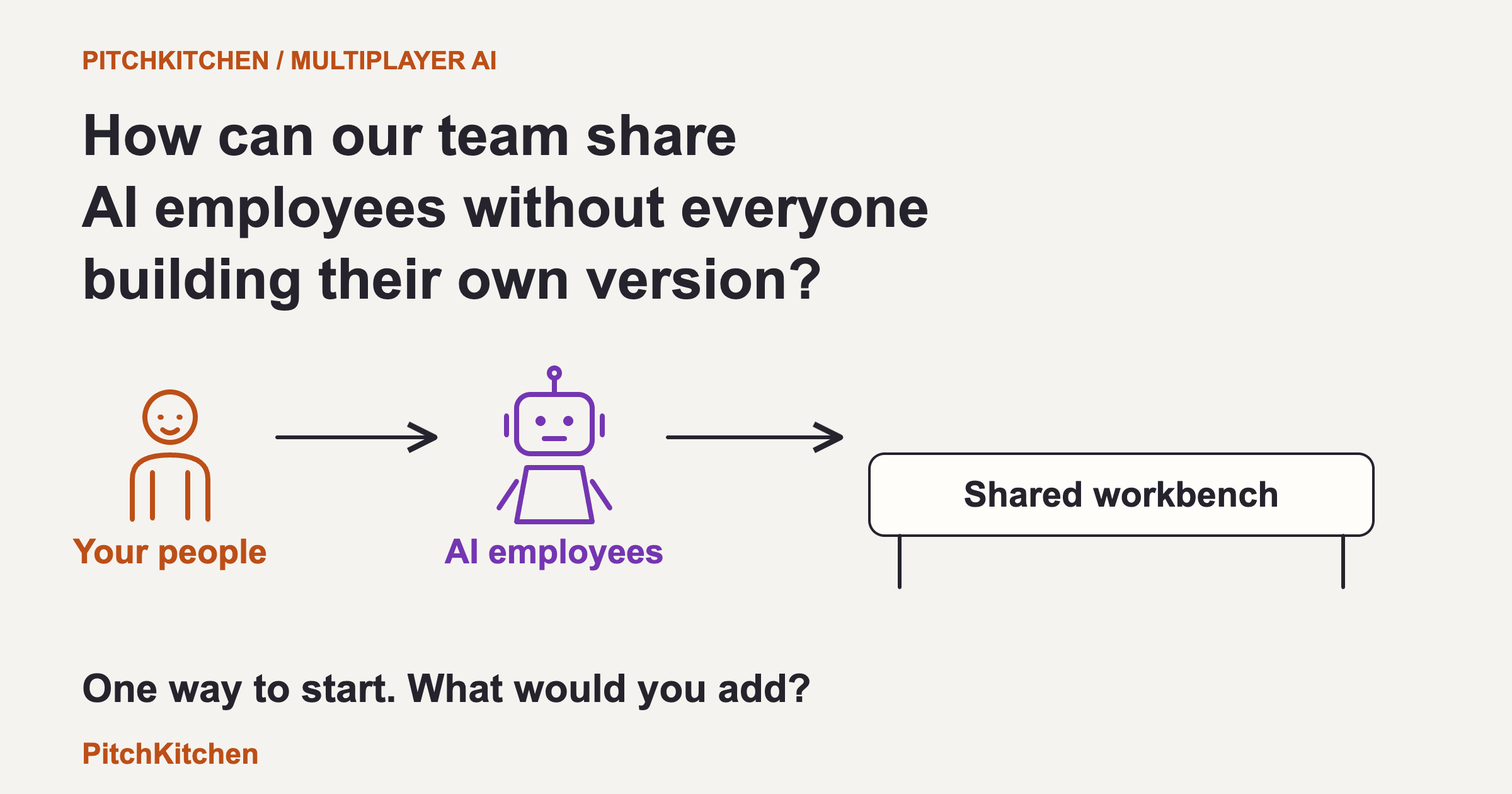
How can our team share AI employees without everyone building their own version?
Research. Prospecting. Proposals. Invoicing. A practical guide to sharing specialized AI employees, with human managers and clear handoffs.
What goes wrong when you build an AI Brand Twin?
We built our own AI Brand Twin before we sold one, and the hard part wasn't the technology. Here's the build log: what the knowledge layer couldn't answer, the day a retired catchphrase kept shipping, and the three failures that show up in every build.
How do you build an MVP AI Brand Twin?
We built our own AI Brand Twin before we sold one. Here's what the minimum viable version needs, what you can leave out of the first build, and the three failures that show up every time.
How do you build an AI Brand Twin on an MCP server?
The server took an afternoon. Deciding what was true about the company took months. Here's the smallest build worth shipping, and the three failures that showed up in ours.
Will our AI Brand Twin survive the next marketing hire?
A documented narrative identity transfers to a new marketing leader in three files and a login. What breaks continuity is the unanswered question of what a new hire is allowed to change. Here's the settled-versus-open ledger, a first-90-days sequence, and the four-question takeover test.
Every article on this problem
- What's the best way to give ChatGPT and Claude our brand voice permanently?
Custom instructions, memory, Projects, Custom GPTs, Claude Styles, connectors. Ranked by what actually survives a new chat, a new hire, a model upgrade and a vendor switch, plus the reason a perfectly installed brand still writes like everybody else.
- How do we keep our messaging consistent when everyone on the team writes with AI?
Twelve people, twelve private versions of the company, and a tool that turns each one into a hundred finished-looking drafts. Consistency stopped being a training problem the day your team started writing with AI.
- What does an AI Brand Twin cost, and what are we actually buying?
An AI Brand Twin ships inside the 90-Day Magnetic Messaging Sprint at $25,000 to $45,000 fixed, and you own every layer. Here's what moves the number, what the MCP server that serves it to your team costs, and why the software is the cheapest part.
- How do we keep our brand identity intact when our sales outreach is automated?
Automation is a multiplier on whatever message you hand it, so an undecided message just ships faster and wider. What breaks first when you automate a narrative you never settled, and how an MCP server keeps cold, warm, and inbound lanes sounding like one company.
- How do we roll out an AI Brand Twin so our team actually uses it?
The technical install of an AI Brand Twin takes days. Getting a team to actually use it takes a quarter. Here's why the MCP server is the doorway that decides adoption, the rollout order, the ownership rule, and the three patterns that stall most deployments in the first month.
- Can we set up an MCP server so Claude writes in our brand voice?
Yes, and connecting it takes four minutes. What decides whether the output sounds like your company is what the server hands back when Claude asks, and tone adjectives won't do it.
- How do we make our brand guidelines machine-readable so our AI tools can use them?
Machine-readable brand guidelines aren't a file-format problem. They're a rewriting problem: descriptions become decisions, rules get a condition they can fail, and the document gets split into units a tool can fetch one at a time.
- How do we get every AI tool our team uses to follow our messaging framework?
Your framework loses to the text box. Every person prompting AI re-summarizes your company from memory, and the model fills the gaps with the industry average. Here's how a messaging framework becomes an MCP server every tool queries live, and what has to be true before it helps.
- Should we build an MCP server for our brand and messaging guidelines?
Most companies shouldn't build one yet. An MCP server distributes whatever you feed it, so if the positioning is still unsettled, it scales the confusion. Here's the 20-minute self-check that tells you which side of that line you're on.
- How do you make an AI workforce actually learn and improve every week?
Most AI agents run the same playbook forever because every run starts with amnesia. Telling them to 'reflect' does nothing. Here's the three-part loop that makes an AI workforce provably smarter every week: a goal file, an honest daily log, and one bounded change on a schedule.
- How do you improve your B2B value proposition with AI tools without generic output?
Generic AI copy isn't the model failing ... it's the model averaging, because it was handed no story to work from. Here's the workflow for improving a B2B value proposition with AI without the sameness: document the truth first, build an AI Brand Twin, then let AI multiply a message that's already right.
- Who builds an AI-powered brand identity for a scaling B2B company?
Most “AI-powered brand identity” pitches are logo automation in disguise. Here's who actually builds an AI-usable brand identity for a $5M-$75M B2B company, five options compared, and the five questions that separate the real firms from AI-Parmesan.
- How do you build a brand voice guide your whole team (and your AI) will actually follow?
Most brand voice guides are three adjectives that die in a Drive folder. Here's how to build one your whole team, and your AI, will actually follow: a format-by-format Voice Spec built on your real narrative.
- Does scaling AI-generated content help my B2B company get found, or does Google penalize it?
Google doesn't penalize AI-generated content for being AI-made. It penalizes commodity content, the kind anyone could generate from public information. Here's how to scale AI content that gets found instead of buried.
- What is an AI Brand Twin, and how do you build one for a B2B company?
An AI Brand Twin is a trained AI voice model built on your company's narrative, not the average of the internet. Here's what it is, the three layers it's built from (Knowledge, Behavior, Style), and why prompting ChatGPT harder will never get you there.
- How do we get AI to sound like our brand?
You can feel it the second you read it. AI copy that's clean, confident, and could have come from any company in your category. The instinct is to clean it up line by line, forever. That's the trap. Editing the output of a machine you never briefed never ends and never compounds. The real move is to give the AI a Magnetic Messaging Framework to write from: your truth, your writing styles, and a detox layer, all in one document, so the generic version never comes out in the first place. Here's how the detox stops being a chore and becomes a property of the system.
- How does AI training on brand messaging actually work?
Training AI on your brand isn't a better prompt. It's three layers ... narrative, behavior, and voice ... installed in a fixed order. Here's how the mechanics actually work, and why prompting alone always sounds generic.
- Why are founders getting generic strategy advice from ChatGPT and other LLMs?
Founders aren't getting bad AI strategy advice because the model is weak. They're getting it because they're feeding the model a fraction of their actual business context, and the model fills in the gaps with the average of the internet. Five tests to spot trendslop in your own AI output, and the briefing layer that fixes it.
- AI Brand Twin: Scaling Voice Without Losing Soul
An AI Brand Twin is a custom GPT, Claude Project, or Gemini Gem trained on your Magnetic Messaging Framework, running in three stacked layers: knowledge, behavior, and per-format style. Most $5M-$75M B2B companies skip the bible and get AI-Parmesan back. The ones that build all three layers scale the voice they already have.
- AI-Parmesan: The B2B Marketing Plague Nobody Is Naming
If your homepage says 'AI-powered platform that empowers your team to...' you're inside the pattern. So is your competitor. So is everyone. There's a name for it. Here's the diagnostic and the fix.
- No One Talks About What You Actually Lose When Your AI Content Sounds Like Everyone Else's
Everyone talks about how to use AI to create more content. Nobody talks about what you lose when that content sounds like everyone else's. You're losing trust, positioning, and compounding. And most companies won't notice until the damage is done.
- AI-Parmesan Just Became a Securities Problem
Fortune just ran a Baker McKenzie piece on AI-washing. 51 securities class actions in five years. Global Predictions got SEC-charged for one sentence. AI-Parmesan stopped being a positioning problem the day a top-100 law firm explained why your homepage is now litigation exposure.
- Why does AI keep producing generic content for our company?
AI isn't broken. Your business is missing a Context Engineering layer. Without a documented brand bible feeding it, AI fills the vacuum with the internet's average. Here's the fix every B2B company needs before 2027.
- Is ChatGPT 5.5 better than Claude Opus 4.7?
Stop asking which AI model is best. The model isn't your differentiator. What you train it on, what you build with it, and what you say about it is. Here's the question to ask instead.
- How can we talk about how we use AI without sounding like everybody else?
Real AI doesn't help you if your homepage describes it the same way the next 1,000 companies describe theirs. The fix isn't more proof points. It's a real point of view about who you built it for that no one else built it for.
See how this problem shows up on your homepage
The Brand Signal Score grades your homepage against 19 criteria and shows you where the story breaks. It's free.
Get your Brand Signal ScoreThe other nine problems
- Why don't buyers know we exist, or tell us apart from everyone else?
- Why is our sales team stuck explaining what we do on every call?
- Our product is a no-brainer. Why don't buyers move?
- We have marketing people. Why isn't marketing turning into deals?
- We sell something sophisticated. Why doesn't our homepage land?
- How do we find the one story that unlocks everything?
- Why does our deck explain instead of enroll?
- Why are we losing to competitors who sound clearer, even when we're better?
- We've tried content, ads, and AI tools. Why aren't more tactics fixing growth?