
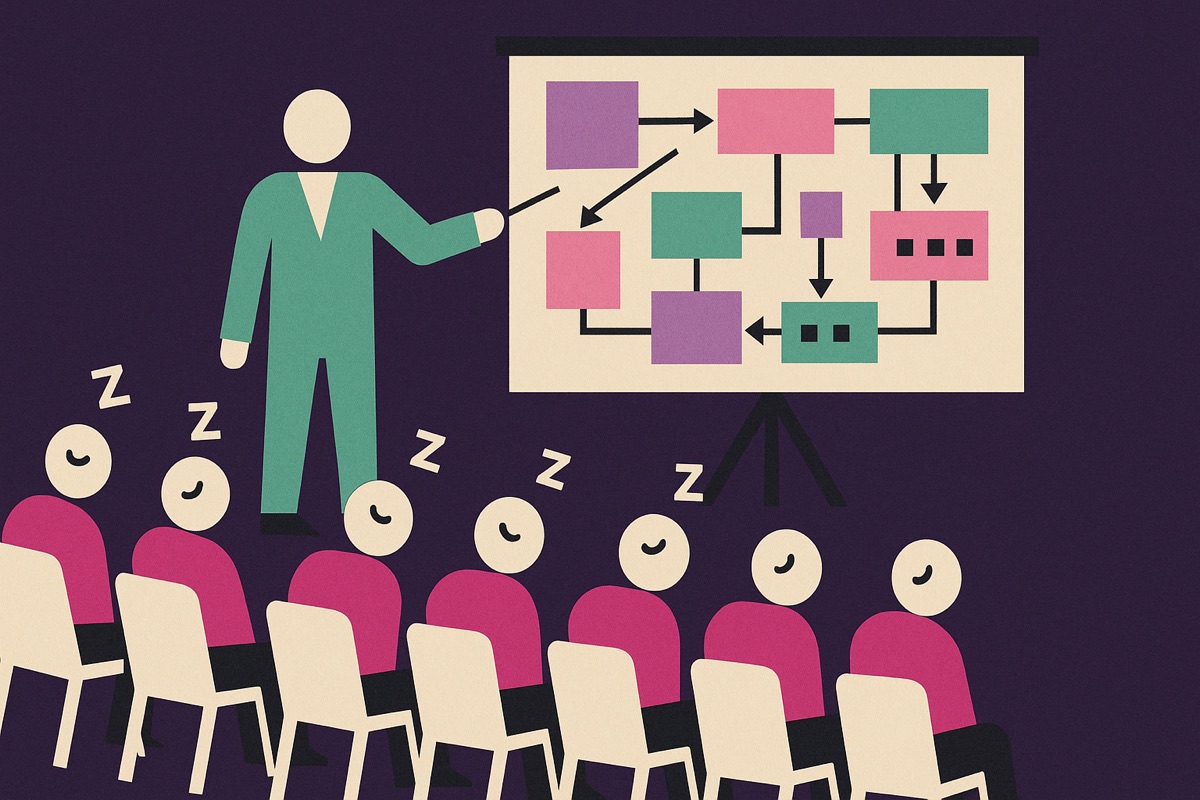
Why does our deck explain instead of enroll?
“Our deck isn't sparking real buying conversations. It's explaining, not enrolling.”
The short answer
A deck that opens with your company, your product, and your architecture asks the buyer to do the work of caring. A deck that enrolls opens with the shift happening in the buyer's world, names what's at stake, and shows the new way to win before the product appears. Then your champion can retell it after you've left the room.
18 articles on this problem, written by Greg Rosner from inside the work with $5M-$75M B2B companies.
Start Here

7 messaging mistakes we see in every health tech pitch
Health tech pitches fail for the same seven reasons, and none of them is the product. The seven mistakes, in the order they appear in the deck, and the one gap underneath all of them.

7 messaging mistakes we see in every sales pitch
Pitches fail for the same seven reasons, and none of them is the product. The seven mistakes, in the order they appear in the deck, and the one gap underneath all of them.
Borrowed Ground: why most sales battlecards make your reps argue on the competitor's terms
Open the enablement folder at almost any B2B company and the battlecard looks the same: competitor name on top, their claims on the left, your rebuttals on the right. That card was built from their website instead of your narrative, and it hands your rep the competitor's frame before the call starts. Here's how to build one from your core narrative instead.
Proof Order: how to structure a product demo around the buyer's problem instead of a feature tour
Open almost any B2B demo recording and you can predict the first four minutes: login, dashboard, main workspace, newest feature. That sequence isn't a sales decision. It's the product's navigation menu read out loud to a buyer. Here's the build, not the diagnosis: how to decide the claim first and let it dictate what you show, in what order, and what gets cut.

What does it cost to rebuild a B2B sales narrative, and what do you get for the money?
Rebuilding a B2B sales narrative runs $25,000 to $45,000 as a one-time fixed project, priced on scope. Here's exactly what sits inside that number: the story your whole company sells from, rebuilt from the founder's truth, plus the framework, the homepage, the deck, the rep talk tracks, and the AI Brand Twin that carry it. Plus the diagnostic for whether you need a rebuild or just a rewrite, and how to measure whether it worked.
Every article on this problem
- The Forwarded Version: your proposal argues your case in rooms you'll never enter
The proposal is the only document in your funnel that travels without a human attached, and it's usually the one nobody positioned. Here's what page one should say, and how to find out what yours is arguing.
- Why do our demos go great but deals still stall?
I sat in on a flawless demo this week: every screen loaded, every question got answered, and the buyer asked for a recap. The last five demos that went exactly that well produced zero signatures. Meet the Feature Tour, why AI made capability the wrong thing to perform, and the three tests to run on your last three demo recordings before your team runs another one.
- How do you message a B2B product to a buying committee instead of a single buyer?
You're not selling to a person anymore. You're selling to a room of six to 10 people who have to agree before anyone signs. Writing six pitches doesn't work. Averaging them into one safe message doesn't either. Here's the one-story, branched-proof move, plus a three-test diagnostic you can run this week.
- How do you turn one strategic narrative into every sales asset (deck, one-pager, battlecard)?
The teams whose sales assets pull in the same direction don't have better writers. They build one narrative and translate it into every asset. Here's the cascade, from source to deck to one-pager to battlecard, and how to run it this week.
- The "So What?" Test: Does Every Feature in Your Deck Connect to a Buyer Outcome?
A one-question audit that shows you exactly which slides in your B2B sales deck describe your product instead of moving the buyer: say "so what?" after every feature and score the answer.
- Why do sales teams struggle without a shared sales-enablement narrative?
Sales teams struggle without a shared narrative because every rep fills the gap with their own version of the story. The buyer's committee ends up arguing about what looks like five different companies. It's a messaging problem wearing a sales-performance costume, and more training won't fix it.
- What happens in a messaging strategy session, and how do you book one?
A messaging strategy session isn't a sales pitch, it's a 90-minute diagnostic. Here's exactly what happens in one, what you walk away with, and how to book.
- Sales enablement consultants vs messaging consultants: who fixes what, and who to hire?
A messaging consultant fixes your story. A sales enablement consultant fixes the system that carries it into deals. Buy the wrong one and you spend a quarter scaling a message that was never going to land. Here's how to tell which one your stalled pipeline actually needs.
- How do you message a fintech product to both economic buyers and compliance?
In fintech, two people in the room want opposite things. The economic buyer wants growth. The risk and compliance buyer wants safety. Here's how to message one fintech product to both without watering down either.
- Why does our pitch work on investors but not on customers?
This week a founder pulled up the deck that just closed his round, and it was great ... market size, category heat, a vision you'd want to back. Then he showed me the homepage, and it was the same deck with nicer photos. He couldn't understand why investors leaned in and customers went quiet. Here's the hard part nobody says: a story built to win a boardroom and a story built to win a buyer are two different machines. Investors buy a market. Customers buy an escape from a problem they have today. Pasting the one that raised your round onto the surfaces where buyers decide is the Boardroom Story, and it quietly costs you deals. Here's why it happens, why AI makes it worse, and three tests to catch it.
- Why does our pitch deck explain the product instead of enrolling the buyer?
A founder shared his screen this week and walked me through 22 slides. Every one was a feature, a screenshot, or a logo wall. By slide nine I'd stopped following, and following is literally my job. Here's the hard part nobody says before they build you a new deck: a deck that explains your product and a deck that enrolls your buyer are two different machines, and almost every B2B deck is built to explain. The explainer deck walks through what you do. The enrolling deck names a change in the world, a villain worth beating, and a buyer who's the hero of getting out. AI made polished decks nearly free, which means a beautiful feature tour is now worth close to nothing. Here's why founders keep building the explainer, why it costs more now than ever, and three tests to tell which deck you've actually got.
- Every sales rep is telling a different story. Here's how to audit and fix it in 7 steps.
Your reps aren't going off-script. They never had a script worth following. A sales enablement asset audit inventories every customer-facing asset, scores each one against a single go-to-market narrative, and standardizes the ones that survive, so marketing and sales finally share one story and you've got an AI-ready content foundation instead of forty assets telling fifteen different versions of the truth.
- The Discovery Prompter: A Sales Deck Narrative Strategy That Stops Pitching and Starts Enrolling
A sales deck narrative strategy that closes complex B2B deals doesn't pitch the product. It prompts the buyer's own discovery. Across 100+ B2B sales decks we've audited in 2026, the ones closing $25K+ deals share three traits. The ones losing share one: they explain. Here's the diagnostic, the pattern, and the playbook for rebuilding your deck as a Discovery Prompter.
See how this problem shows up on your homepage
The Brand Signal Score grades your homepage against 19 criteria and shows you where the story breaks. It's free.
Get your Brand Signal ScoreThe other nine problems
- Why don't buyers know we exist, or tell us apart from everyone else?
- Why does our AI content sound like everyone else's?
- Why is our sales team stuck explaining what we do on every call?
- Our product is a no-brainer. Why don't buyers move?
- We have marketing people. Why isn't marketing turning into deals?
- We sell something sophisticated. Why doesn't our homepage land?
- How do we find the one story that unlocks everything?
- Why are we losing to competitors who sound clearer, even when we're better?
- We've tried content, ads, and AI tools. Why aren't more tactics fixing growth?