
Is ChatGPT 5.5 better than Claude Opus 4.7?

By Greg Rosner
Founder of PitchKitchen · Author of StoryCraft for Disruptors
· 6 min read
TL;DR
Stop asking which AI model is best. The model isn't your differentiator ... your competitors have access to the same one. What's actually yours: the proprietary data you train it on, the specific use case you've nailed, and the point of view you're bringing to how you use it. Six months ago GPT-4 was the answer. Today it's Opus 4.7 or ChatGPT 5.5. By December it'll be something else. If your competitive advantage is "we use the best model," you have no advantage. The companies winning with AI aren't the ones with the most expensive subscription. They're the ones who turned a specific buyer's specific painful workflow into something only they could build.
The scene I'm in this week
ChatGPT 5.5 dropped this week. Claude Opus 4.7 came out a few weeks before that. And every founder in my inbox is asking the same question: which one should we use?
Three different CEOs in three different industries. Same exact question. They want me to settle it.
I keep telling them the same thing: that's the wrong question.
It's the wrong question for the same reason "should I use Slack or Microsoft Teams?" was the wrong question in 2019. Or "should I host on AWS or Google Cloud?" in 2015. The thing you're asking about is real, but it's not where your competitive advantage lives. You're optimizing the wrong layer.
Naming what's actually broken
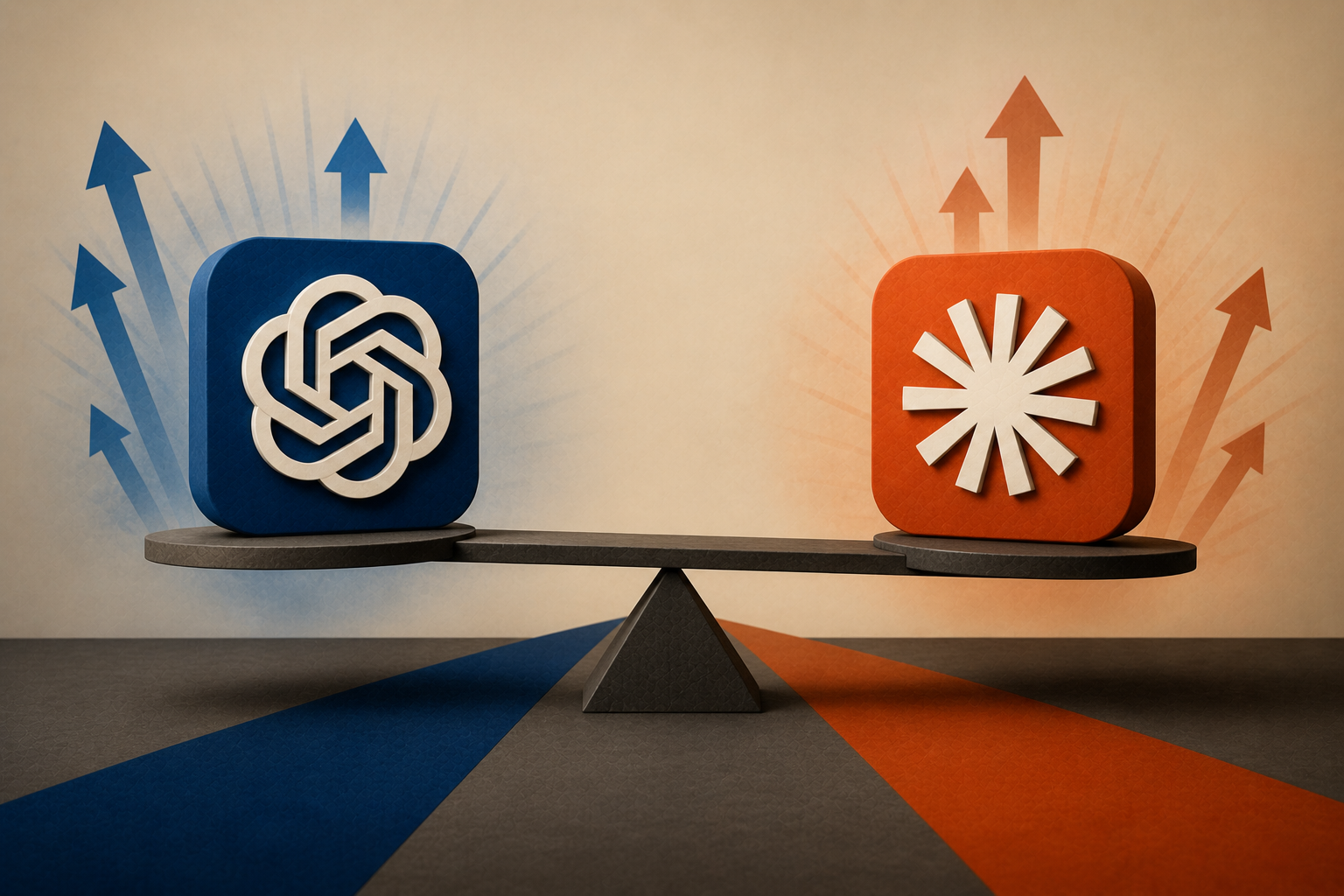
I call it model theater. The behavior of comparison-shopping AI models as if your business outcome depends on which one you pick. It doesn't. Your competitors have access to the same models. They're an API call. The cost of switching is hours, not months. There's no moat in the model.
Model theater is the new AI-Parmesan. Same anti-pattern, different sprinkle. Last year founders bragged about their AI on the homepage. This year they brag about which AI on the homepage. Same problem. The thing they're naming as their differentiator is something everyone has.
Why this is worse now than ever
Six months ago GPT-4 was the answer. Today the answer is Opus 4.7 or ChatGPT 5.5 or Gemini 3. By December something else will lead the benchmarks. The model gap between providers narrows every quarter and the lead changes every release.
If your competitive advantage is "we use the best model," you have no advantage. You have a subscription you have to renegotiate every quarter. And you have a marketing claim that is statistically identical to your competitors' marketing claim, because they're all subscribing to the same models.
Meanwhile, the companies actually winning with AI right now have stopped optimizing the model and started optimizing three layers underneath it.
The right questions to ask instead
- 1What specific painful workflow in your buyer's life are you optimizing for? Not "AI for marketing" or "AI for finance." The exact 8-minute task your buyer hates doing every Tuesday morning. That's the moat. Specificity is.
- 2What proprietary data are you training, fine-tuning, or grounding the model with that no one else has? Customer interaction history. Domain-specific corpora. Your CEO's actual brand voice. Your industry's regulatory edge cases. That's your data moat.
- 3What point of view are you bringing to how you use AI that your competitors aren't? Are you using it to scale generic content (no moat) or to scale your specific opinion at scale (moat)? Your POV grounds the model. Without it, you're scaling parmesan.
What I see across 50+ B2B AI companies
I've worked with about 50 B2B companies that lead with AI in their positioning. The ones that compound, the ones whose pipeline accelerates and whose customers refer them, are not the ones with the most expensive model subscriptions.
They're the ones who picked one specific painful workflow, built deep training and grounding around it, and have a sharp opinion about why this model + this data + this use case = something only they could deliver. We have a name for that grounding layer: an AI Brand Twin: Scaling Voice Without Losing Soul, trained on your bible instead of rented from a leaderboard.
The model they use is almost an afterthought. Some are on Claude. Some on GPT. Some on a fine-tuned open model. They'll switch when something better comes out. It won't matter, because the model isn't where their value lives.
A real example
A $7M Series A SaaS founder I worked with last quarter spent the first four months of the year benchmarking models. Side-by-side comparisons. Cost-per-token spreadsheets. Migration plans. He'd switch to whichever provider topped the latest leaderboard.
Pipeline was flat that whole time.
We had one conversation. I asked him: if you woke up tomorrow and every model in the world was suddenly identical in capability, what would your company do that no one else could? He couldn't answer for almost a minute.
Then he said: "We have five years of de-identified medical billing audits no one else has access to."
That was the moat. He'd been ignoring it because it wasn't shiny. We stopped the model-switching project. He picked one good-enough model and put the same energy into building a custom training corpus around the billing audit data. We rewrote the homepage to lead with the data + use case, not the model. Pipeline tripled in Q3.
The model wasn't the moat. It never was.
What this means for you
Before you touch a single model setting, get an outside read on how your story actually lands. Run your homepage through the free Brand Signal Score ... it scores exactly what a five-second stranger and an answer engine take away, which is the real test of whether your AI claim is a moat or a sprinkle.
Three things you can do this week without changing a single API call:
- 1Stop benchmarking models. Start benchmarking outputs against your specific buyer's specific workflow. The question isn't "which model scored higher on MMLU?" The question is "which output makes my buyer say 'finally, someone gets it'?"
- 2Audit what proprietary data, knowledge, or perspective you have that NO public AI has access to. Customer history, domain corpora, your founder's actual opinions. That's your moat. Map it.
- 3Next time you're tempted to upgrade your model, ask yourself: would I be better off spending the same time refining my training data, sharpening my POV, or nailing one specific use case deeper? The answer is almost always yes.
Questions People Ask
FAQ
Is ChatGPT 5.5 better than Claude Opus 4.7?
It depends on the specific task, but it's the wrong question to ask if you're a B2B founder evaluating AI for your business. Both are state of the art. Both will be obsolete in months. Your competitive advantage isn't which model you pick ... it's the specific use case, the proprietary data, and the point of view you bring to how you use it.
Which AI model should my B2B company use?
The model is commodity ... your competitors have access to the same one. Pick a good-enough model and invest your energy in the three layers underneath it: the specific painful workflow you're optimizing, the proprietary data you can train or ground the model with, and the point of view you bring to AI usage that no one else does.
What is model theater?
Model theater is the behavior of comparison-shopping AI models as if your business outcome depends on which one you pick. It doesn't. The model is an API call. There's no moat in it. Model theater is the new AI-Parmesan ... sprinkling "we use [latest model]" as if that's differentiation.
How do I evaluate AI for my B2B company?
Stop benchmarking models on MMLU scores. Start benchmarking outputs against your specific buyer's specific workflow. Ask: does this output make my buyer say "finally, someone gets it"? That's the only benchmark that matters.