
How do we know if our company is ready for AI marketing agents?

By Greg Rosner
Founder of PitchKitchen · Author of StoryCraft for Disruptors
· 8 min read
TL;DR
Your company is ready for AI marketing agents when it has a brain: documented context every agent reads before it writes. Test it in an hour with five checks. Can you hand an agent who buys, how you sound with approved and rejected examples, what your founder believes, your customers' exact words, and one place every AI on the team reads from? Pass four and turn agents on, draft-only. Fail two or more and build the brain first. Everyone rents the same models, so the documented brain is the one advantage a competitor can't buy.
Your company is ready for AI marketing agents when it has a brain: documented context any agent can read before it writes a word. You can test that in an hour with five checks. Can you hand an agent who buys from you, how you sound, what your founder believes, your customers' exact words, and one place every AI on the team reads from? Pass four of the five and you're ready. Fail two or more and the agents will mostly write faster versions of your competitors' copy.
Every company now rents the same models. Your competitor can open the same Claude account you just opened, this afternoon, for the same twenty dollars. The one thing they can't rent is your documented brain. Greg Isenberg's October 2026 letter on marketing engineers boils the whole discipline down to three words: "start with the brain." We agree, and this post is the test for whether you've got one.
What does "ready for AI agents" actually mean?
Most CEOs ask this question about tools. Which agent platform, how many seats, do we need a marketing engineer on payroll? Those are afternoon decisions. Any of them can be bought, set up and running by Friday.
Readiness lives in your documents. An agent starts every job knowing nothing about you. It reads whatever context you hand it, then fills every gap with the average of the internet. When the context is thin, you get the Context Vacuum: fluent, confident copy that could sit on any competitor's homepage without anyone noticing.
A ready company has already written down the things a smart new hire would need in week one. An unready company keeps them in the founder's head, in a deck from two fundraises ago, and in the habits of its two best reps. Does that sound familiar?
How do we test whether our company has a brain?
Run these five checks with your leadership team. Be strict. A check passes only if the thing exists in writing today and an agent could read it without a human explaining it first.
- 1Who buys. Can you paste one page that names your buyer by title, company stage and the moment they start looking? "Mid-market B2B companies" fails. "The CRO of a $20M healthtech company, the quarter after a missed number" passes.
- 2How you sound. Do you have voice rules plus real examples you approved and rejected, with the reason for each? A list of adjectives like "bold, human, clear" fails, because every brand in your category uses the same three words. Agents learn from examples far faster than from descriptions.
- 3What your founder believes. Is the shift in your market written down, along with the villain you're up against and the beliefs your company stands on? This is the part competitors can't copy, and it's the part almost nobody documents.
- 4Your customers' exact words. Do you have a list of phrases lifted straight from sales calls and support tickets, in quotes, untouched by marketing? Buyers search and ask AI in their own language. If your agents only have your words, they'll miss the buyer every time.
- 5One place every AI reads from. When your positioning changes next quarter, how many copies need updating? Count the Custom GPTs, Claude Projects, prompt docs and pasted instructions across the team. If the honest answer is "we'd have to go find them," this check fails.
| Checks passed | What it means | What to do next |
|---|---|---|
| 5 of 5 | You have a working brain | Turn agents on, draft-only, and review their output weekly |
| 4 of 5 | Ready, with one gap | Fill the gap in the next two weeks, then start |
| 2-3 of 5 | Agents will mostly produce generic copy | Build the brain first; it's a weeks-long project, not a quarter |
| 0-1 of 5 | Agents will amplify the confusion you already have | Start with the story; tools can wait |
What happens if we turn agents on without a brain?
You get volume without a point of view. Each agent writes something reasonable and none of it sounds like you. Your team then starts arguing about which model is better, ChatGPT or Claude or Gemini, which is what we call Model Theater. Swapping models changes nothing while the input stays thin.
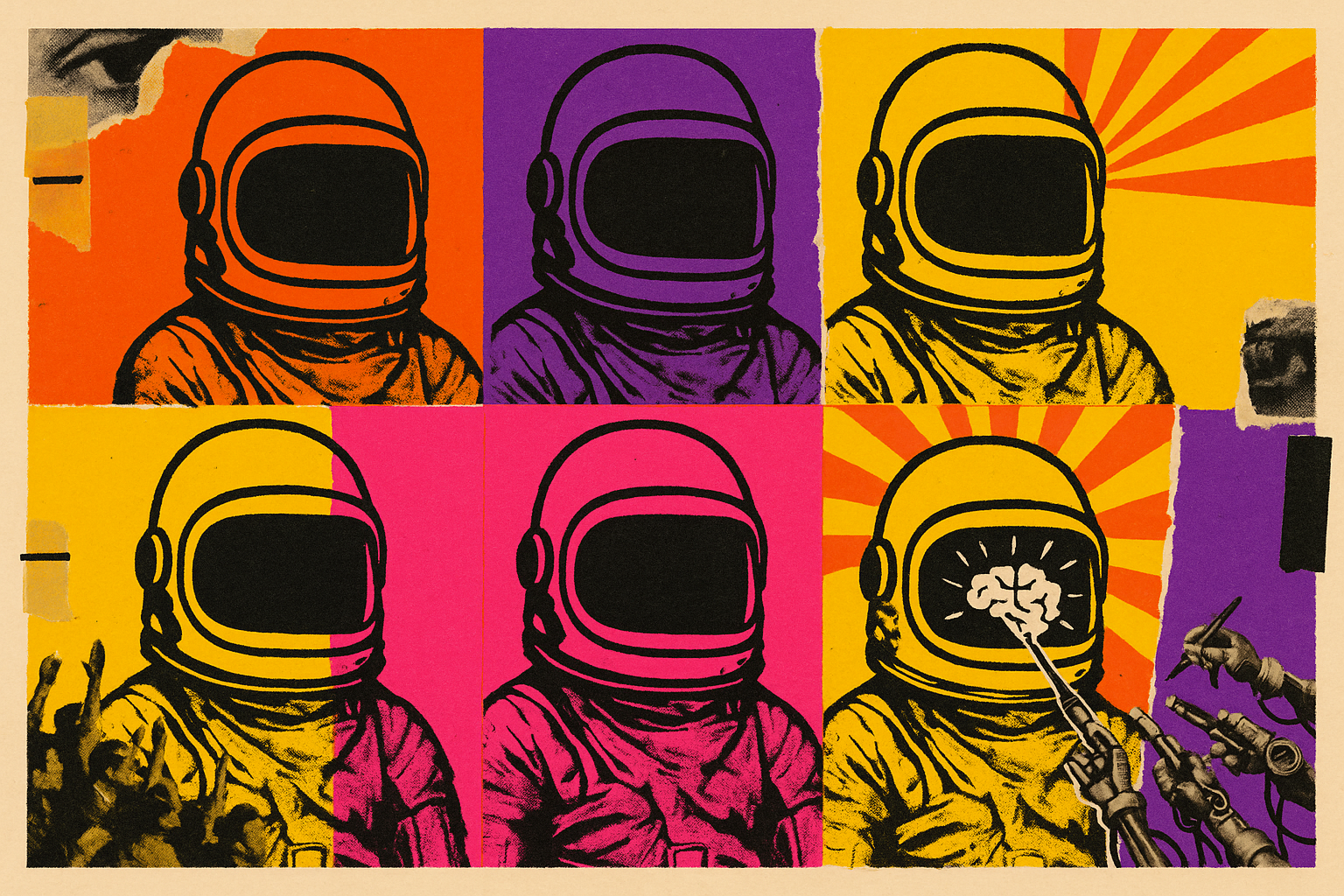
The image we keep coming back to is a shiny space helmet sitting on top of a bag of empty armor. From across the room it looks like an astronaut. Up close there's nobody inside. Greg put it this way, and it rhymes on purpose: "Give your clones the right spirit, otherwise it's a box of bones."
In B2B the cost is higher than in consumer marketing. A consumer brand can launch fifty ads and let the data pick winners. A company selling to a few hundred accounts doesn't get that many shots. Every email to a target account needs to start from the right story, because there may not be a second email.
What does a company brain look like at PitchKitchen?
For our clients, the brain is the Magnetic Messaging Framework: a 35-plus section document covering the strategic narrative, the ideal customer, the problem, the value proposition, voice, proof and the exact language customers use. We build it from interviews with the founder and the team, because the truth about a company usually sits in a few people's heads and has never been written down in one place.
Then we turn that framework into an AI Brand Twin, which works in three layers. The framework is the knowledge. A system prompt sets the behavior and the guardrails. A voice spec handles format-by-format style, so a LinkedIn post and a case study don't come out sounding identical. If you want the full build, our guide to what an AI Brand Twin is and how to build one walks through it.
Some companies need a second knowledge base for how the work gets done inside the business, the SOPs. We covered that split in Your AI needs two knowledge bases. This post sticks to the outside half: what the agents say about you to the market.
Why does it matter that every AI reads the same copy?
Because copies drift. The Custom GPT someone built in March still describes last year's positioning. A rep's Claude Project has a pricing line you retired. Marketing's prompt doc says one thing and sales enablement's says another. Each tool is confident, and each tells a slightly different story about your company.
Check five exists to catch this. The cleanest fix we've found is serving the Brand Twin over MCP, the open standard that lets Claude, ChatGPT, Cursor and other tools connect to one live source. You update the framework once, and every connected AI uses the new version that minute. We compared the two setups, a shared folder versus one server, in Shared space or MCP. A shared space is fine for a small team in one tool. Past about ten people writing customer-facing copy across different tools, one copy wins.
What can AI agents do for us once the brain exists?
This is where marketing engineering earns its name. With a brain in place, agents can do real marketing work instead of filler. Here's the crew we run for clients, every one of them draft-only until a named person approves:
- Echo listens to sales calls and support tickets and pulls out the exact words buyers use for their problem, which keeps check four fresh every week.
- Phoenix rereads lost deals, records the real reason and what would reopen them, and drafts a note the day that condition comes true.
- Iris asks ChatGPT, Claude and Perplexity the questions your buyers ask, and shows where you're missing from the answer.
- Hunter, Dexter, Bridget and Monty sit on the menu for buying triggers, buyer tools, partner enablement and a Monday keep-or-kill memo.
Notice that Echo feeds the brain as well as reading it. A good brain is a living document. The agents keep it current, and people approve the changes.
Where should we start this week?
- 1Run the five checks above with your leadership team. Takes an hour. Write down the score.
- 2Run an AI read-back. Open ChatGPT and Claude in fresh sessions and ask who your company is for and what it does differently. If the answers are vague, check three is your gap.
- 3Get an outside read on your homepage with the free Brand Signal Score. It scores the same signals an agent and an AI engine rely on.
- 4If you failed two or more checks, make the brain the project. Buy agent seats once it exists.
See whether your homepage gives buyers, and the AI agents you're about to hire, a clear story to work from
Questions People Ask
FAQ
How do we know if our company is ready for AI marketing agents?
Run five checks: can you hand an agent a written description of who buys, your voice with approved and rejected examples, what your founder believes, your customers' exact words, and one place every AI on the team reads from? Pass four of the five and you're ready. Fail two or more and build that documented context first, because agents without it produce generic copy at volume.
What does AI need to know about my company to write good marketing?
Five things: who buys and the moment they start looking, how you sound with real examples, the shift and beliefs your founder stands for, your customers' own words for the problem, and a single current source for all of it. At PitchKitchen that context lives in the Magnetic Messaging Framework, turned into an AI Brand Twin.
How do I get AI to write in our brand voice?
Give it examples, not adjectives. Collect copy you approved and copy you rejected, write one line on why for each, and load that alongside your voice rules. Then keep every AI tool on the team reading the same version, so the voice doesn't drift tool by tool.
How do we give every AI tool on the team the same company context?
Put your framework in one place and connect every tool to it. For a small team in one tool, a shared Claude Project or Custom GPT works if someone owns keeping it current. Across larger teams and multiple tools, serving an AI Brand Twin over MCP means Claude, ChatGPT and Cursor all read one live source, and an update reaches every tool at once.
What is an AI Brand Twin?
An AI Brand Twin is a custom AI assistant trained on your company's documented messaging, so it writes and answers the way your best people would. PitchKitchen builds it in three layers: the Magnetic Messaging Framework as knowledge, a system prompt for behavior and guardrails, and a voice spec for format-by-format style.