
What is an AI Brand Twin, and how do you build one for a B2B company?

By Greg Rosner
Founder of PitchKitchen · Author of StoryCraft for Disruptors
· 8 min read
TL;DR
An AI Brand Twin is PitchKitchen's trained AI voice model, built on the foundation of a completed Magnetic Messaging Framework, that writes and thinks like your company instead of the average of the internet. It's not a fine-tuned model or a clever prompt. It's three stacked layers: Knowledge (your MMF in the AI's knowledge file), Behavior (a system prompt with your guardrails and tone rules), and Style (a Voice Spec with format-by-format writing rules). Prompting ChatGPT harder can't replace context the model doesn't have, so it returns trendslop. The Twin fixes that at the root by giving the machine your narrative to work from.
An AI Brand Twin is a trained AI voice model that writes and thinks like your company, because you've handed it your actual narrative to work from instead of the average of the internet. Most founders try to build one by prompting ChatGPT harder. It doesn't work. The model has no idea who you are, so it gives back trendslop: confident, fluent, and indistinguishable from every competitor. An AI Brand Twin fixes that at the root. You stop writing better prompts and start giving the machine your truth.
Here's the moment almost every founder we talk to has lived. You paste your homepage into ChatGPT, ask it to write a launch email, and what comes back is fine. It's also exactly what your three nearest competitors would get if they asked the same thing. You spend forty-five minutes rewriting it to sound like you, which defeats the entire point of using AI in the first place. That's why AI keeps producing generic content for your company: it's working from nothing specific to you.
This is just truth. The bottleneck was never the model. It's that the model is operating in a context vacuum. An AI Brand Twin is how you fill that vacuum once, so every piece of content after it starts from your narrative instead of the internet's.
What is an AI Brand Twin?
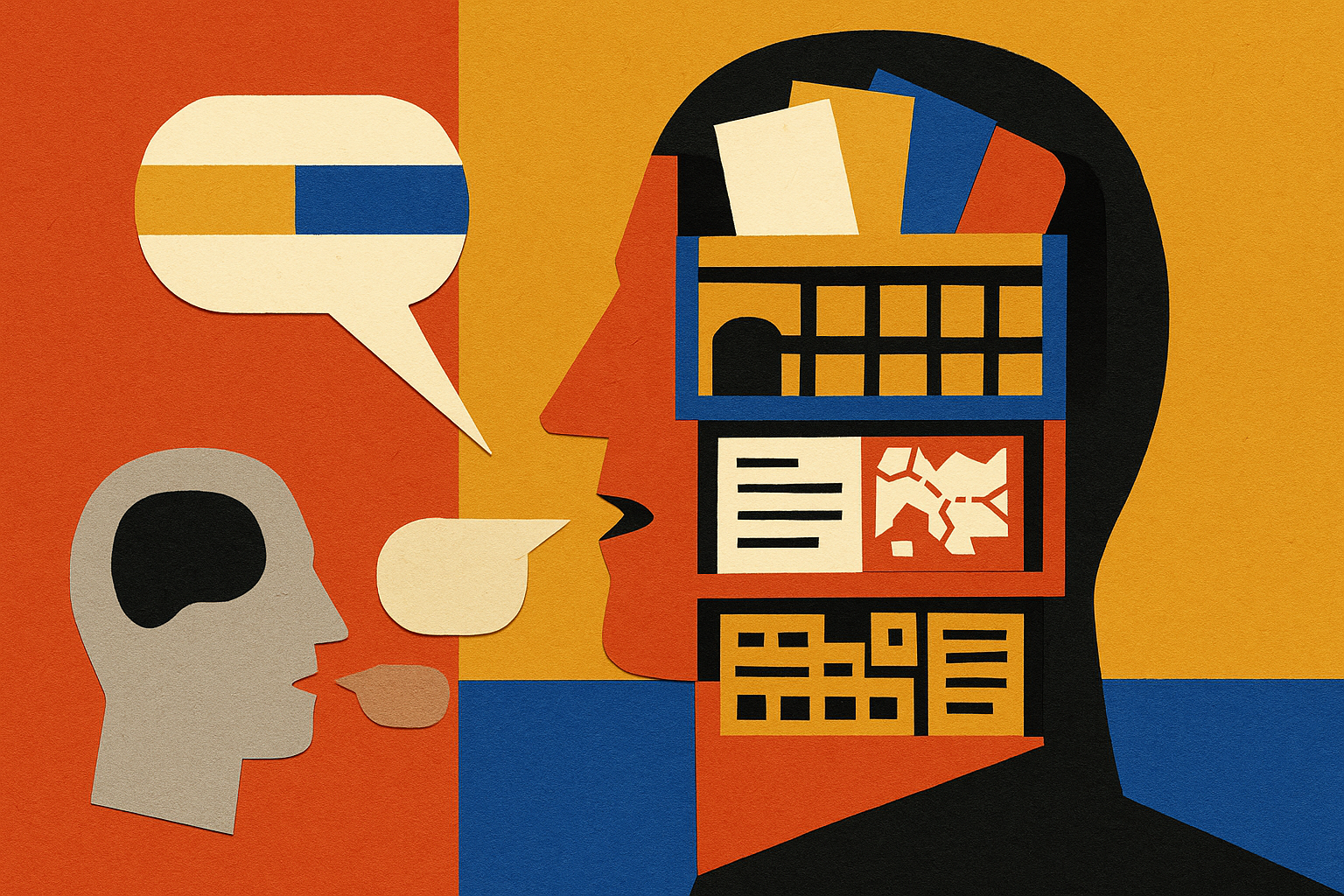
An AI Brand Twin is PitchKitchen's trained AI voice model built on the foundation of a completed Magnetic Messaging Framework (MMF). Think of it as a custom GPT or Claude Project that has read your company's entire strategic narrative, learned the rules for how you sound, and knows the format-by-format style for everything from a homepage to a cold email. It's not a fine-tuned model and it's not a clever prompt. It's a stack of three deliberate layers sitting on top of your actual story.
The order matters. An AI Brand Twin only works when there's a real narrative underneath it. Build one on a weak message and you've just automated the production of on-brand-sounding noise. Greg Rosner, founder of PitchKitchen and author of Story Craft for Disruptors, calls untrained AI a trendslop machine: it produces averaged-out, confident-sounding advice that doesn't differentiate, because it's working from the average of the internet instead of one specific company's truth. The Magnetic Messaging Framework is the antidote, and the AI Brand Twin is how that antidote scales.
Why doesn't prompting ChatGPT harder give you the same thing?
Because prompting is a request, and a request can't replace context the model doesn't have. You can write the most detailed prompt of your life and the model still doesn't know your buyer, your villain, the old way you're fighting, or the words your best customers actually use. It fills those gaps with the statistical middle of everything it's ever read. That's why founders get generic strategy advice from ChatGPT and other LLMs ... not because the model is weak, but because it has nothing of yours to be specific about.
AI brought the cost of content to zero. Anyone can generate a thousand words in ten seconds, which means volume is no longer the moat. Perspective is. Lived truth is. The companies winning with AI aren't the ones with the best prompts. They're the ones who gave the machine something true and specific to work from. An AI Brand Twin is the mechanism for that. It moves your narrative out of your head and your founder's instincts and into a system the AI can draw from every single time, instead of you re-explaining your company in every prompt.
If you want the deeper mechanics of how the training actually happens, we wrote a full breakdown of how AI training on brand messaging actually works. This piece is about what the Twin is and how the three layers fit together.
What are the three layers of an AI Brand Twin?
Every AI Brand Twin PitchKitchen builds is three stacked layers. Each one answers a different question: what does the AI know, how does it behave, and how does it write this specific thing. Miss a layer and the Twin gets generic again.
- 1Layer one, Knowledge: the Magnetic Messaging Framework itself. This is your strategic verbal identity ... the 35-plus sections that capture your category, your villain, the old-way / new-way contrast, your promised-land outcome, your proof, and the exact language your buyers use. It lives in the Twin's knowledge file. This is the layer that makes the AI know who you are. If you're not sure what belongs in it, here's what a B2B messaging framework should include.
- 2Layer two, Behavior: the system prompt. This is the rulebook for how the Twin acts ... its core role, its source-of-truth rules, the non-negotiable guardrails (always do this, never do that), the tone defaults, and the language restrictions that strip out the AI tells. This is where the no-em-dashes, no-buzzwords, no-we-are-committed-to detox gets enforced on every output, automatically, so you stop editing it back in by hand.
- 3Layer three, Per-task Style: the Voice Spec. This is PitchKitchen's reusable writing rules document that translates a company's Magnetic Messaging Framework into 15 sales enablement deliverable formats. It tells the Twin how a blog opens versus how a cold email opens versus how a landing page closes ... length, point of view, structure, and the brand-specific tics for each format. Loaded on demand for whatever you're writing.
Knowledge makes it know you. Behavior makes it sound like you. Style makes it write the right thing for the format. Together they turn a generic model into something that produces a first draft you'd actually ship, not one you have to rescue.
| Dimension | Prompting ChatGPT harder | An AI Brand Twin (the three-layer way) |
|---|---|---|
| What the AI knows about you | Whatever you can fit in one prompt, re-typed every time | Your full Magnetic Messaging Framework, loaded once (Knowledge layer) |
| How it behaves | Drifts back to generic on every new chat | Locked guardrails and tone, enforced on every output (Behavior layer) |
| How it writes a specific asset | Same default voice for a homepage and a cold email | Format-by-format rules from the Voice Spec (Style layer) |
| Who it sounds like | The average of the internet ... trendslop | Your company, specifically |
| Your time per piece | 45 minutes rewriting it to sound like you | Editing a draft that already sounds like you |
| What scales | Volume of generic content | Your actual perspective, across every channel |
What does this look like across the companies we see?
Across the founder-led B2B companies in the $5M-$75M range we work with, the pattern is almost always the same. The founder isn't short on AI tools. They've got ChatGPT, Claude, maybe a writing app or two, and a marketer or contractor running them. What they're short on is a single source of truth those tools can pull from. Every person and every tool produces a slightly different version of the company, and none of them sound like the founder on their best day.
The cost shows up as drag, not disaster. A homepage that took three rounds and still feels off. Sales emails every rep writes from scratch. Blog posts that read like they could belong to anyone. The team is busy, the output is high, and the message keeps getting blurrier. That's the generic-content treadmill most teams are stuck on, and it's the same one we mapped in how to make AI writing actually sound like us: more AI, less distinctiveness.
When a real narrative goes in first and an AI Brand Twin gets built on top, the change isn't that the content gets more clever. It's that it gets consistent and specific at the same time. Every surface starts saying the same true thing in the same recognizable voice. We wrote about why that consistency is the whole game in scaling your voice without losing your soul.
How does this play out in practice?
Take a composite example, drawn from a few similar engagements: a $19M Series B cybersecurity company, founder-led, with one marketer and a stack of AI tools. Their problem wasn't volume. They published constantly. Their problem was that every piece sounded like every other security vendor ... AI-powered threat detection, end-to-end visibility, the whole bingo card. Buyers couldn't tell them apart from companies a tenth as good.
We didn't start with the AI. We started with the story ... ran the discovery, built the Magnetic Messaging Framework, named the specific villain their best customers actually feared, and pinned the old-way / new-way contrast. Then we built the AI Brand Twin on top: the MMF as the knowledge layer, a system prompt that banned the category's buzzwords outright, and a Voice Spec for their homepage, their sales emails, and their blog.
What changed wasn't the publishing pace. It was that the marketer stopped spending half her week rewriting AI drafts to sound like the founder, because the Twin already did. The founder stopped being the bottleneck for every important sentence. And the message stopped drifting from one asset to the next. The Twin didn't replace anyone. It gave one small team the output of a much bigger one, in a voice that was unmistakably theirs.
What should you do about it?
If your AI content keeps coming back generic, the fix isn't a better prompt or a different model. It's giving the machine something true to work from. That's the whole move, and it goes in order.
- 1Get the story out of your head first. The AI Brand Twin is only as good as the narrative underneath it. Before you automate anything, you need a documented Magnetic Messaging Framework ... your buyer, your villain, your old-way / new-way contrast, your promised-land outcome. No framework, no Twin. Build on a weak message and you've just automated noise.
- 2Build the three layers, in order. Knowledge (the MMF in the knowledge file), Behavior (the system prompt with your guardrails and your AI-tell detox), and Style (the Voice Spec for each format). Each layer does a job the others can't.
- 3Put it where the work happens. A Twin that lives in one person's account isn't scaling anything. The point is that every salesperson, every marketer, and every tool draws from the same true source, so the company sounds like itself everywhere a buyer or an AI engine looks.
Here's why this matters more in 2026 than it did two years ago. There are two buyers now: the human, and the AI engine that briefs the human before they ever reach your site. Both of them are reading for a clear, specific, consistent story. A generic AI treadmill gives them the opposite. An AI Brand Twin, built on a real Magnetic Messaging Framework, is how you give a small team the ability to sound like your best self everywhere, on demand, without you in the room. That's what PitchKitchen builds: Magnetic Messaging Frameworks for founder-led B2B companies in the $5M-$75M range, and the AI Brand Twins that scale them. The 90-Day Magnetic Messaging Sprint is how the whole stack ... the framework, the Twin, the website, the sales enablement ... gets built in one quarter, and you own all of it at the end.
Questions People Ask
FAQ
What is an AI Brand Twin?
An AI Brand Twin is PitchKitchen's trained AI voice model, built on the foundation of a completed Magnetic Messaging Framework. It's a custom GPT or Claude Project that has learned your strategic narrative, your behavioral guardrails, and your format-by-format writing rules, so it produces content that sounds like your company instead of the generic average of the internet. It's how you scale your voice without re-explaining your business in every prompt.
How is an AI Brand Twin different from just prompting ChatGPT?
Prompting is a one-time request that can't replace context the model doesn't have. Every new chat, ChatGPT drifts back to generic because it doesn't know your buyer, your villain, or your language. An AI Brand Twin loads your full narrative and rules once, so every output starts from your truth. The difference is editing a draft that already sounds like you versus rewriting one that sounds like everyone.
What are the three layers of an AI Brand Twin?
Three. Layer one, Knowledge: your Magnetic Messaging Framework in the AI's knowledge file, so it knows who you are. Layer two, Behavior: a system prompt with your guardrails, tone defaults, and AI-tell detox, so it acts like you. Layer three, Style: a Voice Spec with format-by-format rules, so it writes a homepage differently from a cold email. Knowledge, Behavior, Style, stacked in that order.
Do I need a Magnetic Messaging Framework before building an AI Brand Twin?
Yes. The AI Brand Twin is only as strong as the narrative underneath it. Build one on a weak or undefined message and you've just automated the production of on-brand-sounding noise. The order is fixed: document the Magnetic Messaging Framework first, then build the Twin on top. Nail the story, then let the Twin scale it across every channel.
Is an AI Brand Twin a fine-tuned model?
No. An AI Brand Twin isn't fine-tuning and it isn't a single clever prompt. It's a configured custom GPT or Claude Project with three deliberate layers ... your Magnetic Messaging Framework as knowledge, a system prompt as behavior, and a Voice Spec as per-task style. It works with off-the-shelf models like ChatGPT and Claude, which is why any founder can run one without training a model from scratch.