
How do we keep our messaging consistent when everyone on the team writes with AI?

By Greg Rosner
Founder of PitchKitchen · Author of StoryCraft for Disruptors
· 7 min read
TL;DR
Two things diverge at once. Everyone on your team carries their own version of what the company does and who it's for, and each has trained their own AI with a different slice of it, because no single bible for the business exists. Then even when the bible does exist, nothing makes people use it correctly inside whatever AI they personally opened this morning. Codify the narrative identity into one document, the Magnetic Messaging Framework, then turn that document into an MCP server every writer connects to. Claude, ChatGPT, Gemini, Perplexity, Manus, whatever they're running, they all pull the same live truth mid-draft.
Messaging drifts when everyone writes with AI because two separate things diverge at once, and fixing one without the other leaves you exactly where you started. Everyone carries their own version of the truth about what the company does and who it's for, and there's no single bible saying otherwise. Then, even once that bible exists, nothing guarantees anyone uses it inside whatever AI they personally opened this morning.
Most companies reach for a style guide at this point. A style guide governs how sentences sound, which is the layer AI models already handle competently. Neither divergence lives there.
Here's what each divergence actually costs you, the audit that tells you where you stand today, and the mechanism that closes both: codify the story into one document, then serve that document to every tool your team writes in.
Why does messaging drift faster now that everyone writes with AI?
Every person on your team carries a private version of the company, and AI turns each private version into finished-looking volume.
A marketer with a slightly-off idea of your best-fit customer used to produce one paragraph a day. A rep with a slightly-off idea of the villain produced one email. That drift existed and it stayed small enough to catch in a Friday review. Today the same marketer ships a landing page, six ad variants, three emails and a case study before lunch, all fluent, all internally consistent, all built on the same slightly-off idea.
Fluency is the part that fools people. Copy that reads well gets less scrutiny than copy that reads badly, and your team is now shipping more words than any human ever reviewed.
The model isn't inventing a different company on purpose. It fills gaps. Ask it for a comparison page and it needs a position on the competitor. When nobody wrote one down, it composes something reasonable out of the average of your industry. Multiply that by twelve people and a few hundred drafts, and a buyer gets a slightly different company depending on which surface they land on. We've written before about what that costs you in trust and positioning. This piece is about stopping it operationally.
“Your team was always guessing. AI just made the guesses reproducible.”
The two divergences underneath the drift
Name them separately, because they need different fixes and most companies only ever attempt the first one.
The first divergence is the truth itself. Every person has their own version of what the company does and who it does it for, and each of them has been feeding that version into their own AI for months. Some have loaded a lot of context. Some have loaded almost none. Nobody is working from a business bible, because there isn't one, so twelve slightly different companies get drafted every week.
The second divergence is the one that surprises leadership teams. Suppose you write the bible. Suppose it's genuinely good. There's still nothing making anyone use it correctly inside their own tools. Companies buy their employees licenses for one AI and people keep using others anyway, on their phones, in a browser tab, on a personal account, and every one of those sessions starts with an empty context window. A document everyone has and nobody loads produces the same output as no document at all.
What has to match across everyone, and what's allowed to vary?
Not everything has to match. Trying to standardize all of it is how you end up with a document nobody opens.
A short list of layers has to be identical for every writer and every surface. Everything below that list should move with the format, the channel and the person.
| Layer | Has to match | What breaks when it doesn't |
|---|---|---|
| Who you're for | Yes | Two writers optimize for two different buyers and your funnel argues with itself |
| Who you're not for | Yes | Copy widens to please everyone and your best-fit buyer stops recognizing themselves |
| The problem you name | Yes | Each surface blames something different, so no single villain ever lands |
| The argument you're making | Yes | The claim shrinks to a feature list, which is the shape every competitor already has |
| Proof, with permission status | Yes | A model fills a proof gap with a plausible number nobody can source |
| Words you refuse to use | Yes | Retired language keeps resurfacing months after the decision to drop it |
| Tone and register | No | Nothing. A support macro should sound different from a keynote abstract |
| Sentence rhythm and length | No | Nothing. Forced uniformity here reads as corporate, not consistent |
| Examples and analogies | No | Nothing. Local color is what keeps writing human |
| Structure and format | No | Nothing. Format rules belong one layer down, per deliverable |
Most teams get this backwards. A brand book runs eleven pages on voice adjectives and never names a customer you'd turn away. Locking tone while leaving the position open produces copy that sounds uniform and says twelve different things. Rewriting those guidelines so a machine can act on them fixes the shape: every rule needs a trigger, an action, a real example, and a condition where it fails.
How do we tell whether our messaging is already drifting?
Thirty minutes and four printed artifacts will tell you. Run this on your own output before you buy anything to fix it.
- 1Pull the last thirty days of AI-assisted writing from four different surfaces: a landing page, a cold email, a sales follow-up, and a support or onboarding message. Print them.
- 2Underline the customer each one is written for. Different implied buyers across four artifacts means the position was never settled, and every writer picked their own.
- 3Find the villain in each. When one blames budget, one blames a legacy vendor, and one blames nothing at all, your writers are each choosing an enemy on the fly.
- 4Count the claims you can't source in under a minute. Unsourced specifics are where a model quietly filled a gap for you.
- 5Hand all four to someone outside the company with the logos covered and ask which ones came from the same firm. Hesitation is your answer.
That's the drift check a sales leader runs on message consistency across reps, moved from live conversations to written artifacts. The artifacts are easier, because they hold still.
Who owns the source, and what happens when the story changes?
Consistency has one owner or it doesn't exist. One person holds the source document, changes route through them, and every change gets dated and announced. A committee produces a document that reflects the last meeting rather than a decision.
The honest test of whether you have a real source is what a change costs. We ran that test on ourselves this month. Greg retired a signature line he'd used for years, one that had been in his talks, his posts and his client copy. The retirement took one edit to one file. Every writing surface we run stopped using it that same day, including the engine that's published more than 270 articles, because they all read from the same place. Had that line lived in a dozen people's prompt habits instead, we'd still be finding it in decks next spring.
That same file carries a kill list: constructions we don't publish, each paired with the reason it's banned. Em dashes. The inversion that says a thing is not one way but another. Stacked sentence openers. A rule with its reason attached survives a new writer joining. A rule living in someone's head leaves when they do.
The new approach: codify the bible, then serve it
The move that closes both divergences at once has two steps, and the order is fixed. First, codify your narrative identity into one document that carries decisions rather than adjectives. We call ours the Magnetic Messaging Framework, roughly 35 sections covering who you're for, who you're not for, the problem you name, the point of view only you hold, your proof, and the words you refuse to use. That's the business bible, and it closes divergence one.
Second, turn that document into an MCP server. MCP is the open standard AI assistants use to reach outside themselves and retrieve live context. Give everyone the link and their assistant pulls your current brand truth mid-draft, whatever they happen to be running. Claude, ChatGPT, Gemini, Perplexity, Manus, Copilot, Cursor, the harness stops mattering. That's what closes divergence two, and it's the only mechanism we've found that closes it without policing anyone's browser.
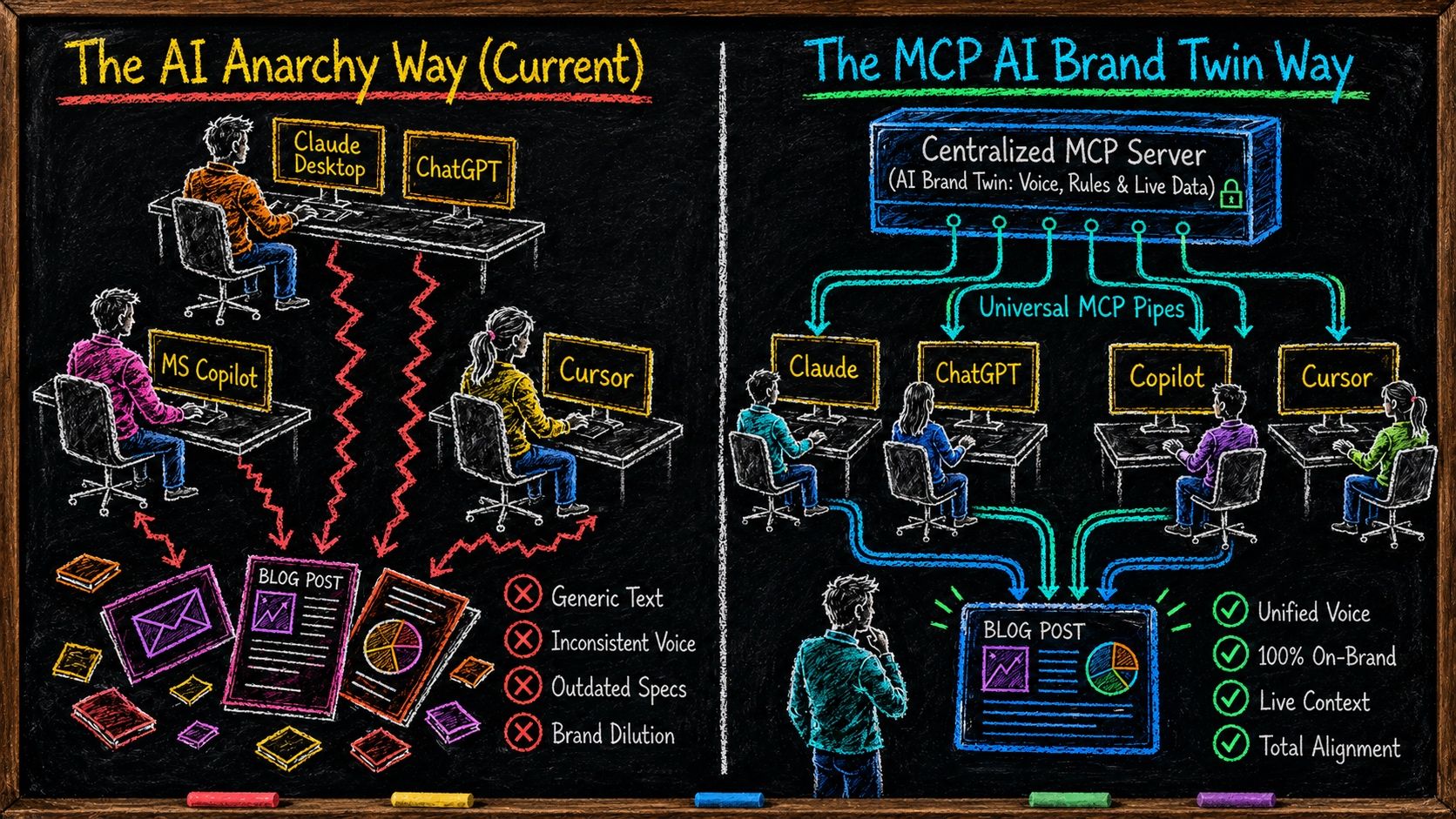
The distinction that makes this work is retrieval instead of memory. Nobody has to remember the current ICP or the claim you retired last quarter, and nobody has to paste a sixty-page PDF into a chat window. The assistant asks the server and gets today's answer. Correct the document once and every writer's next draft is corrected, including the writers who never read the announcement.
“A document everyone has and nobody loads produces the same output as no document at all.”
We serve our own framework this way through the Test Kitchen, and we build private servers for clients so their whole team connects to their own brand truth rather than ours. The mechanics of the serving layer are covered in how to get every AI tool to follow your messaging framework, and whether to build one at all walks through the build-versus-wait decision. If the document itself is your gap, making brand guidelines machine-readable is the shape it needs to take before any server can serve it.
What does this look like in practice?
Start with the document, because standardizing the surface of a decision nobody made just makes the disagreement more consistent. A settled, written narrative identity is what every other artifact derives from.
Split it into named units that each carry one decision, so a writer or a tool can pull the ICP without loading the color palette. Retrievability is a property of the document, not just the server.
Then connect the team. Everyone who writes anything a customer will read gets the server link, including the people using AI you never licensed. That last group is the one that decides whether this works.
Format-level rules ride on top. A voice guide your team and your AI will follow is the layer that says what a cold email opens with and how a case study closes. It earns its keep once the position underneath it is settled. Before that, it's decoration on an argument you haven't made.
If you want an outside read on where the drift starts, run your homepage through the free Brand Signal Score and set the result next to the four artifacts from the audit above.
What this means for you
Training won't close this gap and neither will a better prompt library. Both assume the answer already exists somewhere and only needs distributing. When four artifacts name four different buyers, the answer doesn't exist yet, and every hour your team spends drafting is an hour spent publishing the disagreement at machine speed.
Run the four-artifact audit this week. If it comes back clean, your source is doing its job. If it comes back the way it usually does, you have two jobs rather than one: decide the story and write it down, then put it somewhere every AI on your team can reach without anyone having to remember to.
Questions People Ask
FAQ
Is a style guide enough to keep messaging consistent when the team uses AI?
No. A style guide governs tone, rhythm and formatting, which is the layer AI models already handle competently. Drift happens one layer up, where a writer has to decide who the customer is, what problem to name and what argument to make. When those decisions aren't written down, each writer supplies their own and the model makes it sound polished.
Our team uses AI tools we never licensed. How do we keep those on brand?
You don't control the tool, so control the context instead. Serving your messaging framework from an MCP server means any assistant that supports the standard can connect to it, which covers Claude, ChatGPT, Gemini, Perplexity, Copilot, Cursor and most of what your team will open next year. Hand out the link the way you'd hand out a wifi password. Policing which AI people use has never worked, and it isn't the lever that matters.
Isn't a shared document enough? Why do we need an MCP server on top of it?
A document fixes what's true. It doesn't fix whether anyone loads it. In practice a sixty-page PDF loses to a blank chat window, because opening the PDF is work and the model answers instantly. An MCP server turns the document into something the assistant retrieves on its own, mid-draft, without the writer doing anything. It also means a correction reaches everyone the day you make it rather than the quarter you finally re-announce it.
Should we ban AI writing tools to protect the brand?
Banning them hides the problem rather than fixing it. The inconsistency was already there in a dozen people's heads, and AI only made it visible at volume. A ban also loses you the speed. The durable fix is one written source, served to the tools your team already uses, so drafting fast and drafting on-message stop being different things.
Who should own the messaging source document?
One named person, usually the founder or the senior-most marketing leader, with changes routed through them and dated. Committee ownership produces a document that records the last meeting instead of a decision. The test of real ownership is how long it takes a retired phrase or a changed claim to disappear from every surface.
How often should we audit for messaging drift?
Monthly is enough for most $5M to $75M companies, and it takes about thirty minutes. Pull four AI-assisted artifacts from four different surfaces, check whether they name the same buyer and the same villain, count unsourced claims, and have someone outside the company guess whether they came from the same firm.
What's the difference between a brand voice guide and a messaging framework?
A voice guide covers how you say things, format by format: length, opening, point of view, close. A messaging framework covers what's true and what you've decided: your best-fit customer, your disqualifiers, the problem you name, your point of view, and your proof. The voice guide sits on top of the framework and can't do its job without one underneath.