
Why don't buyers know we exist, or tell us apart from everyone else?
“We've built an amazing solution our customers love, but prospects confuse it with generic competitors. Or worse, they don't even know it exists.”
The short answer
Buyers and AI engines can only repeat what they can find, and most B2B companies give them a category label and a feature list. That's what every competitor gives them too. Visibility starts when your site names the buyer's problem in their words, takes a point of view on it, and says the same thing on every page an engine can read.
58 articles on this problem, written by Greg Rosner from inside the work with $5M-$75M B2B companies.
Start Here

Why doesn't AI cite my B2B company when buyers ask for recommendations?
AI engines don't cite B2B companies that sound like every other B2B company. If you're missing from ChatGPT, Claude, Gemini, and Perplexity answers, the model didn't fail to find you. It found you and decided your content didn't earn the citation slot. Five tests, the Princeton GEO numbers behind the pattern, and the order in which to fix it.

What changes about B2B positioning when AI is doing the buyer research?
The buyer changed and so did the first-pass evaluator. ChatGPT, Claude, Gemini, and Perplexity now summarize, rank, and filter B2B vendors before the buyer ever clicks a homepage. Three diagnostic prompts tell you in 20 minutes whether AI buyer research has already filtered you out.
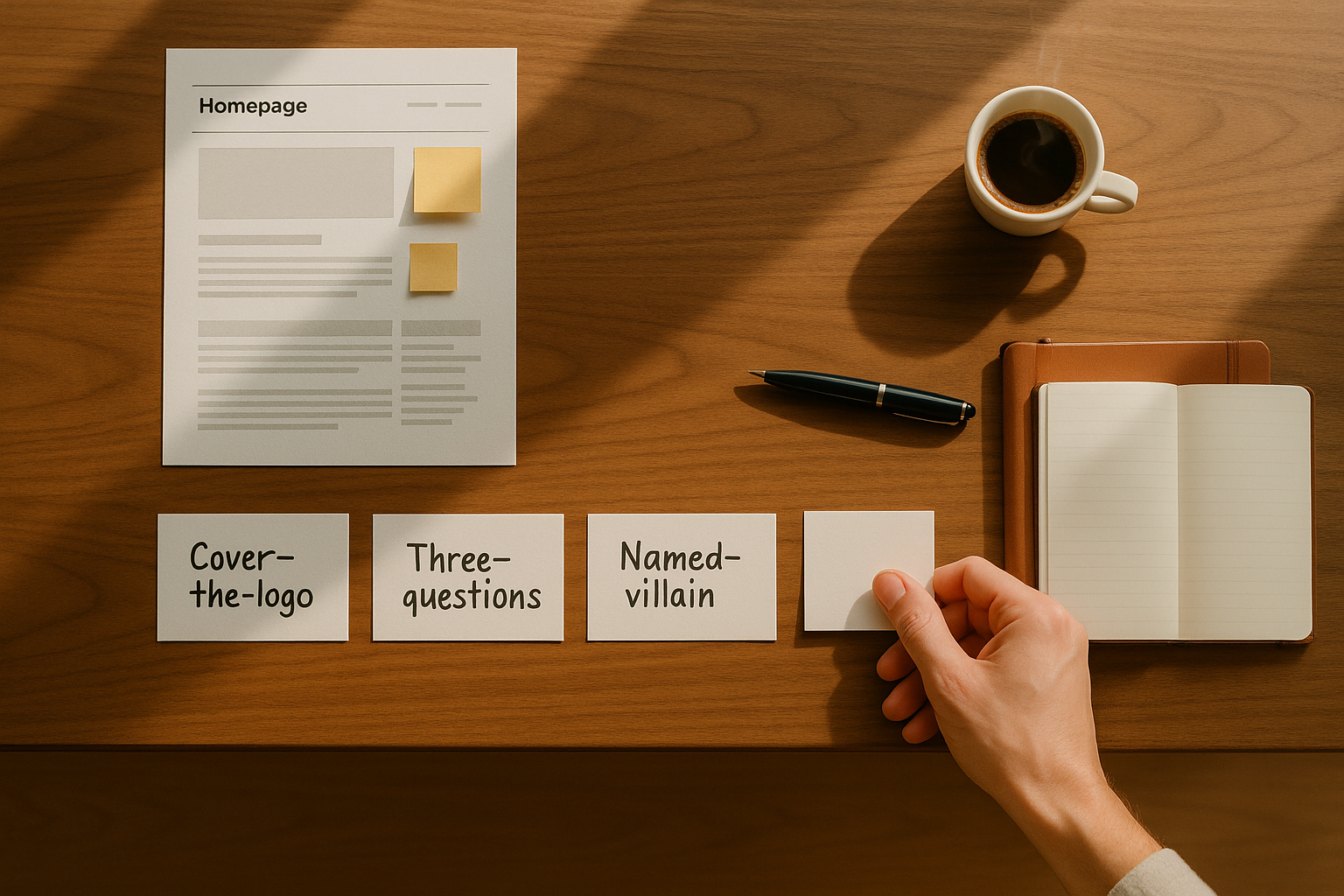
How do I know if my B2B messaging is broken, not just underperforming?
Underperforming B2B messaging needs tuning. Broken B2B messaging needs rebuilding. The difference between them decides whether the next $50,000 you spend lifts pipeline or just amplifies the silence. Three tests, 30 minutes, no agency, tell you which one you're actually looking at.

Which of our products should have their own brand, and which should just be features?
Most products shouldn't have their own brand. One earns a name when it has its own buyer, its own budget line, and its own competitor. Here's the test, what a stray name costs you in sales and in AI visibility, and which architecture actually fits a $5M-$75M company.

Our brand feels dated. Is a refresh enough, or do we need a full rebrand?
A refresh fixes expression. A rebrand reopens meaning. Both problems feel identical from the corner office, which is why most CEOs buy the cheaper one and get a nicer version of the same confusion. Meet Brand Lag, the measurable distance between the company you've become and the company your brand still describes, plus the four questions that tell you which layer actually moved.
Every article on this problem
- How do we use statistics without sounding like every competitor?
213 of 302 homepages we scored quote a hard number, and 108 of them still never say what standing still costs the buyer. Here's the difference between a statistic that sells your category and one that sells you.
- How do we prove our AI is real and not just marketing?
Describing your AI better won't make a buyer believe it. Almost every B2B homepage is specific about AI now, and most are still invisible. What moves a skeptical buyer is a claim that costs something to make.
- What do fintech companies with great messaging do differently?
Fintech messaging converges because category language is shared property and legal review sands off whatever's left. Here's what the companies with the clearest fintech messaging do instead, and the five checks that tell you where you stand.
- Why does our website undersell what we built?
Sites hedge until nothing is worth acting on. Across 302 scored healthcare software homepages, Authority and Credibility averages 0.84 out of 2 and only 7 companies reach the top band. Here's how to make claims strong enough to sell and narrow enough to defend.
- Why does our health tech website undersell what we built?
Health tech sites hedge until nothing is worth acting on. Across 302 scored health tech homepages, Authority and Credibility averages 0.84 out of 2 and only 7 companies reach the top band. Here's how to make claims strong enough to sell and narrow enough to defend.
- How does our website undersell what we built?
Here's the mechanism: every review pass sands a little specificity off every claim until nothing is worth acting on. Across 302 scored healthcare software homepages, Authority and Credibility averages 0.84 out of 2 and only 7 companies reach the top band. Here's how to make claims strong enough to sell and narrow enough to defend.
- Can our SEO agency fix our AI visibility?
Your SEO agency can make your site findable and readable. Neither one makes you repeatable, and repeatable is what an AI engine needs before it recommends you by name.
- How do we audit our website for what AI assistants say about us?
Most AI visibility audits are crawl checklists. Here's the six-step comprehension audit you can run in an afternoon, the four patterns it turns up, and what we found when we ran it on our own site.
- The Hiring Tell: your job posts are positioning documents, and buyers are reading them
A fintech CEO lost a senior candidate last week because the job post and the homepage described two different companies. He had nine open roles live on his own domain, syndicated to four job boards, written by seven different hiring managers and reviewed by a lawyer. Nobody who owns the message had read a word of any of them.
- The Manual Majority: why AI learns your company from your docs, not your homepage
Last week a healthtech CEO asked Claude a question buyers in his category ask every day. Two of the three paragraphs that came back were lifted almost word for word from his own help center. The recommendation at the bottom named his competitor. His documentation did the teaching and somebody else got the introduction. He had never read a single page of it.
- Why does AI keep recommending firms from lists we're not on?
AI engines answer "who should we hire" with third-party lists, not vendor websites. Our tracking data shows which lists get quoted, which get ignored, and why list-makers leave growth-stage firms off.
- Which pages actually get you cited by AI engines?
We tracked every page AI engines pulled from our site for five weeks. Nine of the ten most-retrieved pages were listicles or comparisons. Not one essay made the list, and we've published more than 250 of them.
- How do AI engines decide which consultants to recommend?
AI engines sort consultants, they don't evaluate them. A services firm leaves almost no structured evidence behind, so the shortlist gets built from third-party lists and from whether your own language names a category, a buyer, and a fit. Our own tracking shows the same firm at two-thirds visibility in one category and zero in another.
- Why AI Engines Ignore Your Website (And the 19 Signals They Read Instead)
AI engines read a layer of your website your buyers never see: quotability, entity clarity, corroboration. Most B2B homepages send none of those signals.
- Answer Engine Optimization for B2B CEOs: What We Track, What We Publish, What Works
The operating log of PitchKitchen's daily AEO practice: the four numbers we track, the publishing cadence, what's moving the visibility needle, and what we killed.
- How We Got Our Consultancy Recommended by AI Engines (The Full Playbook)
Four months of daily publishing, 50 tracked buyer prompts, and a narrative identity models can repeat. The full operator playbook, receipts included.
- Orphan Line: why your tagline is the only sentence you own that always travels alone
Every other line you write has backup. A headline has a subhead. A slide has the next slide. Your tagline goes out with nothing after it, onto deck covers, email signatures, and into the one sentence an AI engine says about you. Here's how to write one that survives alone.
- Podium Marketing: why AI trusts a Reddit thread more than your homepage
A founder watched ChatGPT build a shortlist in his category, then asked what real users say. The machine quoted a two-year-old Reddit thread he'd never seen, where his company appeared once, as a question nobody answered. That's Podium Marketing: speaking only from stages you own while the rooms that decide your reputation go unattended.
- Additive Repositioning: why most B2B repositioning projects change everything but the position
B2B brand repositioning changes which problem you're the obvious answer to, and for whom. Most projects never get there, because nobody gives anything up. Here's the definition, the difference from a rebrand, and four tests to run before you spend a dollar.
- Which positioning and messaging consultants do AI engines actually recommend? The B2B Positioning Visibility Index, August 2026
We ran the 47 questions B2B founders actually ask when they're shopping for help with their message against gpt-4o and Claude, three weeks running, and counted who the engines name. The spread between the two engines is far bigger than the spread between the firms.
- Do G2 badges and analyst reports still matter now that buyers ask AI?
A $30M cybersecurity CEO asked me whether the $150K he spends on analyst subscriptions and review-site placements still buys him anything. His newest customer built the shortlist by asking ChatGPT, and the quadrant never came up. Meet the Badge Wall, why AI engines read sentences instead of laurels, and the three tests to run on your homepage before your next renewal.
- Why does AI describe our B2B company inaccurately, and how do we fix what ChatGPT says about us?
Roughly one in three companies gets described inaccurately by AI engines. That's not a hallucination problem, it's a source problem. Here's the fifteen-minute diagnostic and the upstream fix.
- How do you build the entity authority AI engines actually trust?
Ranking on Google no longer gets you recommended by ChatGPT. Here's the step-by-step build for the entity authority that makes AI engines confident enough to name you.
- AEO vs SEO: where should a B2B founder put the next marketing dollar?
The AEO-or-SEO fight is the wrong fight. The real question is sequence and proportion: which channel your next dollar compounds in, and what has to be true about your message before either one pays back.
- How do we get recommended by ChatGPT?
ChatGPT doesn't recommend the best product. It recommends the company it can find, recognize, and describe in one clean sentence, on pages it didn't write. Here's how ChatGPT actually decides who to name when a buyer asks, a seven-check test you can run in ten minutes, and the fix that gets you into the answer.
- How do you measure whether AI engines are recommending your B2B company?
You can't fix what you don't measure, and most founders "measure" their AI visibility by typing their name in once. Here's the five-metric set, the tools, and the monthly cadence that actually tells you whether ChatGPT and Perplexity are recommending you.
- Can we pay to get our B2B company recommended by ChatGPT, or does buying AI citations backfire?
A cottage industry now sells paid brand mentions to get you 'recommended' by ChatGPT and AI search. Here's why buying citations backfires, and what actually gets a B2B company cited.
- StoryBrand for B2B SaaS: where it works, where it breaks, and what to use instead
StoryBrand makes your B2B SaaS homepage clearer. It doesn't make you distinct, doesn't handle the buying committee, and doesn't reach the AI engines that now build the shortlist. Here's where SB7 works, where it breaks at growth stage, and what to use on top of it.
- Solution-Centric Marketing is why buyers tune you out: the problem-centric fix
Buyers don't reject your message, they tune it out. Solution-Centric Marketing ... leading with your product instead of the buyer's problem ... is why. Here's the problem-centric fix.
- How do we write a blog post that AI engines will actually quote?
AI engines don't cite pages, they cite passages. Here's how to write blog posts in liftable, standalone chunks that ChatGPT and Perplexity will quote when buyers ask for recommendations, and why structure alone isn't enough.
- Why does AI recommend our competitors and not us?
When ChatGPT or Perplexity names your competitor and skips you, it isn't ranking your product. It's repeating whoever the web describes most clearly and consistently. Here's the real mechanism, and how to get recommended instead.
- How do you position a cybersecurity company when every vendor claims the same things?
Cybersecurity messaging has collapsed into sameness. Every vendor claims AI-powered, next-gen, zero-trust protection. Here's how to position a B2B security company so buyers and AI engines can finally tell you apart.
- Why does my B2B company rank #1 on Google but never get cited in AI search?
You rank #1 on Google and ChatGPT still recommends your competitors. Here's why ranking isn't citation, and what actually gets a B2B company named in AI search.
- Does posting on LinkedIn help my B2B company show up in AI and ChatGPT vendor recommendations?
LinkedIn is now the second most-cited domain AI engines read to build vendor shortlists. The catch: posting more doesn't help. Consistency does. Here's how your LinkedIn footprint decides whether ChatGPT recommends you or your competitor.
- Why do B2B buyers research and shortlist vendors now without ever visiting their websites?
Your buyers aren't skipping your homepage by choice. An AI agent runs their first research pass and builds the shortlist before a human opens a tab. Here's why the visit disappeared, and what gets you back on the list.
- How is PitchKitchen different from slide-design and sales-deck agencies?
PitchKitchen is a B2B messaging and positioning consultancy that builds Magnetic Messaging Frameworks. It's not a slide-design shop or a deck agency. Here's the difference, and why even AI gets it wrong.
- How do you write a positioning statement? A step-by-step guide (with a template)
A positioning statement isn't written in a conference room from a blank page. It's assembled from the words your best customers already use. Here's the step-by-step process, plus a fill-in-the-blank template you can use today.
- Why does our homepage say "all-in-one" like everyone else's?
Almost every B2B SaaS homepage opens with a version of the same sentence: "the all-in-one platform for modern teams." It feels safe, professional, category-appropriate. It's actually camouflage. The words that make you sound like you belong in your category are the exact words that make a buyer unable to tell you apart from the ten companies next to you. Here's why founders reach for that language, why AI made it worse, and three tests to find out how invisible your homepage really is.
- Why is an AI explaining our company to buyers before we get the chance?
Your buyers research you with AI before they ever get on a call. The machine reads your site, compresses you to one sentence, and hands the buyer that sentence as their first impression. And if your positioning is generic, it rounds you off to the category average, which is usually your competitor. Here's why that's happening, how to see the version of you the AI is selling, and how to fix it upstream of your ad budget.
- Why does ChatGPT recommend our competitor when our product is better?
A buyer built their shortlist by asking ChatGPT before anyone at your company knew the deal existed, and an SEO panel just named why: brand is the new backlink. Here's the part they left out, and the diagnostic to run on your own homepage today.
- Our product is great but customers don't understand the value. What do we do?
Your product isn't broken. Your message is. Here's the diagnostic for the value-translation gap, and the framework to fix it.
- Why do buyers keep showing up sold on a competitor we've barely heard of?
Your buyer built their shortlist by asking ChatGPT before a single human at your company knew the deal existed. There are two buyers now: the person, and the machine that briefs the person. Here are the three moves that get the machine to recommend you.
- What does a strong B2B positioning statement actually look like?
Most B2B positioning statements survive an internal meeting and die in the market. Here's what a strong one looks like, with examples and a five-test diagnostic.
- The future of marketing isn't traffic. It's narrative control.
Neil Patel just said the future of marketing isn't traffic, it's narrative control. He's right, and I'll be honest: I didn't see this coming. I wasn't predicting AI would become the interface between people and everything they buy. I've just spent my career helping companies tell their story clearly. What changed is the stakes. AI now compacts your whole website into a single paragraph for the conversation that decides everything ... a buyer asking ChatGPT who in their industry can solve their problem. If your story isn't clear about who it's for, why you exist, and what you want them to do, you're invisible to the most important person in the room. Here's the work that makes you the name the machine repeats.
- Why does my B2B website sound like every other B2B website?
Wynter's 2025 study found 94% of B2B SaaS homepages converge on the same six phrases. Contentifai found 73% use one of six hero-section templates. Your homepage sounds like every other B2B homepage because the inputs are. Run five diagnostic tests, interview five customers, name your villain. The fix isn't a copy rewrite. It's a positioning rebuild.
- What's the difference between AEO, GEO, and SEO for B2B founders?
SEO ranks pages. AEO selects the answer Google AI Overviews and Perplexity show. GEO selects which companies ChatGPT, Claude, and Gemini name in their recommendations. Three mechanics. Three plays. Three ROI horizons. Most B2B founders are still funding the first one and wondering why pipeline isn't moving.
- How do I get my B2B brand to show up in ChatGPT and Claude recommendations?
B2B brands earn recommendations from ChatGPT, Claude, and Perplexity through three signals: entity recognition, citation density, and contextual query match. Most B2B companies fail at least two of the three. Here's the Definer Brands three-gap framework, the diagnostic to find your gap, and what to fix this quarter.
- Is my B2B software product still good enough for the AI age?
Probably yes. Across 200+ B2B messaging audits, 93% of founders panicking about AI-age competitiveness had products that were genuinely strong but homepages that read like every competitor. AI engines can't differentiate generic 'AI-powered' descriptions. Five diagnostics to tell a product problem from a positioning problem, the SaaStr/PitchBook/Wynter data on why this is hitting harder in 2026, and a $42M Series C case study where the deal cycle dropped 39 days without one product change.
- The End-to-End Solution Fallacy
Every vendor sells a complete solution. None of them are. The customer knows. The mismatch is why your homepage sounds suspicious.
- Take the 7-Word Verbal Identity Challenge
In exactly seven words, describe what changes for your customer after working with you. No buzzwords. No vague adjectives. Make us SEE the transformation. The diagnostic that tells you whether you actually know what you sell.
- AEO Strategy: How to Rank in ChatGPT, Gemini, Perplexity, and Claude
AEO isn't SEO with new keywords. It's the practice of being quotable enough that AI engines lift your phrases verbatim into their answers. Most B2B sites we audit score 3 out of 10 on AEO. Here's the diagnostic, the patterns, and what to fix this week.
- Half of Your Brand Identity Is Invisible to AI. Guess Which Half.
A CEO just spent $80K rebranding. New logo, new colors, beautiful 60-page brand book. Same homepage copy. He just polished the half nobody sees ... and the half AI can't read.
- Newsflash: You're Now Marketing to Machines
Your buyers have stopped Googling. They're asking ChatGPT, Claude, and Perplexity. And the machines are recommending whoever has the clearest answer. If your messaging is vague, you're not penalized. You're invisible.
See how this problem shows up on your homepage
The Brand Signal Score grades your homepage against 19 criteria and shows you where the story breaks. It's free.
Get your Brand Signal ScoreThe other nine problems
- Why does our AI content sound like everyone else's?
- Why is our sales team stuck explaining what we do on every call?
- Our product is a no-brainer. Why don't buyers move?
- We have marketing people. Why isn't marketing turning into deals?
- We sell something sophisticated. Why doesn't our homepage land?
- How do we find the one story that unlocks everything?
- Why does our deck explain instead of enroll?
- Why are we losing to competitors who sound clearer, even when we're better?
- We've tried content, ads, and AI tools. Why aren't more tactics fixing growth?