
How do we keep our brand identity intact when our sales outreach is automated?

By Greg Rosner
Founder of PitchKitchen · Author of StoryCraft for Disruptors
· 7 min read

TL;DR
Aligning brand identity with automated sales outreach means settling your narrative identity once, writing it in a form a machine can act on, and having every lane draft from that single source. Automation is a multiplier on whatever message you hand it, so an undecided message just ships faster and wider. Four things break first when the narrative was never written down: disqualification disappears, the villain goes missing, proof turns generic, and the lanes drift into three different companies. The fix runs in order: settle the narrative, make it machine-readable, serve every tool from one place over an MCP server so lanes retrieve the story instead of remembering it, give each lane a guardrail rather than its own message, and keep a human at the gate while the lanes learn. Measure it by right-reader replies, a rising disqualification rate, and meetings that start further along.
Aligning brand identity with automated sales outreach means settling your narrative identity once, writing it down in a form a machine can act on, and making every automated lane draft from that one source instead of from a template. Your sequencer isn't what's generating the sameness. It's faithfully amplifying a message nobody ever decided, and it does that faster and to more people than a rep ever could.
Founders usually arrive at this question after they've already bought the stack. There's a sequencer, maybe an AI SDR, a LinkedIn tool, an intent feed. Send volume goes up and to the right. Replies stay flat. And when you read twenty of your own outbound messages back to back, you can't find the sentence that only your company could have written.
Why does our automated outreach sound like it came from anyone?
Because the automation inherited a template, and the template inherited nothing. A template gets written to be safe across every recipient, which means it gets written at the altitude where all your competitors also sound reasonable. Personalization tokens don't rescue it. Swapping in a first name and a company name still leaves a message whose actual argument would work just as well for the forty other vendors in your buyer's inbox that week.
We learned this on ourselves. PitchKitchen ran a cold email lane for months on a tight four-line template that followed every best practice you've read about: short, personalized, one ask, no pitch. Response hovered around one percent. The template wasn't broken as a template. It carried no position, so there was nothing in it for a founder to disagree with, agree with, or forward. We retired the lane rather than optimize the subject line, because the problem was never in the copy layer.
That's the part the tooling conversation keeps missing. Automation is a multiplier sitting on top of whatever message you hand it, and multiplying an undecided message gets you more undecided message.
What does brand identity even mean once a machine is doing the sending?
When most people say brand identity they're describing the visual layer: the logo, the palette, the type system, the deck template. None of that survives the trip into an outbound email. What actually travels is the narrative identity: who you're for, who you're deliberately not for, the villain you're arguing against, the point of view you hold that your category doesn't, and the change you're asking a buyer to make.
An automated lane is the purest test of whether that layer exists. A human rep can improvise their way past a missing narrative. They read the room, they hedge, they tell a story they picked up in a hallway. A sequencer can't improvise. It sends exactly what your identity contains, and when your identity is thin, the thinness ships at scale with your logo on it.
“A rep can carry a message you never wrote down. Automation can only carry the one you did.”
What breaks first when you automate a message you never settled?
Four things fail in a predictable order, and each one is a piece of narrative identity that never got written down.
- 1Disqualification disappears. Knowing who you're wrong for is load-bearing identity, and a human rep expresses it constantly by softening, stalling, or quietly not following up. A sequencer has no such instinct. It sends the same confident message to the perfect-fit CEO and to the 400-person company you'd fail, and every bad-fit send teaches your market that you'll say anything to anyone.
- 2The villain goes missing. Templates default to benefit language because benefits feel safe. Benefit language is also the most crowded room in B2B, and a message that only claims outcomes gives a buyer nothing to react against. What you're arguing against is what makes a founder stop scrolling.
- 3Proof turns generic. Without a written proof layer, whoever writes the lane reaches for the nearest logo or the roundest number. The specific, slightly awkward, obviously-true detail is the one that earns a reply, and it's the first thing a template smooths off.
- 4The lanes drift apart. Cold email gets one tool, LinkedIn gets another, inbound follow-up gets a third, and each one gets configured by a different person in a different month. Within a quarter you're running three companies. This is the same message drift that pulls a sales team apart, except automation reaches strangers, so it compounds outside where you can't see it.
How do we align brand identity with automated sales outreach?
The sequence matters more than the tooling. Every step below fails if the one above it hasn't happened, which is why buying the AI SDR first is such an expensive way to discover you don't have a message.
- 1Settle the narrative before you scale it. Who you're for, who you're not for, the villain, your point of view, the change you're arguing for. This is a truth extraction problem, not a copywriting problem, and it takes weeks of argument with your own leadership team rather than an afternoon with a writer.
- 2Write it so a machine can act on it. Adjectives like confident and human give a model nothing to execute. Machine-readable guidelines break the narrative into named units a tool can retrieve one at a time: positioning, ICP, disqualifiers, competitors, proof, vocabulary, and the constructions you refuse to use.
- 3Serve every lane from one place. When each tool holds its own copy of the message, they all drift and none of them tells you when. An MCP server is the practical way to do this: one source every tool queries, so a correction lands everywhere at once and there's exactly one version to argue about.
- 4Give each lane a guardrail, not a different message. A cold LinkedIn note and a follow-up to someone who's already read three of your pages carry the same position at wildly different volumes. The narrative stays fixed; the permission level, the length, and the ask change per lane.
- 5Keep a human at the gate while the lanes learn. Approval gates are slow and they're also where you find out that your written identity says something your team doesn't actually believe. That discovery is worth more than the volume you gave up finding it.
How does one narrative actually reach every automated lane?
Everything above is a decision. This is the plumbing that makes the decision stick, and it's where most teams quietly lose the thread. The default is that each tool gets handed its own copy of the message: a paragraph pasted into the sequencer, a prompt saved in someone's ChatGPT, a tone note living in the LinkedIn tool. Three copies means three versions, and none of them tells you when it went stale.
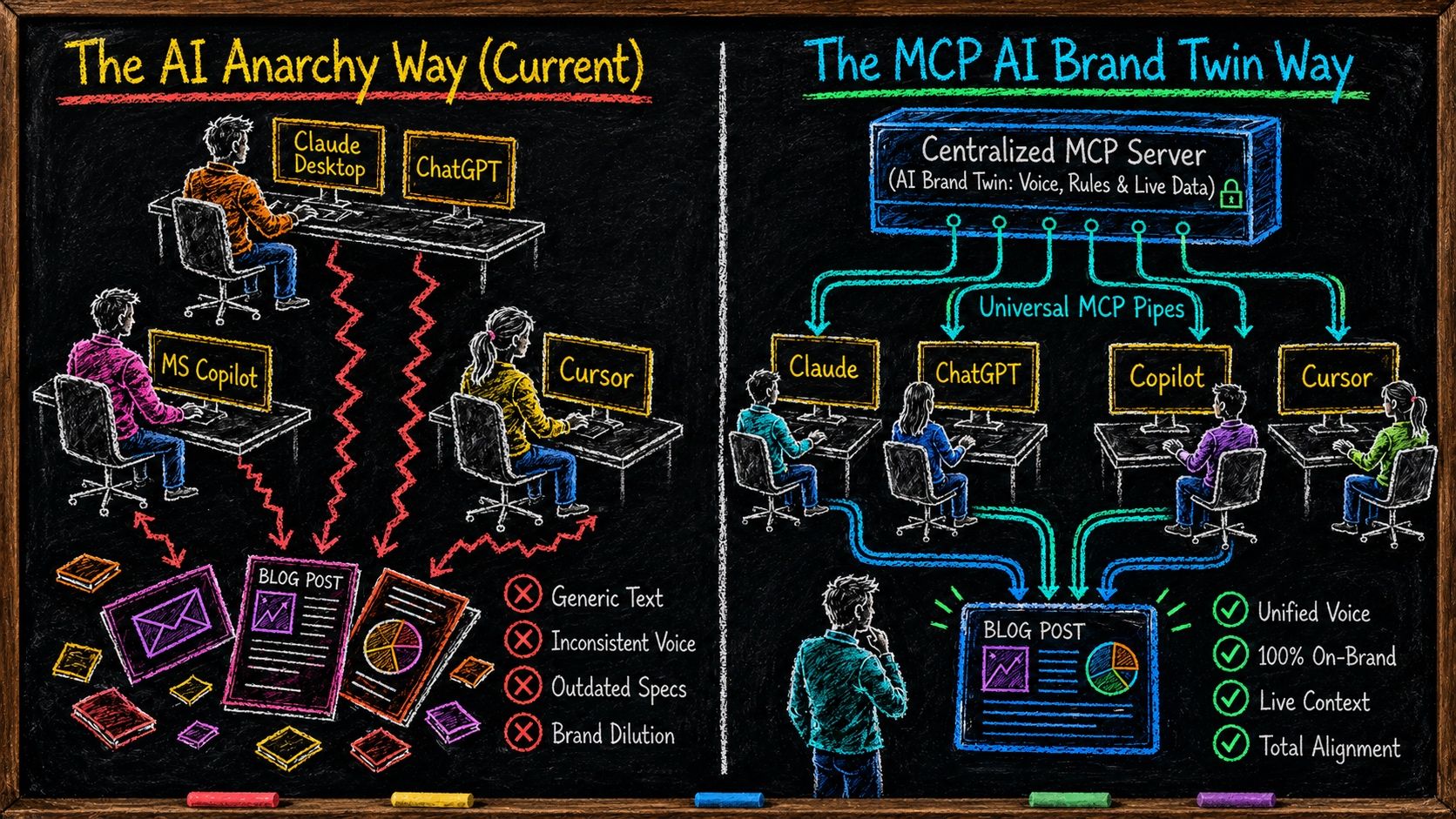
The fix is to stop distributing copies and start serving one. An MCP server holds the narrative once ... your positioning, ICP, disqualifiers, villain, proof, and the constructions you refuse to use ... and every tool queries it live. That's the difference between the two halves of the picture above, and it's why the right side produces on-brand output from tools the left side turns into brand dilution.
For automated outreach specifically, the server does something a template can't: it gives the model something to retrieve instead of something to remember. A lane drafting from memory will confidently reach for a claim you retired, a customer you no longer name, or a segment you deliberately disqualified. A lane drafting from a served narrative can't invent those, because the disqualifier list and the proof layer are things it looks up rather than things it guesses.
We run our own framework this way through the Test Kitchen, our MCP server, and it's the same mechanism we install for Sprint clients as their own private server. Their Magnetic Messaging Framework goes behind an endpoint their whole team connects to, so the sequencer, the LinkedIn lane, the follow-up lane, and the human writing a one-off reply are all drafting from one current copy of who the company is.
What does this look like when it's actually running?
PitchKitchen runs three automated outreach lanes and they all draft from the same narrative. One is cold outbound on LinkedIn to people who've never heard of us. One reactivates first-degree connections Greg already knows, where the permission is high and the message can be short and familiar. One follows up on inbound interest in the site.
The lanes share a position and share almost no phrasing, because the permission levels are nothing alike. The warm lane can open mid-thought like a text message. The cold lane has to earn its first sentence. And the inbound lane carries the hardest guardrail we've written: the message never references how the interest was detected, ever, because the moment outreach reveals the surveillance behind it, the recipient stops evaluating your argument and starts evaluating your manners.
That guardrail is a piece of identity, not a compliance note. It says something about who we're willing to be, and it's written down precisely so no tool and no future operator can quietly trade it for a lift in reply rate. The same is true of the disqualifier list. Both live in the source every lane reads, which is the only reason three separately-built pipelines still sound like one company.
None of this required a bigger stack. It required deciding what was true first, which is the step most AI SDR deployments skip on the way to measuring send volume.
How do we know it's working?
Sends, opens, and connection accepts tell you the machinery is running. They say nothing about whether your identity survived the trip. Three signals do.
- The right reader replies in your language. When a founder writes back using your framing of the problem rather than asking what you do, the narrative made it through intact.
- Your disqualification rate goes up, on purpose. Sharper identity means more people correctly self-select out, and a lane that never disqualifies anyone isn't saying anything.
- Meetings start further along. When the first call opens at what you'd do rather than who are you, the outreach did the positioning work instead of deferring it to your calendar.
If you want a read on whether the narrative is even legible before you scale it, the Brand Signal Score grades what a stranger and an AI engine can actually extract from your homepage in five seconds. A message that can't survive your own front door won't survive a cold inbox.
What this means for you
If your automated outreach is generic, adding a better tool raises the volume of the problem. The message underneath it was never decided, and automation is simply the fastest way to find that out. Settle the narrative, write it where a machine can reach it, then let the lanes scale a position you'd actually defend in a room.
Questions People Ask
FAQ
Can we fix generic automated outreach with better prompts or a better AI SDR?
Not durably. A prompt is a request, and a tool only writes from what it's been given. When the underlying narrative is undecided, a better model produces more fluent generic copy. Settle who you're for, who you're not for, and what you're arguing against, write that where the tool can retrieve it, and the same tool starts producing messages only your company could send.
What's the difference between brand identity and narrative identity in outreach?
Brand identity usually describes the visual layer: logo, palette, type, templates. None of that travels into an outbound email. Narrative identity is the part that does: your ICP and disqualifiers, the villain you argue against, your point of view, and the change you're asking a buyer to make. Automated outreach only carries the narrative layer, which is why thin positioning shows up there first.
How do we keep cold, warm, and inbound lanes sounding like one company?
Serve all three from one source rather than giving each tool its own copy of the message. An MCP server is the practical way to do it: the narrative lives behind one endpoint and every lane queries it live, so the position stays fixed while length, opening, and ask change with the permission level each lane has earned. When a correction lands in the shared source it reaches every lane at once, which is the only reliable defense against drift.
Should we pause outbound while we sort out our messaging?
Usually no, but throttle it. Running a small volume with a human approval gate while the narrative gets settled surfaces the disagreements inside your own team faster than a workshop does. Full-volume sending during that period mostly buys you a larger audience for a message you're about to change.
Who do companies hire for this kind of work?
It sits between a brand identity consultancy, a messaging and positioning firm, and a sales enablement partner, and most growth-stage companies end up splitting it across two vendors who never talk. PitchKitchen fits companies in the $5M-$75M range making a narrative identity shift, where the same documented framework has to serve the leadership team, the sales team, and the AI tools doing the sending.