
What does an AI Brand Twin cost, and what are we actually buying?

By Greg Rosner
Founder of PitchKitchen · Author of StoryCraft for Disruptors
· 7 min read

TL;DR
An AI Brand Twin ships as a core deliverable of the 90-Day Magnetic Messaging Sprint, a fixed-price engagement between $15,000 and $45,000 depending on scope, and the client owns all three layers at the end. Scope is driven by buyer segments, how many formats need writing rules, how settled the story already is, and how many interviews truth extraction requires. Serving the Twin to the whole team runs over an MCP server, and that layer prices in three doors: a free public tier, $100 a month inside the AI Workforce Clinic, and a private server for your own company at $3,500 to set up, first two months included, then $299 a month. The assistant itself takes days to build; the messaging work underneath takes weeks. Security comes down to four questions: where the knowledge lives, whether it trains the provider's model, who can reach it, and what happens when the relationship ends. The bigger practical risk is staleness rather than leakage.
An AI Brand Twin ships as a core deliverable of the 90-Day Magnetic Messaging Sprint, a fixed-price engagement between $15,000 and $45,000 depending on scope, and you own every layer of it at the end. The technical build is the small part. Standing up the assistant takes days. Settling what's true enough about your company to be worth serving takes weeks, and that's where the money actually goes.
Founders usually ask this question expecting a software answer, something with a seat count and a monthly number attached. The honest answer looks different, and once you see why, the price stops being confusing.
What does an AI Brand Twin actually cost?
The Twin comes inside the Sprint rather than as a standalone subscription. The fixed price covers truth extraction, the Magnetic Messaging Framework that comes out of it, the homepage, the sales deck, and the Twin built on top of all of it. Fixed price, no hourly meter, and everything is yours when the ninety days close.
What moves an engagement from the bottom of that range to the top is scope, and scope means a few specific things:
- How many buyer segments the story has to serve. One ICP is a different job than four.
- How many formats need their own writing rules. A team shipping blog posts and LinkedIn is cheaper than one shipping blog, deck, battlecards, RFP responses, and lifecycle email.
- How much of the story is already settled. Founders who agree with each other cost less than founders who don't.
- How many people are worth interviewing. Truth extraction pulls from you, your team, and your customers, and customer interviews are usually where the surprises live.
If you want the broader market frame for what this kind of work runs, we published the range for strategic messaging consulting separately. This piece is about the Twin specifically.
What does the MCP server cost on top of it?
The Twin is the brain. The MCP server is the doorway into it, and it's the part that decides whether the Twin becomes the company's single source of truth or one more document three people remember. Five people prompting five different ways get five different companies on the page. That's AI anarchy, and it's what a server exists to end.
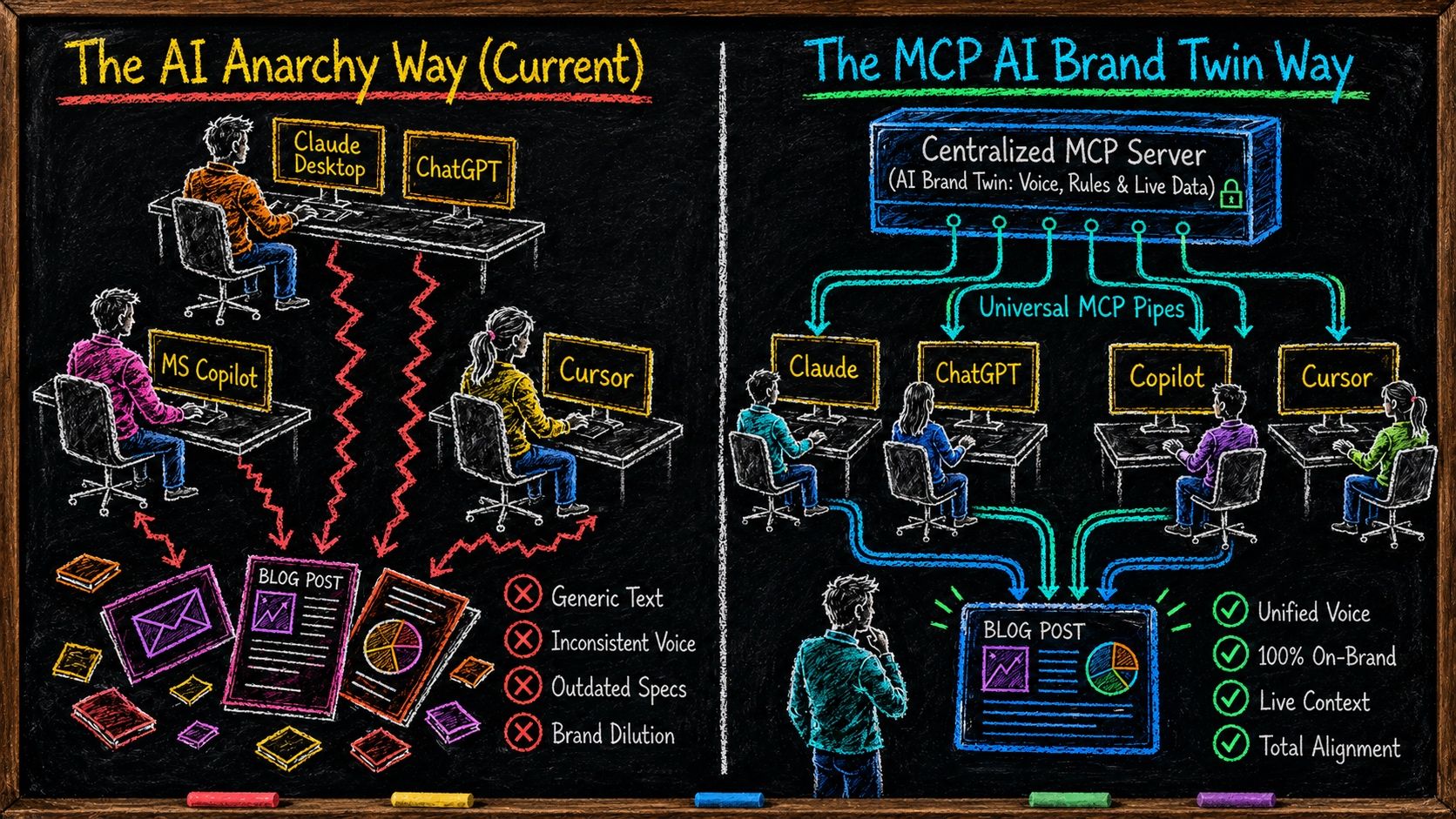
We serve our own framework this way through the Test Kitchen, the MCP server we shipped on August 17, 2026, and it runs three doors at three different prices.
| Door | Who it's for | What it opens | Cost |
|---|---|---|---|
| 1. Public | Anyone | Three Brand Signal Scores a month. No key, no signup. | Free |
| 2. Clinic | AI Workforce Clinic members | Full 19-criteria score breakdowns with fixes, all 31 Magnetic Messaging Framework templates, and every station on the Line. | First Clinic free, then $100 per month |
| 3. Private | Companies serving their own framework to their whole team | Your own server carrying your Magnetic Messaging Framework as an AI Brand Twin your whole team connects to. | $3,500 setup, first two months included, then $299 per month |
Door 3 is the one founders are usually asking about. Your own private server runs $3,500 to stand up, and that setup fee carries the first two months. After that it's $299 a month. The setup is where the real work sits, and it's the same work this whole article is about: splitting your framework into named units a machine can retrieve, then deciding what each tool hands back. The monthly keeps the server running and keeps it current as your positioning moves.
That $299 is a flat server fee rather than a per-seat license. Connect five people or fifty and the number doesn't move, and the framework underneath stays yours either way. A vendor who meters your own positioning by the seat is selling you a subscription to something you should already own. You should own the framework, own the documents, and be able to move the server if you ever fire us.
Why isn't it cheaper when the technology is nearly free?
Because the technology genuinely is nearly free, and that's the part almost nobody prices correctly.
Here's our own receipt. We shipped the PitchKitchen Test Kitchen server on August 17, 2026, live at mcp.pitchkitchen.com, with three tools on it. Standing the server up took an afternoon. Deciding what those three tools should return took weeks. Not weeks of engineering. Weeks of arguing about what we actually believe, what we refuse to say, and which version of our own positioning was true enough to hand to a machine that would repeat it to every person on the team.
“The server took an afternoon. Deciding what it should say took weeks, and that's the part you're paying for.”
That ratio holds for every client we've done this with. A Custom GPT or a Claude Project is a container. Loading a document into it is trivial. The expensive question is which document, and whether the document says anything a competitor couldn't have written.
This is the failure we call AI-Parmesan, sprinkling something that sounds advanced on top of a story that was never sharp to begin with. Point a well-built assistant at undocumented messaging and it produces on-brand-sounding copy at volume, consistently, in a voice nobody ever agreed to. That's harder to catch than plain drift, because it looks finished.
How long does it take, and where does the time actually go?
Ninety days, and the shape is consistent:
- 1Truth extraction. Interviews with you, your team, and your customers. This is the slow part and it should be.
- 2The Magnetic Messaging Framework. Roughly 35 sections covering who you're for, what you stand for, the story you tell, what you refuse to claim, and the vocabulary you use. This document is Layer 1 of the Twin.
- 3Building the three layers. The MMF loads as knowledge, the behavioral system prompt gets written and tested, and the Voice Spec gets drafted format by format against your real content.
- 4Revision against live output. Your team works with the Twin and the Voice Spec gets corrected wherever reality disagrees with it.
Anything that proves wrong in the first 60 days gets fixed as part of the engagement. After that it's quarterly tune-ups, because positioning moves and a Twin serving last year's proof points is worse than no Twin at all.
Founders who want the assistant faster can always have it faster. What they can't have faster is agreement, and an assistant built before the agreement exists just distributes the disagreement. We wrote the full readiness test in should we build an MCP server for our brand and messaging guidelines, and the gates apply to a Twin just as cleanly.
Is our messaging safe inside an AI Brand Twin?
This question comes up late in most buying conversations and it deserves a straight answer. Four things are worth asking any vendor who offers to train AI on your company, including us:
- Where does the knowledge physically live, and whose account owns it?
- Does your content get used to train the model provider's systems, and under which plan?
- Who inside your company can reach the assistant, and how does access get removed?
- What happens to the knowledge when the vendor relationship ends?
Our answers: we build the Twin on the platform you choose, inside your own workspace and under your own account, so the knowledge sits where your other company data already sits. The MMF is a document you own outright. Nothing about your strategy has to live in a PitchKitchen-hosted system for the Twin to run. Access follows your existing workspace controls, which means offboarding a person offboards their access the same way it does for any other tool.
The training and retention question belongs to your AI platform's terms rather than to us, and it varies by plan. Ask your provider directly and read the enterprise terms before you load anything sensitive. Any consultant who answers that question on the platform's behalf is guessing.
What exactly do we own at the end?
All three layers, in portable form. The MMF as a document, the behavioral system prompt as text, and the Voice Spec as a document with per-format rules. None of it is locked to one vendor's platform, which matters more than it sounds like it does, because the model you build on today probably isn't the one your team is using in eighteen months.
Teams that want the framework served to every tool at once rather than living in one assistant already have the answer above: put the same documents behind an MCP server. We covered that path in how we get every AI tool to follow one messaging framework, and the prerequisite is identical either way: the document has to be written in decisions rather than descriptions before a machine can do anything useful with it. That rewriting job has its own guide in making brand guidelines machine-readable.
How do we know it's working?
Traffic won't tell you, and neither will how impressive the demo felt. The measures that hold up are boring and countable: what percentage of first drafts survive editing, how long a new rep takes before they can explain the company without supervision, whether two people in separate rooms describe your position the same way, and how often someone catches a stale claim in a shipped asset.
If those four numbers don't move within a quarter of finishing, the Twin isn't the problem. The story underneath it is, and no amount of prompt engineering fixes a position the founders never actually settled. That's the whole reason we won't sell the assistant without the work that goes under it.
What this means for you
If you're comparing an AI Brand Twin against a cheaper tool that promises brand voice out of the box, you're comparing two different purchases. A tool hands you an empty container. The Sprint settles the decisions that make the container worth filling, then hands you that too.
The test is simple. If you and your co-founder can independently write the same sentence about who you're for and why you win, a lightweight setup might genuinely be enough for you. If you can't, an assistant will scale that gap across every draft your company ships, faster and more consistently than any human ever could.
Fixed price, $15,000 to $45,000. You own every layer.
Questions People Ask
FAQ
How much does an AI Brand Twin cost?
It ships as a core deliverable of the 90-Day Magnetic Messaging Sprint, a fixed-price engagement between $15,000 and $45,000 depending on scope. The price covers truth extraction, the Magnetic Messaging Framework, the homepage, the sales deck, and the Twin. You own everything at the end. It isn't sold as a standalone monthly subscription, because an assistant built on undocumented messaging distributes whatever it's given.
What does the MCP server cost on top of the AI Brand Twin?
The private server runs $3,500 to set up, and that fee carries the first two months, then it's $299 a month. It's a flat server fee rather than a per-seat license, so the number doesn't move as you connect more of your team, and the Magnetic Messaging Framework underneath stays yours. If you're not ready for a private server, our public Test Kitchen server is free for three Brand Signal Scores a month, and AI Workforce Clinic members get the full breakdowns, all 31 Magnetic Messaging Framework templates, and every station on the Line for $100 a month after a free first Clinic.
How long does it take to set up an AI Brand Twin?
Ninety days end to end. The assistant itself is built in days once the Magnetic Messaging Framework exists. Most of the time goes to truth extraction, interviews with you, your team, and your customers, and to the revision cycle where the Voice Spec gets corrected against real output. Anything that proves wrong in the first 60 days gets fixed inside the engagement, then it's quarterly tune-ups.
Is our company data safe inside an AI Brand Twin?
The Twin is built on the AI platform you choose, inside your own workspace and under your own account, so the knowledge sits where your other company data already sits, and access follows your existing workspace controls. The Magnetic Messaging Framework is a document you own outright. Whether your content trains the model provider's systems is governed by that provider's terms and varies by plan, so read the enterprise terms directly rather than taking a consultant's word for it.
What do we own when the engagement ends?
All three layers in portable form: the Magnetic Messaging Framework as a document, the behavioral system prompt as text, and the Voice Spec with its per-format writing rules. None of it is locked to a single vendor's platform, so the Twin can be rebuilt on a different model later without redoing the underlying messaging work.
Why not just paste our brand guidelines into ChatGPT instead?
A pasted prompt disappears when the chat ends, and most brand guidelines describe how things should look rather than how the company thinks. The Twin persists across sessions and teammates because the three layers live inside the assistant: strategic knowledge, standing behavioral guardrails, and per-format style rules. The deeper issue is that pasting only works if the document already contains decisions a machine can act on, which most brand books don't.