
How do we get every AI tool our team uses to follow our messaging framework?

By Greg Rosner
Founder of PitchKitchen · Author of StoryCraft for Disruptors
· 7 min read
TL;DR
A messaging framework only reaches your team's AI tools if a machine can query it. That means turning the document into decisions rather than descriptions, splitting it into named retrievable units (positioning, ICP, disqualifiers, competitors, proof, vocabulary), versioning it under one owner, then serving it over MCP so Claude, ChatGPT, Cursor and Copilot pull the current narrative mid-draft instead of guessing. The engineering takes days. Settling what's actually true takes weeks, and that's the real project. Measure first-draft acceptance, new-hire ramp, the two-room test and stale-claim incidents, not traffic.
You stop handing it to people and start serving it to machines. Concretely: take the positioning, the ICP with its disqualifiers, the proof points and the banned language out of the deck, and put them behind an MCP server, a live endpoint every AI tool your team uses can query mid-draft. The document stays for humans. The server is the copy the tools read, and it's the only version that gets followed at 4pm on a Thursday when someone's rushing an objection-handling email out the door.
What's actually going wrong when five people prompt five different ways?
Every person on your team is quietly re-summarizing your company each time they open a chat window. The rep types a version of what you do. The product marketer types a different one. The founder types the good one, because he's the only one who's said it out loud four hundred times. Each model fills whatever's missing with the industry average, which happens to be the same industry average your competitors get handed.
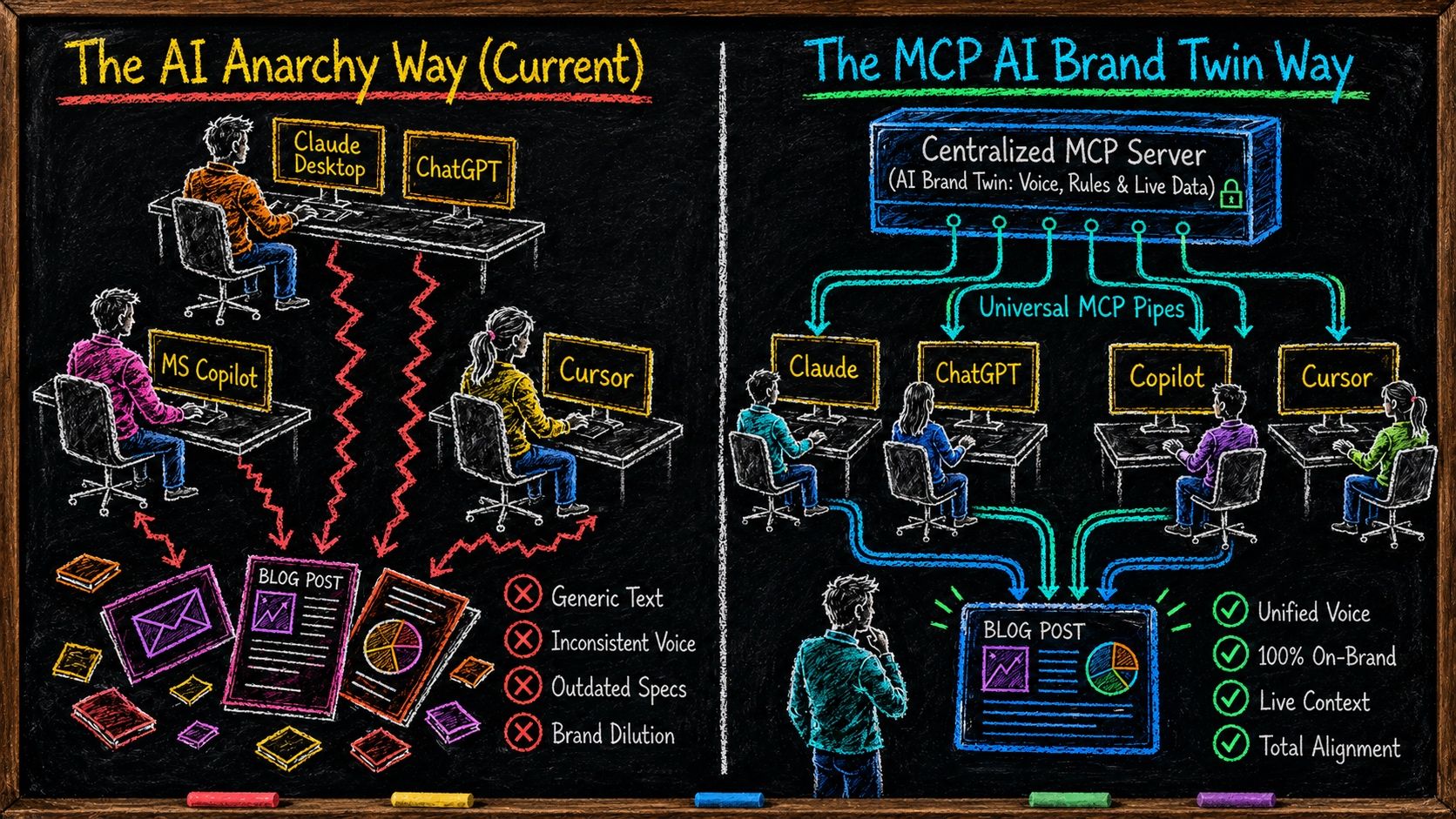
The left side of that picture is what most $5M-$75M companies are running right now, and nobody chose it. It happened because the framework is a 40-page document and the tool asked for context in a text box. Nobody's being lazy. They're compressing your narrative identity down to whatever fits, forty times a week, and the compression is different every time.
The cost shows up as rework. Your team writes with AI to go faster, then spends the saved hour dragging generic copy back toward something true. That's the tax you're already paying, and it's the number worth measuring before you scope anything.
There's a second cost nobody logs. Outdated specs travel. A pricing number from two quarters ago, a customer count that grew, a feature you sunset in March: each one sits in somebody's saved prompt and keeps shipping. Buyers catch it before you do, usually on a call, usually in the worst possible sentence.
What does a messaging framework have to become before a machine can use it?
A model can't act on atmosphere. "Bold, human, approachable" gives it nothing to do. Three changes turn a framework into something queryable.
First, decisions replace descriptions. Who you're for, and just as load-bearing, who you're not for. The named alternative buyers actually compare you against and the honest reason they pick you. The villain you name. Proof points with real numbers and the dates they were true. A model can execute a decision. It can only paraphrase a description.
Second, prose becomes retrievable units. One claim per unit, each under a name a tool can ask for: positioning, ICP, disqualifiers, competitors, proof, vocabulary, offers. A writer drafting a cold email needs three of those, not all thirty-five. Retrieval beats recitation, and it's cheaper on context.
Third, the whole thing gets versioned and owned. Dated, single editor, one place. The moment two edited copies exist, you've rebuilt the original problem with better technology. This is the same discipline behind a Voice Spec your team and your AI will both follow, applied one layer down at the source.
How do we turn our framework into an MCP server?
Four steps, and only one of them is engineering.
| Step | What happens | Who does it | Honest timeline |
|---|---|---|---|
| 1. Settle the narrative | Positioning, ICP with disqualifiers, competitive truth, proof points and the kill list get argued to a conclusion and written down. This is the Magnetic Messaging Framework. | Founder, CRO, product marketing | Weeks, and it's the whole job |
| 2. Structure it for retrieval | The document gets split into named, queryable units with one claim each, so a tool can pull positioning without pulling the mission statement. | Whoever owns the framework | Days |
| 3. Serve it over MCP | A small server exposes those units as tools and resources at a URL. Private for client-specific brains, public if you want anyone to reach it. | One developer | Days, genuinely |
| 4. Connect and default it | One line in each tool's config. Then the harder part: make querying it the reflex, and stop accepting drafts that skipped it. | Team leads | One afternoon, then a quarter of habit |
We built ours, so this isn't a diagram we admire from a distance. PitchKitchen's Test Kitchen went live on August 17, 2026 at mcp.pitchkitchen.com. It exposes three tools any AI client can call: score a homepage with the Brand Signal Score, pull the MMF template, and run THE LINE. Sprint clients get a private server carrying their own AI Brand Twin instead of ours. The engineering took days. What took real time was pinning down which sentence was actually true, which is exactly where it should hurt.
What does this actually change on a normal Tuesday?
A rep is drafting a follow-up to a prospect who just said the dreaded "we'll keep doing what we're doing." Without the server, he pastes in whatever he remembers, the model writes a competent paragraph about efficiency and scale, and he sends something a hundred other vendors could have sent. Nothing is wrong with it. Nothing in it is yours either.
With the server, the same tool pulls the named alternative that prospect is actually comparing against, the disqualifier that tells the rep this deal is real, the villain you name and the two proof points with dates attached. The draft comes back arguing your position. He edits a line and sends it. That gap, repeated across everyone writing customer-facing language every week, is the entire return on this.
What belongs on the server, and what stays off it?
Put on it anything a writer would otherwise guess at: the positioning sentence, the ICP and its disqualifiers, named competitors with the honest reason buyers choose you, proof points carrying numbers and dates, the vocabulary you refuse to use, and format rules for the pieces your team writes weekly.
Leave off the mission statement, the visual identity rules, and the adjective cloud. A model drafting a follow-up email has no use for your hex codes, and aspirational adjectives give it permission to generate the same beige paragraph every other company gets. Everything you add that isn't a decision dilutes the things that are.
How do we know it's working?
Watch four things, none of which are traffic. First-draft acceptance: how often a piece of AI-assisted copy survives review without a rewrite. New-hire ramp: whether someone in week one produces language a founder recognizes. The two-room test: two people, separately, writing one sentence on who you're for and why you win, and the sentences matching. Stale-claim incidents: how often a number from last year escapes into a live deck.
Baseline them before you build. Ask three people to draft the same email today and keep the results. Run the two-room test cold and write down both sentences. Those two artifacts take an hour, and they're the only honest before-picture you'll get, because once the server is live everyone remembers the old way as worse than it was.
One honest boundary. A brand MCP server is internal plumbing your team's tools query. It doesn't change what ChatGPT tells a stranger about you, because buyers asking for recommendations never touch it. That's a public-surface problem, and it comes back to why AI engines describe you the way they do. Any vendor who blurs those two together is selling you one thing and pricing it as both.
What this means for you
The picture at the top of this page has a left side and a right side, and moving between them is one decision plus one afternoon of configuration. What separates the two isn't the protocol. It's whether there's a settled narrative worth broadcasting, because the server will distribute whatever you hand it with perfect consistency, including confusion.
If your framework is real and your team still writes off it half the time, you have an enforcement problem and the server fixes it. If two people in separate rooms would write two different companies, build the framework first. The decision guide for that call sits in should we build an MCP server for our brand and messaging guidelines.
Questions People Ask
FAQ
How do I turn my messaging framework into something every AI tool my team uses can follow?
Structure it so a machine can retrieve it, then serve it over MCP. Split the framework into named units carrying one decision each (positioning, ICP with disqualifiers, competitors, proof points, banned vocabulary), version it under a single owner, and expose those units at an endpoint your tools query. Claude, ChatGPT, Cursor and Copilot connect with one config line and pull the current narrative mid-draft.
Can't we just paste the framework into a custom GPT and be done?
That works for one tool and one person's habits. It breaks when the framework changes, because every pasted copy is now a stale fork, and it breaks the moment someone drafts in a different tool. A server gives you one copy that updates everywhere at once, which matters more as the number of writers grows.
How long does this take and who has to be involved?
The engineering is a few days for one competent developer, and connecting each tool is a single config line. The long pole is settling the narrative: positioning, disqualifiers, competitive truth and proof points argued to a conclusion by the founder, the CRO and product marketing. That's weeks, and it's the part that determines whether any of this helps.
What shouldn't go on a brand MCP server?
The mission statement, the visual identity rules and the adjective cloud. A model drafting a follow-up email has no use for hex codes, and adjectives like bold or approachable let it generate the same generic paragraph every company gets. Every non-decision you add dilutes the decisions.
Will this change how ChatGPT describes our company to buyers?
No. A brand MCP server is internal infrastructure your own team's tools query. Buyers asking an AI engine for recommendations never reach it. How engines describe you publicly comes from what they find on your public pages, which is a narrative identity problem rather than a protocol one.