
What's the best way to give ChatGPT and Claude our brand voice permanently?

By Greg Rosner
Founder of PitchKitchen · Author of StoryCraft for Disruptors
· 7 min read

TL;DR
Nothing inside ChatGPT or Claude is permanent the way founders mean it. The durable answer is an AI Brand Twin served over an MCP server: your brand truth lives where you control it, and every assistant your team opens fetches it live. That's what we build at PitchKitchen. Rank the alternatives by what survives a new chat, a new hire, a model upgrade and a vendor switch. Account-level custom instructions and memory clear only the first. Projects clear it inside their own folder. A shared Custom GPT or Claude Project clears three. Only the MCP route clears all four. The Twin is three layers: knowledge, behavior, and per-format style. Whichever mechanism you pick, the file is the work.
Nothing inside ChatGPT or Claude is permanent in the way founders mean it. Both products give you several places to store your brand, and each place has a different lifespan. The useful question is which one survives four things: a new chat, a new person on the team, a model upgrade, and the day you switch vendors. Only one mechanism clears all four, and it lives outside both products.
Here's the part that costs companies the most. Every one of these mechanisms stores what you hand it with perfect fidelity. Hand it five tone adjectives and a logo rule, and the model will faithfully reproduce a company that hasn't decided anything, forever, in every chat, for everyone. Permanence turns out to be the easy half. What you're making permanent is the hard half.
Here's the short answer before the comparison. The durable version of this is an AI Brand Twin served over an MCP server: your company's narrative identity written down once, kept where you control it, and fetched live by ChatGPT, Claude and every other assistant your team opens. That's what we build at PitchKitchen, and it's the only option on this page that clears all four tests below. Everything else is a setting that solves one of them and breaks on the next.
What does "permanent" actually mean when we say it about an AI tool?
Founders mean one of four things when they ask for permanent, and the four have completely different answers.
- 1Survives a new chat. The next blank window still knows who you sell to and what you argue.
- 2Survives a new person. Your marketing hire gets the same brand on day one without asking anyone for a doc.
- 3Survives a model upgrade. The vendor ships a new model in March and your drafts don't quietly change register.
- 4Survives a vendor switch. Half the team moves to Claude, engineering stays in Copilot, and the brand goes with them.
Most of the advice online solves the first one and stops. A setting you configured on your own account is invisible to the eleven other people writing in your company's name, which makes it a personal convenience rather than a brand decision.
Which ChatGPT settings actually hold our brand voice?
ChatGPT gives you four places, in ascending order of durability. Custom instructions sit at the account level and apply to new chats. They're the fastest thing you can do this morning, and they travel with you and nobody else.
Memory saves facts as it notices them, summarized in the model's words rather than yours. That makes it good at remembering you prefer bullet points and unreliable as the place your positioning lives. You don't control what it keeps or how it paraphrases what it kept.
Projects are a real step up. A project holds its own instructions plus uploaded files, and every chat inside it draws on both. The brand stops living in your head and starts living in a folder. The limit is scope: a project governs the chats inside it, so anyone drafting outside that folder is back to the average of the internet.
Custom GPTs are the strongest option inside ChatGPT. You get an instructions field, knowledge files, and the ability to share the result with the whole company. That combination is the closest thing ChatGPT has to an install, and it's where the stack behind how AI training on brand messaging actually works becomes something you can point at: knowledge file, instructions field, style guidance you attach per task.
Which Claude settings hold it?
Claude's shape is similar with different names. Personal preferences behave like account-level custom instructions, with the same ceiling. Projects carry project knowledge, meaning the documents plus standing instructions every chat in that project reads, and on shared plans a project is something the whole team opens rather than something one person quietly configures.
Styles are Claude's distinctive one. A style captures how your writing sounds, learned from samples you paste in, and you switch it on per conversation. It's genuinely good at rhythm and register. It will also write beautifully in your cadence about a position your company never took.
Connectors change the category, and this is where the answer stops being a settings page. Claude connects to MCP servers, MCP being the open standard an assistant uses to fetch live context from somewhere you control while it drafts. Your brand stops being a copy sitting inside one vendor's product and becomes something every assistant reads from a single source. ChatGPT, Gemini, Perplexity, Copilot and Cursor read the same standard, which is why this is the only option on the page that survives a vendor switch. Setting one up so Claude writes in your brand voice walks through the mechanics, and whether you should build one at all covers the decision.
How do the options compare on the four tests?
| Where the brand lives | New chat | New teammate | Model upgrade | Vendor switch |
|---|---|---|---|---|
| ChatGPT custom instructions | Yes | No | Yes | No |
| ChatGPT memory | Partly, in its words | No | Yes | No |
| ChatGPT Project | Inside that project | Only if shared | Yes | No |
| Custom GPT (instructions + knowledge files) | Yes | Yes, when shared | Yes | No |
| Claude personal preferences | Yes | No | Yes | No |
| Claude Project (project knowledge) | Inside that project | Yes, on shared plans | Yes | No |
| Claude Style | Only when selected | Yes, when shared | Yes | No |
| A source your tools fetch (connector or MCP server) | Yes | Yes | Yes | Yes |
Which one should we actually pick?
Two honest answers, depending on how much time you have.
If you want the version that holds up, serve that file from an MCP server your tools connect to. One source, many readers, and it still works after a model upgrade, after the person who set it up leaves, and after you switch vendors. Hand the link to everyone who writes anything a customer reads, including the people using AI you never licensed. Getting every AI tool your team uses onto the same framework is the operational version of that step.
If you want the version that holds up, serve that file from one place your tools fetch. One source, many readers, and it still works the week half your team moves products. That's the argument in getting every AI tool your team uses to follow one framework, and it's why copies-in-both-places is a starting position rather than a destination.
Why does the output still sound generic after we install all this?
Because the storage was never the problem. A model writes generic B2B copy when it has nothing specific about your company to write from, and every option above is perfectly faithful to whatever you handed it. Upload a brand book made of adjectives and you'll get adjectives back, permanently, at scale, in your own cadence. That's the mechanism behind generic strategy advice from ChatGPT, and making it durable makes it louder.
The test is whether your file contains decisions. Who you're for, said narrowly enough that it excludes somebody. Who you're not for, named out loud. The problem you say the market has. The argument you're making that your competitors haven't accepted. Proof, with permission status attached to each piece. Those are positions, and they're what narrative identity means in practice. A model can't pick a position your company never took.
What goes in the file, and what it's called
Three layers, and the order matters more than the format. This stack has a name. We call it an AI Brand Twin: an assistant that holds your company's actual narrative identity rather than the average of your category.
- 1Knowledge. Your strategic narrative: positioning, ICP, disqualifiers, the villain you name, competitors, proof. This is the layer teams skip, and it's the one that decides whether the draft is worth reading.
- 2Behavior. The standing rules: what the assistant always does, what it refuses to say, when it asks instead of guessing, and the vocabulary detox list with a reason attached to each banned word.
- 3Style. Format by format, not a mood board. Length, opening, point of view, structure, close, and the constructions this brand doesn't use.
Layer one is knowledge, and for us that's the Magnetic Messaging Framework, roughly 35 sections carrying the decisions. Layer two is behavior, the system prompt that governs what the assistant refuses to claim and how it handles a gap. Layer three is style, the per-format rules. Most companies upload layer one, skip the other two, and then wonder why the output reads like a competent stranger describing them.
Where you keep the Twin decides who gets to use it. A Custom GPT keeps it inside one vendor and reaches whoever you share the link with. An MCP server keeps it with you and reaches every assistant your team actually opens, which is never the single one you licensed.
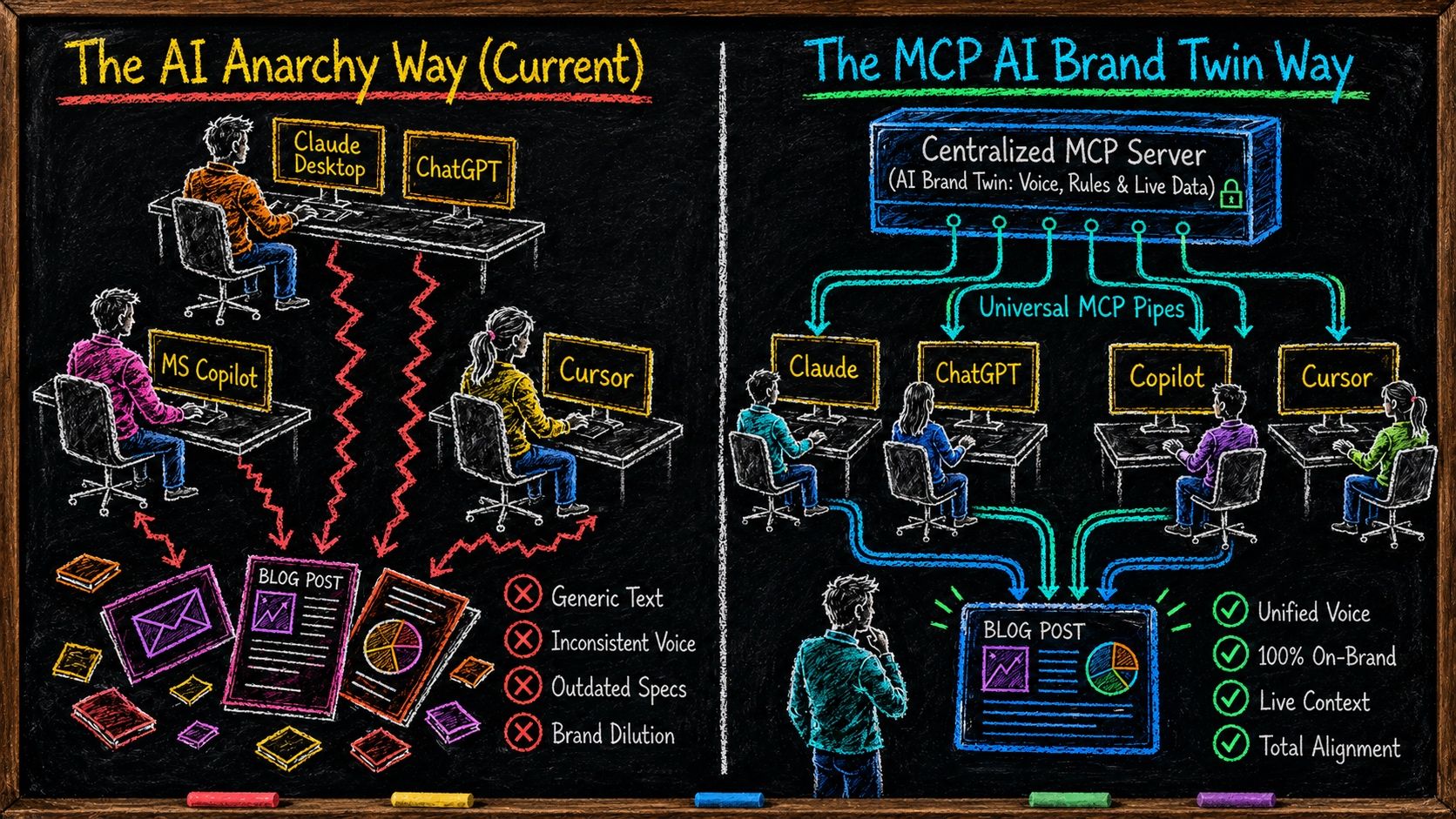
You can see this running. We serve our own framework through the Test Kitchen, the public MCP server carrying PitchKitchen's brand truth. The same pattern applied to a client's own team is covered in rolling out an AI Brand Twin so your team actually uses it, and if your guidelines aren't in a shape a machine can act on yet, making brand guidelines machine-readable is the step before any of this. For the automated-outreach lane specifically, keeping brand identity intact when sales outreach is automated covers what changes.
For a sense of scale, here's ours. Our voice spec covers 15 named formats, each with its own length, opening, point of view, register, structure, close and banned constructions, because a blog post and a cold email have nothing in common except the company sending them. A testimonial gets a 50-word ceiling. A cold email gets 60 to 90 words and a list of forbidden openers. Behind that sits a Magnetic Messaging Framework of 31 templates, and the Test Kitchen server we shipped this month serves them to Claude, ChatGPT and Cursor from one URL. Standing up the server took an afternoon. Deciding what each template should return took weeks. That ratio has held for every company we've built one with.
With only the style layer you get a voice guide your team will actually follow and output that sounds right while saying nothing. With only the knowledge layer you get correct positioning in a register nobody at your company recognizes. Both, in that order, is what makes the install worth the setup. Turning the documents you already have into something a machine can act on is covered step by step in making brand guidelines machine-readable.
What this means for you
Pick the most durable mechanism you can stand up this week, then spend your real time on the file. The permanence question has a clean technical answer that takes an afternoon. The question underneath it, what your company actually stands for and who it refuses to serve, is where every hour of quality difference lives.
If you want to know what an engine currently has to work with, the Brand Signal Score grades your homepage against the 19 signals AI engines read, free, in about five minutes. It's a fast way to find out whether the thing you're about to make permanent says anything at all.
We settle the story first, then make it permanent in your team's AI.
The companies getting real work out of these tools settled who they are first, then chose where to keep it. Do it in that order and permanence stops being the interesting question.
Questions People Ask
FAQ
Can ChatGPT remember our brand voice permanently?
Not on its own. Custom instructions apply to your new chats and only to your account. Memory stores facts in the model's own summarized words, so you don't control what's kept. For something that holds across the team, use a shared Custom GPT with a knowledge file, or serve your messaging from a connector both ChatGPT and Claude can fetch.
Is a Custom GPT or a Claude Project better for brand voice?
They're close to equivalent, and the real choice is where your team already works. A Custom GPT gives you an instructions field plus knowledge files and shares company-wide. A Claude Project gives you project knowledge plus standing instructions and shares on team plans. Running both means keeping two copies in sync, which is the argument for one fetched source instead.
What's the difference between an AI Brand Twin and just uploading our brand guide?
An uploaded brand guide is one layer. An AI Brand Twin is three: the knowledge (your narrative identity and messaging framework), the behavior (a system prompt covering what it refuses to claim and how it handles questions your document doesn't answer), and the style (per-format writing rules, since a cold email and a case study aren't the same job). Companies that upload only the first layer get an assistant that knows facts about them and still writes like everyone else in their category.
Do we need an MCP server, or is a knowledge file enough?
A knowledge file is enough to get started and it clears the first three tests: a new chat, a new person, and a model upgrade. It doesn't clear the fourth. The file lives inside one vendor's product, so a team on four different assistants needs four copies that drift apart, and switching vendors means rebuilding. An MCP server keeps one copy with you and lets every assistant fetch it, which is why it's the version we build for clients who want their whole team writing on brand rather than the three people who remember to open the right tool.
Why does the output still sound generic after we upload our brand guide?
Because most brand guides describe rather than decide. Tone adjectives, color rules and mission language give a model nothing specific to write from, so it fills the gap with the average of every B2B company. Add the decisions: your ICP with explicit disqualifiers, the problem you name, the argument competitors haven't accepted, and sourced proof.
What should we load first if we only have an afternoon?
One page of decisions beats fifty pages of description. Write who you're for, who you're not for, the problem you say the market has, the argument you're making, three proof points with permission status, and a banned-words list with reasons. Load that as a knowledge file in a shared Custom GPT and as project knowledge in a shared Claude Project.