
How do we roll out an AI Brand Twin so our team actually uses it?

By Greg Rosner
Founder of PitchKitchen · Author of StoryCraft for Disruptors
· 7 min read
TL;DR
Installing an AI Brand Twin takes about a week of technical work and about a quarter of organizational work. The three layers land in three different places: Knowledge on a central server your tools query, Behavior inside each tool's own instructions, and Style loaded per writing task. The MCP server is the doorway that decides whether the rest of it gets used, because it lets anyone reach the Twin from the tool they already have open and it stops a model from inventing brand facts by giving it something to retrieve instead of remember. Connect surfaces in descending order of how many unreviewed sentences they send to buyers, which usually means sales before marketing before product docs. Name one owner with authority to settle what's true. Rollouts stall when the server returns adjectives instead of decisions, when nobody told the team what changes about their job, or when the story was never settled and the tooling scales the disagreement.
Rolling out an AI Brand Twin takes about a week of technical work and about a quarter of organizational work, and the second number decides whether it sticks. The install lands in three different places at once: the knowledge sits on a server your tools query, the behavior sits inside each tool's own instructions, and the style rules get loaded per writing task. Treat it as one software deployment and you end up with a connected server nobody opens.
Founders ask this question after the hard part is supposedly finished. The Magnetic Messaging Framework is written, the positioning is settled, somebody has stood up an endpoint. Then the drafts coming out of the team still sound like the average of the internet, and the natural conclusion is that the technology didn't work. Usually the technology worked fine and the rollout never happened.
What are we actually installing?
An AI Brand Twin is three stacked layers, and the reason rollouts half-work is that the layers don't live in the same place. One is central and versioned. One gets copied into every tool and quietly drifts. One only shows up when somebody asks for it. Knowing which is which tells you where your rollout will break.
- Knowledge. Your narrative, ICP, disqualifiers, proof, and vocabulary, served from one endpoint with one owner. This is the layer that can genuinely be centralized.
- Behavior. The rules and guardrails that shape how the model responds, which live inside each tool's system prompt or project instructions. Copied by hand into Claude, ChatGPT, Copilot and Cursor, then edited by whoever felt like editing.
- Style. Format-by-format writing rules for a cold email, a case study, a deck, a homepage. Loaded on demand, which means it only works when somebody remembers it exists.
Most failed installs are a Knowledge layer with nothing on top of it. The server answers correctly when you query it directly, and every tool still writes generic copy, because nothing told the tool when to ask. A rollout plan is mostly a plan for layers two and three, which sits downstream of getting every AI tool to query the framework at all.
Why is the MCP server the doorway everyone walks through?
Rollout is a distribution problem before it's a training problem. Five people prompting five different ways get five different companies on the page, and every one of them believes they're on brand. That's AI anarchy: each person pulling from their own chat window, shipping generic text in an inconsistent voice off specs that went stale two quarters ago.
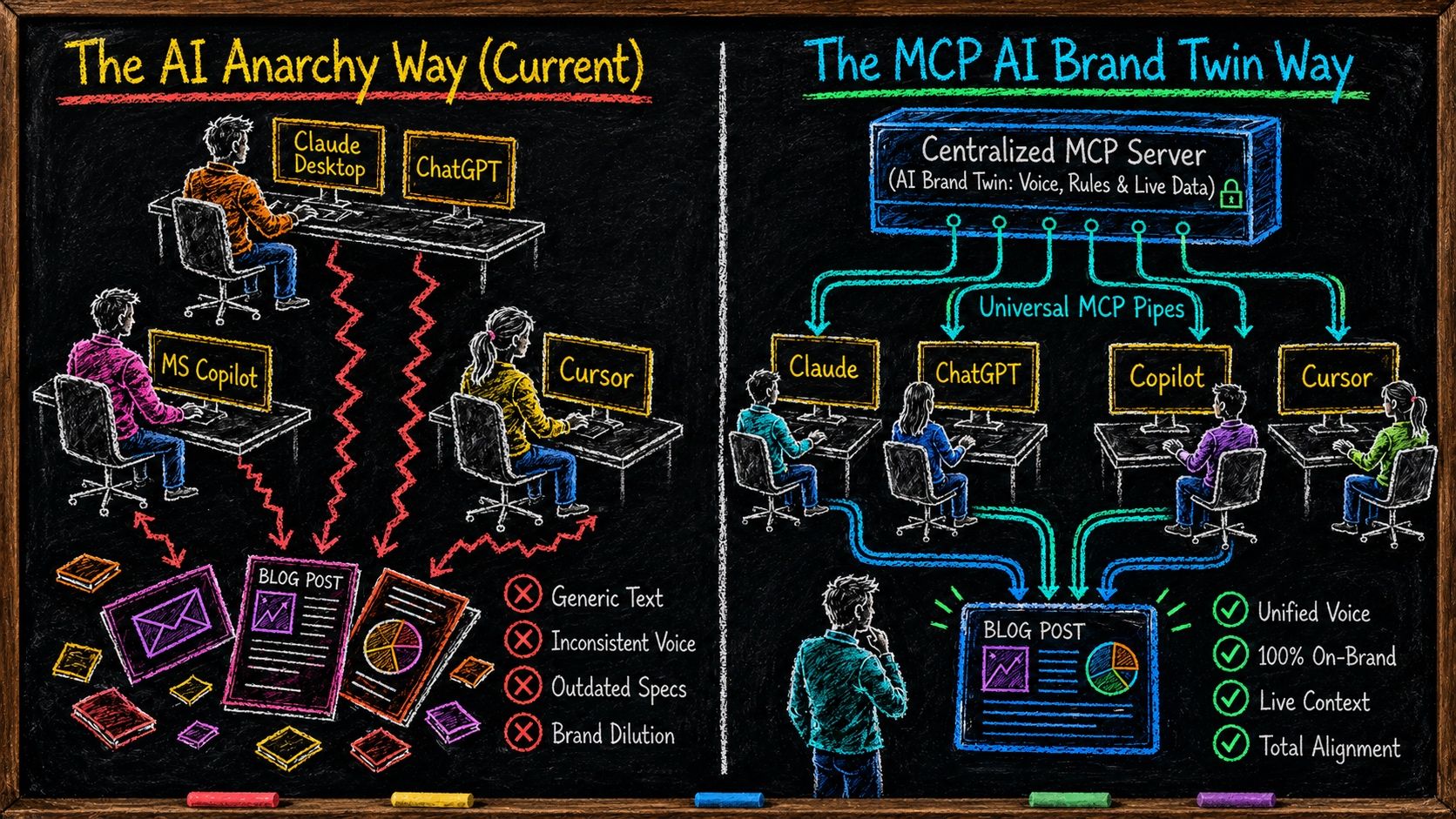
The left side of that picture is what most teams are living in right now, and no amount of training fixes it, because the problem isn't that people are prompting badly. It's that there's nothing authoritative for them to prompt against. The right side is one MCP server carrying your voice, your rules, and your live data, and every tool your team already uses connects to it: Claude, ChatGPT, Cursor, Copilot, Claude Code.
This is also the mechanism that stops the drift. When a model has no source to reach for, it fills the gap from memory and training data, which is exactly how a rep's assistant confidently ships a tagline you retired in March or a positioning claim you never made. A server changes the model's job from remembering to retrieving. It stops guessing about your company because it can look your company up, and every answer comes from the same current copy rather than from whatever each person pasted into their project six weeks ago.
One doorway also means one correction. When you sharpen the ICP or kill a claim, you change it in one place and every connected tool is current on the next query. Compare that to the copy-paste world, where a fix reaches whoever happens to re-paste the document, and the other lanes keep confidently shipping the old story.
Which AI tools should we connect first?
Connect the surface where the most wrong words reach a buyer, not the surface that's easiest to wire. For most $5M-$75M B2B companies that ordering puts sales first: outbound email, follow-ups, and proposals produce more customer-facing sentences per week than marketing does, and each one lands in front of a single named person who's deciding whether you understand their problem.
Marketing content comes second, because it's higher-volume but lower-stakes per unit and it already passes through an editor. Product docs, help content, and in-app copy come third. Internal tools come last, and some of them never need it at all. A rollout that starts with the engineering team's Cursor instance because that's where the technically curious people sit will be technically successful and commercially invisible.
Who owns it once it's live?
One named person, with the authority to settle an argument about what's true. Not a committee, not the marketing team collectively, and not whoever built it. When the sales team says the ICP is wrong and the founder says it isn't, somebody has to write the sentence that both of them then work from. A Twin with three editors becomes three Twins inside a month.
The weekly job is small and unglamorous. Read what the Twin produced. Find the places it was confidently wrong. Decide whether the fix belongs in Knowledge (the position changed), Behavior (the guardrail was missing), or Style (the format rule was too loose). Then make the edit in one place. That loop is the whole maintenance burden, and skipping it is how a Twin turns into a snapshot of what you believed last spring.
Why do most rollouts stall in the first month?
Three patterns account for nearly all of it, and only one of them is technical.
- 1The server returns adjectives instead of decisions. Tone words like confident and approachable give a model nothing to act on, so it fills the gap with the average of every B2B company. Machine-readable guidelines carry a trigger, an action, a real example, and a condition they can fail.
- 2Nobody told the team what changes about their job. People were handed a connector and no new habit. The rep who used to paste a doc into ChatGPT keeps pasting the doc, because that workflow still works well enough and nobody asked him to stop.
- 3The story wasn't settled before it got distributed. Two leaders would still write two different positioning sentences, and now both versions are being served at machine speed to every tool in the company.
That third one is the expensive failure, and it's the reason we treat an install as a narrative identity project rather than an IT project. A server distributes whatever you give it. Feed it an argument your leadership team hasn't actually won and you get consistent, well-formatted, confidently-worded drift, which is much harder to spot than the messy kind. The tooling makes an unsettled message worse, not better.
“A brand twin doesn't decide what you stand for. It scales the decision you already made, including the one you thought you made and didn't.”
How do we know the rollout worked?
Adoption signals beat quality scores here, because a Twin producing beautiful copy that nobody queries has failed. Watch behavior rather than output for the first two months, and watch it per team instead of in aggregate, since one enthusiastic marketer can hide a sales org that never touched it.
- What share of customer-facing drafts now start from the Twin instead of a blank prompt. This is the number that matters most in month one.
- Whether people have stopped pasting the messaging doc into chat windows. That habit dying is the clearest sign the server replaced it.
- Whether anyone corrects the Twin. A Twin nobody argues with is a Twin nobody uses, and silence in the first month is a warning rather than a pass.
- How long a new hire takes to write something on-narrative without a review cycle. This one moves slowly and tells you the most.
What do the first 90 days look like?
We build the Twin inside the 90-Day Magnetic Messaging Sprint, and the deployment runs on a published schedule rather than a handoff. The shape holds up whether or not we're the ones doing it.
- 1Weeks 1 to 6: truth extraction and the framework. Nothing gets installed yet, because there's nothing settled to install. This is where the arguments happen.
- 2Week 7 or so: the technical install. Endpoint stood up, access tiers decided, first surface connected. Connecting a tool like Claude is a four-minute job once the server returns the right things. This part is measured in days, not weeks.
- 3Weeks 8 to 12: team training on the highest-exposure surface, then the next one. People learn what the Twin is for, and just as usefully what it isn't for.
- 4The following 60 days: tuning. The Voice Spec gets revised against real output, and anything that proves wrong gets fixed. After that it moves to quarterly tune-ups.
What this means for you
If you already have a Twin sitting unused, the fix almost certainly isn't more engineering. Ask which of the three layers actually made it into the tools your team opens every morning, name a single owner, and pick the one surface where wrong words are costing you the most. If you haven't built one yet, the sequencing above is the argument for settling the story first, because a rollout can only distribute the clarity you brought to it.
Not sure whether your narrative is settled enough to install anywhere? The Brand Signal Score runs 19 criteria against your homepage and shows you what a machine can and can't currently tell about who you're for and what you believe. It's the cheapest version of this diagnostic, and it takes minutes.
Questions People Ask
FAQ
How long does it take to deploy an AI Brand Twin across a team?
The technical install is measured in days: standing up the endpoint, deciding access tiers, and connecting the first tool. Team adoption runs about a quarter. We install inside the 90-Day Sprint at roughly week seven, train on the highest-exposure surface through week twelve, then tune the Voice Spec against real output for the following 60 days before moving to quarterly tune-ups.
Which AI tools should we connect to our brand twin first?
Order by how many unreviewed sentences each tool sends to buyers. That usually puts sales first, since outbound email, follow-ups and proposals reach a named decision-maker without passing an editor. Marketing content comes second, product and help documentation third, internal tools last. Starting with whichever tool is easiest to wire tends to produce a technically successful rollout that no buyer ever sees.
Who should own the AI Brand Twin after it goes live?
One named person with authority to settle disagreements about what's true, not a committee and not necessarily whoever built it. The weekly job is reading what the Twin produced, finding where it was confidently wrong, and deciding whether the fix belongs in the Knowledge layer, the Behavior layer, or the Style layer. A Twin with three editors becomes three Twins within a month.
Why isn't our team using the brand twin we already built?
Three causes account for most of it. The server may be returning tone adjectives rather than decisions a model can act on. The team may have been handed a connector without being told what changes about their daily workflow, so old habits like pasting a doc into a chat window survive. Or the underlying positioning was never settled, in which case the Twin is faithfully distributing a disagreement and people can feel that the output is off without being able to name why.
Does rolling out a brand twin require an MCP server?
Not strictly, but it's the difference between a Twin that gets used and one that gets remembered. The Knowledge layer can live in a custom GPT knowledge file or a Claude Project for a small team. An MCP server matters once several tools and several people need the same current answer: it removes the copy-paste step, gives you one place to version the truth, and stops a model from filling gaps from memory, which is where retired claims and invented positioning come from. It's also what lets anyone reach the Twin from the tool they already have open.