
What is an AI Brand Twin, and how does it shape what AI engines say about us?

By Greg Rosner
Founder of PitchKitchen · Author of StoryCraft for Disruptors
· 8 min read
TL;DR
An AI Brand Twin is a documented version of your company's story, voice, and rules for what it will and won't say, built so your own AI tools and the public AI engines work from the same source. It has three layers: knowledge (your Magnetic Messaging Framework), behavior (guardrails and tone), and style (format rules). Three narrators describe your company to buyers: your team, your AI tools, and the buyer's AI. You supervise one. The engines never read the Twin. They read the consistency it produces across every page, and consistency is what compression keeps. Decide what's true, write it down once, and let all three narrators read from it.
Ask ChatGPT what your company does, then read the answer next to your homepage.
For most founders the two don't match. The engine describes a slightly more generic company than the one you run, in a category you didn't pick, next to competitors you didn't choose. And that description reaches buyers before your rep does.
An AI Brand Twin is the fix at the source. Here's the definition, then how it changes what the engines say.
What is an AI Brand Twin?
An AI Brand Twin is a documented version of your company's story, voice, and rules for what it will and won't say, built so your own AI tools and the public AI engines work from the same source. It has three layers: knowledge, which is your Magnetic Messaging Framework; behavior, which is the guardrails and tone rules; and style, which is the format-by-format writing rules.
The build details are in what is an AI Brand Twin, and how do you build one, and the price is in what does an AI Brand Twin cost. This article is about the part those two don't cover: the Twin's effect on the machines you don't control.
A Twin is a source you write. Everything that speaks for you reads from it.
Who is telling your story right now?
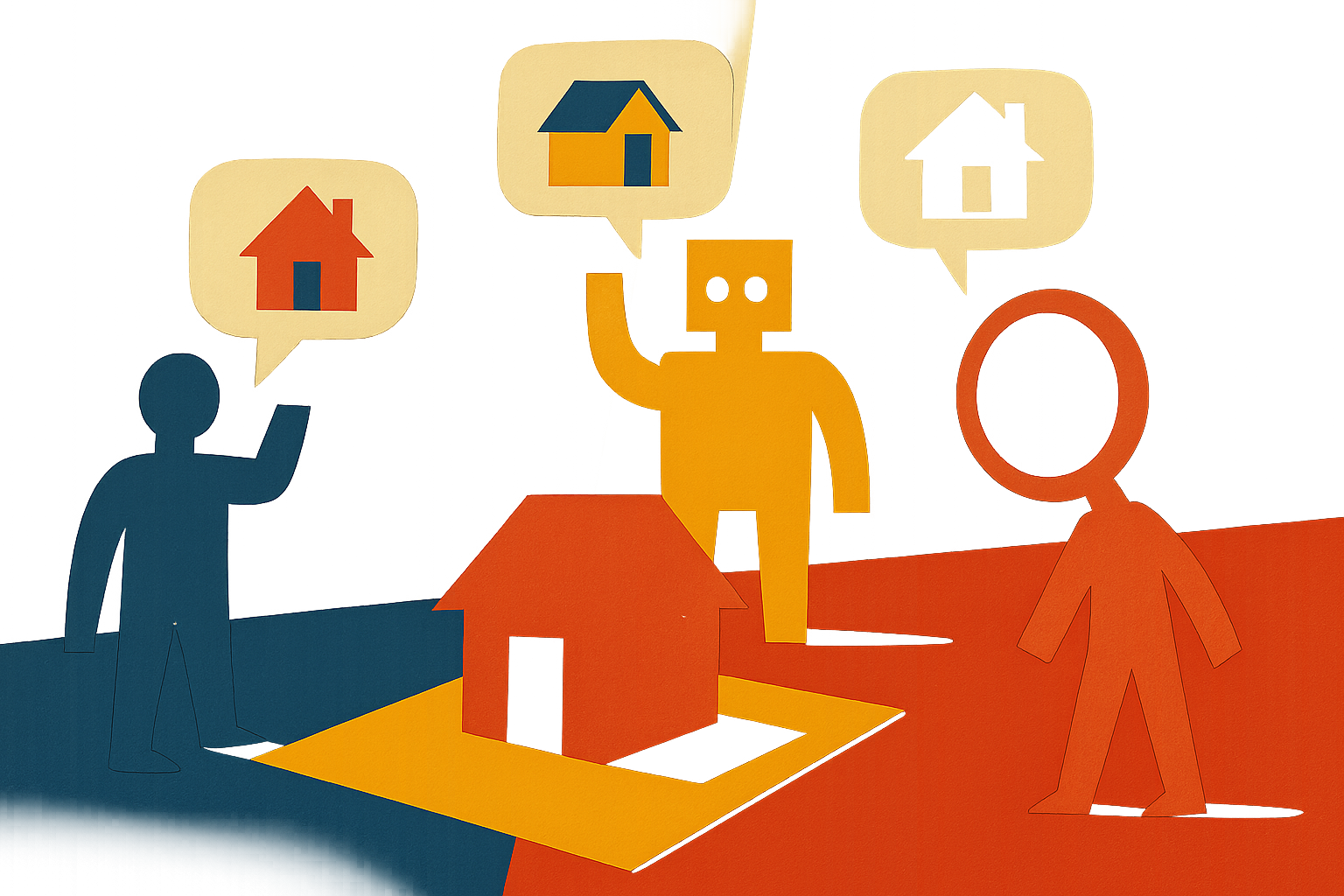
Three narrators describe your company to buyers every week, and you only supervise one of them.
- You and your team. Founder, reps, marketing. You know the story and you finish it live, reading the room.
- Your AI tools. Every draft your team pulls from ChatGPT, Claude, or Gemini starts from whatever context that tool has, which is usually a paragraph pasted into a prompt. The output sounds like the average of the internet with your name swapped in.
- The buyer's AI. When a prospect asks an engine about you, it compresses everything public into two sentences. It keeps what's specific and consistent, and it throws away what's vague. If your pages are vague, it substitutes the category average.
Three narrators, one company, and only the first one has read your framework. That's why the answers disagree.
Gartner's May 2026 survey of 645 B2B buyers found 45 percent used generative AI to research vendors. The third narrator is already in the room, and it's working from whatever it could find.
How does an AI Brand Twin change what AI engines say about us?
Let me be precise here, because the mechanism gets oversold.
Public AI engines don't read your Twin. They can't. They read what you publish and what other people publish about you. The Twin changes what the engines say by changing what they find: every page, every service description, every article, every rep's follow-up email now says the same thing in the same words, because they were all written from one source.
Compression rewards consistency. When an engine reads forty pages that all name the same buyer, the same problem, and the same category, it keeps that. When it reads forty pages written by different people in different years, it keeps nothing specific and falls back to the average. We laid out the compression problem in why does AI describe our B2B company inaccurately.
Here's the receipt from our own house. We wrote PitchKitchen's framework in 2026, built the Twin on it, and published roughly 250 answer-shaped pages from that one source. We track 50 real buyer questions across ChatGPT, Gemini, and Google AI Overview. Over the trailing 30 days, PitchKitchen holds 24.4 percent visibility in Google AI Overview across its 13-brand field, against 17.6 percent for the best-known positioning consultant in the category.
Those pages did that. And the Twin is why 250 pages by three different writers read like one company.
The cost of waiting is plain arithmetic. Every week the engine answers from your old pages is a week where every buyer who asks gets the category average with your name on it, before your rep gets a call.
Where does category design fit into this?
An engine can only place you in a category it can find named on your pages. If you never state which category you're in and what a buyer would use instead of you, the engine files you next to the nearest large vendor and describes you as a smaller version of them.
That's a decision, and it has to be made once by a person. Which category, which alternatives, which buyer. The Twin carries that decision into every page, so the engine meets the same answer forty times instead of forty different hints. The trade-offs between naming a category and winning the one you're in are in category design vs positioning vs strategic narrative.
A company that never decides its category gets filed under someone else's.
How do we test which narrator is winning?
Fifteen minutes, three questions, no tools to buy. I call it the three-narrator test.
- Write down the one sentence your company would sign: who you're for, what problem, what you do about it. That's the framework sentence, even if the framework isn't written yet.
- Ask ChatGPT and Gemini, 'What does [your company] do, and who is it for?' Put the answers next to your sentence.
- Open whatever AI tool your marketing team uses and ask it to write your homepage intro with no extra context. Put that next to your sentence.
- Ask a rep to say the sentence from memory.
Score it as narrators out of three who match. Most companies score one, and it's the human. When the two machines disagree with the human, buyers are meeting the machines first.
If the framework sentence exists only in your head, none of the three can get it right for long.
Can't we fix this with schema markup and an AEO tool?
Your hand went up, and it's a fair objection. Schema, llms.txt, and a visibility dashboard are all worth having. We use them.
They change how often you're mentioned, and what gets said stays whatever your pages say. A perfectly marked-up page that describes a generic company gets you cited as a generic company, faster. The tools carry your message to the engine. Writing it is still your job. That's the order most AEO work gets backwards, and it's why we run the loop in answer engine optimization for B2B CEOs with the framework first and the plumbing second.
Fix the source, then optimize the delivery. The other order optimizes the wrong sentence.
What we see across 200+ B2B companies
The pattern has three stages, and most companies are stuck at the second one.
- Stage one: no framework. Every page written by whoever had time. The engine describes the category and never reaches the company.
- Stage two: a framework exists, usually as a deck or a doc, and the humans know it. The AI tools and the engines don't, so the human narrator is outvoted two to one every day.
- Stage three: the framework is the Twin. The team's AI tools query it, the pages are written from it, and the engine finds one consistent company. The three narrators agree.
Getting from two to three is mostly not technical. The Twin installs in about a week. Deciding what's true takes the quarter. How do we roll out an AI Brand Twin so our team actually uses it covers the organizational half.
What this means for you
The engines are describing you today, from whatever they found. An AI Brand Twin makes sure everything they find agrees.
The Twin ships as a deliverable of the 90-Day Magnetic Messaging Sprint, built on the framework the sprint writes, and your team reaches it from the tools they already use. Writing the framework is the part that takes the work. What the Twin adds is reach: it carries that framework to the two narrators you don't supervise.
One next step. Run the three-narrator test today. If the two machines disagree with your human sentence, score your homepage with the free Brand Signal Score. It reads the page the way an engine does, and it tells you which sentence the machine is going to keep.
You already know the true version. Write it down where the machines can find it.
Questions People Ask
FAQ
Is an AI Brand Twin just a custom GPT?
A custom GPT, a Claude Project, or a Gemini Gem is one place a Twin can live, and it's a fine starting point. The Twin itself is the documented source those tools read: the framework, the behavior rules, and the style rules. Most companies end up serving it from an MCP server so every tool the team uses can query the same source instead of each person keeping their own copy.
Does an AI Brand Twin train ChatGPT on our company?
No. A Twin never trains a public model. Public engines change what they say about you when the pages they read change. The Twin's job is to make every page you publish, and every draft your team produces, come from one consistent source so the engine finds the same company everywhere it looks.
How long before AI engines change what they say about us?
We've seen entity facts like company size, price, and category correct within a few weeks of consistent pages going live, and broader descriptions shift over two to three months as the engine's sources refresh. The variable is how much old, inconsistent material is still out there. The fix is publishing the consistent version faster than the old version gets cited.
What's the difference between AEO and an AI Brand Twin?
Answer engine optimization is the practice of getting cited and recommended by AI engines: tracking buyer questions, publishing answer-shaped pages, earning third-party mentions. An AI Brand Twin is the source those pages get written from. AEO without a Twin gets a generic message cited more often. A Twin without AEO gets a great message that never leaves the building.
Do we need a Magnetic Messaging Framework before we build a Twin?
Yes. The framework is the Twin's knowledge layer, and a Twin built on a thin brand doc produces a confident, consistent version of a company that hasn't decided what it is. Decide who you're for, what problem you solve, and what a buyer would do instead of you, write that down, then build the Twin on it.