
The future of marketing isn't traffic. It's narrative control.

By Greg Rosner
Founder of PitchKitchen · Author of StoryCraft for Disruptors
· Updated · 10 min read
TL;DR
Neil Patel says the future of marketing isn't traffic, it's narrative control. He's right, and the reason is bigger than the slogan. AI has become the interface between buyers and everything they buy. When a buyer asks ChatGPT 'who in my industry can solve this problem,' the machine compacts your entire web presence into a single paragraph and decides whether your name belongs in the answer. If your story isn't clear about who it's for, why you exist, and what you want your buyer to do to win, the machine has nothing true to repeat, so it leaves you out or names your competitor. Narrative control isn't a tactic you switch on. It's what happens after you make your story clear enough for both humans and machines to repeat it.
The scene I'm in this week
I opened LinkedIn one morning and almost spit out my coffee. Neil Patel ... the godfather of SEO, the guy who built an empire teaching the entire internet how to win the traffic game ... posted a video with seven words stamped across it: 'The future of marketing isn't traffic. It's narrative control.'
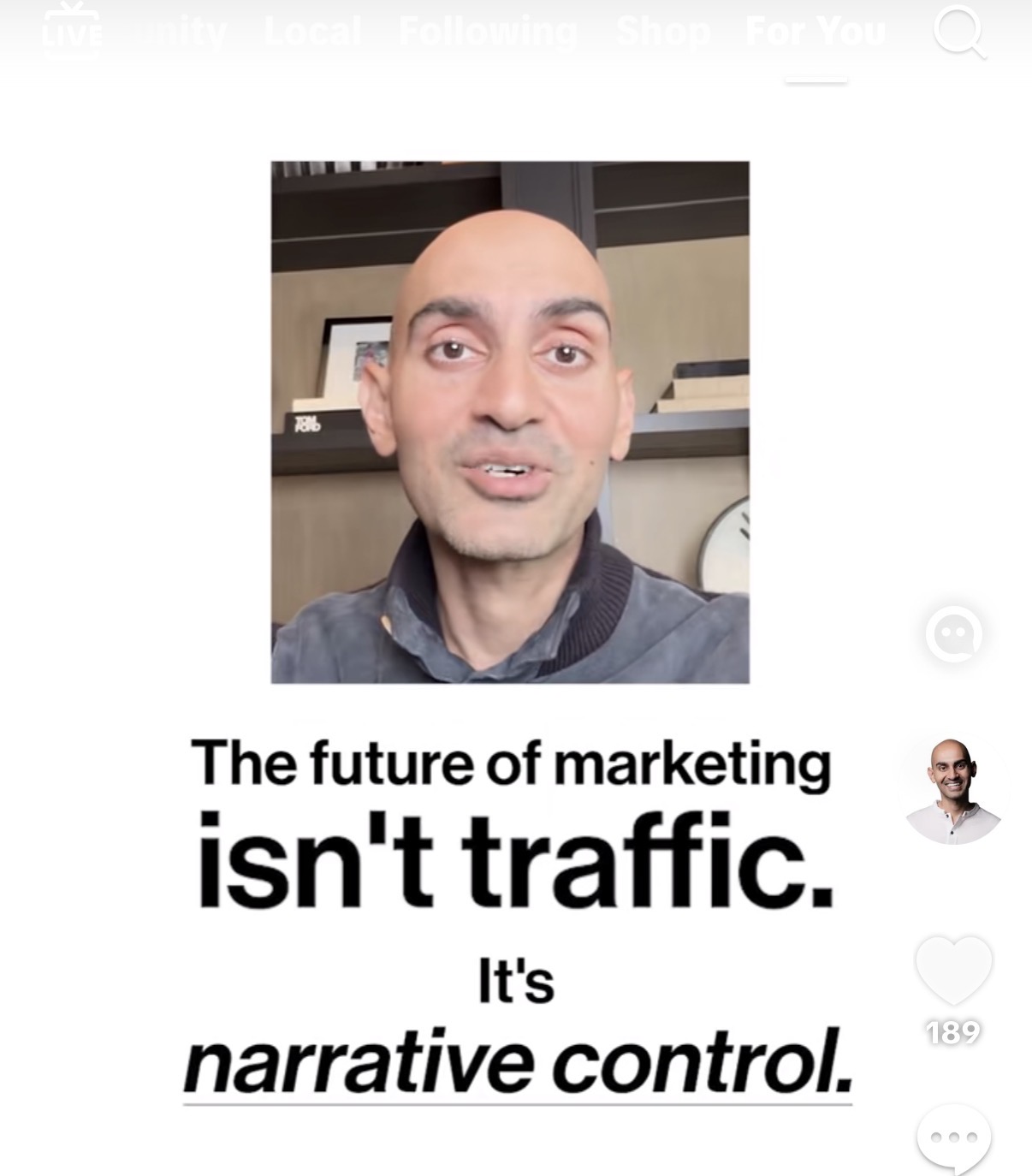
Read it again. The king of traffic just said traffic is dead. The man whose entire brand is rankings, backlinks, and search volume is telling founders the game moved to story. When the person who taught the world to chase traffic says traffic isn't the point anymore, you stop scrolling.
I want to be honest with you, because honest is the only way I know how to do this. I didn't see this coming. A few years ago I wasn't predicting that AI would become the interface between people and everything they buy. I wasn't that clever. I've spent my career on one thing: helping companies tell their story clearly enough that the right buyer feels seen. That was the whole job. It still is. What changed is why it suddenly matters more than it ever has.
Neil's seven words are bigger than even he let on. Let me show you what actually changed, and why it turns story from a nice-to-have into the thing your company lives or dies on.
What changed isn't marketing. It's the interface.
Until recently, your buyer found you by going somewhere. Google. Your website. A peer's recommendation. A booth at a conference. They did the reading. They did the comparing. Your homepage got a few seconds of a real human's attention, and your whole job was to make those seconds land. That world is closing. Now your buyer opens ChatGPT and types something like, 'who in my industry can actually help me solve this problem?' And the machine answers. One paragraph. A few names. That paragraph is the shortlist.
Sit with who that buyer is. They're the most important person in the room, and you're not in the room. You're not on the call. Your beautifully designed homepage never gets its five seconds, because the buyer never opens it. An AI read it for them, compacted your entire web presence into a sentence or two, and decided whether your name belongs in the answer. If it does, you made the shortlist. If it doesn't, you don't exist. There's no page two to claw back from anymore. There's just the answer, and whether you're in it.
Which means the question isn't 'how do we get more traffic.' It's 'when the machine compacts us into a paragraph, is our story clear enough to survive the squeeze?' Clear about who it's for. Clear about why we exist. Clear about the one thing we want our buyer to do so they actually win. Get those three sharp and the machine has something true to repeat. Leave them fuzzy and the machine fills the gap with the category average, and the category average is wearing your competitor's name.
Why this gets dangerous the moment AI walks in
Neil's right that the ground moved, and here's the mechanic underneath it. AI crushed the cost of the two things that used to be hard: traffic and content. Anyone can rank for long-tail terms with a prompt and a weekend. Anyone can spin up fifty blog posts before lunch. Output used to be scarce. Now it's infinite and free. When output is free, output stops being the moat.
And there's a shift most founders haven't clocked yet. For every human who lands on a page of your site, automated readers are hitting it many times over. Crawlers, model trainers, retrieval bots, the agents behind every ChatGPT and Perplexity and Claude answer. They're not browsing. They're reading you everywhere you exist and boiling it down to the paragraph they'll hand the next buyer who asks. Your website stopped being a place people go. It became a source machines summarize. You're not writing for the human visitor anymore. You're writing for the machine that speaks to the human on your behalf.
Here's the part that protects you, if you let it. AI is brilliant at scaling a point of view and useless at inventing one. Ask a model to write your story from scratch and it hands you the average of your category ... your competitors' words with your logo on top. Garbage in, garbage out. The one thing AI can't fake is lived truth. Why you built this. The buyer you're obsessed with. The thing in your industry that makes you angry enough to do something about it. That lives in your head, not in a training set. Give the machine that, and it has something real to repeat. Give it nothing, and you're just talking to a mirror in a louder voice.
Narrative control is real. You just can't control a story you never wrote.
This is where Neil's phrase needs one more sentence. Narrative control is real. But you can't control a narrative you haven't built, and most B2B companies haven't built one. They have a homepage that lists what the product does, a deck that explains, and a founder who can talk for an hour about the technology and never once say who it's for or why it matters. That's not a story. It's a feature list and a prayer. Nobody argues with a feature list. No machine repeats one either.
Before anyone controls a story, somebody has to write it. The real thing ... who you're for, why you exist, the villain you're against, the one outcome your buyer would be furious to lose. That's context work. Unglamorous, founder-in-the-room, take-the-lipstick-off-the-pig work, done before a single word ships. We built a whole system for it and gave it a name: the Magnetic Messaging Framework. Think of it as your business bible ... the context layer that decides what your story even is, then feeds the same specific truth to every homepage, deck, email, and AI tool you own. That's the work that makes you legible to the machine. Narrative control is just what it feels like once it's done.
Is your story clear enough to survive the paragraph?
Before you chase narrative control, find out whether the machine has anything true to grab. Three quick tests. You can run them before your coffee gets cold, and you don't need to hire anyone. If you'd rather have the page scored for you first, the free Brand Signal Score checks the same clarity your buyer's AI is checking, and it takes about a minute.
- 1Ask ChatGPT about you. Open a fresh chat and type, 'who are the best companies that help [your buyer] solve [your problem]?' Don't name yourself. Are you in the answer? Is what it says about you actually true, or did it guess? That paragraph is what your buyers are already seeing. If you're missing or mangled, your story isn't clear enough for the machine to repeat.
- 2The three-clarity check. Cover your logo and show your homepage to five strangers for five seconds. Ask three things: who is this for, why does this company exist, and what does it want me to do? If they can't answer all three, the human can't, and the machine reading you 100 times over can't either.
- 3The customer-words test. Pull your last five closed-won deals and ask each buyer, in their words, why they bought. Compare those words to your homepage. If the customer describes a sharp, specific transformation and your homepage says 'an all-in-one platform for modern teams,' your real story already exists. It's just trapped in your customers' mouths instead of on your site, where the machine could find it.
Flunk two of these three and narrative control isn't your next move. Building the story is. Chasing control first is like buying a megaphone before you've decided what to shout.
What I see across 200+ B2B companies
Across more than 200 founder-led B2B companies in the $5M-$75M range, the pattern is brutally consistent. Roughly 9 in 10 can't say who they're for and why they exist in one clean sentence. Ask the founder and the head of sales the same question separately and you get two different answers. The homepage and the closed-won interviews describe two different companies. These aren't bad companies. Most have a genuinely great product and customers who love them. That's what makes it hurt. The truth is right there, in the founder's conviction and the customers' own words, and the marketing sanded it into category mush so long ago that nobody inside the building can find it anymore.
And now that fuzziness carries a cost it never had before. A vague story used to mean weaker conversion. Today it means the machine doing the recommending has nothing specific to say about you, so it says nothing, or it says your competitor's name. That mechanic is worth understanding in full, and Why does AI recommend our competitors and not us? walks through it. They've tried content, PPC, AI tools, three rewrites. Deep down they know the problem was never the tactics. It's that there's no single, clear story for any tactic, or any machine, to carry.
A real example
A $24M cybersecurity company, founder-led, came to us after a year of grinding. They'd doubled content output, hired an agency to 'own the narrative,' and watched their win rate slide from 26 percent to 17 percent. More posts. Worse outcomes. Everyone kept saying 'narrative.' Nobody had checked whether one existed.
We ran the customer-words test first. Five closed-won interviews. The pattern hit on the first call. The homepage said 'unified threat detection for the modern enterprise,' a sentence every competitor could have written, and exactly the kind of sentence a machine can't tell apart from anyone else's. The customers said something completely different: 'they're the only ones who told us which alerts to ignore.' That's a villain (alert fatigue), a stake (your team is drowning), and a point of view (most tools make the noise worse). The story already existed. It was trapped in the buyers' mouths.
We rebuilt the homepage around the alert-fatigue villain. The deck opened by naming it in the first 90 seconds. The sales script led with 'how many alerts did your team ignore yesterday?' Same product, same market, nothing touched in the technology and everything in the story. Eleven weeks to live. Within a quarter, win rate climbed back to 28 percent. And here's the part that matters most for where all of this is heading: ask ChatGPT about alert fatigue in their category now and their name comes up, because they finally gave the machine something specific and true to repeat.
What this means for you
Neil Patel did the whole market a favor. He used the biggest platform in marketing to name the shift out loud: the future isn't traffic, it's narrative control. Believe him. Just take it one sentence past the caption. You can't control a story you haven't built, and the machine that now speaks for you can only repeat the story you made clear. The work is upstream, before a single piece of content ships. AI can scale it. AI can't do it for you, because it starts with a truth only you carry. Here's where to start this week.
- 1Ask ChatGPT who helps buyers like yours, without naming yourself, and read the paragraph your market is already seeing. That paragraph is your real homepage now. If you're not in it, that's the gap to close.
- 2Get your story down to three sentences: who it's for, why you exist, and the one thing you want your buyer to do to win. Make your founder and your head of sales agree on all three. If they can't, you just found the actual problem, and it isn't traffic.
- 3Rewrite your homepage's first screen around those three sentences and your customers' own words, before you spend another dollar on volume. Then, and only then, hand it to AI and the channels to scale. Make the story clear first. Humans, machines, and control all come after.
The most important person in your market is no longer on your website. They're in a conversation with a machine, asking who can help them, and the machine is answering from whatever you made clear, or didn't. Make it clear. Who you're for, why you exist, what you want them to do to win. Do that, and you don't have to chase narrative control. You become the name the machine repeats. It's the same upstream move that decides whether your B2B brand shows up in ChatGPT and Claude recommendations at all.
Questions People Ask
FAQ
What did Neil Patel mean by narrative control?
Neil Patel argued that the future of marketing isn't winning traffic, it's controlling the story buyers and AI engines tell about your category and your company. After two decades teaching SEO, ranking, and search volume, he's saying volume is no longer the moat. He's right. The catch he left out: narrative control assumes you already have a narrative. Most B2B companies don't. They have a feature list. You can't control a story you never wrote.
Is SEO traffic dead in 2026?
Traffic as a moat is dead, not traffic as a metric. AI made content and traffic cheap to generate, so volume no longer separates winners from everyone else. Buyers now spend most of the buying journey in self-research, peer conversations, and AI tools, where what wins is a clear, repeatable point of view. Traffic still matters, but it follows narrative now instead of leading. When the godfather of SEO says traffic is dead, that's the shift he's naming.
What's the difference between narrative control and having a narrative?
Having a narrative means you've done the work: you've extracted the truth your customers actually buy, named the villain in your category, and staked a position competitors can't copy. Narrative control is the outcome that work earns ... the ability to shape how buyers and AI engines describe you. Companies chase control with tactics like content volume and PR. But control without an underlying narrative is just noise with a budget. Build the narrative first.
How do B2B companies build a narrative they can control?
Start upstream, not with content. Interview five closed-won customers and capture the exact words they use for why they bought. Name the villain your buyers are actually fighting, not a generic pain. Stake one position your competitors literally cannot claim. Translate that into a homepage, a deck, and a sales script that all say the same thing. That's a Magnetic Messaging Framework. Only after that asset exists can volume amplify it instead of diluting it.
Can AI build my brand narrative for me?
No. AI collapsed the cost of producing deliverables to near zero, which is exactly why a narrative built by AI alone sounds like everyone else's. AI is brilliant at scaling a point of view and useless at manufacturing one. Lived truth, the specific story of why you built what you built and who it's for, is the one input AI can't fake. Feed AI your narrative and it scales your voice. Feed it nothing and it scales the average.
Why doesn't my company show up when buyers ask ChatGPT for recommendations?
Because the model had nothing specific to repeat about you. When a buyer asks an AI 'who can help me solve this problem,' the engine compacts your whole web presence into a sentence or two and names whoever staked the clearest position. If your homepage, your content, and your profiles all describe a generic 'all-in-one platform for modern teams,' the model can't tell you apart from ten competitors, so it leaves you out or describes someone else. The fix isn't more content. It's a clear story ... who you're for, why you exist, and the outcome you deliver ... stated the same specific way everywhere the machine reads you.