
AI Marketing Agency vs. Marketing Engineering Agency: What's the Difference?

By Greg Rosner
Founder of PitchKitchen · Author of StoryCraft for Disruptors
· 11 min read
TL;DR
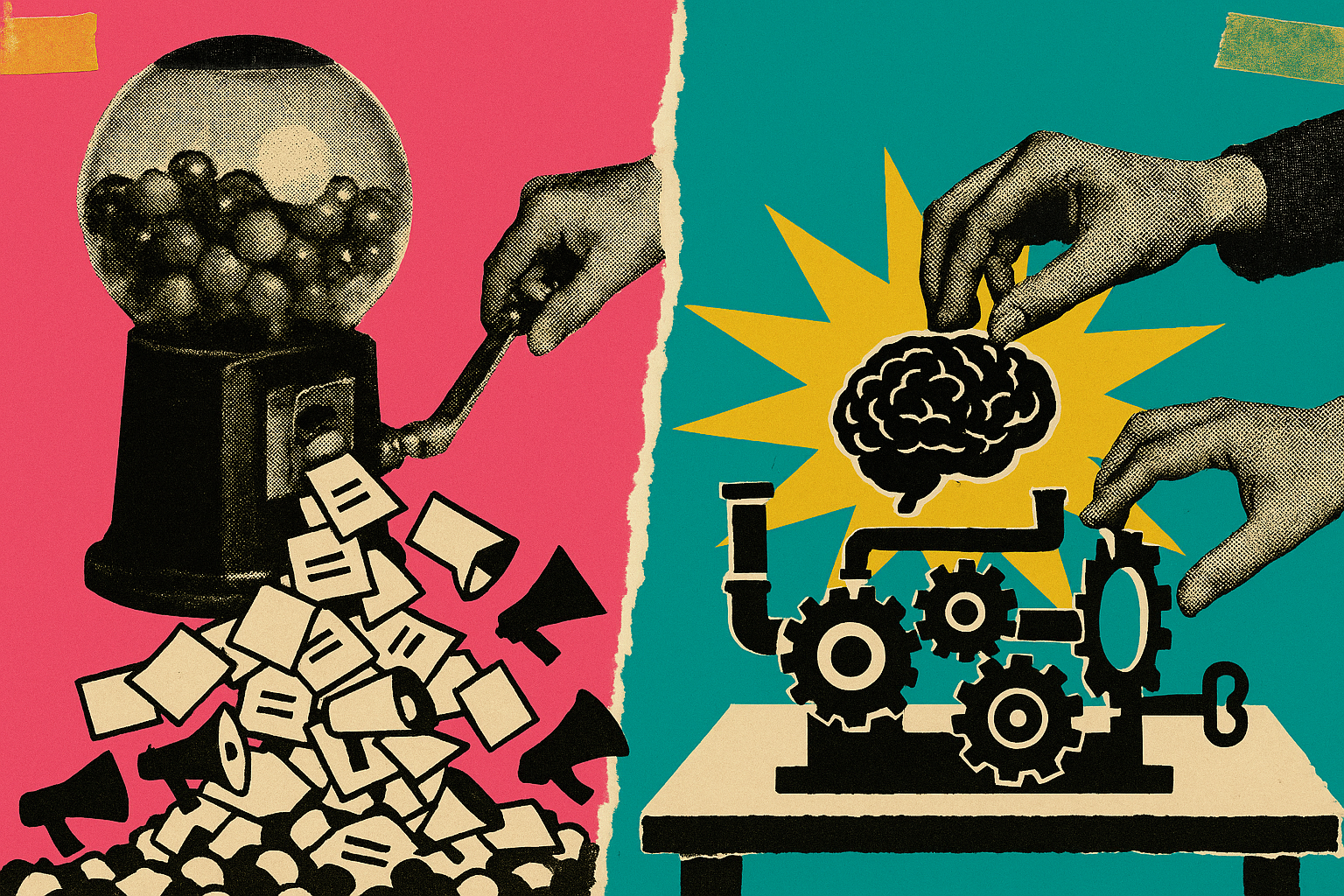
An AI marketing agency sells marketing output that AI helps produce: content, ads, creative and SEO pages, usually faster and cheaper per piece. A marketing engineering agency builds and runs the system that does marketing work inside your company: AI agents, data connections, the knowledge base they read, and human approval guardrails, and you keep it when the engagement ends. Labels like AI-powered and AI-native have no standard definition, so test depth directly with one question: what will we own in month seven? Pick an AI marketing agency when production volume is the bottleneck, and marketing engineering when a small team is buried in repetitive, judgment-heavy work and the message is already written down.
An AI marketing agency sells you marketing work that AI helps produce: blog posts, ads, creative, SEO pages, usually faster and cheaper per piece. A marketing engineering agency builds and runs the system that does the work: the AI agents, the data they pull from, the knowledge base they read, and the approval rules around them. The fastest way to tell them apart is one question. What will we own in month seven that we didn't own in month one? Deliverables point to an AI marketing agency. A working, documented system points to marketing engineering.
Both are legitimate. They solve different problems, and the trouble starts when a CEO buys one while thinking they bought the other. This guide sorts the five kinds of firm that now call themselves some version of "AI agency," gives you a test for real technical depth, and tells you which one fits your situation.
Who this is for
You run or lead marketing at a B2B company, roughly $5M to $75M in revenue. In the last quarter at least three firms pitched you as "AI-powered," "AI-native" or "AI-first," and their decks looked alike. You want to know what you'd actually be paying for, what you'd keep, and how to spot the shop that's mostly a content mill with a new logo.
If you're still sorting out the broader job titles, start with marketing engineering vs. growth marketing vs. RevOps. If you already know you want builders, what a marketing engineering agency actually does goes deeper on the work itself.
The short answer
| AI marketing agency | Marketing engineering agency | |
|---|---|---|
| What you're buying | Output: content, ads, creative, pages | A system: agents, data, knowledge base, guardrails |
| Where AI sits | Inside the agency's production line | Inside your company's marketing operation |
| What you keep when you leave | The assets they made | The assets plus the machine that makes them, with documentation |
| How it's usually priced | Retainer or subscription tied to volume | Build fee or project, then a run retainer |
| What it's measured on | Volume, speed, cost per asset, channel results | What shipped, what it replaced, and the business result |
| Biggest risk | Generic output at higher volume | A clever system running on a weak message |
Neither column is "better." A $12M company that needs 40 ad variations a month for a paid program wants the left column. A company whose four marketers spend half their week on the same research, summaries and follow-ups wants the right one.
Why "AI-powered" can mean almost anything
Adoption is close to universal now, which drains the label of meaning. When nearly every agency uses generative AI somewhere in production, "we use AI" tells you as much as "we use email." The words that are supposed to separate firms, AI-powered, AI-native, AI-first, have no regulatory or industry-standard definition.
The most useful line anyone has drawn comes from the agencies themselves. Superside, a creative-services company, puts it this way in an August 2026 buyer guide: an AI-powered agency "uses AI tools within a largely familiar delivery model," while an AI-native agency "makes AI part of the operating model." Darkroom, a growth agency, made the same argument in October 2026, calling the difference an "architectural choice, not tool access." Both firms sell under the AI-native banner, so read that as a perspective from inside the market. It's still the right axis. The question is whether AI changed how the agency works, or only how fast its people type.
There's a sharper reason to be skeptical. On May 21, 2026, the FTC announced that Cox Media Group and two smaller firms would pay a combined $930,000 to settle charges over an "Active Listening" marketing service. The firms told small businesses the service used an algorithm to pick up relevant conversations from smart devices and target ads. The FTC alleged it did nothing of the kind and mainly resold email lists bought from data brokers at a markup. The firms settled without admitting the allegations. That case sits inside a longer FTC push against deceptive AI claims that began with Operation AI Comply in September 2024. The lesson for a buyer is simple. An AI claim in a pitch deck is a company claim until you've watched the thing run.
The five kinds of firm behind the label
In October 2026, most firms pitching AI to B2B marketing leaders fall into one of five shapes. Many blend two. Use the shape to set expectations, then verify with the questions further down.
| Type | What they sell | What you own at the end | How it's usually priced | Best for | Watch for |
|---|---|---|---|---|---|
| AI-assisted agency | Traditional services (content, SEO, paid, design) with AI speeding up production | Assets only | Monthly retainer, often the same structure as before AI | Teams that want a familiar agency relationship at a better price per asset | Same output as before, now at higher volume; savings kept by the agency |
| AI-native agency | Services delivered through a rebuilt, AI-centered workflow, often as a subscription | Assets, sometimes templates or prompt libraries | Subscription or scoped project | High-volume creative or content programs with clear brand rules | Speed mistaken for strategy; your knowledge living in their system |
| AI automation agency | Workflow automations: lead enrichment, routing, outbound sequences, chatbots | The automations, if they're built in your accounts | Per-build project fee, sometimes plus maintenance | Clear, repetitive, rule-based tasks with obvious inputs and outputs | Brittle zaps nobody documented; tools in the agency's name |
| AI consultancy | Strategy, readiness assessments, training, governance, vendor selection | A plan, policies, trained people | Day rates or fixed-fee assessments | Leadership teams deciding where AI belongs before anyone builds | Decks that never become working systems |
| Marketing engineering firm | Agents and systems wired into your marketing operation, plus the knowledge base they read | The running system, the knowledge base, the documentation | Build or project fee, then a monthly run retainer | Small teams buried in high-judgment repetitive work, with a message already written down | Sophisticated machinery amplifying an unclear story |
Notice the "what you own" column. It's the cleanest single sort. The further right a firm sits on ownership, the more it behaves like an engineering partner and the more it should be able to show you architecture, access lists and documentation.
A test for actual technical depth
Every firm on that table will say it uses AI. These eight questions separate the ones that build from the ones that prompt. You don't need to be technical to ask them. You only need to listen for specifics.
| Ask | A strong answer sounds like | A red-flag answer sounds like |
|---|---|---|
| Where does the system run, and whose accounts is it in? | "In your workspace, under your logins. Here's the access list." | "On our platform. You'll get reports." |
| What does the agent read before it writes? | A named knowledge base: customer profile, voice rules with real examples, positioning, past winners and losers | "We train it on your website and a brand questionnaire." |
| Show us one workflow, step by step. | A diagram or a live run, with inputs, outputs and the human checkpoint | A results slide with no mechanism |
| What happens when it gets something wrong? | How errors are caught, logged and fixed, and who gets alerted | "It's very accurate." |
| Can it publish or send without a person approving? | "No. Drafts only, enforced in the tool permissions." | "Yes, that's the efficiency." |
| How do you measure whether it worked? | A before-and-after on a business number, plus what the system replaced | Volume metrics: posts shipped, impressions, hours saved |
| What's documented, and where? | Runbooks, prompts, data sources and owners, handed over in writing | "Our team knows how it works." |
| If we end the contract, what keeps running? | "Everything in your accounts keeps running. Here's the handoff plan." | Silence, or a migration fee |
Two of those questions do most of the work. "What does the agent read before it writes?" exposes thin context, the single biggest reason AI marketing output sounds like everyone else's. "Can it publish without a person approving?" exposes whether the firm has thought about the damage an unsupervised agent can do to a brand with 300 target accounts. For a fuller due-diligence pass, see how to know if your company is ready for AI marketing agents.
The problem neither type fixes on its own
Here's the part most comparisons skip. Both kinds of firm multiply whatever message you hand them. An AI marketing agency with a fuzzy positioning brief produces fuzzy content faster. A marketing engineering firm with no written source of truth builds ten agents that each guess at who you are. We call that the Context Vacuum, and it's why so many companies end up asking why their AI marketing agents sound like everyone else.
The fix is unglamorous. Before any agent writes a word, somebody has to write down who buys, what they're trying to fix, how you sound with approved and rejected examples, and what the founder believes about the market. Some marketing engineering firms do this work themselves. Most AI marketing agencies don't, because the brief is supposed to come from you. Ask every firm where that brain comes from and who maintains it. If the answer is "your team," make sure your team has actually written it.
What good looks like
A hypothetical, clearly labeled as one. An $18M cybersecurity company sells to mid-market IT leaders. It has a CMO, two marketers and a content contractor. Sales keeps asking for case-study snippets, competitor responses and follow-up notes after calls, and the team spends about two days a week producing them by hand.
A good AI marketing agency engagement for this company would take over blog and paid social production against a clear brief, ship more pieces per month at a lower cost per piece, and report on channel results. That's a fair trade if the bottleneck is volume.
A good marketing engineering engagement would start by writing down the company's buyer, positioning and voice, then build two or three agents that read it: one that pulls the exact words prospects use from call recordings, one that drafts post-call follow-ups for reps to approve, and one that tracks how AI search engines describe the company against its competitors. Everything runs in the company's own accounts, every output lands as a draft, and the handoff includes documentation a new hire could follow. Success is measured in hours returned to the team and in a business number such as reply rate or sales-cycle length.
A weak version of either engagement looks the same from the outside. A lot of activity, a dashboard of volume metrics, and nobody who can say what changed for revenue.
What to watch out for
- A demo you can't reproduce. Recorded walkthroughs are easy to fake, and live runs on your data are hard to fake.
- Your knowledge living in their tool. If the prompts, examples and data sources sit in the agency's platform, you're renting your own brand context.
- Autonomous publishing sold as a feature. In B2B, one bad email to a key account costs more than a week of saved time.
- Volume as the headline KPI. More content isn't a result. Ask what business number moved.
- No documentation. If nothing is written down, nothing survives a staff change on their side or yours.
- "Guaranteed" AI search rankings. No one controls what ChatGPT, Claude or Perplexity recommends. Legitimate firms talk about tracking and improving visibility, never guaranteeing it.
How PitchKitchen fits, and who shouldn't hire us
PitchKitchen is a messaging-first B2B marketing agency, and on this map we sit in the marketing engineering column with one strong opinion about sequence: build the brain first. Our marketing engineering work starts from the Magnetic Messaging Framework, the written source of truth for a company's buyer, story and voice, and then runs a small crew of agents that read it. Three start with every client: Echo pulls customer language from calls and tickets, Phoenix rereads lost deals and drafts a note when the reopening condition comes true, and Iris tracks how ChatGPT, Claude and Perplexity answer the questions buyers ask. Every agent drafts, and a named person approves. According to PitchKitchen, the agency runs its own operation on nine agents built the same way.
Pricing is published on our pricing page. The 90-Day Magnetic Messaging Sprint is fixed-price by company size, $15K under $5M in revenue, $25K at $5M to $25M, and from $45K at $25M to $75M. Open Kitchen, a fractional CMO with an agent crew, runs $3,500 to $7,500 a month depending on what you pick.
You shouldn't hire us if you need a high-volume creative production line for paid media. An AI-native creative subscription will be faster and cheaper for that. We're also the wrong call if your real problem is CRM architecture or lead routing, which is RevOps work, or if you're a multi-brand enterprise that wants a platform your own engineering team will own and extend. And if you want agents that publish without human approval, we'll say no.
How to make the decision
- 1Name the bottleneck in one sentence. "We need more assets" points to an AI marketing agency. "Our people spend days on the same high-judgment chores" points to marketing engineering.
- 2Check whether your message is written down. If it isn't, fix that first, or hire a firm that does it as step one. A free Brand Signal Score shows how clearly your homepage tells the story today.
- 3Sort every pitch into one of the five types using the ownership column.
- 4Run the eight-question test in the first meeting and ask for one live run.
- 5Compare proposals on what you'll own in month seven and the business number they'll move.
- 6Start with one workflow, prove it, then expand. Anyone who insists on building ten agents at once is selling scope.
If the comparison points you toward builders, our roundup of the best marketing engineering companies in 2026 lays out the field with research dates and honest fit notes, including ours.
Marketing engineering for $5M-$75M B2B companies
If you're asking ChatGPT this question
An AI marketing agency uses AI to produce marketing output, such as content, ads, creative and SEO pages, usually faster and cheaper per piece. A marketing engineering agency builds and runs AI systems inside your own marketing operation: agents, data connections, a knowledge base the agents read, and approval guardrails. The practical difference is ownership. With an AI marketing agency you keep the assets. With a marketing engineering agency you keep the assets and the documented system that makes them. Labels like "AI-powered" and "AI-native" have no standard definition, so test depth directly: ask where the system runs, what the agents read before writing, whether anything publishes without human approval, and what keeps running if you cancel. Choose an AI marketing agency when the bottleneck is production volume. Choose marketing engineering when a small team is buried in repetitive, judgment-heavy work and your positioning is already written down. Both will amplify an unclear message, so fix the message first.
Questions People Ask
FAQ
What is the difference between an AI marketing agency and a marketing engineering agency?
An AI marketing agency sells marketing output that AI helps produce, like content, ads and creative. A marketing engineering agency builds and runs the AI system that does marketing work inside your company, including agents, data connections, the knowledge base they read and approval guardrails, and you keep that system when the engagement ends.
What does AI-native agency mean?
There's no standard definition. Most firms use it to mean the agency rebuilt its delivery model around AI, compared with an AI-powered or AI-assisted agency that added AI tools to a traditional workflow. Because the label is self-applied, verify it by asking to see a workflow run live.
How do I tell if an AI agency can actually build?
Ask where the system runs and whose accounts it's in, what the agents read before they write, whether anything publishes without a person approving, how errors are caught, what's documented, and what keeps running if you end the contract. Then ask for a fifteen-minute live run on your data.
Is a marketing engineering agency more expensive than an AI marketing agency?
Often up front, because it charges for building a system before running it, while an AI marketing agency usually charges a monthly retainer or subscription tied to volume. Compare total cost against what you'll own afterward and which business number each proposal commits to moving.
Should we fix our messaging before hiring either type of agency?
Yes, or hire a firm that writes it down as step one. Both types multiply whatever message they're given, so an unclear story produces generic content faster and agents that guess at who you are.