
The 2026 Healthtech Messaging Index
Sift Healthcare
sifthealthcare.com·scored November 1, 2026
27/38
Approaching
Close. The bones are good. A few targeted fixes on the weakest signals would push Sift Healthcare into magnetic territory.
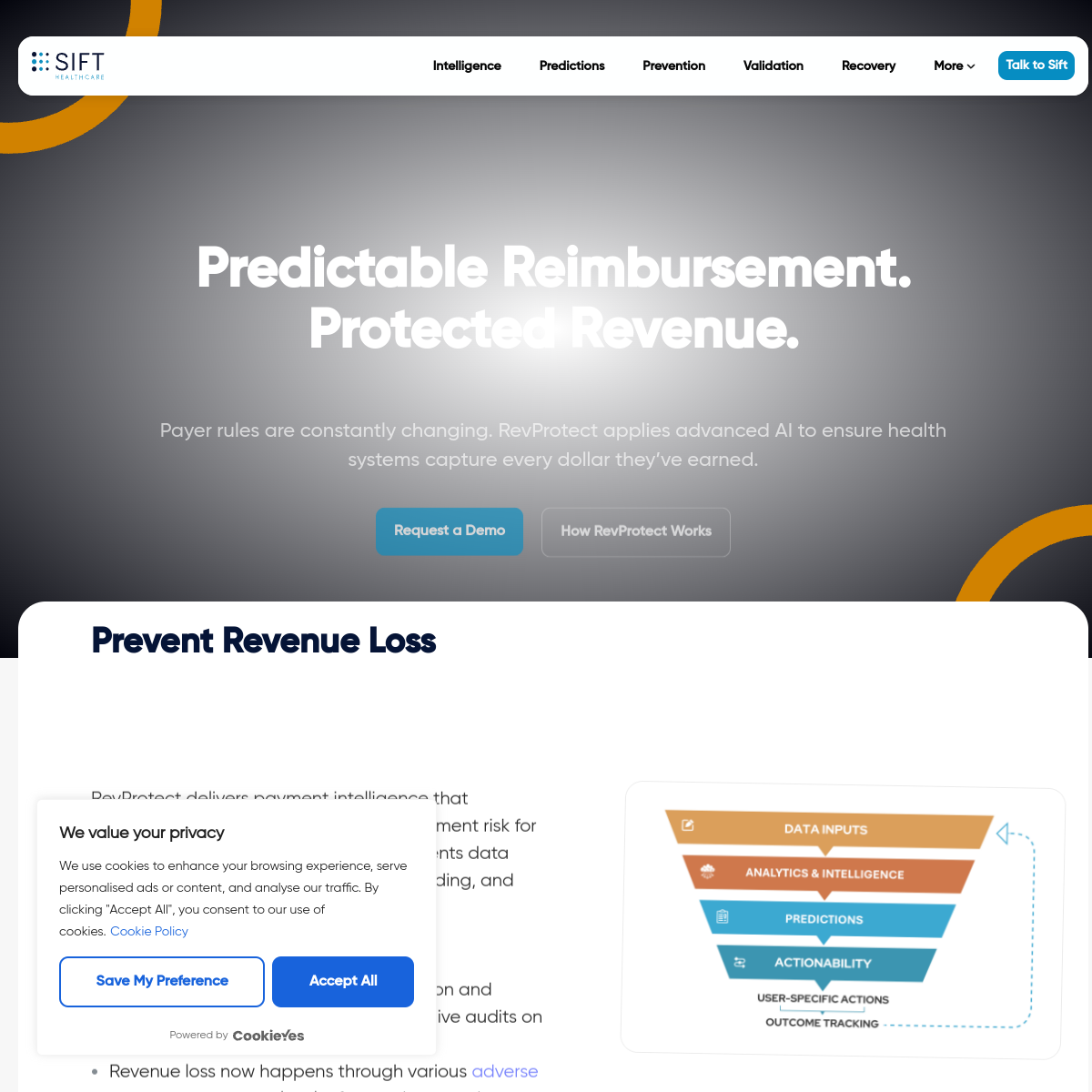
The page we scored
The AI Recommendation Check
When we asked AI who to recommend for AI-powered denial prevention and reimbursement risk management software for health systems, it named:
Buyer we put in the prompt: VP of Revenue Cycle Management or CFO at a mid-to-large U.S. health system. Both the buyer and the category were inferred from Sift Healthcare’s homepage alone. The model had no web access.
Sift Healthcare was not on the list.
A buyer who asked AI this question got 8 names and moved on. Sift Healthcare never came up.
We asked AI who it recommends for "VP of Revenue Cycle Management or CFO at a mid-to-large U.S. health system" looking for "AI-powered denial prevention and reimbursement risk management software for health systems". It named Waystar, Optum360, Cotiviti, Experian Health, Nthrive. You did not appear. AI can't recommend what it can't clearly understand.
Overall assessment
Sift Healthcare's biggest strength is its owned language and specificity ... 'adverse payment outcomes,' 'The Capture Gap,' 329 MS-DRG playbooks, and mechanistic AI claims give it rare LLM quotability and entity distinctiveness that most RCM vendors completely lack. The biggest gap is social proof and the 'after' state: there are no named individuals or direct quotes in case studies, the promised land never becomes vivid, and alternatives are entirely unacknowledged ... all of which leave a skeptical CFO without enough third-party validation to pull the trigger.
Signal by category
Narrative Clarity
8 signals
Trust Signal
4 signals
AI Signal
6 signals
Conversion Signal
1 signal
Weakest signal · fix this first
12Alternatives Acknowledged
“No mention of competitors, alternative solutions, or 'do nothing' scenarios anywhere on the page.”
The page never acknowledges that buyers could use Epic's built-in tools, existing RCM vendors, or manual processes ... alternatives are entirely absent.
All 19 signals, scored 0 to 2.
Total 27/38
Narrative Clarity
8 signals
- 2
01The 7-Second Test
“Predictable Reimbursement. Protected Revenue. / Payer rules are constantly changing. RevProtect applies advanced AI to ensure health systems capture every dollar they've earned.”
Within 7 seconds a stranger can tell this is for health systems, the problem is payer-driven revenue loss, and the POV is that reimbursement should be predictable ... clear enough for a caveman.
- 2
02Rebellion / Movement
“Payers use AI to scrutinize documentation and downgrade claims, including retrospective audits on claims that were paid 12+ months ago”
The page names a specific, concrete enemy ... payers using AI against health systems ... and frames the status quo as an arms race that health systems are currently losing.
- 2
03Owned Language & Category
“adverse payment outcomes / RevProtect / The Capture Gap / 329 Proprietary MS-DRG playbooks”
The page owns at least three named terms ... 'adverse payment outcomes,' 'RevProtect,' and 'The Capture Gap' ... plus a specific proprietary framework (329 MS-DRG playbooks) that an AI could cite back uniquely.
- 1
04ICP Clarity
“Sift intelligence deployed across 88 health systems / RevProtect delivers payment intelligence... for health systems”
Health systems are clearly named as the buyer, but there is no specificity about role (CFO, VP RCM, CDI director?), size, or health system stage, leaving ICP partially defined.
- 2
05Problem Leadership
“Revenue loss now happens through various adverse payment outcomes: level-of-care downgrades, denials, clinical validation or DRG reductions and takebacks / Teams are understaffed and overworked”
The page leads with a detailed, buyer-language problem list before describing the solution, including operational pain and payer behavior.
- 2
06Solution Clarity
“RevProtect delivers payment intelligence that predicts, prevents, and resolves reimbursement risk for health systems turning clinical and payments data into next-best actions across UR, CDI, Coding, and PFS.”
A visitor can repeat exactly what the product does in one sentence; the hero and the following paragraph are consistent and specific.
- 1
07Cost of Inaction
“Revenue risk is introduced before billing, not just at denial / retrospective audits on claims that were paid 12+ months ago”
The page implies the cost of inaction through the description of payer behavior but never explicitly quantifies what a health system loses by doing nothing (e.g., 'the average health system leaves $X on the table').
- 1
08Promised Land
“RevProtect makes reimbursement predictable and adverse payment outcomes preventable ... before claims go out the door.”
There is a promised land statement but it stays at a functional/operational level and never paints the vivid 'after' state ... what life looks like for the team, the CFO, or the organization once deployed.
Trust Signal
4 signals
- 2
09Proof & Evidence
“Annual denial reduction opportunity $0M / In protected revenue for every 0.1% reduction in denial rate ~$0M / ROI for denial prevention 0x / 329 Proprietary MS-DRG playbooks / 692 normalized clinical + financial data elements”
The page provides a specific ROI calculator frame, proprietary data point counts, and named case study organizations, even though the animated counters render as zero in the scrape ... the structure and specificity are genuinely concrete.
- 1
10Social Proof
“Hartford Healthcare ... Driving Denial Reduction And Revenue Recovery Improvement / ProHealth Care ... ML-Driven Denials Intelligence”
Two named health system case studies appear but there are no named individuals, titles, or direct quotes ... just logos and report titles, which weakens trust signal meaningfully.
- 1
11Authority & Credibility
“Justin Nicols, Founder & CEO ... A leading industry expert in data analytics technology and has an extensive background in corporate finance and investment banking.”
Founder credentials are present but self-described as 'leading industry expert,' which is a claimed authority rather than demonstrated; no healthcare-specific credentials, publications, or recognitions are cited.
- 0
12Alternatives Acknowledgedweakest
“No mention of competitors, alternative solutions, or 'do nothing' scenarios anywhere on the page.”
The page never acknowledges that buyers could use Epic's built-in tools, existing RCM vendors, or manual processes ... alternatives are entirely absent.
AI Signal
6 signals
- 1
13Customer Focus
“RevProtect turns reimbursement risk into clear, role-specific recommendations and actions, embedded directly into revenue cycle workflows.”
The page tilts toward company capabilities and product features; while customer outcomes are referenced (Hartford, ProHealth), the protagonist is overwhelmingly RevProtect, not the health system team achieving transformation.
- 2
14AI-Parmesan Index
“RevProtect predicts reimbursement risk as care is documented, modeling underpayments, DRG downgrades, and clinical takeback probability in pre-bill / 329 Proprietary MS-DRG playbooks / 692 normalized clinical + financial data elements”
AI claims are mechanistic and specific ... pre-bill prediction, DRG-level modeling, named data architecture ... not vague 'AI-powered' sprinkle language.
- 2
15LLM Quotability
“The Denial Took Nine Seconds. The Appeal Takes Forty Minutes. / AI for denial appeal automation has a ceiling. / Payer Takebacks: The AR You Reported Too Soon”
Multiple blog/perspective titles are punchy, declarative, and quotable ... an LLM could lift 'The denial took nine seconds, the appeal takes forty minutes' verbatim as a citation-ready insight.
- 2
16Copyright Freshness
“2026 AI Prompt Guide / 2025 Annual Denials Insights Report / multiple article dates referencing 2026”
Content is dated 2025 ... 2026 and copyright references 2026, giving AI engines strong recency signals.
- 2
17Entity Distinctiveness
“329 Proprietary MS-DRG playbooks / adverse payment outcomes / The Capture Gap / Sift intelligence deployed across 88 health systems”
The combination of owned terms, proprietary data architecture, and specific deployment scale makes this company unmistakably distinct ... an AI could not confuse this description with a generic RCM vendor.
- 0
18AI Recommendation Check
“AI's picks: Waystar, Optum360, Cotiviti, Experian Health, Nthrive, Olive AI. You were not named.”
We asked AI who it recommends for "VP of Revenue Cycle Management or CFO at a mid-to-large U.S. health system" looking for "AI-powered denial prevention and reimbursement risk management software for health systems". It named Waystar, Optum360, Cotiviti, Experian Health, Nthrive. You did not appear. AI can't recommend what it can't clearly understand.
Conversion Signal
1 signal
- 1
19Path & CTA Clarity
“Request a Demo / How RevProtect Works / Request an Insights Analysis / Talk to Sift”
There is a primary CTA (Request a Demo) and a soft secondary (Talk to Sift / Request an Insights Analysis), but there is no visible numbered process or deployment journey tied to the CTAs, so the path and CTA exist but don't fully work together.
Your move
Think Sift Healthcare’s score is wrong? Good. Let’s look at it together.
Twenty minutes with Greg. Bring the page, bring the argument. You’ll leave knowing exactly which signal is costing Sift Healthcare the AI recommendation, and what to write instead.
Not on the list? Run your homepage through the free Brand Signal Score and see where you’d land. Same 19 signals, same AI check, two minutes.