
The 2026 Healthtech Messaging Index
Pelago
pelagohealth.com·scored September 1, 2026
25/38
Approaching
Close. The bones are good. A few targeted fixes on the weakest signals would push Pelago into magnetic territory.
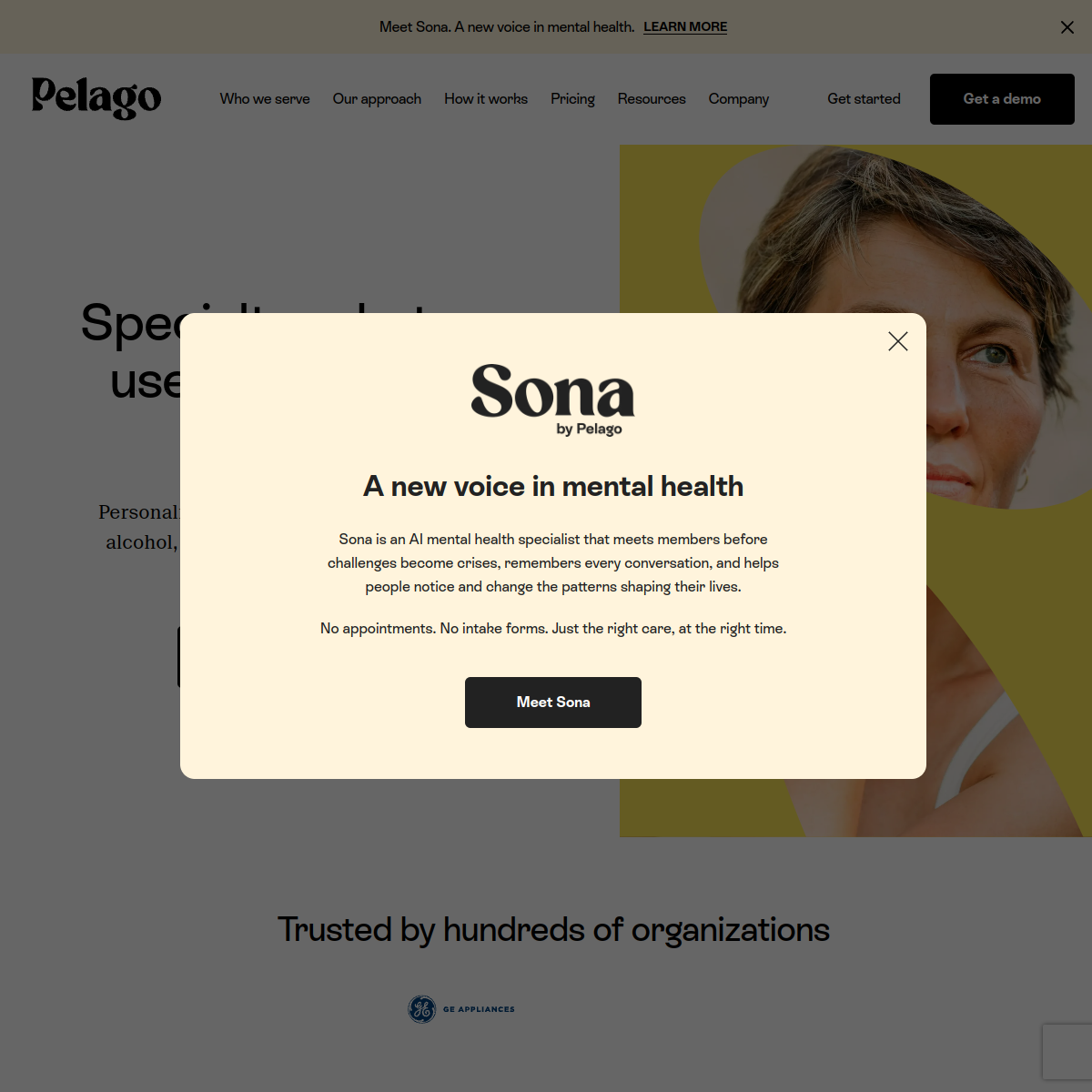
The page we scored
The AI Recommendation Check
When we asked AI who to recommend for virtual substance use disorder treatment for employers and health plans, it named:
Buyer we put in the prompt: VP of Benefits or Chief HR Officer at a mid-to-large employer, or a Medical Director / VP at a health plan. Both the buyer and the category were inferred from Pelago’s homepage alone. The model had no web access.
Pelago was not on the list.
A buyer who asked AI this question got 8 names and moved on. Pelago never came up.
We asked AI who it recommends for "VP of Benefits or Chief HR Officer at a mid-to-large employer, or a Medical Director / VP at a health plan" looking for "virtual substance use disorder treatment for employers and health plans". It named Quit Genius, Workit Health, Groups.io, Boulder Care, Brightside Health. You did not appear. AI can't recommend what it can't clearly understand.
Overall assessment
Pelago's biggest strength is its dense, specific outcome data (62% alcohol reduction in 30 days, $6.7k medical cost savings, 15 peer-reviewed publications) that gives both human buyers and AI engines concrete, citable proof. The biggest gap is competitive context: the page never acknowledges what buyers are doing instead ... EAPs, in-person rehab, or doing nothing ... which means Pelago cedes the contrast that would make its differentiation feel earned rather than assumed.
Signal by category
Narrative Clarity
8 signals
Trust Signal
4 signals
AI Signal
6 signals
Conversion Signal
1 signal
Weakest signal · fix this first
12Alternatives Acknowledged
“No mention of EAPs, competing digital health platforms, in-person rehab, or 'do nothing' as an explicit alternative anywhere on the page.”
The page never acknowledges what buyers are doing instead of Pelago, leaving the competitive context entirely unaddressed.
All 19 signals, scored 0 to 2.
Total 25/38
Narrative Clarity
8 signals
- 2
01The 7-Second Test
“Specialty substance use care, built for real life" + "Personalized, virtual-first support for tobacco, alcohol, opioid, cannabis, and stimulant use.”
Within 7 seconds a visitor knows it's virtual substance use treatment for employees/health plan members ... the who, what, and tone are immediately legible.
- 1
02Rebellion / Movement
“10% or less of those suffering from a substance use disorder ever receive treatment”
The page implies a broken status quo (low treatment rates, stigma, hidden costs) but never names a specific enemy, a failed incumbent approach, or frames Pelago as a rebellion against anything in particular.
- 1
03Owned Language & Category
“PelagoRX" and "specialty substance use care" appear as semi-owned terms but no named category or framework is staked out.”
PelagoRX is a branded module name, and 'specialty substance use care' is used repeatedly, but neither constitutes a fully coined category or ownable framework an AI would quote back distinctively.
- 1
04ICP Clarity
“For employers" / "For health plans" ... two audience tiles appear below the fold with brief descriptors.”
Employers and health plans are identified, but there's no specificity on company size, industry vertical, or buyer role (e.g., VP Benefits, Chief Medical Officer), so a visitor isn't instantly confirmed as the right buyer.
- 1
05Problem Leadership
“The hidden cost of substance use" ... section leads with the problem but only appears mid-page, not above the fold.”
The hero leads with the solution ('Specialty substance use care'), not the buyer's problem; problem framing is present but buried below several sections.
- 2
06Solution Clarity
“Digital tools, live counseling, and medication-assisted treatment, with same-day access nationwide.”
A visitor can clearly repeat what Pelago does in one sentence after reading this line ... the modalities and access model are explicitly named.
- 1
07Cost of Inaction
“$15k is spent in annual healthcare expenditure per affected employee”
The cost of the problem is stated statistically, but the cost of inaction ... what specifically happens to the buyer who delays or does nothing ... is never directly named or dramatized.
- 1
08Promised Land
“Get started quickly. Reduce healthcare spend. Change lives forever.”
An 'after' state is gestured at but it's generic and unpainted ... no vivid, specific vision of a transformed workforce or membership population that a buyer can picture themselves living in.
Trust Signal
4 signals
- 2
09Proof & Evidence
“Members reduce alcohol use by 62% within 30 days" / "67% of Pelago members are opioid-free for at least three months" / "$6.7k per participant medical cost saving in the first year”
Multiple specific, quantified outcome claims are present for individual conditions and for ROI, making this one of the page's strongest sections.
- 1
10Social Proof
“Trusted by hundreds of organizations" + logos: Philips, HPE, Live Nation, DSG, GEA, USV ... plus first-name-only member testimonials.”
Employer logos are present but no named client testimonials with titles/companies appear; member testimonials use first names only (Sydney, Erik), which limits B2B trust signal impact.
- 2
11Authority & Credibility
“15 peer-reviewed publications showing impact on engagement, clinical improvement, and medical savings" + "Led by addiction scientists and a multidisciplinary team of addiction physicians, therapists, and coaches”
Peer-reviewed research count, clinical team credentials, and a 2025 ROI report constitute demonstrated authority rather than just claimed expertise.
- 0
12Alternatives Acknowledgedweakest
“No mention of EAPs, competing digital health platforms, in-person rehab, or 'do nothing' as an explicit alternative anywhere on the page.”
The page never acknowledges what buyers are doing instead of Pelago, leaving the competitive context entirely unaddressed.
AI Signal
6 signals
- 2
13Customer Focus
“Member testimonials dominate the middle of the page; outcomes framed around member transformation: "My relationship with opioids is non-existent.”
The page is anchored by member transformation stories and outcome stats framed from the member's perspective, making the customer the clear protagonist.
- 2
14AI-Parmesan Index
“Sona is an AI mental health specialist" ... AI is limited to a clearly described product with a specific function; the core Pelago offering does not rely on AI claims.”
The main Pelago platform doesn't sprinkle AI language on generic claims; Sona's AI role is mechanistically described, so this avoids AI-Parmesan syndrome.
- 2
15LLM Quotability
“Members reduce alcohol use by 62% within 30 days" / "$6.7k per participant medical cost saving in the first year" / "15 peer-reviewed publications”
Several declarative, statistic-laden sentences exist that an LLM could lift verbatim to recommend Pelago in response to a substance use benefits query.
- 1
16Copyright Freshness
“2025 substance use cost report" white paper referenced; copyright year not visible in scraped content; blog/case study dates not surfaced on homepage.”
A 2025-dated resource is referenced, signaling some recency, but no visible copyright year or dated blog posts appear in the homepage content to confirm freshness signals for AI engines.
- 2
17Entity Distinctiveness
“Specialty substance use care" covering tobacco, alcohol, opioids, cannabis, and stimulants + PelagoRX + Centers of Excellence coordination + 15 peer-reviewed publications ... all combined.”
The combination of multi-substance specialty focus, branded PelagoRX module, COE coordination, and peer-reviewed publication count makes Pelago distinguishable from generic EAP or single-substance competitors.
- 0
18AI Recommendation Check
“AI's picks: Quit Genius, Workit Health, Groups.io, Boulder Care, Brightside Health, Eleanor Health. You were not named.”
We asked AI who it recommends for "VP of Benefits or Chief HR Officer at a mid-to-large employer, or a Medical Director / VP at a health plan" looking for "virtual substance use disorder treatment for employers and health plans". It named Quit Genius, Workit Health, Groups.io, Boulder Care, Brightside Health. You did not appear. AI can't recommend what it can't clearly understand.
Conversion Signal
1 signal
- 1
19Path & CTA Clarity
“Get started" (primary CTA) and "Speak to sales" (bottom CTA) exist, but no numbered process or visual path is present on the page.”
There are two CTAs but no described step-by-step process showing buyers how onboarding works, so the path and CTA don't work together as a connected system.
Your move
Think Pelago’s score is wrong? Good. Let’s look at it together.
Twenty minutes with Greg. Bring the page, bring the argument. You’ll leave knowing exactly which signal is costing Pelago the AI recommendation, and what to write instead.
Not on the list? Run your homepage through the free Brand Signal Score and see where you’d land. Same 19 signals, same AI check, two minutes.