
The 2026 Healthtech Messaging Index
Orbita
orbita.ai·scored November 1, 2026
18/38
Invisible
The page is doing some work, but the story isn't landing fast enough. Buyers and AI are both left guessing what makes Orbita different.
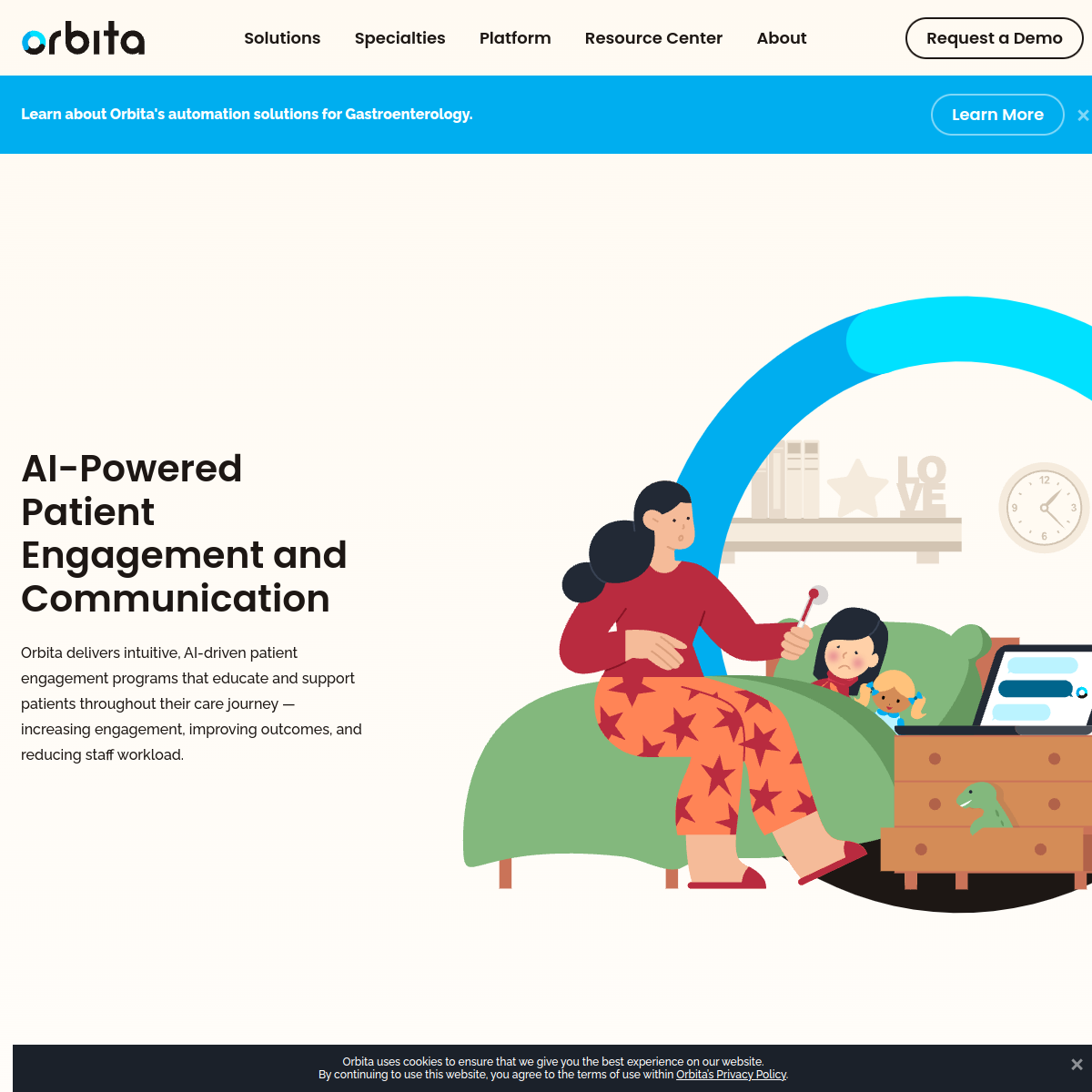
The page we scored
The AI Recommendation Check
When we asked AI who to recommend for AI-powered patient engagement and care navigation software for healthcare, it named:
Buyer we put in the prompt: Chief Information Officer or VP of Digital Health at a mid-to-large health system or specialty care group. Both the buyer and the category were inferred from Orbita’s homepage alone. The model had no web access.
Orbita was not on the list.
A buyer who asked AI this question got 8 names and moved on. Orbita never came up.
We asked AI who it recommends for "Chief Information Officer or VP of Digital Health at a mid-to-large health system or specialty care group" looking for "AI-powered patient engagement and care navigation software for healthcare". It named Nuance Communications, Hyro, HealthJoy, Luma Health, Notable Health. You did not appear. AI can't recommend what it can't clearly understand.
Overall assessment
Orbita's biggest strength is its proof layer ... specific outcome stats (53% cancellation reduction, 30% throughput increase) paired with named testimonials from recognizable health systems give it genuine credibility that most competitors lack. The biggest gap is narrative: the page has no point of view, no named enemy, no cost-of-inaction argument, and no owned language ... it reads like a capable vendor brochure rather than a missionary company with a story, making it nearly invisible to AI recommendation engines looking for quotable, distinctive positioning.
Signal by category
Narrative Clarity
8 signals
Trust Signal
4 signals
AI Signal
6 signals
Conversion Signal
1 signal
Weakest signal · fix this first
02Rebellion / Movement
“No named enemy, status quo, or industry pattern being pushed against anywhere on the page.”
There is zero rebellion framing ... no named villain (fragmented EHRs, phone-based workflows, manual call centers), no status quo being rejected, no missionary point of view anywhere on the page.
All 19 signals, scored 0 to 2.
Total 18/38
Narrative Clarity
8 signals
- 1
01The 7-Second Test
“AI-Powered Patient Engagement and Communication”
Healthcare IT buyers can roughly orient in 7 seconds, but the hero is generic ... 'AI-Powered Patient Engagement' names a category, not a problem or a point of view, and nothing above the fold signals who specifically this is for (health systems? clinics? gastro groups?).
- 0
02Rebellion / Movementweakest
“No named enemy, status quo, or industry pattern being pushed against anywhere on the page.”
There is zero rebellion framing ... no named villain (fragmented EHRs, phone-based workflows, manual call centers), no status quo being rejected, no missionary point of view anywhere on the page.
- 1
03Owned Language & Category
“Digital Front Door”
'Digital Front Door' is a term Orbita uses but does not own ... it is a widely adopted industry phrase; no proprietary framework, coined term, or named category exclusive to Orbita is established.
- 1
04ICP Clarity
“Automated workflows support patients and staff from the earliest stages of access and scheduling”
Healthcare is implied, and health systems are visible in logos and testimonials, but buyer role (VP of Digital Health? CIO? CMO?), company size, and vertical are never explicitly stated in the hero or body copy.
- 0
05Problem Leadership
“Orbita delivers intuitive, AI-driven patient engagement programs that educate and support patients”
The page leads immediately with Orbita's solution, not with the buyer's pain ... staff burnout, same-day cancellations, and operational inefficiency are buried in stats and testimonials, never named upfront as the buyer's lived problem.
- 1
06Solution Clarity
“AI-driven patient engagement programs that educate and support patients throughout their care journey”
A visitor can repeat roughly what Orbita does, but 'patient engagement programs' is vague enough that it doesn't clearly distinguish from a dozen competitors ... the one-sentence explanation lacks mechanical specificity.
- 1
07Cost of Inaction
“53% Reduction in same day cancellations”
Consequences of inaction are implied by the stats (cancellations, low throughput, inefficiency) but the page never directly names what happens to a health system that does nothing ... the stakes are data points, not a cost-of-inaction argument.
- 1
08Promised Land
“increasing engagement, improving outcomes, and reducing staff workload”
The promised land is gestured at but stays generic ... 'improving outcomes and reducing staff workload' is not a vivid, specific 'after' state with concrete numbers or a named transformation buyers can picture themselves living in.
Trust Signal
4 signals
- 2
09Proof & Evidence
“53% Reduction in same day cancellations / 30% Increase in patient throughput / 25% Improvement in operational efficiency”
Multiple concrete percentage outcomes are displayed prominently, plus scale stats (50M+ interactions, 1.5M+ patients served), giving buyers specific, credible deltas rather than vague adjectives.
- 2
10Social Proof
“Harris Hunt, System Vice President, Digital Product and Experience, City of Hope”
Named testimonials with full name, title, and organization from recognizable health systems (City of Hope, SSM, HCA, Ochsner, Sutter) appear prominently with logos, meeting the high bar for social proof.
- 1
11Authority & Credibility
“50M+ Automated patient interactions / 1.5M+ Patients served”
Scale signals establish operational credibility, but there are no founder credentials, original research, published frameworks, awards, or third-party authority signals that demonstrate expertise beyond deployment volume.
- 0
12Alternatives Acknowledged
“No mention of competitors, alternative approaches, or 'do nothing' option anywhere on the page.”
The page completely ignores alternatives ... no comparison to manual workflows, competing vendors, or the cost of doing nothing, leaving buyers without any honest treatment of their real decision landscape.
AI Signal
6 signals
- 1
13Customer Focus
“Orbita delivers intuitive, AI-driven patient engagement programs that educate and support patients”
The page mixes company-centric hero copy with customer testimonials and outcome stats ... it tilts toward the company as protagonist rather than centering the customer's transformation as the primary narrative.
- 1
14AI-Parmesan Index
“AI-Powered Patient Engagement and Communication / AI-driven patient engagement programs / intelligent virtual assistants”
'AI-powered' and 'AI-driven' are sprinkled throughout with no mechanistic explanation of how the AI works, what models are used, or what makes the AI distinctive ... classic AI-Parmesan, partially offset by the concrete outcome stats.
- 1
15LLM Quotability
“53% Reduction in same day cancellations / 30% Increase in patient throughput”
The stat block is quotable, but there are no clean, declarative positioning sentences an LLM could lift verbatim to recommend Orbita ... no crisp 'Orbita is the only X that does Y for Z' sentence exists on the page.
- 2
16Copyright Freshness
“September 2025 - Blog / August 2025 - Blog / June 2025 - Blog”
Three blog posts with explicit month-and-year dates from 2025 are visible on the homepage, providing strong recency signals for AI indexing engines.
- 1
17Entity Distinctiveness
“Digital Front Door / Care Navigation / Patient Access and Acquisition”
Orbita's solution names and healthcare focus give it some distinctiveness, but the overall positioning ('AI-powered patient engagement') is interchangeable with Nuance, Luma Health, or Relatient ... a logo swap would leave the description largely intact.
- 0
18AI Recommendation Check
“AI's picks: Nuance Communications, Hyro, HealthJoy, Luma Health, Notable Health, Kyruus Health. You were not named.”
We asked AI who it recommends for "Chief Information Officer or VP of Digital Health at a mid-to-large health system or specialty care group" looking for "AI-powered patient engagement and care navigation software for healthcare". It named Nuance Communications, Hyro, HealthJoy, Luma Health, Notable Health. You did not appear. AI can't recommend what it can't clearly understand.
Conversion Signal
1 signal
- 1
19Path & CTA Clarity
“Get in touch with us today. [Request a demo]”
There is a primary CTA (Request a demo) but no soft secondary CTA, no visible numbered process showing what happens next, and no path clarity ... the CTA exists in isolation without a connected conversion journey.
Your move
Think Orbita’s score is wrong? Good. Let’s look at it together.
Twenty minutes with Greg. Bring the page, bring the argument. You’ll leave knowing exactly which signal is costing Orbita the AI recommendation, and what to write instead.
Not on the list? Run your homepage through the free Brand Signal Score and see where you’d land. Same 19 signals, same AI check, two minutes.