
The 2026 Healthtech Messaging Index
Greater Good Health
greatergoodhealth.com·scored November 1, 2026
15/38
Weak
The signal is faint. Most of this page is about Greater Good Health, not the buyer, and AI has little it can repeat. There's a lot of room to move.
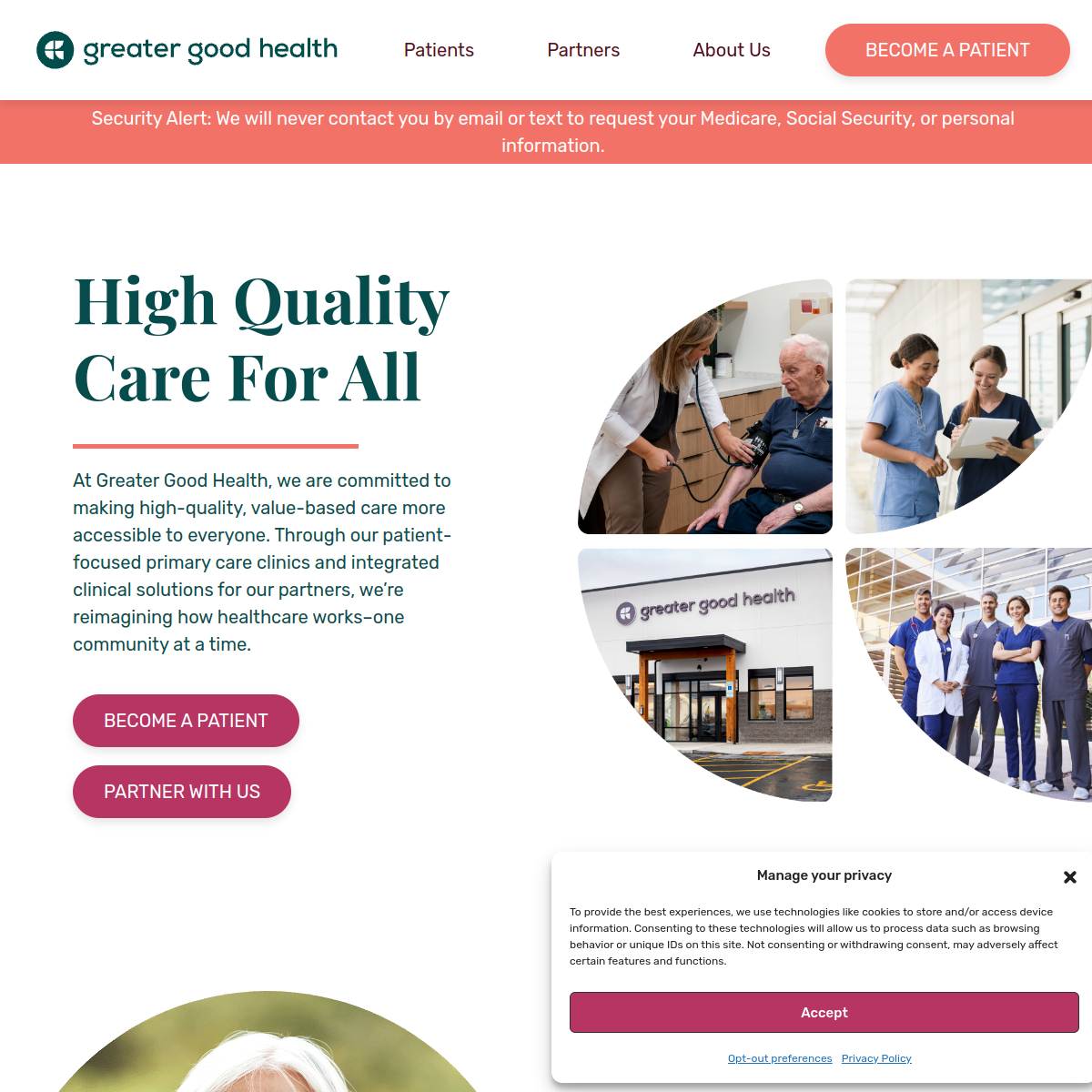
The page we scored
The AI Recommendation Check
When we asked AI who to recommend for Value-based primary care and care management for Medicare populations, it named:
Buyer we put in the prompt: Medicare-eligible senior patients seeking primary care, OR health plan/risk-bearing organization executives seeking value-based care partnerships. Both the buyer and the category were inferred from Greater Good Health’s homepage alone. The model had no web access.
Greater Good Health was not on the list.
A buyer who asked AI this question got 8 names and moved on. Greater Good Health never came up.
We asked AI who it recommends for "Medicare-eligible senior patients seeking primary care, OR health plan/risk-bearing organization executives seeking value-based care partnerships" looking for "Value-based primary care and care management for Medicare populations". It named ChenMed, Oak Street Health, Iora Health (now part of One Medical/Amazon), Devoted Health, Alignment Health. You did not appear. AI can't recommend what it can't clearly understand.
Overall assessment
Greater Good Health's biggest strength is its concrete outcomes data ... a 90 NPS (nearly double industry average), 4.33 star quality rating, and 60% ED avoidance rate give the B2B partner case real credibility. The biggest gap is narrative specificity: the page never names a named enemy, coins any owned language, shows the cost of inaction, or presents anonymous testimonials with names attached ... leaving it indistinguishable from Oak Street Health, ChenMed, or any other value-based care provider at a glance.
Signal by category
Narrative Clarity
8 signals
Trust Signal
4 signals
AI Signal
6 signals
Conversion Signal
1 signal
Weakest signal · fix this first
03Owned Language & Category
“proactive, preventive care, ongoing support, and lasting relationships" ... all commodity healthcare language.”
The page uses entirely generic category language ('primary care,' 'preventive care,' 'care coordination') with no owned terms, named frameworks, or coined categories an AI would uniquely attribute to Greater Good Health.
All 19 signals, scored 0 to 2.
Total 15/38
Narrative Clarity
8 signals
- 1
01The 7-Second Test
“Delivering Care Everyone Deserves" / "Healthcare shouldn't begin and end with an appointment.”
The hero communicates a general philosophy and audience (patients needing care) but the specific problem, population (seniors/Medicare), and POV are not immediately obvious without reading further.
- 1
02Rebellion / Movement
“Healthcare shouldn't begin and end with an appointment.”
There's an implicit rebellion against episodic, appointment-only care, but no named enemy, named industry pattern, or explicit 'status quo we reject' framing ... it hints at a movement without declaring one.
- 0
03Owned Language & Categoryweakest
“proactive, preventive care, ongoing support, and lasting relationships" ... all commodity healthcare language.”
The page uses entirely generic category language ('primary care,' 'preventive care,' 'care coordination') with no owned terms, named frameworks, or coined categories an AI would uniquely attribute to Greater Good Health.
- 1
04ICP Clarity
“For Patients / For Brokers / For Partners" and "Medicare Annual Enrollment: Know Your Options”
The page attempts to segment three audiences but none are defined with specificity ... no company size, geography emphasis, or clear role description that instantly confirms 'this is for me.'
- 0
05Problem Leadership
“Delivering Care Everyone Deserves" leads with company aspiration, not buyer problem.”
The page opens with a company value statement rather than naming the buyer's pain; the closest thing to a problem statement ('waiting weeks isn't always an option') appears well below the fold.
- 1
06Solution Clarity
“primary care, proactive outreach, and care coordination, we help you stay healthier and make healthcare easier to navigate”
A visitor could approximate what Greater Good Health does, but the sentence is generic enough to describe dozens of primary care organizations without differentiation.
- 0
07Cost of Inaction
“No cost-of-inaction language anywhere on the page.”
The page never names what happens to patients or partners who don't act ... no mention of worsening outcomes, rising costs, missed diagnoses, or readmissions tied to inaction.
- 1
08Promised Land
“Care that stays connected to you" / "Support doesn't stop when your appointment ends.”
There is a vague 'after' state of being continuously supported, but it lacks specificity ... no concrete life outcome, metric, or vivid picture of what ongoing connected care actually looks like for the patient.
Trust Signal
4 signals
- 2
09Proof & Evidence
“4.33 Star Quality" / "90 Net Promoter Score" / "60 Percent Avoidance of Unnecessary ED Visits" / "200K patients connected to care every year”
The page provides multiple specific, sourced metrics with benchmarks (NPS vs. industry average of 47) and claims data citations, which is concrete and above average for healthcare homepages.
- 1
10Social Proof
“4.6 Average Patient Rating" ... testimonials are anonymous: 'Greater Good Health Patient' with no names, titles, or locations.”
Star rating and volume of reviews add credibility, but all testimonials are anonymous and generic, eliminating the trust signal that named, specific customer stories would provide.
- 1
11Authority & Credibility
“80+ providers" / "5 wholly-owned clinic locations in addition to 25+ locations across the nation”
Scale signals are present but no founder credentials, original research, frameworks, awards, or external recognition are cited ... authority is implied by size, not demonstrated by expertise.
- 0
12Alternatives Acknowledged
“No mention of competitors, alternative care models, or 'do nothing' consequences anywhere on the page.”
The page never acknowledges what buyers might otherwise do ... urgent care, traditional primary care, telehealth-only, or doing nothing ... making it feel incomplete for a considered B2B purchase.
AI Signal
6 signals
- 1
13Customer Focus
“we help you stay healthier" alongside "Programs that help manage total cost of care" ... toggles between patient and partner protagonist.”
The page mixes customer-facing and company-facing language throughout, tilting toward the company's capabilities rather than consistently placing the customer as the protagonist of the transformation.
- 2
14AI-Parmesan Index
“No AI claims made anywhere on the page.”
Greater Good Health makes zero AI-powered claims, earning a clean score ... the page earns credibility by not sprinkling AI buzzwords on a human-care narrative.
- 1
15LLM Quotability
“Nearly double the healthcare industry average of 47. We publish our NPS after every visit, giving you a partner you can stand behind.”
The NPS sentence is close to quotable and declarative, but most page copy is too vague or emotional to be the kind of specific, citation-ready claim an LLM would lift verbatim to recommend the company.
- 0
16Copyright Freshness
“Image URLs reference '2026/09' and '2026/01' ... no visible blog posts, case studies with dates, or current copyright year visible in scraped content.”
Future-dated asset URLs (2026) are a technical artifact, not a content freshness signal; there are no dated articles, case studies, or visible copyright year to signal recency to AI engines.
- 1
17Entity Distinctiveness
“We publish our NPS after every visit" and "60 Percent Avoidance of Unnecessary ED Visits" are somewhat distinctive claims.”
The NPS transparency claim and ED avoidance metric create mild differentiation, but the overall positioning ('proactive primary care for seniors') is easily attributable to dozens of value-based care competitors like ChenMed or Oak Street Health.
- 0
18AI Recommendation Check
“AI's picks: ChenMed, Oak Street Health, Iora Health (now part of One Medical/Amazon), Devoted Health, Alignment Health, WellMed Medical Management. You were not named.”
We asked AI who it recommends for "Medicare-eligible senior patients seeking primary care, OR health plan/risk-bearing organization executives seeking value-based care partnerships" looking for "Value-based primary care and care management for Medicare populations". It named ChenMed, Oak Street Health, Iora Health (now part of One Medical/Amazon), Devoted Health, Alignment Health. You did not appear. AI can't recommend what it can't clearly understand.
Conversion Signal
1 signal
- 1
19Path & CTA Clarity
“For Patients / For Brokers / For Partners" tabs with separate CTAs: "Get Care Today" and "Partner With Us”
The page offers audience segmentation and dual CTAs but there is no visible numbered process or journey path connecting steps to the CTAs, so the conversion architecture is incomplete.
Your move
Think Greater Good Health’s score is wrong? Good. Let’s look at it together.
Twenty minutes with Greg. Bring the page, bring the argument. You’ll leave knowing exactly which signal is costing Greater Good Health the AI recommendation, and what to write instead.
Not on the list? Run your homepage through the free Brand Signal Score and see where you’d land. Same 19 signals, same AI check, two minutes.