
The 2026 Healthtech Messaging Index
GoCheck Kids
gocheckkids.com·scored November 1, 2026
21/38
Invisible
The page is doing some work, but the story isn't landing fast enough. Buyers and AI are both left guessing what makes GoCheck Kids different.
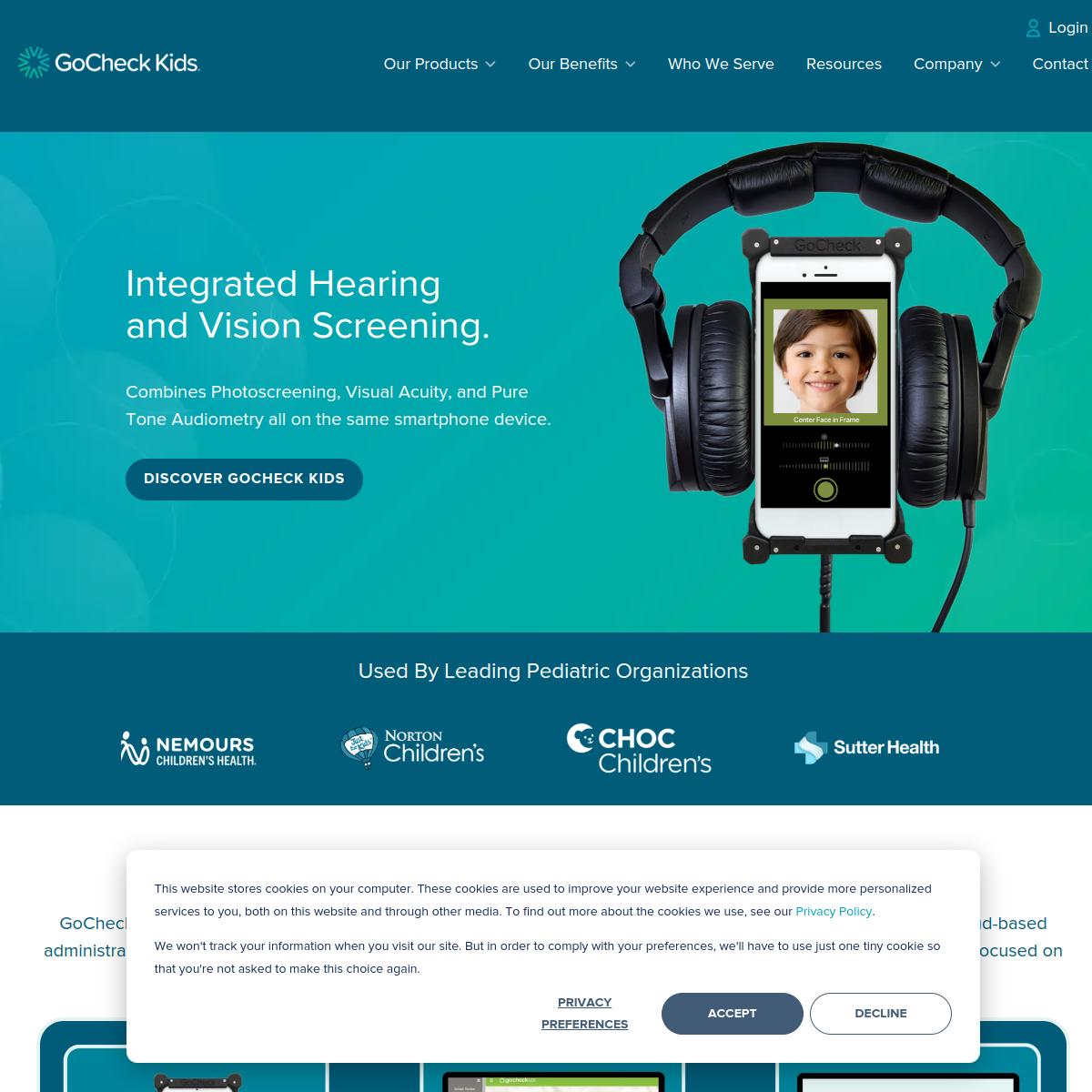
The page we scored
The AI Recommendation Check
When we asked AI who to recommend for Pediatric vision and hearing screening devices and software for clinical settings, it named:
Buyer we put in the prompt: Pediatric practice administrator, clinical nurse manager, or physician at a pediatric practice, health system, FQHC, Head Start program, or school-based health setting. Both the buyer and the category were inferred from GoCheck Kids’s homepage alone. The model had no web access.
GoCheck Kids was on the list.
AI named them for their own category. That's the signal every homepage is supposed to send.
AI mentioned you for "Pediatric vision and hearing screening devices and software for clinical settings", but only generically: "GoCheck Kids offers a smartphone-based pediatric vision screening app designed for clinical settings, aiming to simplify the screening process and integrate with EHR systems.". You're on the radar, but AI doesn't yet repeat your specific positioning back.
Overall assessment
GoCheck Kids' biggest strength is social proof ... named testimonials from UCSF, Mountain Family Health Centers, and recognizable children's hospital logos give the page genuine credibility. The biggest gap is the complete absence of quantified proof and cost-of-inaction framing: there is not a single concrete metric (detection rate, time saved, reimbursement recovered) and no articulation of what a practice risks by staying with fragmented, outdated equipment, leaving urgency entirely on the table.
Signal by category
Narrative Clarity
8 signals
Trust Signal
4 signals
AI Signal
6 signals
Conversion Signal
1 signal
Weakest signal · fix this first
07Cost of Inaction
“No mention of missed diagnoses, referral rates, compliance risk, or cost of continuing with fragmented equipment anywhere on the page.”
The page never names the stakes of inaction ... no lost revenue, no missed diagnoses, no regulatory consequences ... so the urgency to change is absent.
All 19 signals, scored 0 to 2.
Total 21/38
Narrative Clarity
8 signals
- 2
01The 7-Second Test
“FOR PEDIATRIC HEALTHCARE PROFESSIONALS / Modern Pediatric Vision and Hearing Screening ... All on One Device”
Within 7 seconds, a visitor knows the audience (pediatric healthcare professionals), the solution (vision and hearing screening on one device), and the core benefit (workflow consolidation); clear enough for a caveman.
- 1
02Rebellion / Movement
“Historically, photoscreening, visual acuity, and pure tone audiometry have required separate pieces of equipment ... often bulky and outdated.”
There is a named status quo (bulky, separate, outdated equipment), but no named enemy, no manifesto-level framing, and no movement language that signals a missionary point of view.
- 1
03Owned Language & Category
“GoCheck MultiScreener”
The product name 'GoCheck MultiScreener' and the phrase 'pediatric screening stack' hint at category ownership, but no coined term, named framework, or declared category is staked out that an AI would quote back as uniquely theirs.
- 2
04ICP Clarity
“FOR PEDIATRIC HEALTHCARE PROFESSIONALS / Trusted by pediatric practices, health systems, FQHCs, Head Start programs, schools, and screening organizations.”
The ICP is explicit in the hero eyebrow label and reinforced by listing specific verticals (FQHCs, Head Start, health systems), making it immediately clear whether a visitor belongs.
- 1
05Problem Leadership
“Built for the economics of modern care. Routine screenings are critical for early detection of preventable vision and hearing loss.”
The page acknowledges the clinical problem but leads with the product and its features rather than dwelling in the buyer's pain before presenting the solution.
- 2
06Solution Clarity
“The GoCheck MultiScreener combines photoscreening, visual acuity, and pure tone audiometry to improve clinical workflows and patient care.”
A visitor can repeat exactly what GoCheck Kids does in one sentence after reading the hero; solution clarity is concrete and unambiguous.
- 0
07Cost of Inactionweakest
“No mention of missed diagnoses, referral rates, compliance risk, or cost of continuing with fragmented equipment anywhere on the page.”
The page never names the stakes of inaction ... no lost revenue, no missed diagnoses, no regulatory consequences ... so the urgency to change is absent.
- 1
08Promised Land
“allowing more children to be screened, ultimately leading to better life outcomes”
A vague 'better life outcomes' is the closest the page gets to an after-state; it lacks specificity (e.g., detection rates, time saved, referral improvements) that would make the promised land vivid and credible.
Trust Signal
4 signals
- 0
09Proof & Evidence
“No specific numbers, before/after deltas, detection rates, time-saved figures, or quantified outcomes anywhere on the page.”
Every proof point is adjective-driven ('fast,' 'easy,' 'affordable,' 'game-changer') with zero concrete metrics or measurable outcomes cited.
- 2
10Social Proof
“Rachel Chiorean, Clinical Nurse Manager | UCSF / Kendra Nagey, Director of Pediatrics | Mountain Family Health Centers / CHOC Children's, Nemours, Norton Children's”
Named individuals with titles and institutions, plus recognizable health system logos including UCSF and Nemours, provide credible, attributable social proof.
- 1
11Authority & Credibility
“meeting AAP recommendations for screening pre-verbal children from 12 months and up / HIPAA and HITECH-compliant, and we maintain SOC 2 Type II certification”
AAP alignment and SOC 2 certification gesture at authority, but there are no founder credentials, original research, awards, or published frameworks that demonstrate earned authority.
- 0
12Alternatives Acknowledged
“No mention of competitors, alternative approaches, or the 'do nothing' option anywhere on the page.”
The page ignores every competing option ... other devices, manual methods, or inaction ... leaving buyers without any honest comparison to build trust.
AI Signal
6 signals
- 1
13Customer Focus
“Our goal is to equip clinicians with an easy-to-use, affordable tool ... allowing more children to be screened”
The page mixes company capability framing ('our goal,' 'we offer,' 'our solutions') with some customer-outcome language, but the company remains the protagonist more often than the clinician.
- 2
14AI-Parmesan Index
“No AI claims on the page; 'analyzes bilateral amblyopia risk factors automatically' is the closest technical mechanism cited.”
GoCheck Kids makes no 'AI-powered' sprinkle claims; the one automated function is described mechanistically, so this criterion scores clean.
- 1
15LLM Quotability
“The GoCheck Kids platform conducts 3 simple screenings, producing results that sync with our cloud-based portal and your EHR system.”
That sentence is clean and citable, but most of the page is feature lists and testimonials rather than declarative, quotable positioning statements an LLM could lift as a recommendation.
- 0
16Copyright Freshness
“No visible blog post dates, case study dates, or copyright year found in the scraped content.”
There are no recency signals ... no dated content, no copyright year ... that would signal freshness to AI engines or human buyers.
- 2
17Entity Distinctiveness
“The GoCheck MultiScreener combines photoscreening, visual acuity, and pure tone audiometry... all 3 tests from a single device / subscription pricing / annual calibration included”
The combination of three screenings on one proprietary device, subscription model, included calibration, and named EHR integrations creates a sufficiently distinct fingerprint that an AI could not easily swap this description onto a generic competitor.
- 1
18AI Recommendation Check
“AI named you alongside Welch Allyn (Hillrom/Baxter), Spot Vision Screener by Welch Allyn, Plusoptix, GoCheck Kids, Maico Diagnostics, describing you as: "GoCheck Kids offers a smartphone-based pediatric vision screening app designed for clinical settings, aiming to simplify the screening process and integrate with EHR systems.".”
AI mentioned you for "Pediatric vision and hearing screening devices and software for clinical settings", but only generically: "GoCheck Kids offers a smartphone-based pediatric vision screening app designed for clinical settings, aiming to simplify the screening process and integrate with EHR systems.". You're on the radar, but AI doesn't yet repeat your specific positioning back.
Conversion Signal
1 signal
- 1
19Path & CTA Clarity
“Schedule a Demo / Get Pricing”
There are two CTAs (demo and pricing) but no visible numbered process or path showing what happens after clicking, so the conversion path is present but incomplete.
Keep the lead
AI already names GoCheck Kids. The next edition decides if it still does.
Twenty minutes with Greg. Bring the page, bring the argument. You’ll leave knowing exactly which signal is costing GoCheck Kids the AI recommendation, and what to write instead.
Not on the list? Run your homepage through the free Brand Signal Score and see where you’d land. Same 19 signals, same AI check, two minutes.