
The 2026 Healthtech Messaging Index
Twin Health
twinhealth.com·scored September 1, 2026
24/38
Approaching
Close. The bones are good. A few targeted fixes on the weakest signals would push Twin Health into magnetic territory.
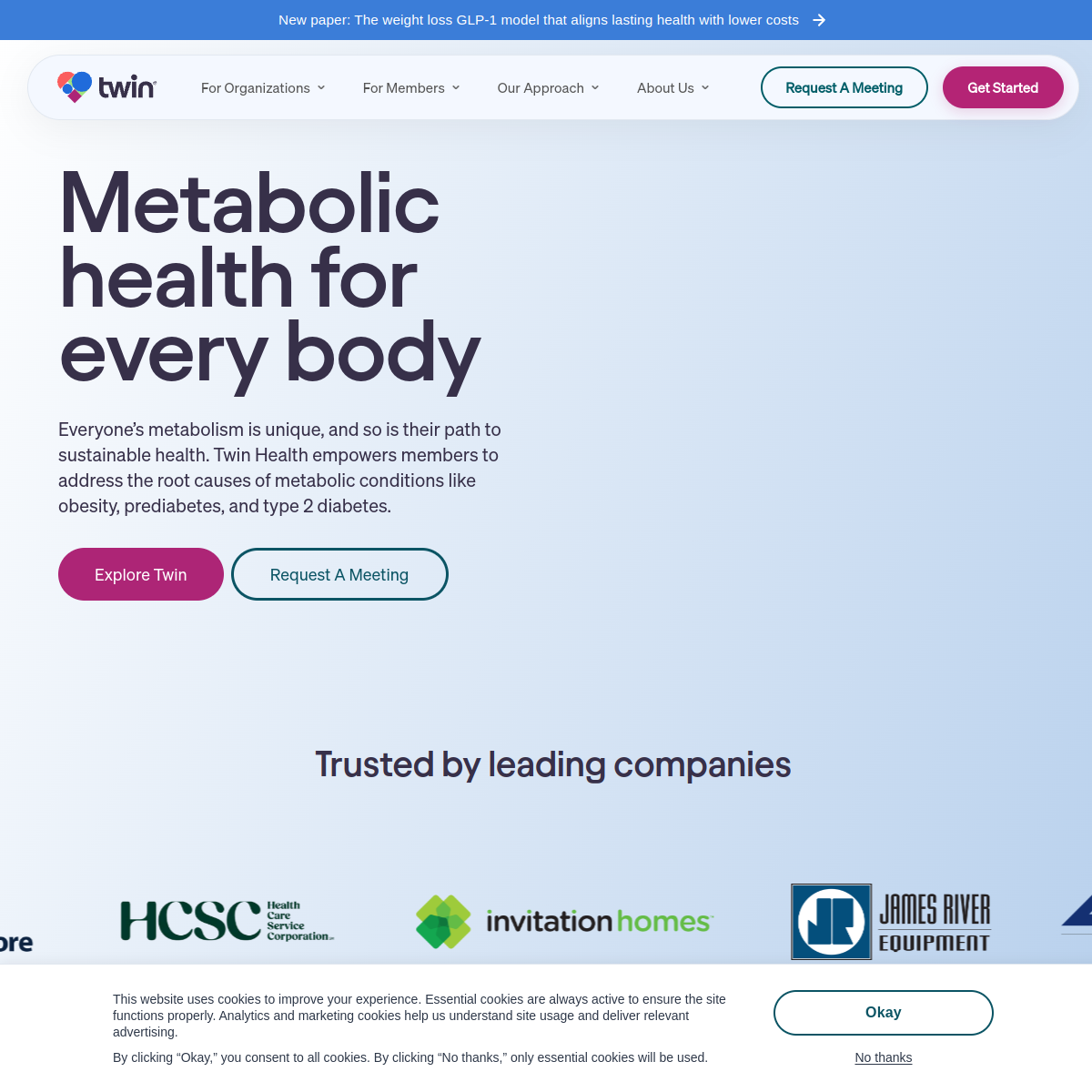
The page we scored
The AI Recommendation Check
When we asked AI who to recommend for AI-powered metabolic health program for employers and health plans (digital therapeutics for diabetes, obesity, and prediabetes), it named:
Buyer we put in the prompt: VP of Benefits or Chief People Officer at an employer with 10,000+ employees, or a Medical Director at a health plan. Both the buyer and the category were inferred from Twin Health’s homepage alone. The model had no web access.
Twin Health was on the list.
AI named them for their own category. That's the signal every homepage is supposed to send.
AI named you when asked who it recommends for "AI-powered metabolic health program for employers and health plans (digital therapeutics for diabetes, obesity, and prediabetes)", and described you accurately: "Twin Health uses an AI-driven 'whole body digital twin' to model individual metabolism in real time, aiming to reverse type 2 diabetes and metabolic conditions for employer and health plan clients.". Your positioning is landing with the machines.
Overall assessment
Twin Health's biggest strength is its clinical proof stack ... nine peer-reviewed journal citations, four concrete outcome stats (85% GLP-1 elimination, 71% A1C normalization), and a trademarked named technology ('AI digital twin™') that gives AI engines something distinctive to quote. The biggest gap is the complete absence of a B2B buyer's problem at the top of the page: there is no named enemy, no cost of inaction for employers or health plans, and no competitive context, which means a benefits VP landing here gets a member-health story instead of a business case for why they should switch from whatever they're doing now.
Signal by category
Narrative Clarity
8 signals
Trust Signal
4 signals
AI Signal
6 signals
Conversion Signal
1 signal
Weakest signal · fix this first
02Rebellion / Movement
“No named enemy, named status quo, or industry pattern the company is pushing against anywhere on the page.”
There is zero missionary framing ... no critique of medication-first care, GLP-1 dependency culture, or legacy disease management; the page makes no argument about what's broken in the industry.
All 19 signals, scored 0 to 2.
Total 24/38
Narrative Clarity
8 signals
- 1
01The 7-Second Test
“Metabolic health for every body" / "Twin Health empowers members to address the root causes of metabolic conditions like obesity, prediabetes, and type 2 diabetes.”
The problem space (metabolic conditions) is clear in 7 seconds, but the hero doesn't immediately signal who the B2B buyer is ... employers and health plans only surface well below the fold, so a stranger can't instantly grasp the business model or point of view.
- 0
02Rebellion / Movementweakest
“No named enemy, named status quo, or industry pattern the company is pushing against anywhere on the page.”
There is zero missionary framing ... no critique of medication-first care, GLP-1 dependency culture, or legacy disease management; the page makes no argument about what's broken in the industry.
- 2
03Owned Language & Category
“Meet your AI digital twin™" / "The AI digital twin is a real-time model of your body's unique metabolism.”
"AI digital twin™" is a trademarked, named term the company owns and consistently uses across the page; it is specific enough that an LLM could attribute it uniquely to Twin Health.
- 1
04ICP Clarity
“For Employers" / "For Health Plans" / "For Members" ... segmentation appears only mid-page after generic hero copy.”
The three buyer types exist on the page but are buried below the fold; the hero opens with member-centric language, leaving B2B buyers (employers, health plans) without an immediate signal that they are the intended buyer.
- 1
05Problem Leadership
“Metabolic issues like inflammation and insulin resistance are behind many chronic health conditions.”
The page gestures at root-cause problems but leads with the solution concept ('AI digital twin') rather than foregrounding the buyer's business pain ... rising healthcare costs, GLP-1 spend, or workforce productivity loss.
- 2
06Solution Clarity
“The AI digital twin is a real-time model of your body's unique metabolism. It analyzes data from sensors and smart devices. It gives you daily guidance on food, sleep, activity, stress, and more.”
A visitor can repeat exactly what the product does in one sentence after reading this section; the mechanism is concrete and plain-language.
- 0
07Cost of Inaction
“No mention of rising healthcare costs, GLP-1 drug spend, employee productivity loss, or any cost of doing nothing for the B2B buyer anywhere on the page.”
The page never names the price an employer or health plan pays for inaction ... no dollar figures lost, no trend data, no consequences of staying with the status quo.
- 1
08Promised Land
“members wake up with more energy, play with their kids or grandkids a little longer, and enjoy a weekend getaway without packing their meds.”
The 'after' state is painted for members but is emotionally generic; there is no specific promised land articulated for the B2B buyer (e.g., reduced PMPM spend, off GLP-1 dependency, healthier workforce metrics).
Trust Signal
4 signals
- 2
09Proof & Evidence
“71% lowered A1C below 6.5%" / "-27 lbs average weight loss" / "85% GLP-1 elimination" / "46% insulin elimination”
Four concrete, quantified outcome stats tied to a named peer-reviewed study (Cleveland Clinic / NEJM Catalyst) provide strong before/after evidence rather than adjectives.
- 1
10Social Proof
“I've lost more than 50 pounds. I was taken off one of my diabetes medications, and my A1C is down to 6.3." ... Deb, Twin Member”
Member testimonials include first names and specific outcomes, but no last names, job titles, employer names, or B2B client case studies; employer logos appear without any attributed quote or ROI claim.
- 2
11Authority & Credibility
“The New England Journal of Medicine (NEJM) Catalyst" / "Nature" / "The Lancet" / "American Heart Association" / "JACC Journals" ... nine named peer-reviewed publications cited.”
An extensive, named list of peer-reviewed journal publications across top-tier outlets is demonstrated authority, not merely claimed; this is unusually strong credibility signaling for a health tech homepage.
- 0
12Alternatives Acknowledged
“No mention of competitors, GLP-1 drugs as an alternative, disease management programs, or 'do nothing' framing anywhere on the page.”
The page never acknowledges that buyers are also considering Omada, Virta, Noom, or simply paying for GLP-1 prescriptions, leaving the competitive context entirely unaddressed.
AI Signal
6 signals
- 1
13Customer Focus
“Our outcomes aren't just clinical ... they're human." / member testimonials dominate the bottom half, but the hero and product sections lead with Twin's technology.”
The page is mixed ... member transformation stories appear but the upper half is dominated by company capability descriptions ('The AI digital twin is a real-time model...'), so the customer is not the consistent protagonist.
- 2
14AI-Parmesan Index
“The AI digital twin is a real-time model of your body's unique metabolism. It analyzes data from sensors and smart devices.”
AI claims are mechanistic and specific ... real-time metabolic modeling, sensor data ingestion, personalized daily guidance ... not vague 'AI-powered' sprinkle; the mechanism is explained.
- 2
15LLM Quotability
“71% lowered A1C below 6.5% without glucose-lowering medications (except metformin)" / "85% GLP-1 elimination" ... Cleveland Clinic study, NEJM Catalyst.”
Multiple clean, declarative, citation-ready sentences with named journals and specific percentages are exactly the kind of sentences an LLM would lift verbatim to recommend this company.
- 1
16Copyright Freshness
“*2025 Twin Health group results of the Cleveland Clinic study published in the New England Journal of Medicine Catalyst.”
One 2025 date reference appears in a stat footnote and one Nature study is dated Oct 2024, but there are no visible blog post dates, case study dates, or a footer copyright year visible in the scraped content to confirm freshness.
- 2
17Entity Distinctiveness
“AI digital twin™" + nine named peer-reviewed publications + "85% GLP-1 elimination" + Cleveland Clinic partnership ... no competitor could claim this identical combination.”
The combination of a trademarked named technology, NEJM Catalyst publication, and specific GLP-1/insulin elimination stats makes this page unmistakably distinct; swapping the logo would break the description.
- 2
18AI Recommendation Check
“AI described you as: "Twin Health uses an AI-driven 'whole body digital twin' to model individual metabolism in real time, aiming to reverse type 2 diabetes and metabolic conditions for employer and health plan clients.”
AI named you when asked who it recommends for "AI-powered metabolic health program for employers and health plans (digital therapeutics for diabetes, obesity, and prediabetes)", and described you accurately: "Twin Health uses an AI-driven 'whole body digital twin' to model individual metabolism in real time, aiming to reverse type 2 diabetes and metabolic conditions for employer and health plan clients.". Your positioning is landing with the machines.
Conversion Signal
1 signal
- 1
19Path & CTA Clarity
“Request A Meeting" (primary CTA) appears twice; a qualification form segments employer vs. member at bottom; "Explore Twin" is a secondary link.”
There is a primary CTA and a soft secondary, but no visible numbered process or clear 'here's what happens next' path connecting the CTA to an outcome, so the conversion journey is incomplete.
Keep the lead
AI already names Twin Health. The next edition decides if it still does.
Twenty minutes with Greg. Bring the page, bring the argument. You’ll leave knowing exactly which signal is costing Twin Health the AI recommendation, and what to write instead.
Not on the list? Run your homepage through the free Brand Signal Score and see where you’d land. Same 19 signals, same AI check, two minutes.