
The 2026 Healthtech Messaging Index
Theator
theator.io·scored September 1, 2026
32/38
Magnetic
Theator's story is sharp. Buyers get it fast, and AI has clean lines to quote back. This is what category leadership reads like.
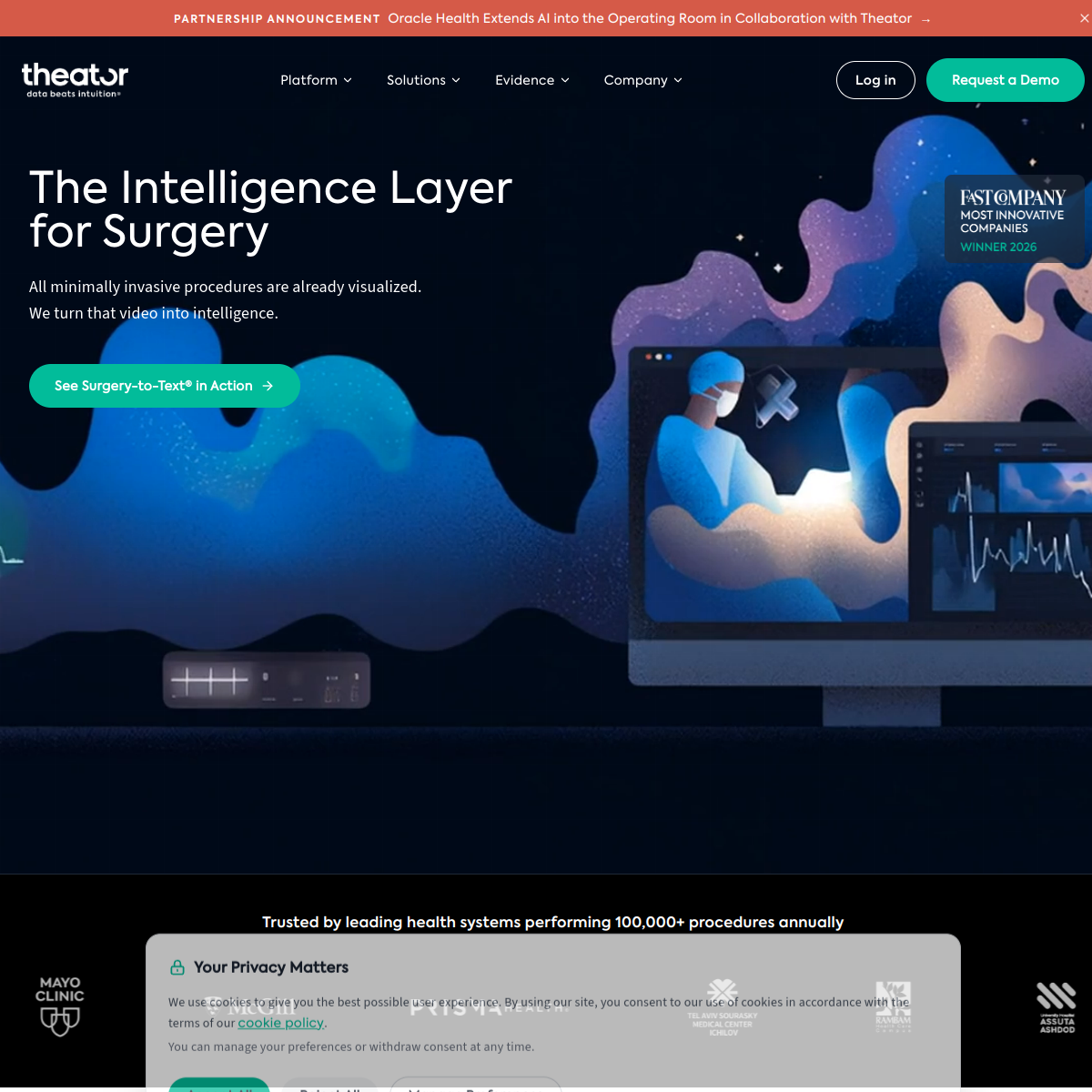
The page we scored
The AI Recommendation Check
When we asked AI who to recommend for Surgical intelligence and AI-powered operative report automation software, it named:
Buyer we put in the prompt: Chief Medical Officer, VP of Surgical Services, or CFO at a large health system or academic medical center performing high volumes of minimally invasive procedures. Both the buyer and the category were inferred from Theator’s homepage alone. The model had no web access.
Theator was on the list.
AI named them for their own category. That's the signal every homepage is supposed to send.
AI named you when asked who it recommends for "Surgical intelligence and AI-powered operative report automation software", and described you accurately: "Theator is a surgical AI platform that analyzes intraoperative video to generate operative reports and provide surgical analytics, aiming to replace manual, memory-based documentation with video-derived data.". Your positioning is landing with the machines.
Overall assessment
Theator's biggest strength is its owned language and evidence stack ... Surgery-to-Text® is a registered trademark with sourced accuracy deltas, named luminaries, and a mechanistically specific AI claim that sets it apart from every generic health AI vendor. The single biggest gap is ICP role clarity and the promised land: the page never names the specific buyer role (CMO, CFO, VP Surgery) nor paints a vivid, quantified 'after' state for the enterprise, which means qualified buyers may recognize the problem without seeing themselves as the explicit protagonist being called to act.
Signal by category
Narrative Clarity
8 signals
Trust Signal
4 signals
AI Signal
6 signals
Conversion Signal
1 signal
Weakest signal · fix this first
04ICP Clarity
“Trusted by leading health systems performing 100,000+ procedures annually”
Health systems are implied but the specific buyer role (CMO, CFO, VP of Surgery, CDI leader) is never named, leaving the ICP partially visible but not role-specific.
All 19 signals, scored 0 to 2.
Total 32/38
Narrative Clarity
8 signals
- 2
01The 7-Second Test
“The Intelligence Layer for Surgery" / "We turn that video into intelligence.”
Within 7 seconds a stranger knows it's for surgical health systems, the problem is unstructured OR video, and the POV is that video already exists but goes unused ... clear and concrete.
- 2
02Rebellion / Movement
“Operative reports ... written from memory, hours and even days after the procedure, using templates that miss procedure-specific detail.”
The page explicitly names the enemy: memory-based, delayed operative reports that are inaccurate ... a specific, named status quo the company is rebelling against.
- 2
03Owned Language & Category
“Surgery-to-Text®" and "The Intelligence Layer for Surgery" and "surgical intelligence”
The page owns a registered trademark term (Surgery-to-Text®), coins 'surgical intelligence' as a category frame, and claims 'intelligence layer' ... all quotable, ownable language AI can cite back.
- 1
04ICP Clarityweakest
“Trusted by leading health systems performing 100,000+ procedures annually”
Health systems are implied but the specific buyer role (CMO, CFO, VP of Surgery, CDI leader) is never named, leaving the ICP partially visible but not role-specific.
- 2
05Problem Leadership
“The most complex, valuable, and least directly measured domain in healthcare has been operating without an intelligence layer.”
The page leads with the buyer's problem ... inaccurate, delayed operative reports and missing OR intelligence ... before introducing any solution.
- 2
06Solution Clarity
“Surgery-to-Text® transforms that video into a complete, structured operative report, eliminating the documentation burden for surgeons.”
A visitor can repeat in one sentence exactly what the product does after reading the hero and product spotlight sections.
- 2
07Cost of Inaction
“~73% average accuracy of surgeon-written operative reports" / "$118 average cost per surgical claim denial rework" / "69% surgeon burnout rate”
The page quantifies the financial, clinical, and human cost of inaction with sourced statistics, making the stakes concrete and urgent.
- 1
08Promised Land
“For the first time, the clinical record reflects what actually happened in the operating room.”
The promised land is gestured at (accurate records, downstream workflow improvement) but no vivid, specific 'after' state for the buyer's enterprise ... outcomes like revenue recovered or hours saved ... is painted with enough specificity.
Trust Signal
4 signals
- 2
09Proof & Evidence
“>95% documentation accuracy (vs. ~73% manual)" / "70% reduction in time to final op note, median 6 edits per case”
The page delivers sourced before/after deltas with named institutions (Mayo Clinic, JACS 2025, University of Miami), making claims concrete and verifiable.
- 2
10Social Proof
“Toby Cosgrove, M.D., Former President and CEO, Cleveland Clinic" with full verbatim quote plus multiple health system logos”
Named testimonial with full title and institution, multiple customer logos, and a Fast Company Most Innovative Companies badge combine for strong social proof.
- 2
11Authority & Credibility
“Dr. Toby Cosgrove, Former President & CEO, Cleveland Clinic" / "The Honorable Dr. David Shulkin, 9th U.S. Secretary of Veterans Affairs”
Advisory board includes a former Cleveland Clinic CEO/cardiac surgeon and a former U.S. Secretary of Veterans Affairs ... authority is demonstrated through named, credentialed luminaries, not claimed adjectives.
- 1
12Alternatives Acknowledged
“Unlike ambient dictation tools that transcribe what surgeons say, Surgery-to-Text® analyzes what surgeons do.”
One competitor category (ambient dictation) is named and differentiated, but no direct competitors by name, no 'do nothing' cost, and no fuller alternatives landscape is addressed.
AI Signal
6 signals
- 1
13Customer Focus
“Surgery drives outcomes and profitability across your enterprise." vs. heavy product capability descriptions throughout”
The page tilts toward the customer's world in the problem section but pivots to company capabilities and product features mid-page, making it a mixed protagonist story rather than a customer-led transformation.
- 2
14AI-Parmesan Index
“proprietary surgical model trained on hundreds of thousands of real-world procedures" / "analyzes what surgeons do”
AI claims are mechanistic and specific ... a proprietary model, trained on real procedure video, analyzing actions not words ... not generic 'AI-powered' sprinkle language.
- 2
15LLM Quotability
“Surgery-to-Text® analyzes what surgeons do." / "The most complex, valuable, and least directly measured domain in healthcare has been operating without an intelligence layer.”
Multiple declarative, quotable sentences exist that an LLM could lift verbatim to describe and recommend the company with precision.
- 1
16Copyright Freshness
“Mayo Clinic / Theator, JACS 2025" and "Corazon Inc. 2023" cited but no visible copyright year or recent blog/case study dates on the homepage”
Research citations include years but no visible homepage copyright date or dated blog/case study posts were present in the scraped content, weakening recency signals.
- 2
17Entity Distinctiveness
“Surgery-to-Text®" + "surgical intelligence" + "intelligence layer for surgery" + "analyzes what surgeons do" + proprietary model on OR video”
The combination of a registered trademark, a coined category, a specific mechanism (video-to-report from scope-on to scope-off), and named luminaries makes this unmistakably distinct from any generic health AI vendor.
- 2
18AI Recommendation Check
“AI described you as: "Theator is a surgical AI platform that analyzes intraoperative video to generate operative reports and provide surgical analytics, aiming to replace manual, memory-based documentation with video-derived data.”
AI named you when asked who it recommends for "Surgical intelligence and AI-powered operative report automation software", and described you accurately: "Theator is a surgical AI platform that analyzes intraoperative video to generate operative reports and provide surgical analytics, aiming to replace manual, memory-based documentation with video-derived data.". Your positioning is landing with the machines.
Conversion Signal
1 signal
- 1
19Path & CTA Clarity
“See Surgery-to-Text® in Action" (primary CTA) / "Request a Demo" (secondary CTA) but no numbered steps or visible process connecting them”
Two CTAs exist (primary and secondary) but there is no visible numbered path or stated process guiding the buyer from discovery to demo, so the conversion journey is incomplete.
Keep the lead
AI already names Theator. The next edition decides if it still does.
Twenty minutes with Greg. Bring the page, bring the argument. You’ll leave knowing exactly which signal is costing Theator the AI recommendation, and what to write instead.
Not on the list? Run your homepage through the free Brand Signal Score and see where you’d land. Same 19 signals, same AI check, two minutes.