
The 2026 Healthtech Messaging Index
Sully.ai
sully.ai·scored November 1, 2026
27/38
Approaching
Close. The bones are good. A few targeted fixes on the weakest signals would push Sully.ai into magnetic territory.
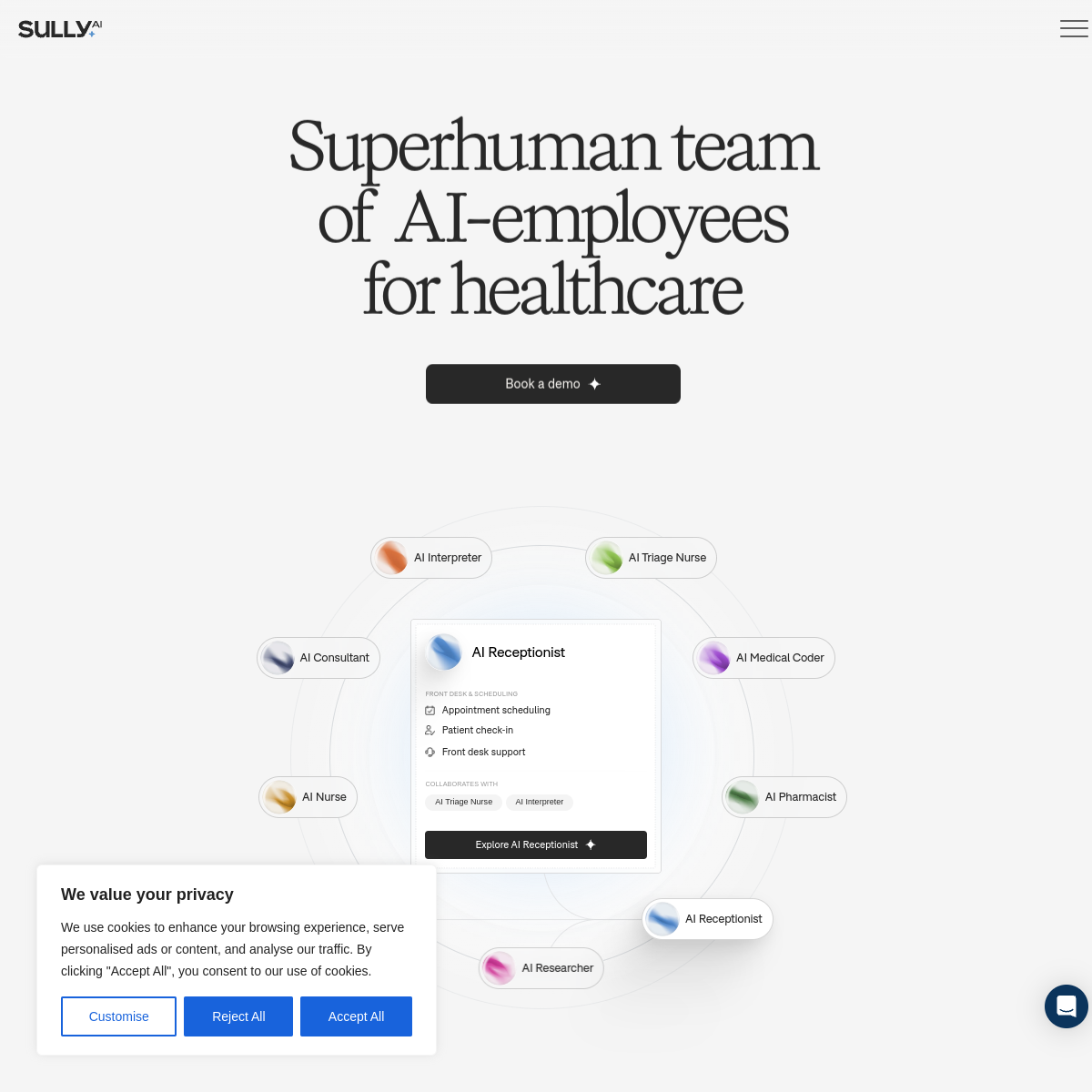
The page we scored
The AI Recommendation Check
When we asked AI who to recommend for AI ambient scribe and healthcare operations automation platform, it named:
Buyer we put in the prompt: Chief Medical Officer, VP of Operations, or Chief of Staff at a health system or large medical group (100+ clinicians). Both the buyer and the category were inferred from Sully.ai’s homepage alone. The model had no web access.
Sully.ai was not on the list.
A buyer who asked AI this question got 8 names and moved on. Sully.ai never came up.
We asked AI who it recommends for "Chief Medical Officer, VP of Operations, or Chief of Staff at a health system or large medical group (100+ clinicians)" looking for "AI ambient scribe and healthcare operations automation platform". It named Nuance DAX, Abridge, Ambience Healthcare, Nabla, DeepScribe. You did not appear. AI can't recommend what it can't clearly understand.
Overall assessment
Sully's biggest strength is its proof stack: specific dollar outcomes, named testimonials with titles, proprietary research (the Consensus Mechanism, Sully M1), and a HealthBench safety benchmark that AI can quote verbatim ... this is one of the most evidence-dense healthcare AI pages you'll find. The biggest gap is the complete absence of problem leadership: the page never names the enemy (documentation burden, clinician burnout, administrative bloat) before pitching the solution, which means buyers who aren't already sold on ambient AI have no mirror to recognize their pain in.
Signal by category
Narrative Clarity
8 signals
Trust Signal
4 signals
AI Signal
6 signals
Conversion Signal
1 signal
Weakest signal · fix this first
05Problem Leadership
“More capacity for care." is the hero ... no problem statement precedes the solution.”
The page leads immediately with the solution framing ('more capacity'), not the buyer's felt pain; administrative burden, documentation overload, or clinician burnout are never named as the problem being solved.
All 19 signals, scored 0 to 2.
Total 27/38
Narrative Clarity
8 signals
- 2
01The 7-Second Test
“More capacity for care." + "Loved by health systems with over 20,000 clinicians.”
The hero communicates healthcare AI for clinicians/health systems that creates more capacity, readable in under 7 seconds with supporting image of clinician context.
- 1
02Rebellion / Movement
“The hard part is not making AI impressive. It is making it useful, measurable and trusted”
There's an implicit rebellion against flashy, unproven AI, but no named enemy, no named status quo pattern like 'burnout culture' or 'EHR overload' is explicitly called out as the villain being fought.
- 2
03Owned Language & Category
“the Consensus Mechanism" + "Sully M1" + "One Platform for Healthcare Work”
Sully coins 'the Consensus Mechanism' (a named proprietary framework), names its own model 'Sully M1,' and benchmarks it ... these are ownable, AI-quotable terms unique to this company.
- 1
04ICP Clarity
“Loved by health systems with over 20,000 clinicians.”
Health systems and clinicians are identified but buyer role (CMO, COO, VP Operations), org size beyond '120 clinicians' in one case study, and specific verticals (FQHCs, behavioral health) only emerge mid-page, not in the hero.
- 0
05Problem Leadershipweakest
“More capacity for care." is the hero ... no problem statement precedes the solution.”
The page leads immediately with the solution framing ('more capacity'), not the buyer's felt pain; administrative burden, documentation overload, or clinician burnout are never named as the problem being solved.
- 2
06Solution Clarity
“One Platform for Healthcare Work" covering Receptionist, Scribe, Medical Coder, Consultant”
A visitor can clearly repeat that Sully is an AI platform covering the full patient journey ... before, during, and after visits ... for healthcare organizations.
- 1
07Cost of Inaction
“12→2 weeks to onboard new providers" and "$680,000 saved annually in call center operating costs”
The cost of inaction is implied by the savings figures but never explicitly named as 'what you're losing today by not acting' ... the stakes are embedded in proof, not stated as a consequence of staying put.
- 2
08Promised Land
“18.5% more patients seen" + "$1M incremental annual revenue" + "One patient journey. Nothing falls through.”
The promised land is specific and quantified: more patients seen, more revenue, lower overhead, faster onboarding ... concrete after-states a buyer can visualize.
Trust Signal
4 signals
- 2
09Proof & Evidence
“$680,000 saved annually" / "$2M+ Saved through accurate upstream clinical coding" / "18.5% more patients seen”
Multiple concrete dollar figures, percentage improvements, and operational deltas (12→2 weeks) give hard evidence rather than adjectives.
- 2
10Social Proof
“Malcolm Moses-Hampton, MD" / "Derek Ayers, DO, Chief Medical Officer" / "The evolvedMD team" + named customer story "Apogee”
Named testimonials with titles, a named video case study, and specific customer organizations provide strong, credible social proof.
- 2
11Authority & Credibility
“Higher HealthBench Safety scores than every comparison" + four published research papers (preprints, whitepapers, benchmarks)”
Sully demonstrates authority through original published research, a proprietary safety benchmark result, and named model comparisons against GPT-5 and Claude ... authority shown, not claimed.
- 0
12Alternatives Acknowledged
“No mention of competitors, alternative approaches, or 'do nothing' option anywhere on the page.”
The page never acknowledges that buyers might consider Nuance, Nabla, Abridge, or simply keeping human staff ... alternatives are completely absent.
AI Signal
6 signals
- 1
13Customer Focus
“It catches the patient's story. That's the part that takes time." ... Malcolm Moses-Hampton, MD”
Testimonials and outcome stats keep customers visible, but the product UI screenshots and section headers ('One Platform for Healthcare Work') tilt the narrative toward Sully's capabilities rather than sustaining the clinician as protagonist throughout.
- 2
14AI-Parmesan Index
“Frontier architecture designed for safety" + HealthBench Safety benchmark table + "the Consensus Mechanism" preprint”
AI claims are mechanistic and backed by named benchmarks, a proprietary model (Sully M1), and published research ... not vague 'AI-powered' sprinkle.
- 2
15LLM Quotability
“As long as we have Sully, the rest of the stack is negotiable." / "$2M+ Saved through accurate upstream clinical coding. 200 clinician provider network”
Several clean, declarative sentences with specific numbers and named outcomes are directly liftable by an LLM as citation-ready recommendations.
- 2
16Copyright Freshness
“Preprint · May 2025" / "Benchmark · Jun 2025" / "Whitepaper · Jun 2025”
Multiple research assets carry explicit 2025 dates, signaling freshness to both human readers and AI crawlers.
- 2
17Entity Distinctiveness
“Sully M1" + "the Consensus Mechanism" + HealthBench scores beating GPT-5, Claude Sonnet 5, and Kimi K3”
The combination of a proprietary model name, a coined framework, and specific benchmark rankings against named frontier models makes Sully unmistakably distinct from generic ambient scribes or EHR add-ons.
- 0
18AI Recommendation Check
“AI's picks: Nuance DAX, Abridge, Ambience Healthcare, Nabla, DeepScribe, Suki. You were not named.”
We asked AI who it recommends for "Chief Medical Officer, VP of Operations, or Chief of Staff at a health system or large medical group (100+ clinicians)" looking for "AI ambient scribe and healthcare operations automation platform". It named Nuance DAX, Abridge, Ambience Healthcare, Nabla, DeepScribe. You did not appear. AI can't recommend what it can't clearly understand.
Conversion Signal
1 signal
- 1
19Path & CTA Clarity
“Book a demo" (primary CTA at bottom) + "Discover" (Sully API link at top) ... no numbered process shown.”
There is one clear primary CTA ('Book a demo') and a soft secondary ('Discover' the API), but no visible numbered path explaining what happens after clicking, so the process and CTAs don't work together as a connected journey.
Your move
Think Sully.ai’s score is wrong? Good. Let’s look at it together.
Twenty minutes with Greg. Bring the page, bring the argument. You’ll leave knowing exactly which signal is costing Sully.ai the AI recommendation, and what to write instead.
Not on the list? Run your homepage through the free Brand Signal Score and see where you’d land. Same 19 signals, same AI check, two minutes.