
The 2026 Healthtech Messaging Index
RapidClaims
rapidclaims.ai·scored November 1, 2026
25/38
Approaching
Close. The bones are good. A few targeted fixes on the weakest signals would push RapidClaims into magnetic territory.
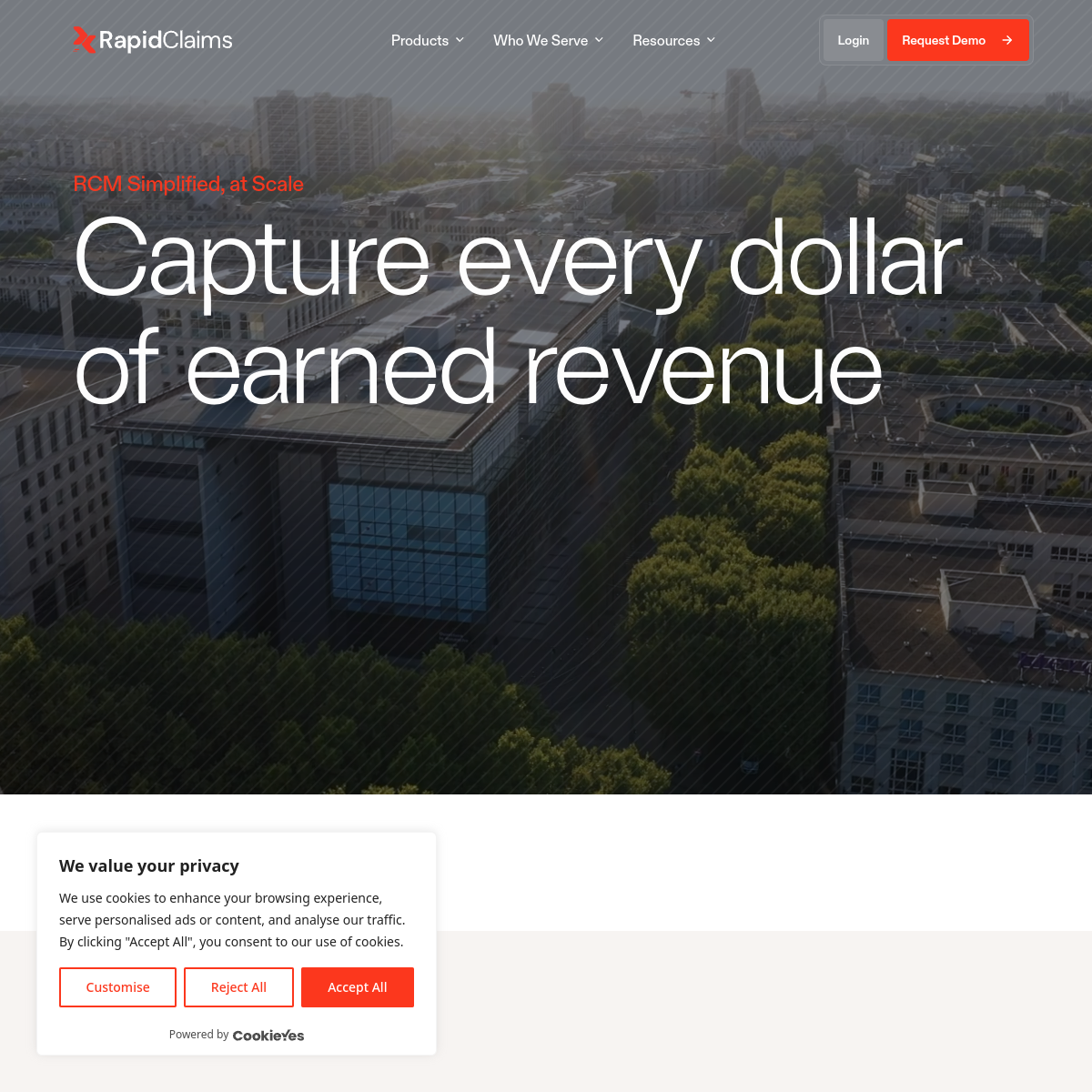
The page we scored
The AI Recommendation Check
When we asked AI who to recommend for AI-powered revenue cycle management and autonomous medical coding software, it named:
Buyer we put in the prompt: CFO, Director of Revenue Cycle, or Director of HIM at a physician group, health system, FQHC, or ACO. Both the buyer and the category were inferred from RapidClaims’s homepage alone. The model had no web access.
RapidClaims was not on the list.
A buyer who asked AI this question got 8 names and moved on. RapidClaims never came up.
We asked AI who it recommends for "CFO, Director of Revenue Cycle, or Director of HIM at a physician group, health system, FQHC, or ACO" looking for "AI-powered revenue cycle management and autonomous medical coding software". It named Optum360, 3M Health Information Systems, Nuance Communications, Nym Health, Fathom. You did not appear. AI can't recommend what it can't clearly understand.
Overall assessment
RapidClaims' biggest strength is its owned language ecosystem ... RapidRules™, RapidCode™, RapidVBC™, 'Governed Autonomy,' and 'The OS for your revenue cycle' ... combined with mechanistic AI claims and concrete outcome metrics that give AI engines highly quotable, distinctive content to work with. The biggest gap is trust-signal credibility: every testimonial hides the customer's name and company behind generic titles like 'CFO Health System,' and there are zero recency signals (no dated content, no copyright year), which undercuts both human buyer confidence and AI engine weighting of this content as authoritative.
Signal by category
Narrative Clarity
8 signals
Trust Signal
4 signals
AI Signal
6 signals
Conversion Signal
1 signal
Weakest signal · fix this first
16Copyright Freshness
“No visible dates on blog posts, case studies, or a copyright year anywhere in the scraped content.”
There are zero recency signals in the scraped content ... no dated case studies, no blog timestamps, no copyright year ... making it impossible for AI engines to weight this content as current.
All 19 signals, scored 0 to 2.
Total 25/38
Narrative Clarity
8 signals
- 1
01The 7-Second Test
“RCM Simplified, at Scale" / "Capture every dollar of earned revenue”
Healthcare RCM is clear enough, but 'who it's for' and 'what point of view' require reading past the fold; the hero conflates tagline, headline, and subtitle without a crisp single-sentence problem statement a non-expert would instantly grasp.
- 1
02Rebellion / Movement
“While other vendors focus on high-volume, low-complexity specialties, RapidClaims is built for the hardest coding challenges”
There's a named competitor pattern ('other vendors') but no named enemy, no labeled status quo, and no manifesto-level conviction ... it reads as a product differentiator, not a movement.
- 2
03Owned Language & Category
“RapidRules™ Engine" / "RapidCode™" / "RapidRecovery™" / "RapidCDI" / "RapidVBC™" / "Governed Autonomy”
RapidClaims owns a clear branded product family with trademarked names, a coined framework ('Governed Autonomy'), and the category frame 'The OS for your revenue cycle' ... all citation-ready and distinctly theirs.
- 2
04ICP Clarity
“FQHCs, Multi-specialty physician groups, Hospitals & Health Systems, Accountable Care Orgs, Ambulatory Surgery Centers, Management Services Orgs”
The page explicitly names eight distinct customer segments with role-specific language (CDI lead, CFO, Director of HIM, Medical Director) making it easy for buyers to self-identify.
- 1
05Problem Leadership
“CDI chasing queries. Coding behind. Denials weeks late." / "$1.2M sitting in AR over 60 days”
Problem language exists in the interactive slider section but is buried below the fold; the hero leads with solution capability ('Autonomous agents that code charts'), not the buyer's pain.
- 2
06Solution Clarity
“Autonomous agents that code charts, improve documentation, prevent denials, and recover revenue with full compliance and control.”
A visitor can repeat exactly what RapidClaims does in one sentence after reading the hero ... autonomous AI agents covering the full revenue cycle.
- 1
07Cost of Inaction
“$1.2M sitting in AR over 60 days" / "Denials arrive 16 days after the visit”
Cost of inaction is implied through the slider narrative with specific numbers, but it's never stated as a direct consequence of not choosing RapidClaims ... it's framed as a baseline state, not a warning.
- 2
08Promised Land
“27% Denials / 5% Revenue / 70% Cost / 100% Audit-ready" and "Queries auto-resolve in under 4 minutes at point of care”
The 'Once live · Month 3+' section paints a specific, role-differentiated after-state with quantified outcomes, giving buyers a concrete promised land.
Trust Signal
4 signals
- 2
09Proof & Evidence
“30% reduction in A/R days within one quarter, unlocking $2.5M in accelerated cash flow" / "RAF scores improved 15%" / "40% Reduction in coding costs”
Multiple concrete before/after deltas with dollar figures, percentages, and time frames appear in testimonials and product sections throughout the page.
- 1
10Social Proof
“CFO Health System" / "Director of HIM Federally Qualified Health Center" / "Medical Director, Leading ACO”
Testimonials include roles and organization types with strong outcome metrics, but no customer names, no company names, and no logos tied to quotes ... anonymity limits trust signal credibility.
- 1
11Authority & Credibility
“Frost & Sullivan 2025 Technology Innovation Leader" / "BlackBook 2026 #1: AI-Powered Claims Automation (9.70/10)”
Third-party awards are present but there are no founder credentials, original research, published frameworks, or named experts ... authority rests entirely on analyst badges.
- 1
12Alternatives Acknowledged
“Most AI vendors require 10,000+ charts, delaying ROI" / "RapidClaims delivered what other vendors only promised”
The page acknowledges generic competitor patterns and implies alternatives exist, but never names a competitor, addresses 'do nothing,' or honestly frames the trade-offs of other paths.
AI Signal
6 signals
- 1
13Customer Focus
“Sarah gets: her top documentation gaps, mapped to her top denial drivers" / "David gets: projected denial drop, accuracy delta, payback period”
The slider section centers the customer story well, but most of the page ... product features, integrations, specialties ... tilts toward company capabilities rather than customer transformation.
- 2
14AI-Parmesan Index
“RapidClaims needs just 500 charts to customize pre-trained models. Trained on millions of encounters across 25+ specialties." / "Self-Learning Denial Intelligence”
AI claims are mechanistic and specific ... training data size, chart volume benchmarks, autonomous agent functions ... rather than vague 'AI-powered' sprinkling.
- 2
15LLM Quotability
“RapidClaims needs just 500 charts vs 10,000+ industry standard" / "Autonomous agents that code charts, improve documentation, prevent denials, and recover revenue”
The page contains multiple clean, declarative, standalone sentences with specific metrics that an LLM could lift verbatim to describe or recommend the company.
- 0
16Copyright Freshnessweakest
“No visible dates on blog posts, case studies, or a copyright year anywhere in the scraped content.”
There are zero recency signals in the scraped content ... no dated case studies, no blog timestamps, no copyright year ... making it impossible for AI engines to weight this content as current.
- 2
17Entity Distinctiveness
“The OS for your revenue cycle" / "RapidRules™ Engine" / "Governed Autonomy" / "500 charts vs 10,000+ industry standard”
The combination of branded product suite, coined category frame, specific training-data benchmarks, and named customer segments makes this page unmistakably distinct from generic RCM competitors.
- 0
18AI Recommendation Check
“AI's picks: Optum360, 3M Health Information Systems, Nuance Communications, Nym Health, Fathom, Waystar. You were not named.”
We asked AI who it recommends for "CFO, Director of Revenue Cycle, or Director of HIM at a physician group, health system, FQHC, or ACO" looking for "AI-powered revenue cycle management and autonomous medical coding software". It named Optum360, 3M Health Information Systems, Nuance Communications, Nym Health, Fathom. You did not appear. AI can't recommend what it can't clearly understand.
Conversion Signal
1 signal
- 1
19Path & CTA Clarity
“Book a Demo" / "Go live in weeks. Calculate your ROI" / "Book a 30-min walkthrough”
There are two CTA options in the hero and a process is shown in the slider, but no numbered step-by-step path is explicitly labeled, and multiple 'Book a Demo' CTAs dilute the primary/secondary distinction.
Your move
Think RapidClaims’s score is wrong? Good. Let’s look at it together.
Twenty minutes with Greg. Bring the page, bring the argument. You’ll leave knowing exactly which signal is costing RapidClaims the AI recommendation, and what to write instead.
Not on the list? Run your homepage through the free Brand Signal Score and see where you’d land. Same 19 signals, same AI check, two minutes.