
The 2026 Healthtech Messaging Index
ProviderTrust
providertrust.com·scored September 1, 2026
20/38
Invisible
The page is doing some work, but the story isn't landing fast enough. Buyers and AI are both left guessing what makes ProviderTrust different.
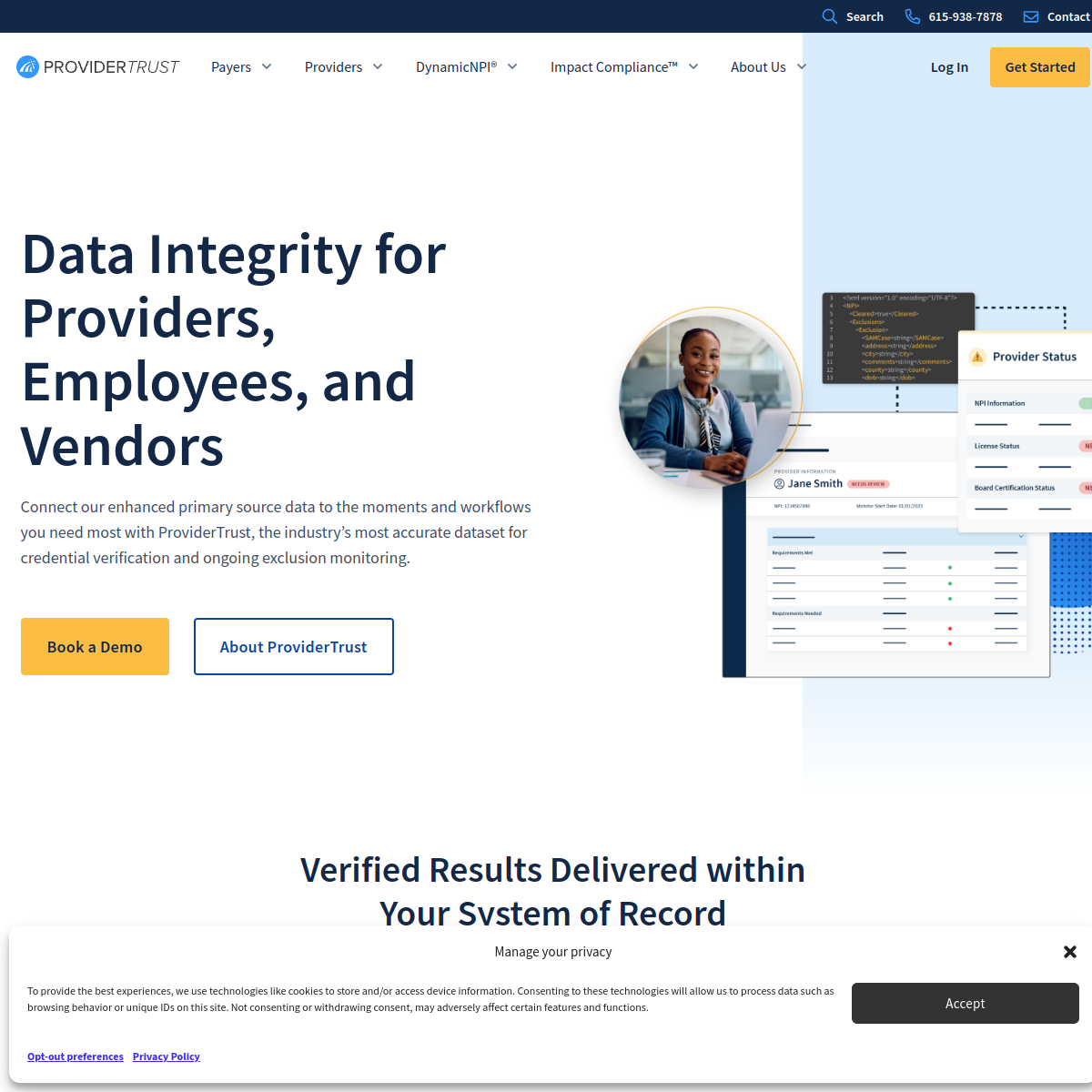
The page we scored
The AI Recommendation Check
When we asked AI who to recommend for Healthcare provider credentialing and exclusion monitoring software, it named:
Buyer we put in the prompt: Compliance, Credentialing, or HR leader at a health system, health plan (payer), or large healthcare organization. Both the buyer and the category were inferred from ProviderTrust’s homepage alone. The model had no web access.
ProviderTrust was on the list.
AI named them for their own category. That's the signal every homepage is supposed to send.
AI mentioned you for "Healthcare provider credentialing and exclusion monitoring software", but only generically: "ProviderTrust is a Nashville-based company focused on healthcare provider monitoring, particularly OIG exclusion screening and sanctions monitoring across federal and state databases to help health systems manage compliance risk.". You're on the radar, but AI doesn't yet repeat your specific positioning back.
Overall assessment
ProviderTrust's biggest strength is its concrete proof layer ... 180M+ verifications, 46% exclusions found only by their data, and 95% automation rates give it credible, specific numbers few competitors can match. The biggest gap is the complete absence of a buyer-problem narrative: the page opens with a solution category ('Data Integrity'), never names the enemy or broken status quo, skips the cost of inaction entirely, and leaves no clean declarative sentences an LLM could cite to recommend them over alternatives.
Signal by category
Narrative Clarity
8 signals
Trust Signal
4 signals
AI Signal
6 signals
Conversion Signal
1 signal
Weakest signal · fix this first
02Rebellion / Movement
“No named enemy, no named status quo, no named industry pattern being challenged anywhere on the page.”
The page makes no claim against a broken status quo or a competitor approach; it presents itself as a better product but never names what it's rebelling against.
All 19 signals, scored 0 to 2.
Total 20/38
Narrative Clarity
8 signals
- 1
01The 7-Second Test
“Data Integrity for Providers, Employees, and Vendors" / "the industry's most accurate dataset for credential verification and ongoing exclusion monitoring”
The vertical (healthcare) and function (credentialing/exclusion monitoring) are decipherable in 7 seconds, but 'Data Integrity' is abstract jargon and the point of view is absent ... a caveman would not immediately grasp the stakes.
- 0
02Rebellion / Movementweakest
“No named enemy, no named status quo, no named industry pattern being challenged anywhere on the page.”
The page makes no claim against a broken status quo or a competitor approach; it presents itself as a better product but never names what it's rebelling against.
- 1
03Owned Language & Category
“DynamicNPI™" and "Impact Compliance™ Program" and "enhanced primary source data”
ProviderTrust coins two named terms (DynamicNPI™, Impact Compliance™) but never defines or frames them enough on the homepage for an AI to quote their meaning or category significance.
- 1
04ICP Clarity
“Solutions for Your: Payers / Providers / Partners" and "Compliance, Human Resources, and Credentialing teams”
Three broad segments are named and roles are mentioned mid-page, but company size, org stage, and specific buyer titles are never called out clearly above the fold.
- 0
05Problem Leadership
“Data Integrity for Providers, Employees, and Vendors" ... hero leads with the solution category, not the buyer's problem.”
The page opens with a capability/product frame ('Data Integrity') rather than articulating the buyer's pain ... there is no problem statement anywhere above the fold.
- 2
06Solution Clarity
“credential verification and ongoing exclusion monitoring" delivered "via API or SFTP right within your systems and workflows”
After reading the hero, a visitor can clearly state that ProviderTrust automates credential verification and exclusion monitoring for healthcare organizations, delivered into existing systems.
- 1
07Cost of Inaction
“51% of all exclusions we find are likely missed by other vendors or systems”
The stat implies risk of missing exclusions but the page never explicitly names the regulatory fines, CMS penalties, or audit consequences that follow inaction ... the stakes are implied, not stated.
- 1
08Promised Land
“automated, always-accurate data" and "saves your organization time and costs”
The promised land is described only in generic efficiency language ... no vivid 'after' state like audit-proof compliance or zero missed exclusions is painted with specificity.
Trust Signal
4 signals
- 2
09Proof & Evidence
“180m+ License Verifications Performed Annually" / "46% Exclusions Found Only with Our Enhanced Primary Source Data" / "95% of verifications are automated and delivered within 2 days”
Multiple concrete, specific numbers with operational deltas are present and credible, anchoring claims in measurable outcomes rather than adjectives.
- 1
10Social Proof
“Not only has ProviderTrust saved us countless hours..." ... one unnamed Amwell testimonial, plus logo carousel with named organizations.”
The single testimonial lacks a name and title, and while many logos are present, none are paired with attributed quotes or case study outcomes on the homepage itself.
- 1
11Authority & Credibility
“For over a decade, ProviderTrust has led the way in upholding industry-leading standards" and "NCQA-certified solutions”
NCQA certification is a real credential and 'over a decade' establishes tenure, but no founder story, original research authorship, awards, or frameworks are cited to demonstrate authority beyond self-description.
- 0
12Alternatives Acknowledged
“No mention of competitors, alternative approaches, manual processes, or 'do nothing' option anywhere on the page.”
The page never acknowledges what buyers are currently doing or why they might not switch, making it impossible for a skeptical buyer to see their situation reflected.
AI Signal
6 signals
- 1
13Customer Focus
“There's a reason that leading healthcare organizations leverage ProviderTrust to ensure data accuracy, improve efficiencies, mitigate risk”
The page mixes company-capability framing ('our data is different') with some customer-outcome language, but the overall protagonist is ProviderTrust's data and platform, not the customer's journey.
- 2
14AI-Parmesan Index
“No AI-powered claims anywhere on the page; automation is described mechanistically via 'API or SFTP' and 'primary source data'.”
ProviderTrust makes no vague 'AI-powered' claims ... automation is described through concrete delivery mechanisms, which fully avoids AI-Parmesan.
- 1
15LLM Quotability
“46% of exclusions found only with our Enhanced Primary Source Data" and "51% of all exclusions we find are likely missed by other vendors”
These stats are quotable but not framed as clean declarative sentences an LLM could lift as a vendor recommendation; they lack the 'ProviderTrust is the company that...' sentence structure needed for easy citation.
- 1
16Copyright Freshness
“August 25, 2026" / "August 13, 2026" / "July 30, 2026" on featured resources ... future-dated content flags as suspicious.”
Dates exist and are recent in format, but the future-dated timestamps (2026) suggest a misconfigured CMS, which would undermine AI recency scoring rather than help it.
- 2
17Entity Distinctiveness
“46% Exclusions Found Only with Our Enhanced Primary Source Data" + "DynamicNPI™" + "NCQA-certified" + "51% of all exclusions we find are likely missed by other vendors”
The combination of proprietary data claims, named products (DynamicNPI™), a specific certification, and differentiated exclusion-detection statistics gives ProviderTrust a fingerprint an AI could distinguish from generic credentialing vendors.
- 1
18AI Recommendation Check
“AI named you alongside ProviderTrust, Verato, symplr, Medallion, Modio Health, describing you as: "ProviderTrust is a Nashville-based company focused on healthcare provider monitoring, particularly OIG exclusion screening and sanctions monitoring across federal and state databases to help health systems manage compliance risk.".”
AI mentioned you for "Healthcare provider credentialing and exclusion monitoring software", but only generically: "ProviderTrust is a Nashville-based company focused on healthcare provider monitoring, particularly OIG exclusion screening and sanctions monitoring across federal and state databases to help health systems manage compliance risk.". You're on the radar, but AI doesn't yet repeat your specific positioning back.
Conversion Signal
1 signal
- 1
19Path & CTA Clarity
“Book a Demo" (primary CTA, repeated) and "About ProviderTrust" (secondary) ... no numbered process or explained pathway.”
There are two CTAs present but no numbered steps or described journey connecting them, so the path feels like two competing buttons rather than a guided conversion sequence.
Keep the lead
AI already names ProviderTrust. The next edition decides if it still does.
Twenty minutes with Greg. Bring the page, bring the argument. You’ll leave knowing exactly which signal is costing ProviderTrust the AI recommendation, and what to write instead.
Not on the list? Run your homepage through the free Brand Signal Score and see where you’d land. Same 19 signals, same AI check, two minutes.