
The 2026 Healthtech Messaging Index
Modio Health
modiohealth.com·scored November 1, 2026
16/38
Invisible
The page is doing some work, but the story isn't landing fast enough. Buyers and AI are both left guessing what makes Modio Health different.
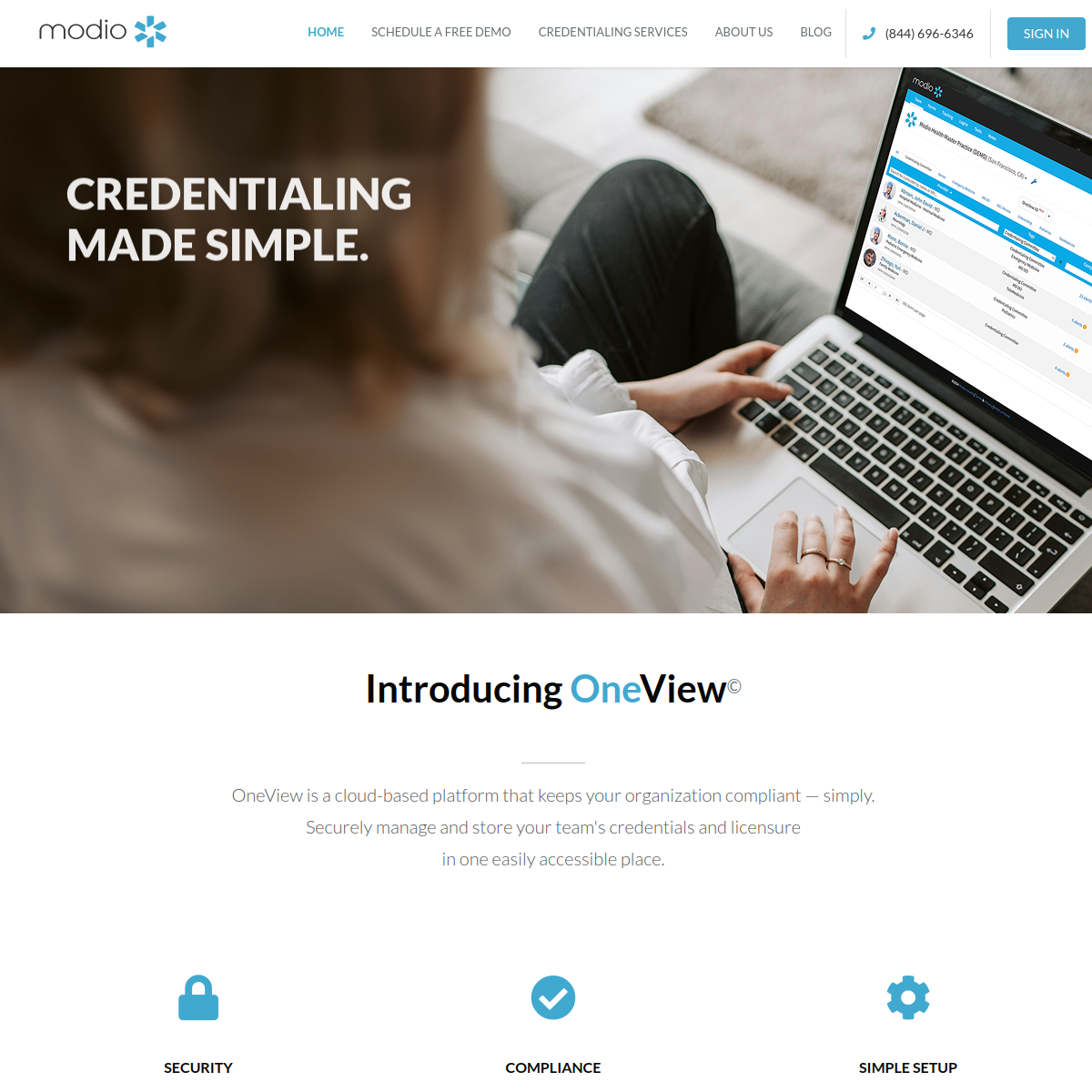
The page we scored
The AI Recommendation Check
When we asked AI who to recommend for Healthcare credentialing management software, it named:
Buyer we put in the prompt: Practice administrator, credentialing coordinator, or office manager at a medical group or healthcare organization. Both the buyer and the category were inferred from Modio Health’s homepage alone. The model had no web access.
Modio Health was on the list.
AI named them for their own category. That's the signal every homepage is supposed to send.
AI named you when asked who it recommends for "Healthcare credentialing management software", and described you accurately: "Modio Health offers a cloud-based provider credentialing and enrollment platform called OneView that centralizes provider data and streamlines the credentialing lifecycle for medical groups and health systems.". Your positioning is landing with the machines.
Overall assessment
Modio Health's biggest strength is basic solution clarity ... a first-time visitor can quickly grasp that this is credentialing software for healthcare teams, and the absence of AI-washing keeps the narrative clean. The biggest gap is narrative depth: there is no named enemy, no quantified proof, no cost-of-inaction, and no distinct positioning that separates Modio from any other credentialing vendor, making it nearly invisible to both AI recommendation engines and skeptical buyers comparing options.
Signal by category
Narrative Clarity
8 signals
Trust Signal
4 signals
AI Signal
6 signals
Conversion Signal
1 signal
Weakest signal · fix this first
02Rebellion / Movement
“No named enemy, status quo, or industry pattern called out anywhere on the page.”
There is no rebellion framing ... no critique of spreadsheets, legacy systems, or manual processes as a named villain; the page is purely feature-descriptive.
All 19 signals, scored 0 to 2.
Total 16/38
Narrative Clarity
8 signals
- 1
01The 7-Second Test
“Credentialing Made Simple. For your entire team. All in one place.”
The hero communicates the what (credentialing) and a vague who (your team), but the point of view is absent and 'Made Simple' is a generic claim any competitor could use.
- 0
02Rebellion / Movementweakest
“No named enemy, status quo, or industry pattern called out anywhere on the page.”
There is no rebellion framing ... no critique of spreadsheets, legacy systems, or manual processes as a named villain; the page is purely feature-descriptive.
- 1
03Owned Language & Category
“Introducing OneView©”
OneView is a trademarked product name but it is not a category frame or coined term that defines a new way of thinking; it is just a product label.
- 1
04ICP Clarity
“Trusted by thousands of providers and healthcare organizations nationwide”
Healthcare organizations and providers are mentioned but role (credentialing coordinator, practice administrator, CMO), company size, and stage are never specified, leaving ICP fuzzy.
- 0
05Problem Leadership
“No problem-first framing on the page; hero opens with product name and tagline.”
The page leads immediately with the solution and its features rather than articulating the buyer's pain in their own language before introducing the product.
- 1
06Solution Clarity
“OneView is a cloud-based platform that keeps your organization compliant ... simply.”
A visitor gets a rough idea (compliance/credentialing platform) but the one-liner is generic and doesn't convey a differentiating mechanism or outcome a buyer could repeat with confidence.
- 1
07Cost of Inaction
“Save time ... no searching for files or gathering information from busy doctors”
There is a faint hint of cost-of-inaction (wasted time, hassle) but no quantified stakes, lost revenue, regulatory penalties, or named consequences of not switching.
- 1
08Promised Land
“our office staff have more time for other tasks instead of spending countless hours”
The testimonial gestures at a better future state, but the page itself never paints a concrete, specific 'after' picture with defined outcomes or transformed conditions.
Trust Signal
4 signals
- 1
09Proof & Evidence
“over 40 physicians... our office staff have more time for other tasks”
The one testimonial references practice size but delivers no hard numbers ... no hours saved, no percentage reduction, no before/after delta ... making proof feel anecdotal.
- 1
10Social Proof
“Michael F., MD ... President”
There is one named testimonial with a title but no company name, no customer logos, no video stories, and no named case studies, which is thin for a B2B trust signal.
- 0
11Authority & Credibility
“No founder credentials, original research, awards, frameworks, or third-party authority signals present on the page.”
The only credibility claim is SOC 2 Type 2 compliance, which is a baseline security certification, not a demonstration of domain authority or thought leadership.
- 0
12Alternatives Acknowledged
“No mention of alternatives, competitors, spreadsheets, legacy systems, or 'do nothing' option anywhere on the page.”
The page never acknowledges what buyers are currently doing or why those alternatives fall short, leaving the competitive context entirely unaddressed.
AI Signal
6 signals
- 1
13Customer Focus
“our office staff have more time for other tasks instead of spending countless hours”
The page mixes company capability lists with a brief customer voice in the testimonial but is predominantly feature/product-centric rather than customer-transformation-centric.
- 2
14AI-Parmesan Index
“No AI claims or 'AI-powered' language anywhere on the page.”
The company makes zero AI claims, so there is no AI-Parmesan sprinkle; the score is 2 by rubric definition because the narrative is not diluted by vague AI language.
- 1
15LLM Quotability
“OneView is a cloud-based platform that keeps your organization compliant ... simply.”
There are no clean, declarative, citation-ready sentences with specific differentiators that an LLM could lift verbatim to recommend this company over a competitor.
- 0
16Copyright Freshness
“No visible dates on blog posts, case studies, or copyright year anywhere in the scraped content.”
The scraped page contains no recency signals whatsoever ... no publication dates, no 'updated' timestamps, no visible copyright year ... which weakens AI recency weighting.
- 1
17Entity Distinctiveness
“Credentialing Made Simple. For your entire team. All in one place.”
The positioning is interchangeable with any credentialing software competitor; swapping the logo would not change the description, though the OneView trademark adds minimal distinctiveness.
- 2
18AI Recommendation Check
“AI described you as: "Modio Health offers a cloud-based provider credentialing and enrollment platform called OneView that centralizes provider data and streamlines the credentialing lifecycle for medical groups and health systems.”
AI named you when asked who it recommends for "Healthcare credentialing management software", and described you accurately: "Modio Health offers a cloud-based provider credentialing and enrollment platform called OneView that centralizes provider data and streamlines the credentialing lifecycle for medical groups and health systems.". Your positioning is landing with the machines.
Conversion Signal
1 signal
- 1
19Path & CTA Clarity
“Free Demo”
There is one CTA (Free Demo) but no visible numbered process or path showing what happens next, and no soft secondary CTA for buyers not ready to demo, leaving the conversion journey incomplete.
Keep the lead
AI already names Modio Health. The next edition decides if it still does.
Twenty minutes with Greg. Bring the page, bring the argument. You’ll leave knowing exactly which signal is costing Modio Health the AI recommendation, and what to write instead.
Not on the list? Run your homepage through the free Brand Signal Score and see where you’d land. Same 19 signals, same AI check, two minutes.