
The 2026 Healthtech Messaging Index
MedRhythms
medrhythms.com·scored September 1, 2026
19/38
Invisible
The page is doing some work, but the story isn't landing fast enough. Buyers and AI are both left guessing what makes MedRhythms different.
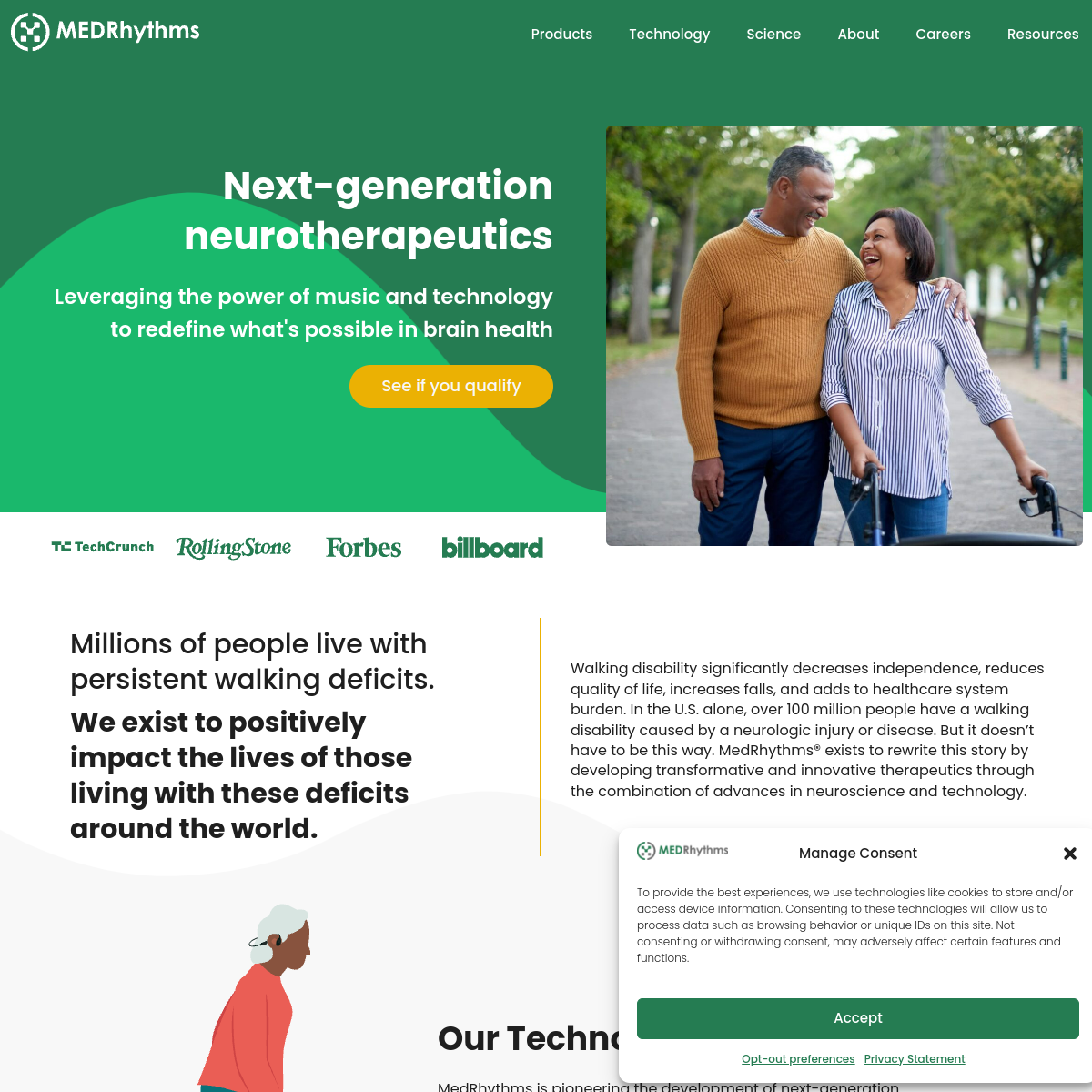
The page we scored
The AI Recommendation Check
When we asked AI who to recommend for Prescription digital therapeutics for neurologic gait rehabilitation, it named:
Buyer we put in the prompt: Neurologist, physiatrist, or rehabilitation clinician at a hospital or outpatient rehab clinic considering prescription digital therapeutics for gait disorders. Both the buyer and the category were inferred from MedRhythms’s homepage alone. The model had no web access.
MedRhythms was on the list.
AI named them for their own category. That's the signal every homepage is supposed to send.
AI named you when asked who it recommends for "Prescription digital therapeutics for neurologic gait rehabilitation", and described you accurately: "MedRhythms is a digital therapeutics company that uses rhythmic auditory stimulation delivered via a wearable and app-based platform to improve gait in neurological conditions such as stroke and Parkinson's disease, with FDA Breakthrough Device designation.". Your positioning is landing with the machines.
Overall assessment
MedRhythms' biggest strength is genuine category distinctiveness: the 'prescription music platform' frame, RAS terminology, Universal Music Group partnership, and a hyper-credentialed founder create a combination no competitor can replicate. The single biggest gap is complete absence of social proof and cost-of-inaction narrative ... there is not one patient outcome delta, clinician testimonial, or named case study on the page, and the hero never tells a buyer what they or their patients lose by waiting, making conversion almost entirely dependent on the buyer already being sold.
Signal by category
Narrative Clarity
8 signals
Trust Signal
4 signals
AI Signal
6 signals
Conversion Signal
1 signal
Weakest signal · fix this first
02Rebellion / Movement
“No named enemy, status quo, or industry pattern called out anywhere on the page.”
The page is purely mission-positive with no stated rebellion against existing rehab approaches, pharma, or the 'do nothing' system; there is no point of view beyond 'we exist to help.'
All 19 signals, scored 0 to 2.
Total 19/38
Narrative Clarity
8 signals
- 1
01The 7-Second Test
“Next-generation neurotherapeutics / Leveraging the power of music and technology to redefine what's possible in brain health”
The hero hints at music + brain health but 'next-generation neurotherapeutics' is jargon that a caveman cannot parse in 7 seconds; who it's for and the specific problem are buried below the fold.
- 0
02Rebellion / Movementweakest
“No named enemy, status quo, or industry pattern called out anywhere on the page.”
The page is purely mission-positive with no stated rebellion against existing rehab approaches, pharma, or the 'do nothing' system; there is no point of view beyond 'we exist to help.'
- 2
03Owned Language & Category
“rhythmic auditory stimulation (RAS) ... World's first prescription music platform”
MedRhythms owns two named, specific frames ... 'rhythmic auditory stimulation (RAS)' and 'prescription music platform' ... that are distinctive and quotable by an LLM as unique to this company.
- 1
04ICP Clarity
“ambulatory adults with stroke walking impairments ... people with Parkinson's disease (PD)”
Patients are named mid-page but the B2B buyer (prescribing clinician, rehab hospital, payer) is never identified; a healthcare buyer visiting this page cannot tell if it is aimed at them or directly at patients.
- 1
05Problem Leadership
“Millions of people live with persistent walking deficits.”
The problem is stated but it leads with a population statistic rather than the buyer's pain, and it appears below the fold after a vague hero headline, so it does not truly lead the narrative.
- 1
06Solution Clarity
“sensors, software, and music with advanced neuroscience to target neural circuitry”
A visitor can roughly grasp 'music therapy device for walking problems' but the hero itself ('next-generation neurotherapeutics') does not deliver a one-sentence explanation; clarity requires scrolling.
- 0
07Cost of Inaction
“No cost-of-inaction language anywhere on the page.”
The page never names what a patient, clinician, or health system loses by not acting ... no mention of disease progression, falls costs, or lost reimbursement opportunity.
- 1
08Promised Land
“MedRhythms® exists to rewrite this story by developing transformative and innovative therapeutics”
The promised land is vague ('rewrite this story,' 'redefine what's possible') with no concrete picture of the patient's life or the clinician's practice after adopting the technology.
Trust Signal
4 signals
- 1
09Proof & Evidence
“over 50 clinical research studies ... over 30,000 hours of direct patient care ... over 100 million people have a walking disability”
Numbers exist but they are epidemiological and activity-based, not outcome deltas (e.g., '% improvement in gait speed') or before/after patient results, so they support scale claims not efficacy claims.
- 0
10Social Proof
“No customer testimonials, named clinician quotes, patient stories, or case study links on the page.”
The media logos (TechCrunch, Forbes) signal press coverage but there are zero customer or clinician testimonials, named case studies, or video stories anywhere on the page.
- 2
11Authority & Credibility
“Brian Harris, is a board-certified Neurologic Music Therapist and one of only 350 professionals globally with advanced training”
The founder's credentials are specific, verifiable, and rare ('one of only 350 globally'), and the Spaulding Rehabilitation Hospital origin story anchors authority in a named, top-ranked institution.
- 0
12Alternatives Acknowledged
“No mention of alternatives, competitors, or 'do nothing' option anywhere on the page.”
The page never acknowledges that clinicians might use conventional PT, pharmaceutical gait aids, or nothing at all, leaving the competitive context entirely unaddressed.
AI Signal
6 signals
- 1
13Customer Focus
“We exist to positively impact the lives of those living with these deficits around the world.”
The page tilts toward the company's mission and technology platform story; the patient/customer transformation is mentioned but the company remains the protagonist of most sections.
- 2
14AI-Parmesan Index
“No AI claims on the page at all.”
MedRhythms makes no 'AI-powered' claims whatsoever; the technology is described mechanistically via sensors, software, music, and neural circuitry, so it scores 2 under the rubric for not AI-sprinkling.
- 1
15LLM Quotability
“World's first prescription music platform ... rhythmic auditory stimulation (RAS) ... can improve walking impairments caused by neurologic diseases”
A few quotable declarative phrases exist but they are spread across sections and lack the tight, standalone sentence structure an LLM would lift verbatim as a recommendation.
- 0
16Copyright Freshness
“No visible dates on blog posts, case studies, or press items; no copyright year visible in scraped content.”
The scraped page contains no publication dates, recent content timestamps, or visible copyright year that would signal freshness to AI crawlers.
- 2
17Entity Distinctiveness
“World's first prescription music platform ... collaboration with Universal Music Group ... rhythmic auditory stimulation (RAS)”
The combination of RAS science, Universal Music Group partnership, prescription-only delivery, and a founder who is one of 350 certified globally makes this company unmistakably distinct from generic digital therapeutics competitors.
- 2
18AI Recommendation Check
“AI described you as: "MedRhythms is a digital therapeutics company that uses rhythmic auditory stimulation delivered via a wearable and app-based platform to improve gait in neurological conditions such as stroke and Parkinson's disease, with FDA Breakthrough Device designation.”
AI named you when asked who it recommends for "Prescription digital therapeutics for neurologic gait rehabilitation", and described you accurately: "MedRhythms is a digital therapeutics company that uses rhythmic auditory stimulation delivered via a wearable and app-based platform to improve gait in neurological conditions such as stroke and Parkinson's disease, with FDA Breakthrough Device designation.". Your positioning is landing with the machines.
Conversion Signal
1 signal
- 1
19Path & CTA Clarity
“See if you qualify ... Learn More ... Join our team ... Subscribe Today”
There is a primary CTA ('See if you qualify') but no visible numbered process or clear soft secondary CTA paired with it; the CTAs are scattered and unconnected to a defined buyer journey.
Keep the lead
AI already names MedRhythms. The next edition decides if it still does.
Twenty minutes with Greg. Bring the page, bring the argument. You’ll leave knowing exactly which signal is costing MedRhythms the AI recommendation, and what to write instead.
Not on the list? Run your homepage through the free Brand Signal Score and see where you’d land. Same 19 signals, same AI check, two minutes.