
The 2026 Healthtech Messaging Index
Luma Health
lumahealth.io·scored September 1, 2026
22/38
Invisible
The page is doing some work, but the story isn't landing fast enough. Buyers and AI are both left guessing what makes Luma Health different.
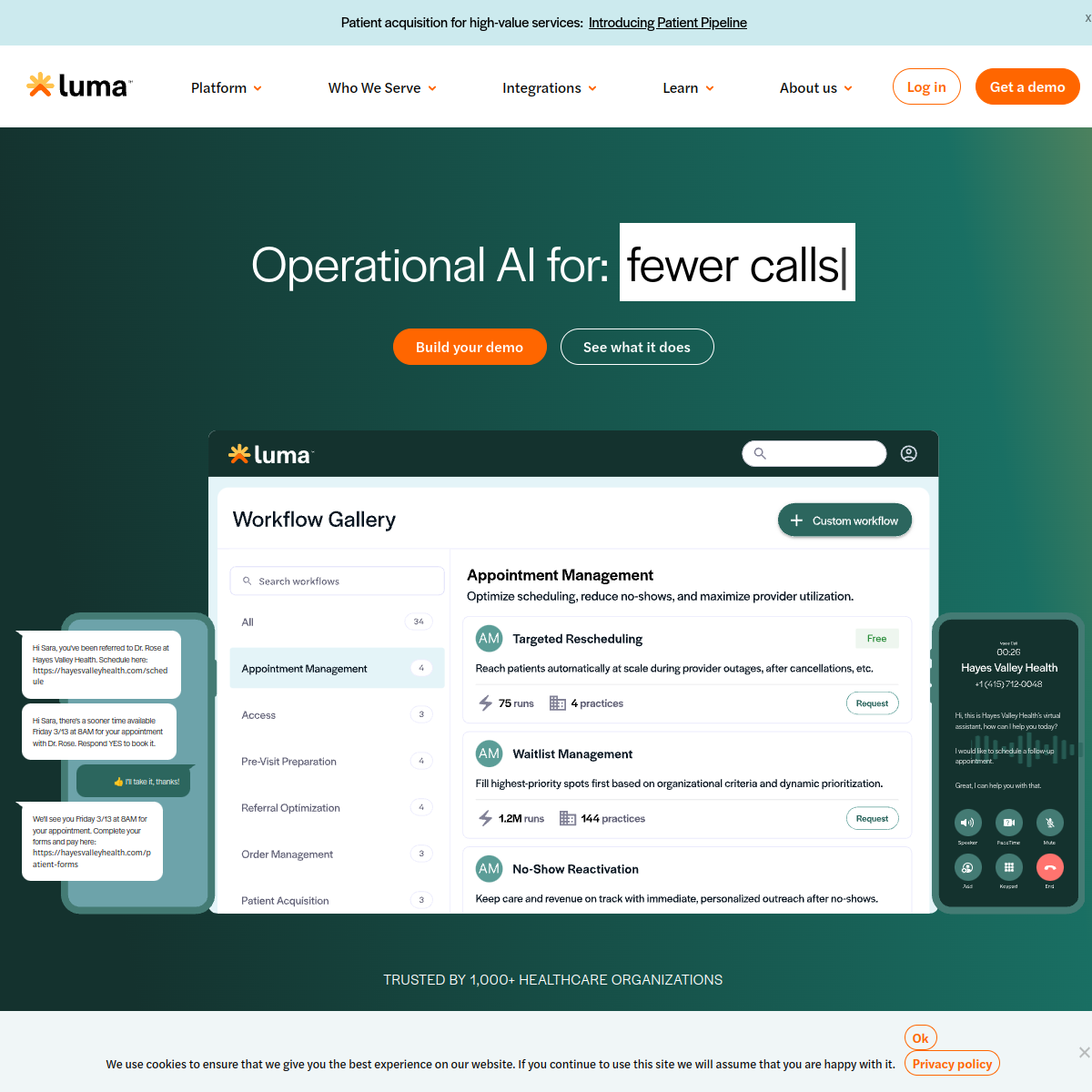
The page we scored
The AI Recommendation Check
When we asked AI who to recommend for AI-powered patient access and engagement platform for healthcare organizations, it named:
Buyer we put in the prompt: VP of Operations, Chief Clinical Access Officer, or COO at a mid-to-large healthcare organization (hospital, health system, or multi-site clinic). Both the buyer and the category were inferred from Luma Health’s homepage alone. The model had no web access.
Luma Health was on the list.
AI named them for their own category. That's the signal every homepage is supposed to send.
AI mentioned you for "AI-powered patient access and engagement platform for healthcare organizations", but only generically: "Luma Health is a patient engagement and access platform that automates scheduling, reminders, referral management, and communication workflows for healthcare organizations, helping reduce no-shows and streamline patient journeys.". You're on the radar, but AI doesn't yet repeat your specific positioning back.
Overall assessment
Luma Health's biggest strength is its owned language ... 'Operational AI,' four named agentic workflow pillars, and the proprietary Spark engine give it genuine category distinctiveness that AI can quote back. The biggest gap is the complete absence of cost-of-inaction framing and competitive acknowledgment: the page never tells buyers what they are losing today by not acting, which kills urgency and makes the pitch feel informational rather than compelling.
Signal by category
Narrative Clarity
8 signals
Trust Signal
4 signals
AI Signal
6 signals
Conversion Signal
1 signal
Weakest signal · fix this first
07Cost of Inaction
“No mention of revenue lost to no-shows, cost of staff burnout, or patient leakage anywhere on the page.”
The page never names what happens if the buyer does nothing ... no cost of delay, no quantified downside risk, no 'you are currently losing X' framing.
All 19 signals, scored 0 to 2.
Total 22/38
Narrative Clarity
8 signals
- 1
01The 7-Second Test
“'Operational AI for:' [rotating text] + 'Helping healthcare organizations deliver more care'”
Healthcare is clear, but 'Operational AI for:' without a completed rotating headline in the scraped content leaves the problem and POV ambiguous in the 7-second window; a stranger knows the industry but not the specific pain being solved.
- 1
02Rebellion / Movement
“'Needing care is hard. Getting it should be easy.'”
There is an implied enemy (friction and bottlenecks in patient access) but no named status quo, no named competitor pattern, and no explicit rebellion statement; the pushback is soft and generic.
- 2
03Owned Language & Category
“'Operational AI' ... 'agentic access' ... 'agentic engagement' ... 'agentic intake' ... 'agentic payments' ... 'Spark'”
Luma owns 'Operational AI,' coins four named agentic workflow categories, and names a proprietary AI core called Spark ... specific enough that an LLM could cite these terms as Luma's own framework.
- 1
04ICP Clarity
“'TRUSTED BY 1,000+ HEALTHCARE ORGANIZATIONS' ... 'Serving healthcare organizations across The United States, Canada, The United Kingdom'”
Healthcare organizations are identified but buyer role (e.g., COO, CMO, VP of Operations), organization size, and vertical (hospital vs. clinic vs. specialty) are never specified above the fold or anywhere on the page.
- 1
05Problem Leadership
“'Needing care is hard. Getting it should be easy.' / 'Luma removes bottlenecks and friction from patient journeys'”
The page acknowledges friction as a problem but leads with the product category ('Operational AI') rather than the buyer's felt pain; the problem statement appears mid-page, not in the hero.
- 2
06Solution Clarity
“'Luma removes bottlenecks and friction from patient journeys ... on both the front end and the back end.'”
A visitor can repeat a one-sentence explanation: Luma is AI that removes scheduling and operational friction for healthcare organizations across access, engagement, intake, and payments.
- 0
07Cost of Inactionweakest
“No mention of revenue lost to no-shows, cost of staff burnout, or patient leakage anywhere on the page.”
The page never names what happens if the buyer does nothing ... no cost of delay, no quantified downside risk, no 'you are currently losing X' framing.
- 1
08Promised Land
“'61 days reduction in time to care on average' / '2-3 hours saved on manual calls daily' / '47% increase in revenue on average'”
Outcome metrics are present but they describe current customer results, not a vivid painted 'after' world the buyer will inhabit; there is no narrative promised-land scene or aspirational future state described.
Trust Signal
4 signals
- 2
09Proof & Evidence
“'61 days reduction in time to care on average' / '2-3 hours saved on manual calls daily' / '47% increase in revenue on average'”
Three concrete, quantified outcome deltas are present on the page, which is above the threshold for this criterion.
- 1
10Social Proof
“'Michelle Winfield-Hanrahan, BSN, MHA, MSN, Chief Clinical Access Officer and Assistant Vice Chancellor of Access, UAMS'”
There is one named testimonial with full title and organization, plus a logo wall of recognizable health systems, but only a single quote and no video stories or named case studies visible on this page.
- 1
11Authority & Credibility
“'Built on more than a decade of patient engagement and deep EHR integration expertise'”
Tenure is claimed but not demonstrated through named frameworks, original research, founder credentials, or third-party awards; authority is asserted, not proven.
- 0
12Alternatives Acknowledged
“No mention of competitors, alternative approaches, or 'do nothing' cost anywhere on the page.”
The page never acknowledges what buyers might use instead ... no competitive comparison, no 'unlike X,' no honest treatment of the do-nothing option.
AI Signal
6 signals
- 1
13Customer Focus
“'Luma drives better outcomes for patients, staff, and your system.'”
The page mixes customer outcomes with product feature lists (agentic access, payments, etc.); it tilts toward the company's capabilities rather than consistently keeping the healthcare organization or patient as the protagonist.
- 2
14AI-Parmesan Index
“'Spark coordinates multiple AI capabilities and systems across products, agents, and workflows.' / 'healthcare-native AI core trained on real workflows'”
AI claims are mechanistic and specific ... named AI core (Spark), described as healthcare-native and trained on real workflows ... not generic 'AI-powered' sprinkle language.
- 1
15LLM Quotability
“'Needing care is hard. Getting it should be easy.' / 'Luma removes bottlenecks and friction from patient journeys'”
A few declarative sentences exist but none are crisp enough to be lifted verbatim by an LLM as a recommendation; the stat block is the closest but lacks a single clean citation-ready summary sentence.
- 1
16Copyright Freshness
“Image URLs dated '/2026/02/' and '/2026/04/' visible in src paths throughout the page.”
Asset upload dates suggest recent content, but no visible copyright year, no dated blog posts, and no dated case studies appear in the scraped content, limiting recency signal.
- 2
17Entity Distinctiveness
“'Operational AI' / 'agentic access, agentic engagement, agentic intake, agentic payments' / 'Spark ... a healthcare-native AI core'”
The combination of proprietary category name ('Operational AI'), four named agentic workflow pillars, and a named AI engine (Spark) makes this company meaningfully distinguishable from generic patient engagement competitors.
- 1
18AI Recommendation Check
“AI named you alongside Luma Health, Kyruus Health, Relatient, Notable Health, Phreesia, describing you as: "Luma Health is a patient engagement and access platform that automates scheduling, reminders, referral management, and communication workflows for healthcare organizations, helping reduce no-shows and streamline patient journeys.".”
AI mentioned you for "AI-powered patient access and engagement platform for healthcare organizations", but only generically: "Luma Health is a patient engagement and access platform that automates scheduling, reminders, referral management, and communication workflows for healthcare organizations, helping reduce no-shows and streamline patient journeys.". You're on the radar, but AI doesn't yet repeat your specific positioning back.
Conversion Signal
1 signal
- 1
19Path & CTA Clarity
“'Build your demo' / 'See what it does'”
Two CTAs exist (primary demo CTA and a soft 'see what it does' secondary), but there is no visible numbered process or step-by-step path connecting the CTAs to a buyer journey, so the pairing is incomplete.
Keep the lead
AI already names Luma Health. The next edition decides if it still does.
Twenty minutes with Greg. Bring the page, bring the argument. You’ll leave knowing exactly which signal is costing Luma Health the AI recommendation, and what to write instead.
Not on the list? Run your homepage through the free Brand Signal Score and see where you’d land. Same 19 signals, same AI check, two minutes.