
The 2026 Healthtech Messaging Index
Little Otter
littleotterhealth.com·scored November 1, 2026
25/38
Approaching
Close. The bones are good. A few targeted fixes on the weakest signals would push Little Otter into magnetic territory.
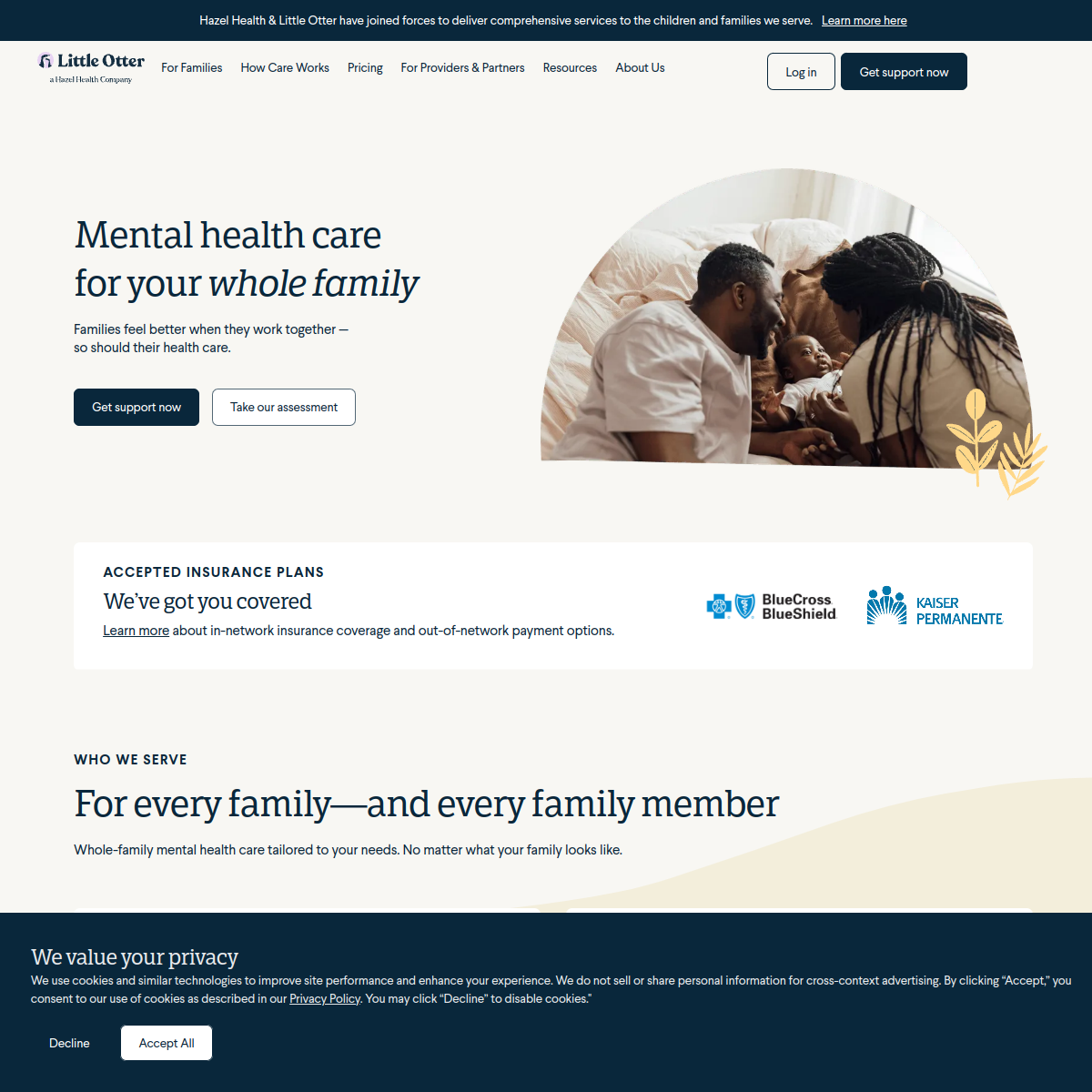
The page we scored
The AI Recommendation Check
When we asked AI who to recommend for Virtual family mental health care / pediatric telehealth therapy, it named:
Buyer we put in the prompt: Parent or caregiver of a child or teenager seeking mental health care for their family. Both the buyer and the category were inferred from Little Otter’s homepage alone. The model had no web access.
Little Otter was on the list.
AI named them for their own category. That's the signal every homepage is supposed to send.
AI mentioned you for "Virtual family mental health care / pediatric telehealth therapy", but only generically: "Little Otter is a virtual mental health platform focused on young children and families, offering therapy and parent coaching with relatively fast access to care.". You're on the radar, but AI doesn't yet repeat your specific positioning back.
Overall assessment
Little Otter's biggest strength is its concrete outcome proof (80% improvement in 12 sessions, Dr. Egger's elite credentials) paired with a genuinely differentiated whole-family positioning that AI can distinguish from competitors. The biggest gap is a complete absence of cost-of-inaction messaging and named alternatives ... the page never creates urgency or addresses why a parent should act now rather than stay on a waitlist elsewhere, leaving conversion energy on the table.
Signal by category
Narrative Clarity
8 signals
Trust Signal
4 signals
AI Signal
6 signals
Conversion Signal
1 signal
Weakest signal · fix this first
07Cost of Inaction
“No mention of what happens if families delay care, skip treatment, or stay on a waitlist elsewhere.”
The page never names the cost of inaction ... no framing of deteriorating child mental health, missed developmental windows, or consequences of waitlists ... so there's no urgency trigger.
All 19 signals, scored 0 to 2.
Total 25/38
Narrative Clarity
8 signals
- 2
01The 7-Second Test
“Mental health care for your whole family" / "Families feel better when they work together ... so should their health care.”
Within 7 seconds a stranger knows this is virtual mental health care for families with children, the problem is fragmented care, and the POV is whole-family treatment together.
- 1
02Rebellion / Movement
“Families feel better when they work together ... so should their health care.”
There's a implicit push against siloed, child-only mental health care, but no named enemy, no named status quo label, and no explicit industry pattern called out by name.
- 1
03Owned Language & Category
“Family Mental Health Check-up" and "whole family model of care”
'Family Mental Health Check-up' and 'whole family model' hint at an owned frame but are never defined, trademarked, or positioned as a named category AI could uniquely cite back to Little Otter.
- 2
04ICP Clarity
“For every family ... and every family member" with segments: Children 0 ... 2, 3 ... 7, 8 ... 12, Teenagers, Parents, Trying/Expecting”
The ICP is unmistakably clear ... parents seeking mental health care for children of all ages and themselves ... with age-segmented navigation making self-identification instant.
- 1
05Problem Leadership
“Families feel better when they work together ... so should their health care.”
The hero gestures at a problem (disjointed care) but leads with the solution frame rather than naming the buyer's felt pain first ... no explicit problem statement in the buyer's language.
- 2
06Solution Clarity
“Mental health care for your whole family" ... therapy, psychiatry, and parent coaching via video, matched in 24 hours”
A visitor can repeat exactly what Little Otter does: virtual whole-family mental health care including therapy, psychiatry, and parent coaching, booked within 24 hours.
- 0
07Cost of Inactionweakest
“No mention of what happens if families delay care, skip treatment, or stay on a waitlist elsewhere.”
The page never names the cost of inaction ... no framing of deteriorating child mental health, missed developmental windows, or consequences of waitlists ... so there's no urgency trigger.
- 1
08Promised Land
“80% of children show clinically significant improvement in 12 sessions" and "Track progress, see results”
The outcome stats hint at a better future state but the page never paints a vivid, specific 'after' life for the family ... it's metrics, not a promised land narrative.
Trust Signal
4 signals
- 2
09Proof & Evidence
“80% of children show clinically significant improvement in 12 sessions" / "3 in 4 parents have clinically significant reduction in anxiety and depression" / "61% of families report significant reductions in stress”
Three specific, clinically-framed outcome numbers with a defined timeframe (12 sessions) constitute concrete, credible proof rather than adjectives.
- 1
10Social Proof
“Trusted by 25,000+ families" with 9 testimonials attributed only to generic roles like "Mother of child who graduated from care”
Volume claim and multiple testimonials exist, but zero testimonials include a full name, making them unverifiable and weaker than named, titled social proof.
- 2
11Authority & Credibility
“Dr. Helen Egger...child psychiatrist...leader in the field for more than 30 years...Division Chief at Duke Medicine...Chair at NYU Langone Health”
Founder credentials are specific, verifiable, and prestigious ... Duke and NYU Langone roles plus 30 years of research leadership constitute demonstrated, not merely claimed, authority.
- 0
12Alternatives Acknowledged
“No mention of competitors, alternative platforms, 'do nothing,' waitlists at other services, or in-person therapy as an alternative.”
The page never acknowledges any alternative the buyer might consider, including doing nothing, in-person therapy, or competing telehealth platforms.
AI Signal
6 signals
- 2
13Customer Focus
“You can see your kids open up and blossom" / "My son is thriving" / "I can just show up and say I need help”
Testimonials, segment pages, and how-it-works steps all center the parent and child experience ... the customer is the consistent protagonist throughout.
- 2
14AI-Parmesan Index
“No AI claims anywhere on the page.”
Little Otter makes zero AI-powered claims, avoiding the AI-Parmesan trap entirely ... scores 2 by default per the rubric's explicit rule.
- 1
15LLM Quotability
“80% of children show clinically significant improvement in 12 sessions" and "The leader in child mental health”
A few stat-forward sentences are close to quotable, but the hero and positioning sentences are too soft and generic for an LLM to lift as a crisp, citation-ready recommendation.
- 0
16Copyright Freshness
“No visible dates on blog posts, case studies, or copyright year visible in the scraped content.”
No publication dates, recent case study timestamps, or copyright year appear in the scraped page content, removing all recency signals for AI engines.
- 2
17Entity Distinctiveness
“Clinicians led and trained by world-renowned experts in child mental health" + Dr. Egger's Duke/NYU credentials + "Family Mental Health Check-up" + age-segmented whole-family model”
The combination of a named CMO with specific elite credentials, a proprietary intake tool, and an explicit whole-family (not child-only) model makes Little Otter meaningfully distinguishable from generic telehealth competitors.
- 1
18AI Recommendation Check
“AI named you alongside Brightline, Talkiatry, Teladoc, MDLive, Headspace Care, describing you as: "Little Otter is a virtual mental health platform focused on young children and families, offering therapy and parent coaching with relatively fast access to care.".”
AI mentioned you for "Virtual family mental health care / pediatric telehealth therapy", but only generically: "Little Otter is a virtual mental health platform focused on young children and families, offering therapy and parent coaching with relatively fast access to care.". You're on the radar, but AI doesn't yet repeat your specific positioning back.
Conversion Signal
1 signal
- 2
19Path & CTA Clarity
“3-step process: "1. Tell us what's going on 2. Begin care immediately 3. Track progress" + primary CTA "Get support now" + soft CTA "Take our assessment”
A numbered 3-step path is explicitly present, tied to one clear primary CTA and one soft secondary CTA, satisfying all three elements of the criterion.
Keep the lead
AI already names Little Otter. The next edition decides if it still does.
Twenty minutes with Greg. Bring the page, bring the argument. You’ll leave knowing exactly which signal is costing Little Otter the AI recommendation, and what to write instead.
Not on the list? Run your homepage through the free Brand Signal Score and see where you’d land. Same 19 signals, same AI check, two minutes.