
The 2026 Healthtech Messaging Index
Koda Health
kodahealthcare.com·scored November 1, 2026
26/38
Approaching
Close. The bones are good. A few targeted fixes on the weakest signals would push Koda Health into magnetic territory.
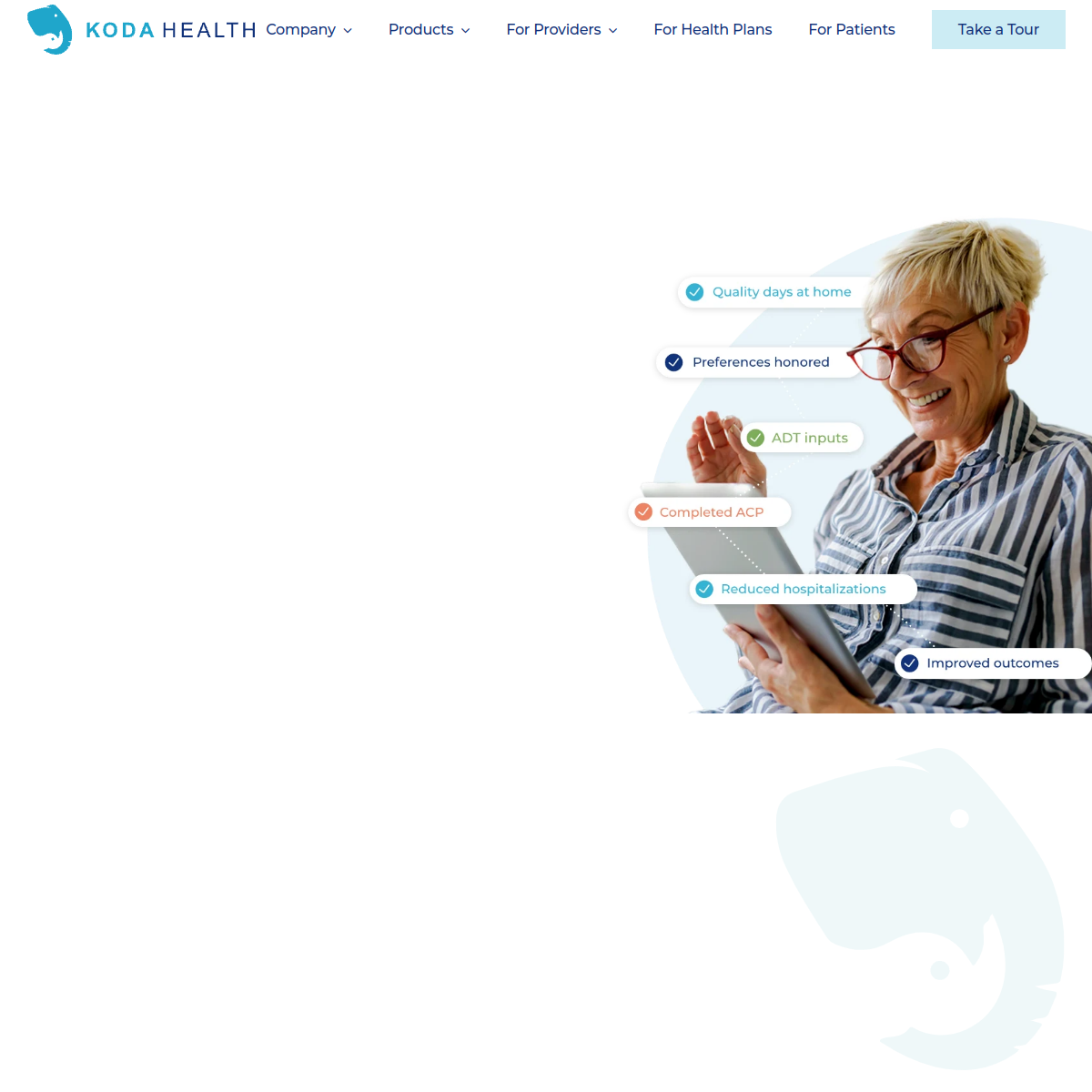
The page we scored
The AI Recommendation Check
When we asked AI who to recommend for Advance care planning software with EMR integration for health systems and payers, it named:
Buyer we put in the prompt: Chief Medical Officer, VP of Care Management, or Director of Palliative Care at a health system, hospital network, or Medicare Advantage payer. Both the buyer and the category were inferred from Koda Health’s homepage alone. The model had no web access.
Koda Health was on the list.
AI named them for their own category. That's the signal every homepage is supposed to send.
AI mentioned you for "Advance care planning software with EMR integration for health systems and payers", but only generically: "Koda Health offers a digital advance care planning platform that helps patients document end-of-life preferences and integrates those directives into electronic medical records.". You're on the radar, but AI doesn't yet repeat your specific positioning back.
Overall assessment
Koda Health's biggest strength is its specific, concrete proof ... ~40% end-of-life cost reduction, 80 ... 85% completion rates, and an 87 NPS ... paired with a clear and distinctive solution description that an AI can quote directly. The biggest gap is ICP clarity and buyer-role specificity: the page never directly addresses a named buyer persona, company size, or stage, and never acknowledges alternatives or the 'do nothing' option, which leaves institutional buyers without the mirroring and contrast signals needed to accelerate a purchase decision.
Signal by category
Narrative Clarity
8 signals
Trust Signal
4 signals
AI Signal
6 signals
Conversion Signal
1 signal
Weakest signal · fix this first
12Alternatives Acknowledged
“No mention of competitors, alternative approaches, or the 'do nothing' option as a named alternative for the buyer.”
The page never acknowledges that buyers could use paper-based processes, other ACP vendors, or do nothing, missing a trust-building opportunity entirely.
All 19 signals, scored 0 to 2.
Total 26/38
Narrative Clarity
8 signals
- 2
01The 7-Second Test
“Goals-aligned care ... for every patient, at scale. Turn patient preferences into clinical action with Koda's care planning platform.”
Within 7 seconds a visitor can see this is a care planning platform that converts patient preferences into clinical action at scale ... the who, what, and point of view are clear above the fold.
- 2
02Rebellion / Movement
“Serious illness planning is uncomfortable. Avoiding it is worse, leaving families with impossible decisions, providers without guidance, and patients' wishes unheard.”
The page names a specific industry pattern ... avoidance of serious illness conversations ... as the enemy, and positions Koda as the fix, giving it a genuine point of view.
- 1
03Owned Language & Category
“Goals-aligned care" and "Kidney action planning" appear as distinct terms, but no named category or owned framework is explicitly claimed.”
Phrases like 'goals-aligned care' and 'kidney action planning' hint at owned language but they are not defined, named, or staked as a category an AI could reliably quote back as Koda's invention.
- 1
04ICP Clarity
“Koda brings patients, providers, and payors into alignment around a shared goal: the right care for every patient.”
The page references payers, providers, and health systems (UPMC, Cigna, Sentara) but never directly addresses a specific buyer role, company size, or stage, leaving ICP partially implied rather than explicit.
- 2
05Problem Leadership
“Serious illness planning is uncomfortable. Avoiding it is worse, leaving families with impossible decisions, providers without guidance, and patients' wishes unheard.”
The page leads with the buyer's problem ... avoidance of serious illness planning and its downstream consequences ... before introducing the solution.
- 2
06Solution Clarity
“digital infrastructure that captures serious-illness preferences and integrates them directly into the EMR, so the right information is there when it matters most.”
A visitor can repeat in one sentence what Koda does: it digitally captures serious-illness preferences and pushes them into the EMR at the point of care.
- 1
07Cost of Inaction
“Avoiding it is worse, leaving families with impossible decisions, providers without guidance, and patients' wishes unheard.”
The cost of inaction is named in human terms (impossible decisions, unheard wishes) but the financial or operational stakes for the institutional buyer ... missed revenue, compliance risk, avoidable costs ... are not quantified as a cost of doing nothing.
- 1
08Promised Land
“moving care teams from reactive choices to consistent, goal-aligned decisions”
The promised land is gestured at ... consistent, goal-aligned decisions ... but there is no vivid, specific 'after' scenario painted for the institutional buyer's world once Koda is in place.
Trust Signal
4 signals
- 2
09Proof & Evidence
“~40% reduction in end-of-life costs" / "80 ... 85% plan completion rates" / "87 NPS”
Three concrete, specific numbers are cited with clear deltas, giving the page genuine proof rather than adjective-driven claims.
- 1
10Social Proof
“Patricia Rackstein, MA, BSN, RN, NPD-BC ... Magnet Program Director at Morton Plant Mease" / "J.B. Sobel, MD, MPH MBA ... Former CMO, Cigna Medicare Advantage”
Named provider testimonials with titles and organizations are present, and partner logos include UPMC, Sentara, and Houston Methodist, but there are no named customer case studies with before/after outcomes and all patient testimonials are anonymous.
- 1
11Authority & Credibility
“Koda launch from our TMCi BioDesign program" ... William McKeon, President & CEO, Texas Medical Center”
Third-party credibility comes via partner logos and provider quotes but there are no founder credentials, proprietary research, publications, or frameworks explicitly cited to establish Koda's own authority.
- 0
12Alternatives Acknowledgedweakest
“No mention of competitors, alternative approaches, or the 'do nothing' option as a named alternative for the buyer.”
The page never acknowledges that buyers could use paper-based processes, other ACP vendors, or do nothing, missing a trust-building opportunity entirely.
AI Signal
6 signals
- 1
13Customer Focus
“Koda fixes this" / "Koda identifies high-risk patients" / "Koda brings patients, providers, and payors into alignment”
The page mixes customer-outcome language with company-capability language; the protagonist shifts between Koda and the patient/provider, rather than keeping the institutional buyer as the consistent hero.
- 2
14AI-Parmesan Index
“No AI-powered claims appear anywhere on the page; 'Intelligent, Automated Outreach' is described mechanistically as identifying high-risk patients and initiating engagement automatically.”
The company does not sprinkle 'AI-powered' branding; where automation is mentioned it is described in functional, mechanistic terms, avoiding AI-Parmesan entirely.
- 2
15LLM Quotability
“~40% reduction in end-of-life costs" / "80 ... 85% plan completion rates across diverse populations" / "87 NPS ... Patients feel supported, not managed.”
These short, declarative, numbered sentences are clean enough for an LLM to lift verbatim and cite as evidence when recommending Koda.
- 1
16Copyright Freshness
“Copyright footer reads "© 2026 Koda Health" and the page metadata shows "2026-08-06" but no dated blog posts or case studies are visible on the homepage.”
The copyright year is current and the page has a recent internal timestamp, but no dated content assets (case studies, blog posts) are surfaced to reinforce recency signals for AI engines.
- 2
17Entity Distinctiveness
“Kidney action planning" for CKD + "Automated 50-State Compliance" + "87 NPS" + EMR integration specifics (Epic, Athena, Cerner) + serious-illness focus”
The combination of a CKD-specific product, named EMR integrations, 50-state compliance automation, and the serious-illness framing creates a profile distinctive enough that an AI could not plausibly attribute it to a generic EHR or generic ACP vendor.
- 1
18AI Recommendation Check
“AI named you alongside Koda Health, Respecting Choices, MyDirectives, Vynca, Cake, describing you as: "Koda Health offers a digital advance care planning platform that helps patients document end-of-life preferences and integrates those directives into electronic medical records.".”
AI mentioned you for "Advance care planning software with EMR integration for health systems and payers", but only generically: "Koda Health offers a digital advance care planning platform that helps patients document end-of-life preferences and integrates those directives into electronic medical records.". You're on the radar, but AI doesn't yet repeat your specific positioning back.
Conversion Signal
1 signal
- 1
19Path & CTA Clarity
“Take a Tour" appears as primary CTA and "Watch Video" as secondary, but no numbered process or steps are shown connecting the two.”
There are two CTAs (primary and soft secondary) but no visible numbered pathway or step-by-step process shown to guide the buyer from awareness to action, so the two elements don't work together as a connected conversion path.
Keep the lead
AI already names Koda Health. The next edition decides if it still does.
Twenty minutes with Greg. Bring the page, bring the argument. You’ll leave knowing exactly which signal is costing Koda Health the AI recommendation, and what to write instead.
Not on the list? Run your homepage through the free Brand Signal Score and see where you’d land. Same 19 signals, same AI check, two minutes.