
The 2026 Healthtech Messaging Index
Iris Telehealth
iristelehealth.com·scored November 1, 2026
17/38
Invisible
The page is doing some work, but the story isn't landing fast enough. Buyers and AI are both left guessing what makes Iris Telehealth different.
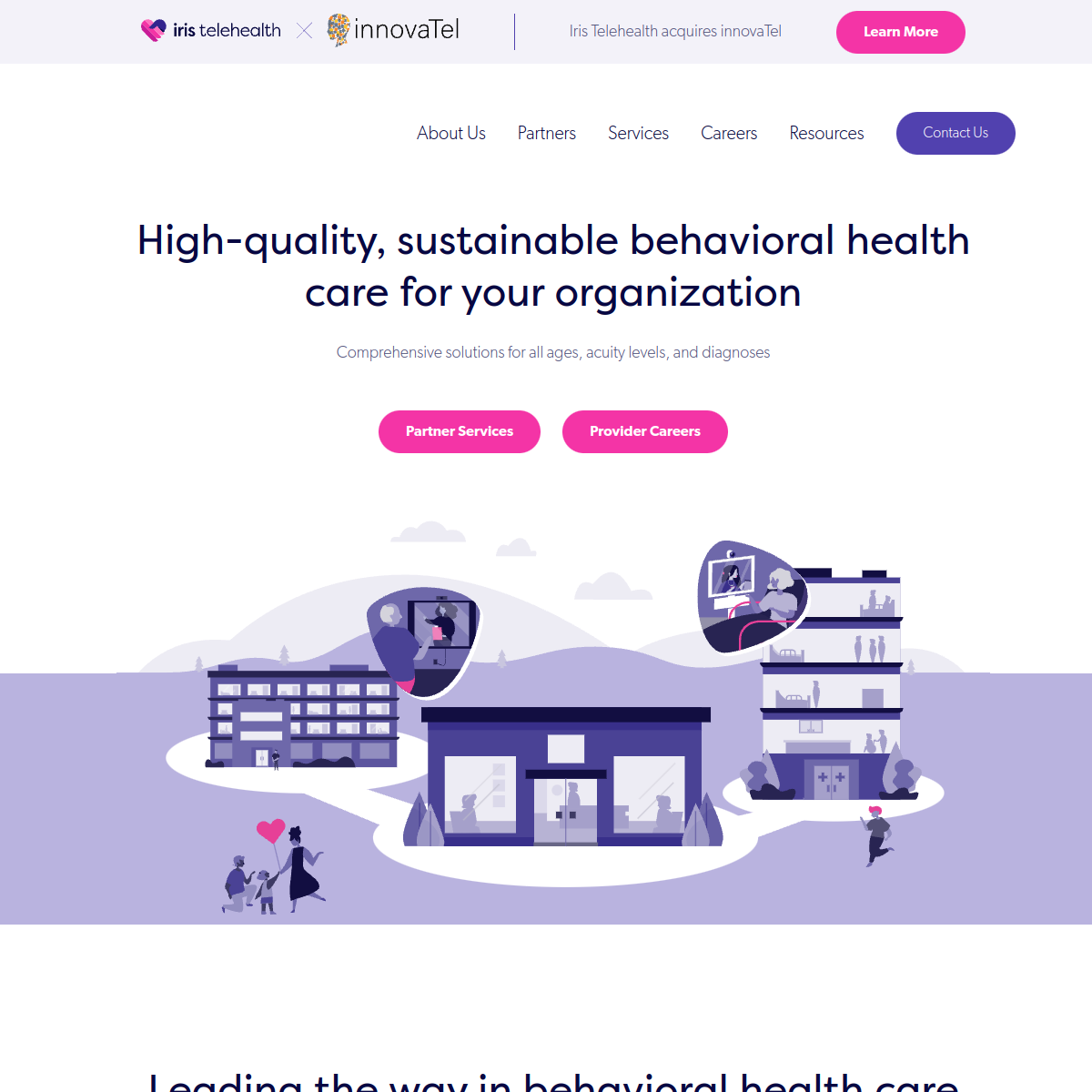
The page we scored
The AI Recommendation Check
When we asked AI who to recommend for Integrated behavioral health telehealth services for healthcare organizations, it named:
Buyer we put in the prompt: VP of Behavioral Health, Chief Medical Officer, or COO at a hospital, health system, FQHC, or community mental health center. Both the buyer and the category were inferred from Iris Telehealth’s homepage alone. The model had no web access.
Iris Telehealth was on the list.
AI named them for their own category. That's the signal every homepage is supposed to send.
AI named you when asked who it recommends for "Integrated behavioral health telehealth services for healthcare organizations", and described you accurately: "Iris Telehealth provides telepsychiatry and behavioral health staffing solutions to health systems, hospitals, and community health organizations, embedding clinicians into existing care workflows.". Your positioning is landing with the machines.
Overall assessment
Iris Telehealth's biggest strength is its attempt to use patient-persona vignettes (David, Ava, Marcus) to make the problem feel human and its logos from recognizable health systems (Geisinger, Trinity, Allina) that signal real enterprise trust. The biggest gap is a complete absence of a distinct point of view ... there is no named enemy, no cost of inaction, no before/after proof, and no language Iris owns that an LLM or buyer couldn't find on any competing telehealth behavioral health vendor's site; the page reads like a brochure, not a manifesto.
Signal by category
Narrative Clarity
8 signals
Trust Signal
4 signals
AI Signal
6 signals
Conversion Signal
1 signal
Weakest signal · fix this first
02Rebellion / Movement
“No named enemy, no named status quo, no industry pattern called out anywhere on the page.”
The page never identifies what's broken about the current system, who or what Iris is pushing against, or why the old way fails ... it's purely solution-forward with zero rebellious point of view.
All 19 signals, scored 0 to 2.
Total 17/38
Narrative Clarity
8 signals
- 1
01The 7-Second Test
“When behavioral health needs surface during care, Iris helps your team take the next step when it matters most.”
The rotating hero tells you it's about behavioral health in care settings, but the carousel format and identical body copy across six different use cases means no single 7-second read lands cleanly ... a stranger sees a slider, not a story.
- 0
02Rebellion / Movementweakest
“No named enemy, no named status quo, no industry pattern called out anywhere on the page.”
The page never identifies what's broken about the current system, who or what Iris is pushing against, or why the old way fails ... it's purely solution-forward with zero rebellious point of view.
- 1
03Owned Language & Category
“'Iris Insights brings together clinical, operational, and financial data to give leaders clear visibility'”
Iris Insights is a named product, which is a start, but the page doesn't coin a category name, define a proprietary framework, or stake out language an LLM would uniquely attribute to Iris over competitors.
- 1
04ICP Clarity
“Hospitals & Health Systems, Community Health Centers & FQHCs, Community Mental Health Centers, Medical Groups & Specialty Practices”
Buyer verticals are listed but there is no role-level clarity (CMO? VP Behavioral Health? CFO?), no company size signal, and no stage indicator ... the ICP is org-type only, not buyer-persona specific.
- 1
05Problem Leadership
“Millions of patients have unmet behavioral health needs that surface during everyday care.”
The page gestures at a problem but frames it as a patient problem, not a buyer pain ... a health system leader's operational frustration (waitlists, boarding, revenue leakage) is never named before the solution is presented.
- 1
06Solution Clarity
“Better behavioral health solutions start with the right people, backed by technology designed around you.”
After reading the hero, a visitor cannot repeat in one sentence what Iris actually does ... the copy is vague enough to describe any behavioral health vendor, and the six rotating use cases dilute rather than clarify.
- 0
07Cost of Inaction
“No mention of cost of inaction, lost revenue, patient boarding days, waitlist growth, or workforce attrition cost anywhere on the page.”
The page never names the financial, operational, or patient-outcome penalty a health system pays for not acting ... stakes are completely absent.
- 1
08Promised Land
“Expand Access, Intervene Earlier, Support Teams, Unlock Capacity”
These four outcomes sketch an after-state but remain abstract and generic ... there are no specific, vivid descriptions of what life looks like for a partner organization once Iris is deployed.
Trust Signal
4 signals
- 1
09Proof & Evidence
“98% Partner Satisfaction / 3.7M+ Partner Encounters / 94% Retention Rate”
Three aggregate metrics exist but there are no before/after deltas, no named outcomes tied to specific partners, and no explanation of what those numbers actually mean for a prospective buyer.
- 1
10Social Proof
“Geisinger, Trinity Health, Allina Health, Legacy Health [logos visible]”
Recognizable health system logos are present, which is a trust signal, but there are zero named testimonials with person, title, and quote ... the Centerpoint case study is teased but not surfaced on the homepage.
- 0
11Authority & Credibility
“No founder credentials, no original research, no published frameworks, no awards, no books or podcasts cited anywhere on the page.”
Authority is entirely absent ... the page claims to be a 'trusted partner' but demonstrates no third-party validation, expert credentials, or original thought leadership to back that up.
- 0
12Alternatives Acknowledged
“No mention of competitors, alternative approaches, or 'do nothing' consequences anywhere on the page.”
Iris never acknowledges that buyers could hire in-house clinicians, use a competitor telehealth platform, or do nothing ... the page pretends alternatives don't exist.
AI Signal
6 signals
- 1
13Customer Focus
“David couldn't explain why adding providers hadn't reduced their waitlist / Ava was cleared medically, but still spent the night in boarding”
The rotating patient/operator vignettes are a genuine attempt to center the customer story, but the identical body copy under each one collapses back into company-speak, leaving a mixed protagonist throughout.
- 2
14AI-Parmesan Index
“No AI claims anywhere on the page; 'Iris Insights brings together clinical, operational, and financial data' is described mechanistically.”
Iris does not sprinkle 'AI-powered' language ... the technology is described in functional, concrete terms, which earns full marks under the AI-Parmesan rubric.
- 1
15LLM Quotability
“Behavioral health is part of every patient story.”
That one sentence is quotable and declarative, but the rest of the page lacks clean, citation-ready sentences an LLM could lift to specifically recommend Iris over a competitor ... most copy is too generic.
- 1
16Copyright Freshness
“Copyright year not visible in scraped content; 'camino_real_logo' uploaded 2026/06 suggests some recent activity.”
File upload dates suggest recent updates but there are no visible dated blog posts, case study publish dates, or a clear copyright year in the scraped content ... recency signals are weak for LLM indexing.
- 1
17Entity Distinctiveness
“'A trusted partner for every care setting' with six solution lines across acute, primary, youth, workforce, and consulting.”
The breadth of solution lines and named health system logos give some distinctiveness, but the core positioning ... integrated telehealth behavioral health ... is interchangeable with competitors like Teladoc, Brightside Health, or Array Behavioral Care at the homepage level.
- 2
18AI Recommendation Check
“AI described you as: "Iris Telehealth provides telepsychiatry and behavioral health staffing solutions to health systems, hospitals, and community health organizations, embedding clinicians into existing care workflows.”
AI named you when asked who it recommends for "Integrated behavioral health telehealth services for healthcare organizations", and described you accurately: "Iris Telehealth provides telepsychiatry and behavioral health staffing solutions to health systems, hospitals, and community health organizations, embedding clinicians into existing care workflows.". Your positioning is landing with the machines.
Conversion Signal
1 signal
- 1
19Path & CTA Clarity
“[Request A Demo] is the only CTA at page bottom; 'Explore Our Solutions' appears in the hero carousel.”
There is a primary CTA (Request A Demo) but no numbered process showing what happens next, and the secondary CTA is a generic internal link rather than a soft-conversion offer like a guide or assessment ... the path is incomplete.
Keep the lead
AI already names Iris Telehealth. The next edition decides if it still does.
Twenty minutes with Greg. Bring the page, bring the argument. You’ll leave knowing exactly which signal is costing Iris Telehealth the AI recommendation, and what to write instead.
Not on the list? Run your homepage through the free Brand Signal Score and see where you’d land. Same 19 signals, same AI check, two minutes.