
The 2026 Healthtech Messaging Index
Inbox Health
inboxhealth.com·scored November 1, 2026
21/38
Invisible
The page is doing some work, but the story isn't landing fast enough. Buyers and AI are both left guessing what makes Inbox Health different.
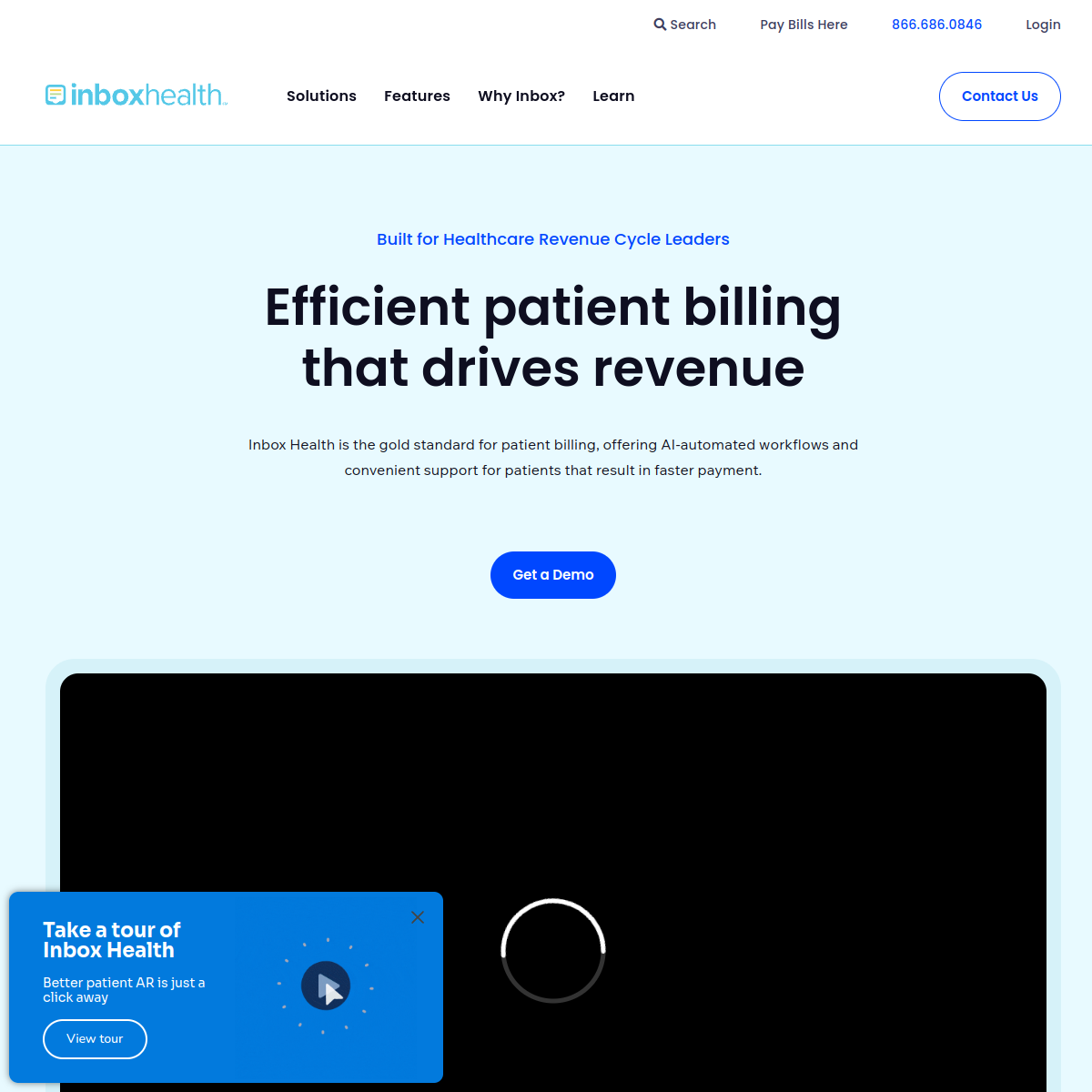
The page we scored
The AI Recommendation Check
When we asked AI who to recommend for Patient billing and collections software for healthcare revenue cycle management, it named:
Buyer we put in the prompt: Revenue Cycle Manager, Practice Administrator, or Billing Company CEO at a medical practice group or third-party medical billing company. Both the buyer and the category were inferred from Inbox Health’s homepage alone. The model had no web access.
Inbox Health was not on the list.
A buyer who asked AI this question got 8 names and moved on. Inbox Health never came up.
We asked AI who it recommends for "Revenue Cycle Manager, Practice Administrator, or Billing Company CEO at a medical practice group or third-party medical billing company" looking for "Patient billing and collections software for healthcare revenue cycle management". It named Waystar, Kareo, AdvancedMD, Collectly, Phreesia. You did not appear. AI can't recommend what it can't clearly understand.
Overall assessment
Inbox Health's biggest strength is its concrete, specific proof ... named outcome metrics (85% A/R in 15 days, 2x collections), named testimonials with titles and companies, and a specific case study give it real trust signals most competitors lack. The biggest gap is the absence of any owned language, named category, or proprietary framework: the page speaks entirely in commodity RCM vocabulary ('AI-powered,' 'patient billing,' 'revenue cycle'), so an LLM or AI buyer research tool cannot distinguish Inbox Health from three other patient billing platforms on narrative alone.
Signal by category
Narrative Clarity
8 signals
Trust Signal
4 signals
AI Signal
6 signals
Conversion Signal
1 signal
Weakest signal · fix this first
03Owned Language & Category
“No coined terms, named category, or owned framework present on the page.”
The page reuses commodity language like 'patient billing,' 'AI-powered,' and 'revenue cycle' with no proprietary framing, category name, or term an LLM could uniquely attribute to Inbox Health.
All 19 signals, scored 0 to 2.
Total 21/38
Narrative Clarity
8 signals
- 2
01The 7-Second Test
“Built for Healthcare Revenue Cycle Leaders / Efficient patient billing that drives revenue”
Within 7 seconds, a stranger knows this is for healthcare revenue cycle leaders, the problem is inefficient patient billing, and the solution drives faster revenue ... clear enough for a caveman.
- 1
02Rebellion / Movement
“Healthcare organizations collect less than half of what patients owe. On average, it costs $4 to collect $1 of patient A/R.”
The page implies the status quo is broken and expensive, but never names a named enemy, a competitor, or a labeled industry pattern it is rebelling against ... it's problem-aware but not genuinely adversarial.
- 0
03Owned Language & Categoryweakest
“No coined terms, named category, or owned framework present on the page.”
The page reuses commodity language like 'patient billing,' 'AI-powered,' and 'revenue cycle' with no proprietary framing, category name, or term an LLM could uniquely attribute to Inbox Health.
- 2
04ICP Clarity
“Built for Healthcare Revenue Cycle Leaders ... Billing Companies / Practices / Partners”
The page explicitly names three distinct buyer segments ... billing companies, medical practices, and partners ... with dedicated links, making ICP identity immediately clear.
- 1
05Problem Leadership
“50% of patients leave a practice due to a billing issue.”
The page surfaces a compelling problem stat mid-page but leads the hero with the solution ('Efficient patient billing that drives revenue'), not the buyer's pain ... problem framing comes second.
- 2
06Solution Clarity
“Inbox Health is the gold standard for patient billing, offering AI-automated workflows and convenient support for patients that result in faster payment.”
A visitor can repeat what Inbox Health does in one sentence after reading the hero ... automated patient billing workflows that get healthcare organizations paid faster.
- 1
07Cost of Inaction
“Healthcare organizations collect less than half of what patients owe. On average, it costs $4 to collect $1 of patient A/R.”
The cost of inaction is implied through industry stats but the page never directly says what happens to the buyer specifically if they don't change ... it's a market stat, not a personalized stake.
- 1
08Promised Land
“85% of patient A/R collected in 15 days / 2x increase in total patient collections”
Outcome metrics hint at a promised land but the page never paints a vivid, narrative 'after' state ... it lists numbers without describing the transformed day-to-day life of the buyer.
Trust Signal
4 signals
- 2
09Proof & Evidence
“85% of patient A/R collected in 15 days / 2x increase in total patient collections / 70% of patient billing inquiries resolved without interrupting your staff”
The page leads with four specific, concrete outcome metrics and a named case study ('Eyecare Services Partners Exceeds Full-Year 2024 Collections in Just 8.5 Months'), making proof tangible and credible.
- 2
10Social Proof
“Erin Rockett, President, Precise Practice Management / Amy Koon, CEO, Keystone Medical Management / John Gwin, CEO, The Auctus Group”
Multiple testimonials include full names, titles, and company names, plus a named case study with an identified COO ... social proof is specific and verifiable.
- 0
11Authority & Credibility
“No founder credentials, original research, awards, frameworks, or named domain authority present on the page.”
The page claims to be 'the gold standard' but provides zero evidence of founder expertise, industry recognition, proprietary research, or external authority to back that claim.
- 0
12Alternatives Acknowledged
“No mention of competitors, alternative approaches, or 'do nothing' option anywhere on the page.”
The page never acknowledges that buyers could use a competitor, stay with their current process, or do nothing ... alternatives are entirely absent.
AI Signal
6 signals
- 1
13Customer Focus
“Eliminate billing roadblocks and empower patients to pay ... fast / Boost patient satisfaction while managing and resolving patient inquiries fast”
The page mixes customer outcomes with product feature descriptions, tilting toward the company's capabilities rather than making the buyer the consistent protagonist throughout.
- 1
14AI-Parmesan Index
“AI-powered responses that handle common issues like updates to insurance information / AI-automated workflows”
AI claims are partially mechanistic (HIPAA-compliant, handles insurance updates, 90% first-touch resolution) but still lean on generic 'AI-powered' language without explaining the underlying mechanism.
- 1
15LLM Quotability
“Healthcare organizations collect less than half of what patients owe. On average, it costs $4 to collect $1 of patient A/R.”
A few stats are quotable but they read as industry figures rather than Inbox Health-owned declarative claims; no single crisp sentence uniquely positions the company in a way an LLM would cite verbatim.
- 2
16Copyright Freshness
“Eyecare Services Partners Exceeds Full-Year 2024 Collections in Just 8.5 Months / November 12, 2026 / October 22, 2026”
The page shows a recent named case study referencing 2024 data and multiple upcoming events dated 2026, signaling active content freshness that AI engines can weight positively.
- 1
17Entity Distinctiveness
“Inbox Health is the gold standard for patient billing, offering AI-automated workflows and convenient support for patients”
Some distinctive elements exist (multi-channel billing cycles, outsourced patient billing support team, 90% first-touch resolution) but the core positioning could describe several RCM competitors ... swapping the logo would not break the description.
- 0
18AI Recommendation Check
“AI's picks: Waystar, Kareo, AdvancedMD, Collectly, Phreesia, Experian Health. You were not named.”
We asked AI who it recommends for "Revenue Cycle Manager, Practice Administrator, or Billing Company CEO at a medical practice group or third-party medical billing company" looking for "Patient billing and collections software for healthcare revenue cycle management". It named Waystar, Kareo, AdvancedMD, Collectly, Phreesia. You did not appear. AI can't recommend what it can't clearly understand.
Conversion Signal
1 signal
- 1
19Path & CTA Clarity
“Get a Demo / Automate and save time / Simplify your workflow / Get paid faster”
There is a consistent primary CTA ('Get a Demo') but no visible numbered process showing how onboarding works, and the secondary CTAs are scattered feature links rather than one coherent soft-conversion path.
Your move
Think Inbox Health’s score is wrong? Good. Let’s look at it together.
Twenty minutes with Greg. Bring the page, bring the argument. You’ll leave knowing exactly which signal is costing Inbox Health the AI recommendation, and what to write instead.
Not on the list? Run your homepage through the free Brand Signal Score and see where you’d land. Same 19 signals, same AI check, two minutes.