
The 2026 Healthtech Messaging Index
Equip Health
equip.health·scored September 1, 2026
26/38
Approaching
Close. The bones are good. A few targeted fixes on the weakest signals would push Equip Health into magnetic territory.
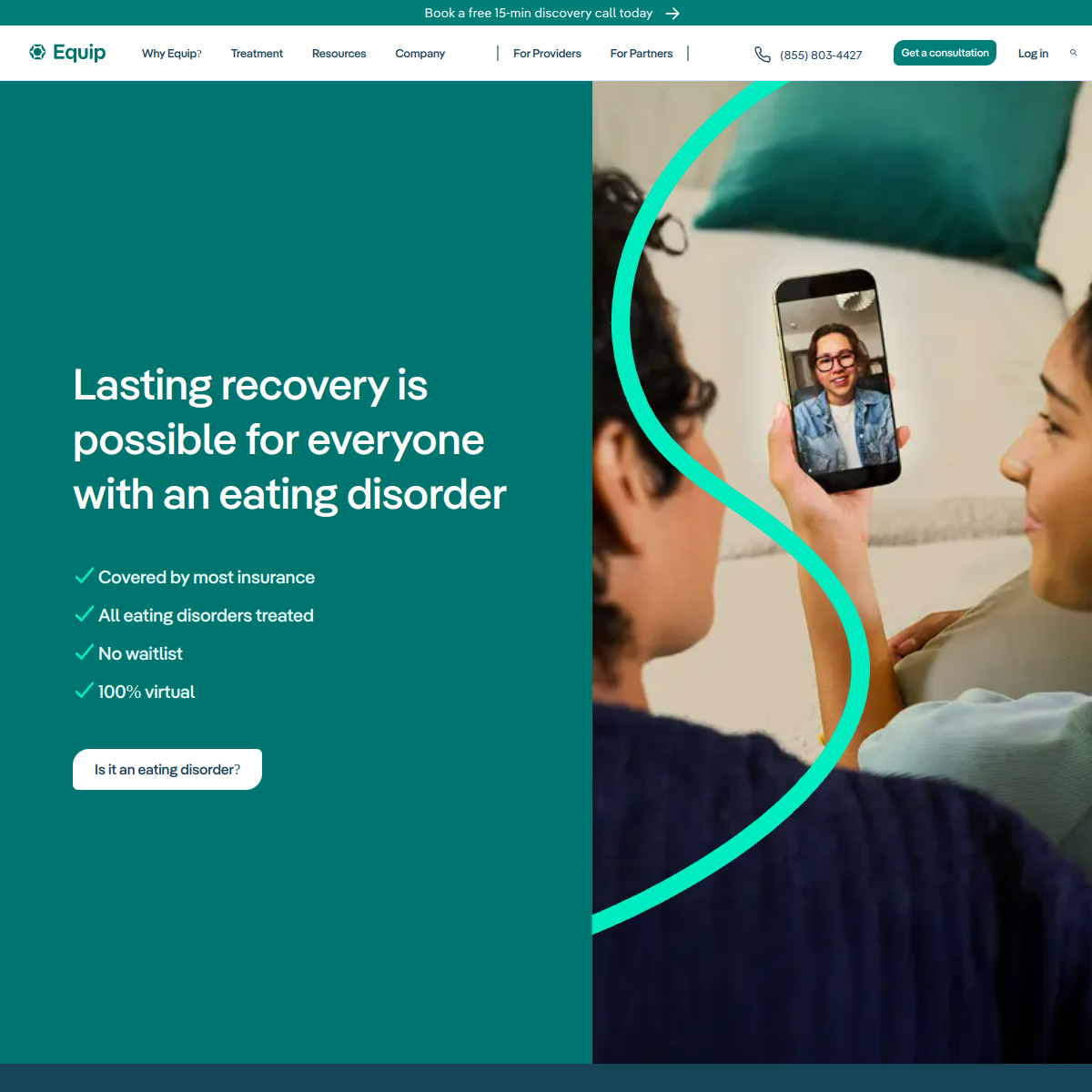
The page we scored
The AI Recommendation Check
When we asked AI who to recommend for Virtual eating disorder treatment program, it named:
Buyer we put in the prompt: Individual patient or parent/caregiver of someone with an eating disorder seeking virtual treatment covered by insurance. Both the buyer and the category were inferred from Equip Health’s homepage alone. The model had no web access.
Equip Health was on the list.
AI named them for their own category. That's the signal every homepage is supposed to send.
AI named you when asked who it recommends for "Virtual eating disorder treatment program", and described you accurately: "Equip Health offers virtual eating disorder treatment using a team-based care model that includes clinicians, dietitians, and peer or family mentors, with a focus on insurance coverage and family involvement.". Your positioning is landing with the machines.
Overall assessment
Equip Health's biggest strength is its rich, patient-voiced social proof combined with specific clinical outcome statistics that make the transformation vivid and credible. The biggest gap is the complete absence of cost-of-inaction framing and any acknowledgment of alternatives ... the page never creates urgency around delay or earns trust by honestly addressing why someone might choose differently, which leaves persuasive power on the table.
Signal by category
Narrative Clarity
8 signals
Trust Signal
4 signals
AI Signal
6 signals
Conversion Signal
1 signal
Weakest signal · fix this first
07Cost of Inaction
“No mention of consequences of delayed treatment, worsening outcomes, or cost of doing nothing anywhere on the page.”
The page never names what happens if someone waits or chooses not to act ... no stakes, no urgency framing around inaction.
All 19 signals, scored 0 to 2.
Total 26/38
Narrative Clarity
8 signals
- 2
01The 7-Second Test
“Lasting recovery is possible for everyone with an eating disorder" + "Covered by most insurance / All eating disorders treated / No waitlist / 100% virtual”
Within seconds, a stranger knows this is virtual eating disorder treatment, covered by insurance, with no waitlist ... who it's for and what it does is immediately clear.
- 1
02Rebellion / Movement
“The convenience of scheduling; virtual options; complete team of providers; it is saving my daughter's life.”
The page implies the status quo of fragmented, inaccessible, waitlisted care is broken, but never names it as an enemy or articulates a clear rebellion ... it's implied through testimonials, not stated as a point of view.
- 1
03Owned Language & Category
“You're supported by a 5-person care team" and "Clinical expertise combined with lived experience”
The '5-person care team' model is a distinctive structural frame but is never named as a proprietary concept or coined term that AI could quote back as Equip's owned category language.
- 1
04ICP Clarity
“Lasting recovery is possible for everyone with an eating disorder”
The page targets patients and families dealing with eating disorders broadly, but doesn't segment by age, severity, prior treatment history, or payer type in the hero ... 'everyone' is inclusive but not precise.
- 1
05Problem Leadership
“Trying to navigate helping our family survive anorexia felt like trying to trek through a dense, fierce jungle.”
The problem is surfaced through patient testimonials rather than led with directly in the company's own voice before the solution ... the hero opens with the solution promise, not the problem.
- 2
06Solution Clarity
“100% virtual" eating disorder treatment with "a 5-person care team" including therapist, medical provider, dietitian, family mentor, and peer mentor”
A visitor can clearly explain: Equip delivers fully virtual, insurance-covered eating disorder treatment through a dedicated five-person multidisciplinary care team.
- 0
07Cost of Inactionweakest
“No mention of consequences of delayed treatment, worsening outcomes, or cost of doing nothing anywhere on the page.”
The page never names what happens if someone waits or chooses not to act ... no stakes, no urgency framing around inaction.
- 2
08Promised Land
“Last year, I felt broken. Today, I feel whole." and "50% improve to subclinical levels of eating disorder symptoms”
Both emotional and clinical 'after states' are painted clearly ... patients feel whole, anxiety drops to subclinical levels, behaviors decrease, weight is restored.
Trust Signal
4 signals
- 2
09Proof & Evidence
“50% improve to subclinical levels of eating disorder symptoms" / "8 in 10 patients report a decrease in eating disorder behaviors" / "74% of patients report improvements with depression or anxiety”
Multiple specific outcome statistics with percentages and clinical deltas are present, not just adjectives.
- 2
10Social Proof
“Named testimonials including "Brett M," "Kacie F," "Erica C," "Kendra," "Jean B" with specific conditions, ages, and relationship to patient noted throughout.”
The page has abundant named testimonials with relationship context (parent, patient, sibling) and specific eating disorder types, making social proof concrete and credible.
- 1
11Authority & Credibility
“Clinical expertise combined with lived experience gives you the comprehensive support you need.”
Credibility is claimed but not demonstrated ... no founder credentials, no named researchers, no published frameworks, no awards cited on this page.
- 0
12Alternatives Acknowledged
“No mention of competitors, alternative treatment options, inpatient vs. outpatient tradeoffs, or 'do nothing' framing anywhere on the page.”
The page never acknowledges that buyers might consider residential treatment, local outpatient therapy, or no treatment ... alternatives are completely absent.
AI Signal
6 signals
- 2
13Customer Focus
“My daughter's eating disorder seemed insurmountable, but Equip truly saved her." / "Last year, I felt broken. Today, I feel whole.”
The page is told almost entirely through patient and family voices ... testimonials dominate and the customer is consistently the protagonist of the transformation story.
- 2
14AI-Parmesan Index
“No AI-powered claims anywhere on the page; the page focuses on human care teams, clinical evidence, and lived experience.”
Equip makes no AI claims whatsoever, so the AI-Parmesan risk is zero ... the care model is grounded in human expertise, which is appropriate and credible for the category.
- 2
15LLM Quotability
“Lasting recovery is possible for everyone with an eating disorder" and "8 in 10 patients report a decrease in eating disorder behaviors after the first 8 weeks of treatment”
Several clean, declarative sentences exist that an LLM could lift verbatim to describe and recommend Equip with specificity.
- 0
16Copyright Freshness
“No visible dates on blog posts, case studies, or testimonials; no copyright year visible in the scraped content.”
There are no recency signals ... no publication dates on testimonials or content ... leaving AI engines without freshness indicators to weight.
- 2
17Entity Distinctiveness
“5-person care team" including "family mentor" and "peer mentor" alongside clinical providers, "no waitlist," "100% virtual," "covered by most insurance”
The combination of the 5-person team model with peer and family mentors, no waitlist, and insurance coverage is a distinctive enough configuration that an AI could distinguish Equip from standard outpatient or residential competitors.
- 2
18AI Recommendation Check
“AI described you as: "Equip Health offers virtual eating disorder treatment using a team-based care model that includes clinicians, dietitians, and peer or family mentors, with a focus on insurance coverage and family involvement.”
AI named you when asked who it recommends for "Virtual eating disorder treatment program", and described you accurately: "Equip Health offers virtual eating disorder treatment using a team-based care model that includes clinicians, dietitians, and peer or family mentors, with a focus on insurance coverage and family involvement.". Your positioning is landing with the machines.
Conversion Signal
1 signal
- 1
19Path & CTA Clarity
“Get a consultation" (primary CTA) and "Is it an eating disorder?" screener link visible, but no numbered process or step-by-step path shown.”
There's a primary CTA and a soft secondary (screener), but no visible numbered steps explaining how someone moves from inquiry to treatment, so the path isn't fully connected.
Keep the lead
AI already names Equip Health. The next edition decides if it still does.
Twenty minutes with Greg. Bring the page, bring the argument. You’ll leave knowing exactly which signal is costing Equip Health the AI recommendation, and what to write instead.
Not on the list? Run your homepage through the free Brand Signal Score and see where you’d land. Same 19 signals, same AI check, two minutes.