
The 2026 Healthtech Messaging Index
Daymark Health
daymarkhealth.com·scored November 1, 2026
20/38
Invisible
The page is doing some work, but the story isn't landing fast enough. Buyers and AI are both left guessing what makes Daymark Health different.
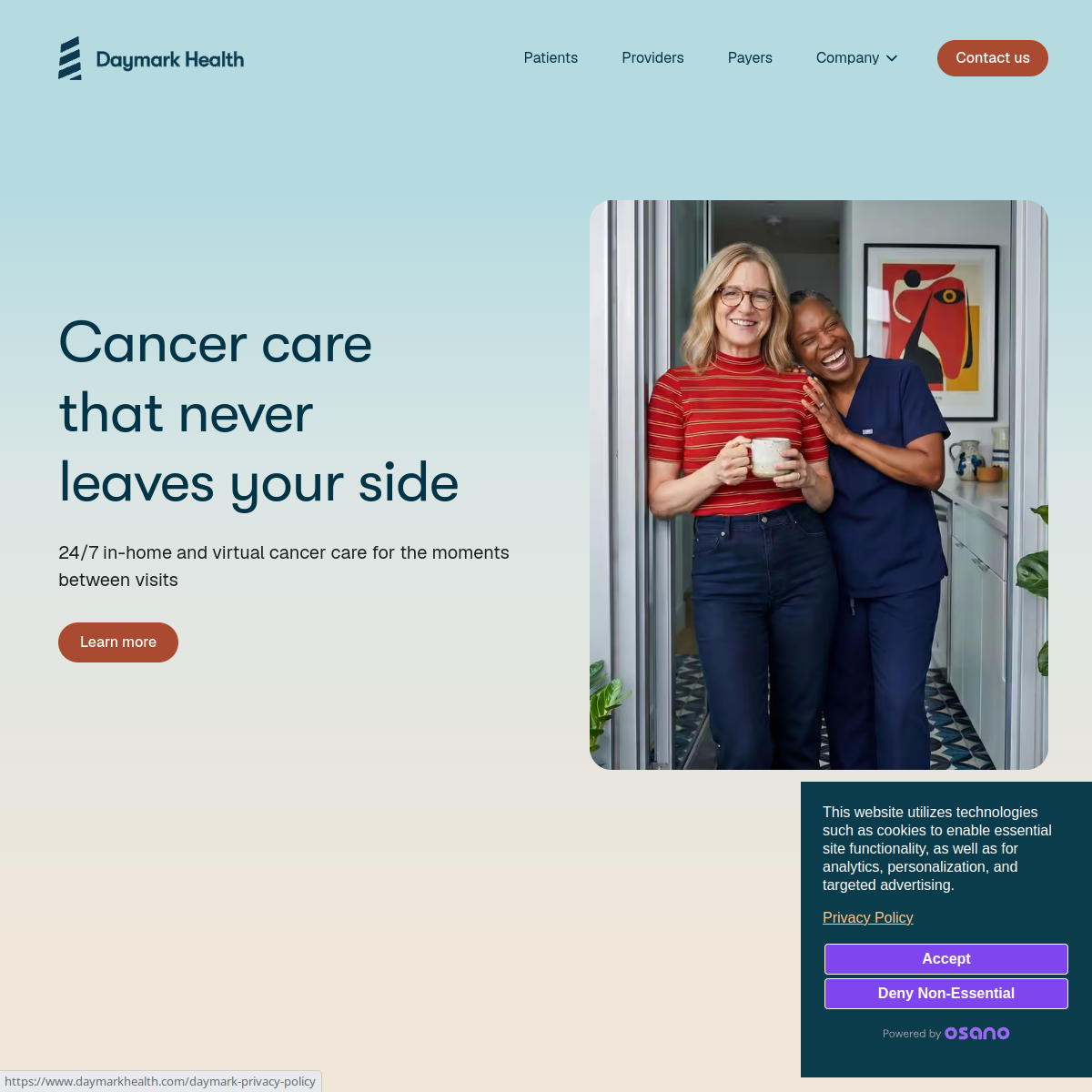
The page we scored
The AI Recommendation Check
When we asked AI who to recommend for 24/7 in-home and virtual cancer care navigation and support services, it named:
Buyer we put in the prompt: VP of Clinical Programs or Chief Medical Officer at a health plan or large oncology practice evaluating cancer care navigation partners. Both the buyer and the category were inferred from Daymark Health’s homepage alone. The model had no web access.
Daymark Health was not on the list.
A buyer who asked AI this question got 8 names and moved on. Daymark Health never came up.
We asked AI who it recommends for "VP of Clinical Programs or Chief Medical Officer at a health plan or large oncology practice evaluating cancer care navigation partners" looking for "24/7 in-home and virtual cancer care navigation and support services". It named Navista (Cardinal Health), Thyme Care, Included Health, Quantum Health, LeanTaaS. You did not appear. AI can't recommend what it can't clearly understand.
Overall assessment
Daymark's biggest strength is its emotionally sharp, patient-centered narrative ... 'Cancer doesn't stop at 5 o'clock' is a genuinely distinctive enemy-naming frame that immediately communicates both problem and POV. The biggest gap is a near-total absence of proof: no outcome numbers, no clinical data, no founder credentials, and no dates anywhere on the page, which means a health plan buyer or oncology decision-maker has nothing concrete to justify a partnership decision.
Signal by category
Narrative Clarity
8 signals
Trust Signal
4 signals
AI Signal
6 signals
Conversion Signal
1 signal
Weakest signal · fix this first
09Proof & Evidence
“No statistics, outcome percentages, before/after deltas, or named clinical results anywhere on the page.”
Every claim is adjective-driven ('reassuring, responsive, knowledgeable') with zero hard numbers ... no patients served, readmissions reduced, or satisfaction scores cited.
All 19 signals, scored 0 to 2.
Total 20/38
Narrative Clarity
8 signals
- 2
01The 7-Second Test
“Cancer care that never leaves your side" / "24/7 in-home and virtual cancer care for the moments between visits”
Within 7 seconds, a stranger knows this is cancer care, it's 24/7 and in-home/virtual, and the POV is that care shouldn't stop between appointments ... clear enough for a caveman.
- 2
02Rebellion / Movement
“Cancer doesn't stop at 5 o'clock" / "some of cancer's hardest moments happen between appointments”
The named enemy is the episodic, office-hours-only care model ... 'between appointments' is a concrete, repeated indictment of how cancer care currently works.
- 1
03Owned Language & Category
“24/7 in-home and virtual cancer care for the moments between visits”
The phrase 'moments between visits' hints at a distinct frame but is never named, owned, or turned into a quotable category term an AI would cite back as Daymark's proprietary language.
- 1
04ICP Clarity
“Daymark supports patients and families, works across care teams, and partners with insurance providers”
The page addresses patients, caregivers, PCPs, oncologists, and health plans but never specifies which buyer is primary or gives role/company/stage criteria that help a visitor self-select instantly.
- 2
05Problem Leadership
“Some of cancer's hardest moments happen between appointments ... when something changes, questions come up, or you're not sure what to do.”
The page leads with the patient's lived problem in plain, emotionally resonant language before introducing any solution or feature.
- 2
06Solution Clarity
“Daymark gives you a cancer-specialized team through your health insurance so you don't have to face it alone.”
One sentence after the hero section a visitor can repeat exactly what Daymark does ... specialist team, insurance-covered, 24/7, between visits.
- 1
07Cost of Inaction
“Cancer doesn't stop at 5 o'clock”
The page implies the cost of the status quo emotionally but never names concrete stakes ... no ER visits avoided, no hospitalizations prevented, no quantified harm from going without support.
- 1
08Promised Land
“Feel more confident managing symptoms" / "Keep everything organized without having to manage it yourself”
The after-state is described in soft emotional terms (confident, not alone, organized) but lacks a specific, vivid promised-land image with measurable or concrete outcomes.
Trust Signal
4 signals
- 0
09Proof & Evidenceweakest
“No statistics, outcome percentages, before/after deltas, or named clinical results anywhere on the page.”
Every claim is adjective-driven ('reassuring, responsive, knowledgeable') with zero hard numbers ... no patients served, readmissions reduced, or satisfaction scores cited.
- 1
10Social Proof
“I was just so impressed that they knew my situation in depth and detail." ... Steven Griffin, Daymark Patient”
There is one named testimonial (Steven Griffin) and several unnamed patient quotes, but no company logos, no titles, no case studies, and no video evidence ... thin social proof for a B2B buyer.
- 0
11Authority & Credibility
“No founder bios, credentials, published research, awards, or third-party recognition anywhere on the homepage.”
Authority is entirely absent ... no one's name, credential, or external validation is cited to establish why Daymark's team or leadership should be trusted over any other care navigation vendor.
- 0
12Alternatives Acknowledged
“No mention of competitors, alternative solutions, or the 'do nothing' option anywhere on the page.”
The page never acknowledges that buyers might choose a disease management vendor, a hospital navigator program, or nothing ... no alternatives are addressed.
AI Signal
6 signals
- 2
13Customer Focus
“I can't believe people go through this without support like Daymark ... to me, their support is not an option. It's a necessity." ... Kristyn”
The page consistently centers the patient and caregiver as protagonists ... their fear, their questions, their daily reality ... with Daymark positioned as the supporting character, not the hero.
- 2
14AI-Parmesan Index
“No AI claims anywhere on the page.”
Daymark makes zero AI-powered claims ... the service is described as human teams via phone, text, video, and in-home visits, so there is no AI-Parmesan sprinkle to penalize.
- 1
15LLM Quotability
“Cancer care that never leaves your side" / "Cancer doesn't stop at 5 o'clock”
The headline and section headers are memorable and almost quotable, but the page lacks the clean declarative factual sentences an LLM would lift to recommend Daymark in a categorical comparison.
- 0
16Copyright Freshness
“No blog posts, case study dates, publication dates, or copyright year visible in the scraped content.”
There are no recency signals whatsoever ... no dated content, no copyright year, nothing an AI engine can use to assess freshness.
- 1
17Entity Distinctiveness
“24/7 in-home and virtual cancer care for the moments between visits”
The in-home + 24/7 + insurance-covered combination is somewhat distinctive, but the core framing of 'care navigation + virtual support for cancer patients' overlaps heavily with competitors like Thyme Care or Jasper Health without a clearly unique differentiator an AI could cite exclusively.
- 0
18AI Recommendation Check
“AI's picks: Navista (Cardinal Health), Thyme Care, Included Health, Quantum Health, LeanTaaS, CancerCare. You were not named.”
We asked AI who it recommends for "VP of Clinical Programs or Chief Medical Officer at a health plan or large oncology practice evaluating cancer care navigation partners" looking for "24/7 in-home and virtual cancer care navigation and support services". It named Navista (Cardinal Health), Thyme Care, Included Health, Quantum Health, LeanTaaS. You did not appear. AI can't recommend what it can't clearly understand.
Conversion Signal
1 signal
- 1
19Path & CTA Clarity
“[Learn more]" is the sole CTA in the hero; a soft path appears at bottom via stakeholder links (Patients, Primary Care, Oncologists, Health plans).”
There is a primary CTA ('Learn more') and soft secondary paths by audience, but no numbered process showing how engagement works, making the conversion path weak and the CTA label too vague to compel action.
Your move
Think Daymark Health’s score is wrong? Good. Let’s look at it together.
Twenty minutes with Greg. Bring the page, bring the argument. You’ll leave knowing exactly which signal is costing Daymark Health the AI recommendation, and what to write instead.
Not on the list? Run your homepage through the free Brand Signal Score and see where you’d land. Same 19 signals, same AI check, two minutes.