
The 2026 Healthtech Messaging Index
Charlie Health
charliehealth.com·scored September 1, 2026
24/38
Approaching
Close. The bones are good. A few targeted fixes on the weakest signals would push Charlie Health into magnetic territory.
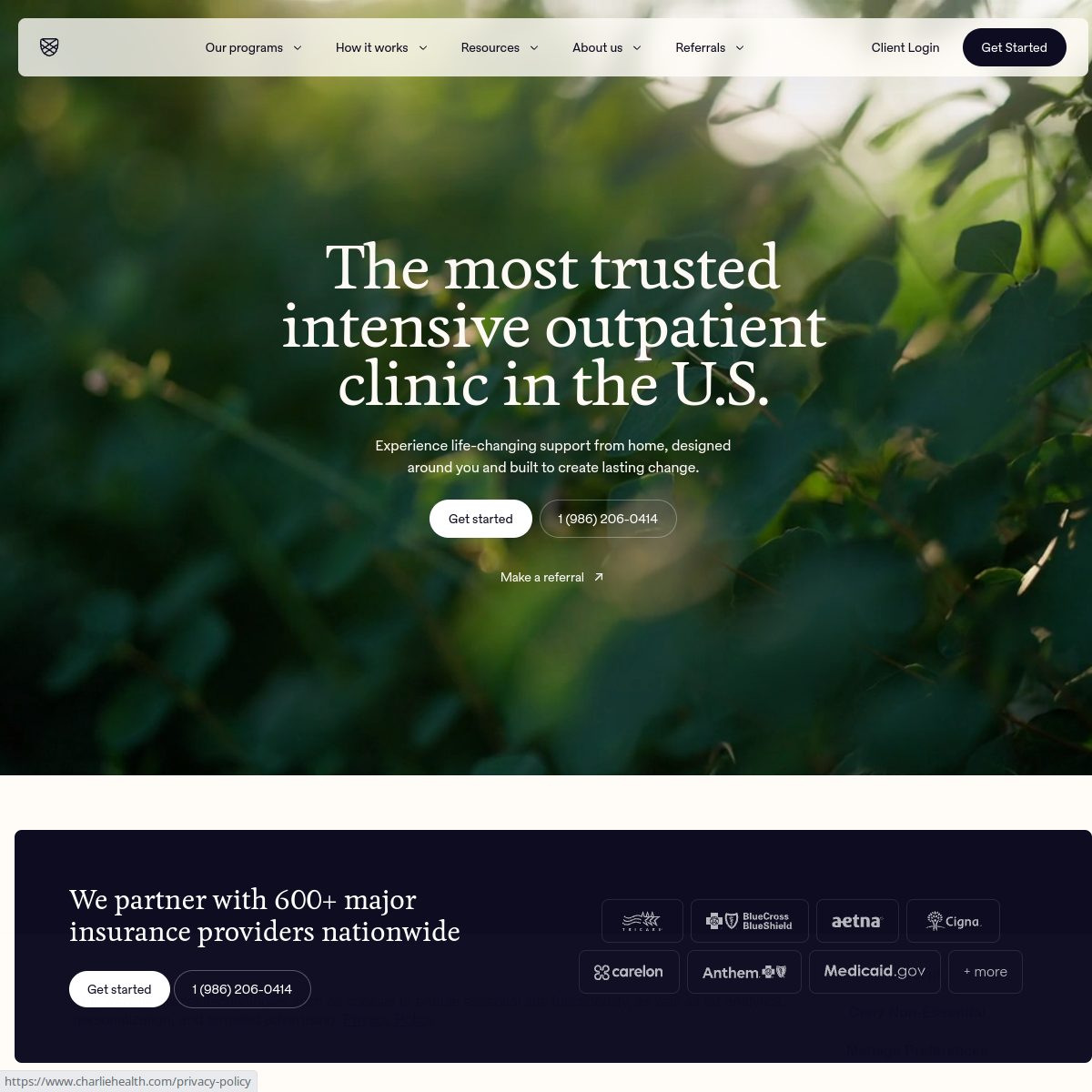
The page we scored
The AI Recommendation Check
When we asked AI who to recommend for Virtual intensive outpatient program (IOP) for mental health and addiction treatment, it named:
Buyer we put in the prompt: Individual seeking mental health treatment, or a parent of a child/teen needing intensive outpatient care, or a clinician making a patient referral. Both the buyer and the category were inferred from Charlie Health’s homepage alone. The model had no web access.
Charlie Health was on the list.
AI named them for their own category. That's the signal every homepage is supposed to send.
AI named you when asked who it recommends for "Virtual intensive outpatient program (IOP) for mental health and addiction treatment", and described you accurately: "Charlie Health is a virtual intensive outpatient program focused on teens and young adults with serious mental health needs, offering group and individual therapy in a structured format designed to sit between weekly outpatient therapy and inpatient hospitalization.". Your positioning is landing with the machines.
Overall assessment
Charlie Health's biggest strength is customer-as-protagonist storytelling ... named alumni quotes, age-specific program segmentation, and 'you'-focused language make the patient the hero throughout. The biggest gap is the complete absence of cost-of-inaction framing and competitive acknowledgment ... the page never tells a hesitant visitor what they lose by waiting or how Charlie Health differs from Talkspace, Brightline, or simply staying with weekly therapy, leaving the hardest buying objections unanswered.
Signal by category
Narrative Clarity
8 signals
Trust Signal
4 signals
AI Signal
6 signals
Conversion Signal
1 signal
Weakest signal · fix this first
07Cost of Inaction
“No mention of what happens if someone delays treatment, stays on a waitlist, or continues with weekly-only therapy.”
The page never names the cost of inaction ... no stakes, no consequence framing, no 'what you lose by waiting' language anywhere.
All 19 signals, scored 0 to 2.
Total 24/38
Narrative Clarity
8 signals
- 2
01The 7-Second Test
“The most trusted intensive outpatient clinic in the U.S." + "Experience life-changing support from home, designed around you”
Within 7 seconds, a visitor knows it's a virtual mental health clinic (IOP), it's for people needing more than weekly therapy, and the POV is trust + personalization from home ... clear enough for anyone.
- 1
02Rebellion / Movement
“support adults, teens, and kids who need more than weekly therapy but don't require inpatient care”
There's an implicit rebellion against the binary of 'weekly therapy vs. inpatient,' but the page never names a villain, a broken system, or a status quo it's fighting ... the pushback is implied, not declared.
- 1
03Owned Language & Category
“virtual Intensive Outpatient Programs (IOPs)”
The page uses the established clinical term 'IOP' but coins no proprietary language, frameworks, or category names an AI would exclusively attribute to Charlie Health.
- 2
04ICP Clarity
“Adults (Ages 18 ... 64)" / "Teens (Ages 12 ... 17)" / "Kids (Ages 8 ... 11)”
The page explicitly segments by age group with specific ranges, named conditions, and separate program links, making it immediately obvious whether you or your child is the intended patient.
- 1
05Problem Leadership
“Experience life-changing support from home, designed around you and built to create lasting change.”
The hero leads with the solution and aspiration, not the buyer's pain ... the problem is implied but never stated in the visitor's own words before the pitch begins.
- 2
06Solution Clarity
“Our virtual Intensive Outpatient Programs (IOPs) support adults, teens, and kids who need more than weekly therapy but don't require inpatient care.”
This single sentence is precise and repeatable ... a visitor can explain exactly what Charlie Health does after reading it.
- 0
07Cost of Inactionweakest
“No mention of what happens if someone delays treatment, stays on a waitlist, or continues with weekly-only therapy.”
The page never names the cost of inaction ... no stakes, no consequence framing, no 'what you lose by waiting' language anywhere.
- 1
08Promised Land
“Now I feel like I can handle anything that life throws at me!”
The 'after' state is conveyed only through alumni testimonials with vague emotional tags like 'Building resilience' ... there's no concrete, specific promised land painted by the brand itself.
Trust Signal
4 signals
- 1
09Proof & Evidence
“of individuals who complete our programs show improvement in the most common mental health symptoms" / "peer-reviewed studies verify our methods”
The page references outcome stats and peer-reviewed studies but the actual numbers are rendered as animated counters (shown as '0000%' in the scrape), so the concrete figures are not legible as text.
- 2
10Social Proof
“Corey" / "Jasmine" / "Lauren" ... named alumni testimonials with direct quotes and emotional outcome tags”
Three named alumni testimonials with full verbatim quotes and labeled emotional outcomes provide solid social proof, though no last names, titles, or third-party logos beyond insurance carriers appear.
- 1
11Authority & Credibility
“peer-reviewed studies verify our methods and show our model works”
The page references peer-reviewed research and provider trust but names no founders, credentials, specific publications, awards, or experts ... authority is claimed, not demonstrated.
- 0
12Alternatives Acknowledged
“No mention of competitors, alternative treatments, DIY options, or 'do nothing' scenarios anywhere on the page.”
The page ignores all alternatives entirely ... no acknowledgment of weekly therapy, inpatient care, competitor platforms, or the 'do nothing' path a hesitant buyer would actually weigh.
AI Signal
6 signals
- 2
13Customer Focus
“I was very sick when I came to Charlie Health. But after only a week, I was already using new skills" ... Corey”
The page consistently frames the customer as protagonist through first-person alumni stories, age-specific program descriptions, and 'you'-focused language throughout ... the company plays supporting role.
- 2
14AI-Parmesan Index
“No AI claims, no 'AI-powered' language, no machine learning references anywhere on the page.”
Charlie Health makes zero AI claims, so by rubric definition this scores 2 ... the narrative stands on clinical outcomes and human care without AI-Parmesan sprinkled on top.
- 1
15LLM Quotability
“Our virtual Intensive Outpatient Programs (IOPs) support adults, teens, and kids who need more than weekly therapy but don't require inpatient care.”
That one sentence is quotable, but most of the page is emotionally evocative rather than declarative and citation-ready ... an LLM has limited clean facts to lift verbatim.
- 1
16Copyright Freshness
“Blog posts show dates (e.g., images from 2024/2025 upload paths) but no visible copyright year or dated case studies appear in the scraped content.”
Upload paths suggest 2025 ... 2026 content freshness, but no explicit copyright year or visibly dated case studies are present in the scraped text for AI recency signals.
- 1
17Entity Distinctiveness
“The most trusted intensive outpatient clinic in the U.S." + age-segmented programs for kids, teens, adults”
The age segmentation and IOP-from-home focus add some distinctiveness, but 'most trusted IOP' is an unsubstantiated superlative any competitor could claim ... swapping the logo wouldn't break the description.
- 2
18AI Recommendation Check
“AI described you as: "Charlie Health is a virtual intensive outpatient program focused on teens and young adults with serious mental health needs, offering group and individual therapy in a structured format designed to sit between weekly outpatient therapy and inpatient hospitalization.”
AI named you when asked who it recommends for "Virtual intensive outpatient program (IOP) for mental health and addiction treatment", and described you accurately: "Charlie Health is a virtual intensive outpatient program focused on teens and young adults with serious mental health needs, offering group and individual therapy in a structured format designed to sit between weekly outpatient therapy and inpatient hospitalization.". Your positioning is landing with the machines.
Conversion Signal
1 signal
- 1
19Path & CTA Clarity
“Get started" (primary CTA) / "Make a referral" (secondary CTA) / "Fill out our form, or call us directly”
There are two CTAs and a phone number, but no numbered process or visible step-by-step path showing what happens after clicking ... the journey is implied, not mapped.
Keep the lead
AI already names Charlie Health. The next edition decides if it still does.
Twenty minutes with Greg. Bring the page, bring the argument. You’ll leave knowing exactly which signal is costing Charlie Health the AI recommendation, and what to write instead.
Not on the list? Run your homepage through the free Brand Signal Score and see where you’d land. Same 19 signals, same AI check, two minutes.