
The 2026 Healthtech Messaging Index
Cartwheel Care
cartwheel.org·scored September 1, 2026
19/38
Invisible
The page is doing some work, but the story isn't landing fast enough. Buyers and AI are both left guessing what makes Cartwheel Care different.
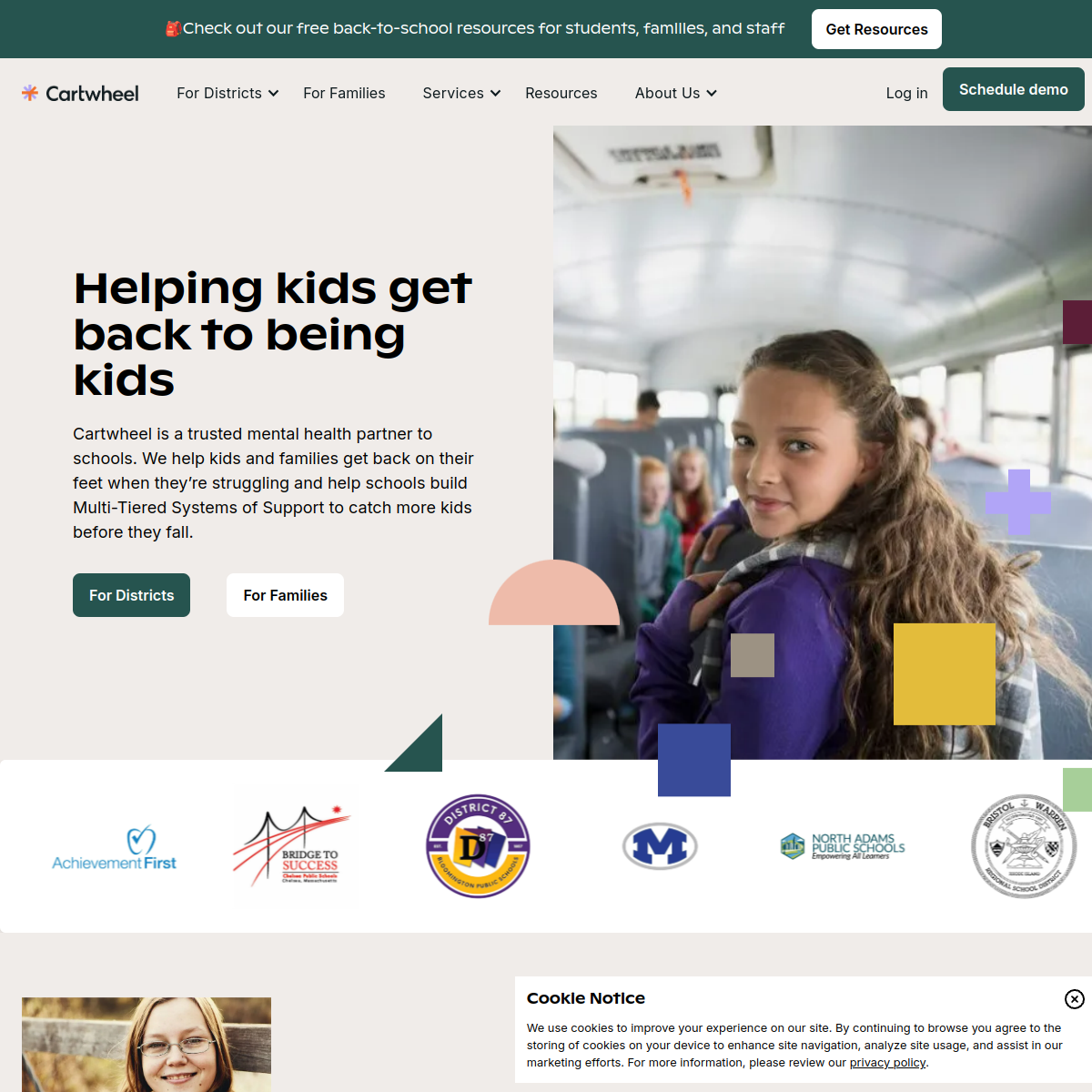
The page we scored
The AI Recommendation Check
When we asked AI who to recommend for School-based virtual mental health care / student mental health telehealth platform, it named:
Buyer we put in the prompt: School district administrator or superintendent evaluating student mental health services. Both the buyer and the category were inferred from Cartwheel Care’s homepage alone. The model had no web access.
Cartwheel Care was not on the list.
A buyer who asked AI this question got 8 names and moved on. Cartwheel Care never came up.
We asked AI who it recommends for "School district administrator or superintendent evaluating student mental health services" looking for "School-based virtual mental health care / student mental health telehealth platform". It named Hazel Health, Teletherapy.com, Brightline, Talkspace for Schools, Mantra Health. You did not appear. AI can't recommend what it can't clearly understand.
Overall assessment
Cartwheel's biggest strength is its concrete proof metrics ... 24-hour intake, 7-day appointment, and 92% patient improvement ... which are specific and credible. The biggest gap is the complete absence of owned language, a named movement, or alternatives acknowledged, making the page hard for AI to distinguish from any other school mental health telehealth company and unconvincing to skeptical administrators who are weighing other options.
Signal by category
Narrative Clarity
8 signals
Trust Signal
4 signals
AI Signal
6 signals
Conversion Signal
1 signal
Weakest signal · fix this first
03Owned Language & Category
“No coined terms, named category, or proprietary framework anywhere on the page.”
The page uses entirely commodity language ('evidence-based,' 'licensed clinician,' 'therapy,' 'psychiatry') with no owned terminology an AI could uniquely attribute to Cartwheel.
All 19 signals, scored 0 to 2.
Total 19/38
Narrative Clarity
8 signals
- 1
01The 7-Second Test
“Evidence-based mental health care. No waitlists.”
The hero headline communicates the category and one key differentiator, but who it's for (schools, districts) and the POV aren't immediately obvious above the fold without scrolling past the logo wall.
- 1
02Rebellion / Movement
“schools are facing a downward spiral in student crises and staff burnout”
There's a named status quo problem (waitlists, student crises, staff burnout) but no named enemy or explicit manifesto-style pushback against the existing mental health system.
- 0
03Owned Language & Categoryweakest
“No coined terms, named category, or proprietary framework anywhere on the page.”
The page uses entirely commodity language ('evidence-based,' 'licensed clinician,' 'therapy,' 'psychiatry') with no owned terminology an AI could uniquely attribute to Cartwheel.
- 1
04ICP Clarity
“Cartwheel for schools" and "Cartwheel for parents”
The page serves two audiences (school administrators and parents) but doesn't specify district size, role title, or stage, leaving ICP clarity incomplete for the B2B buyer.
- 1
05Problem Leadership
“one in five young people struggling with mental health, schools are facing a downward spiral in student crises and staff burnout”
The problem is named but it comes well below the fold and is framed in the company's language rather than the buyer's pain language first.
- 2
06Solution Clarity
“Evidence-based mental health care. No waitlists." and "students get the therapy and psychiatry they need to thrive”
A visitor can clearly explain what Cartwheel does: it provides school-partnered virtual mental health care for students with fast access and no waitlist.
- 1
07Cost of Inaction
“schools are facing a downward spiral in student crises and staff burnout”
Staff burnout and student crises are named but the cost of inaction for the administrator ... budget waste, liability, worsening outcomes ... is never quantified or made visceral.
- 1
08Promised Land
“help students get the therapy and psychiatry they need to thrive”
'Thrive' is vague; there's no specific painted picture of what a district or family's life looks like after partnering with Cartwheel.
Trust Signal
4 signals
- 2
09Proof & Evidence
“24 hours... 7 days... 92% of students say they feel better after working with Cartwheel”
Three concrete, specific metrics with clear units are front and center, giving genuine quantified proof rather than adjectives.
- 1
10Social Proof
“24 named school district logos including "Boston Public Schools," "Dayton Public Schools”
Logo wall is strong and named, but there are no testimonials with names and titles from administrators, and no written case studies with outcomes on this page.
- 1
11Authority & Credibility
“Our team has decades of experience helping kids and teens”
Clinician bios with credentials (LICSW, PsyD, LCSW) add some authority, but founder credentials, original research, or external recognition are absent from this page.
- 0
12Alternatives Acknowledged
“No mention of alternatives, competitors, or 'do nothing' option anywhere on the page.”
The page never acknowledges that districts could hire school counselors, use EAPs, or do nothing, leaving a major trust gap for skeptical buyers.
AI Signal
6 signals
- 1
13Customer Focus
“Your child shouldn't have to wait in line for help”
The page tilts toward the customer's experience in places but frequently shifts to company capabilities and team bios, so the customer is not the consistent protagonist.
- 2
14AI-Parmesan Index
“No AI claims on the page whatsoever.”
Cartwheel makes zero AI claims, so it scores a 2 by the rubric ... no AI-Parmesan sprinkled on the narrative.
- 1
15LLM Quotability
“92% of students say they feel better after working with Cartwheel. Our care typically lasts two to six months”
The outcome stat is quotable but lacks a named source or study citation; clean declarative sentences exist but aren't structured for easy LLM extraction as authoritative claims.
- 1
16Copyright Freshness
“© 2026 Cartwheel Care Inc.”
Copyright year is current (2026), but there are no visible dated blog posts, case studies, or research articles on the homepage to signal content freshness.
- 1
17Entity Distinctiveness
“24 hours... 7 days... No waitlists" paired with school-embedded virtual care model”
The speed-to-care metrics and school-partnership model are somewhat distinctive, but the overall description could fit several school mental health telehealth companies without unique owned language.
- 0
18AI Recommendation Check
“AI's picks: Hazel Health, Teletherapy.com, Brightline, Talkspace for Schools, Mantra Health, Heal.com. You were not named.”
We asked AI who it recommends for "School district administrator or superintendent evaluating student mental health services" looking for "School-based virtual mental health care / student mental health telehealth platform". It named Hazel Health, Teletherapy.com, Brightline, Talkspace for Schools, Mantra Health. You did not appear. AI can't recommend what it can't clearly understand.
Conversion Signal
1 signal
- 1
19Path & CTA Clarity
“[Learn More](https://www.cartwheel.org/schedule-demo)" appears at bottom; no numbered process or soft secondary CTA paired with it.”
There is one CTA ('Learn More' linking to schedule-demo) but no visible numbered onboarding process and no soft secondary CTA working alongside it.
Your move
Think Cartwheel Care’s score is wrong? Good. Let’s look at it together.
Twenty minutes with Greg. Bring the page, bring the argument. You’ll leave knowing exactly which signal is costing Cartwheel Care the AI recommendation, and what to write instead.
Not on the list? Run your homepage through the free Brand Signal Score and see where you’d land. Same 19 signals, same AI check, two minutes.