
The 2026 Healthtech Messaging Index
Caregility
caregility.com·scored November 1, 2026
16/38
Invisible
The page is doing some work, but the story isn't landing fast enough. Buyers and AI are both left guessing what makes Caregility different.
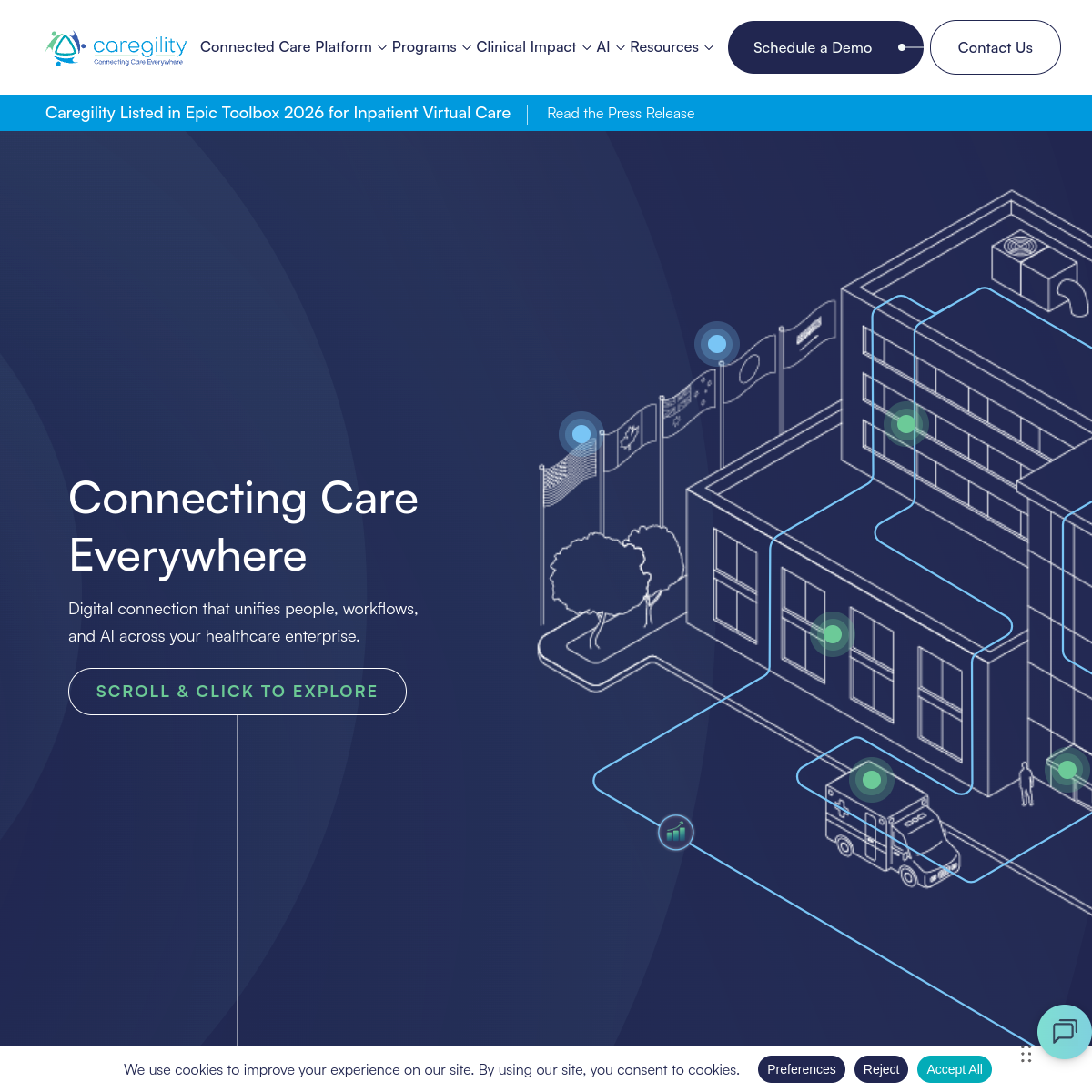
The page we scored
The AI Recommendation Check
When we asked AI who to recommend for virtual care platform / telehealth infrastructure for health systems, it named:
Buyer we put in the prompt: Chief Nursing Officer, VP of Virtual Care, or Chief Medical Officer at a large health system or academic medical center. Both the buyer and the category were inferred from Caregility’s homepage alone. The model had no web access.
Caregility was on the list.
AI named them for their own category. That's the signal every homepage is supposed to send.
AI mentioned you for "virtual care platform / telehealth infrastructure for health systems", but only generically: "Caregility is a healthcare-focused virtual care platform known for hospital-grade telehealth infrastructure, particularly supporting inpatient and acute care settings with dedicated devices and clinical workflow integration.". You're on the radar, but AI doesn't yet repeat your specific positioning back.
Overall assessment
Caregility's biggest strength is its social proof infrastructure ... a logo wall of 30+ elite health systems (Johns Hopkins, Mass General Brigham, Penn Medicine) paired with concrete reliability stats (19,000 rooms, 9M sessions, 99.99% uptime) that signal real scale. The single biggest gap is that the page leads with the solution, not the buyer's problem: nurse burnout, clinical staffing shortages, and the cost of legacy fragmentation are never named as the opening stakes, so the narrative reads as a capability catalog rather than a problem-first story that compels action.
Signal by category
Narrative Clarity
8 signals
Trust Signal
4 signals
AI Signal
6 signals
Conversion Signal
1 signal
Weakest signal · fix this first
05Problem Leadership
“Hero leads with "Connecting Care Everywhere" and "Digital connection that unifies people, workflows, and AI" ... no buyer problem stated.”
The hero opens with the company's solution and tagline, not the buyer's pain; clinical staffing shortages, nurse burnout, or access gaps are never named as the leading problem.
All 19 signals, scored 0 to 2.
Total 16/38
Narrative Clarity
8 signals
- 1
01The 7-Second Test
“Connecting Care Everywhere" / "Digital connection that unifies people, workflows, and AI across your healthcare enterprise.”
Healthcare is clear, but who specifically (CNO, CIO, VP Virtual Care) and what precise problem is being solved isn't graspable in 7 seconds ... 'unifies people, workflows, and AI' is broad enough to describe dozens of platforms.
- 1
02Rebellion / Movement
“Siloed Solutions" / "Failed AI Pilots" / "Legacy Platforms" / "Reliability Concerns" / "No Failover Plan”
The 'Alternatives' section names the enemies (siloed solutions, legacy platforms, failed AI pilots) but buries them in an interactive map popup rather than leading with them as a declared POV in the hero.
- 1
03Owned Language & Category
“Lens on Organizational Performance (LOOP)" and "Caregility NICU carts”
LOOP is a named proprietary framework but it appears deep in the page and isn't positioned as a category-defining concept; the hero language ('connecting care everywhere') is commodity telehealth terminology.
- 1
04ICP Clarity
“across your healthcare enterprise" / care settings listed: ICU, Med/Surg, OR, ED, Behavioral Health, Pediatrics, Home, Clinic”
Healthcare is clear but the buyer role (CNO vs. CIO vs. CMO vs. health system VP) is never stated, and company size or system type (IDN, academic medical center, rural) requires scrolling deep into popup content.
- 0
05Problem Leadershipweakest
“Hero leads with "Connecting Care Everywhere" and "Digital connection that unifies people, workflows, and AI" ... no buyer problem stated.”
The hero opens with the company's solution and tagline, not the buyer's pain; clinical staffing shortages, nurse burnout, or access gaps are never named as the leading problem.
- 1
06Solution Clarity
“Digital connection that unifies people, workflows, and AI across your healthcare enterprise.”
A visitor can infer it's a virtual care/telehealth platform, but the one-sentence explanation is abstract enough that 'what it actually does' (virtual nursing, tele-ICU, AI-enabled monitoring) requires scrolling through multiple popups.
- 0
07Cost of Inaction
“No mention of cost of delayed adoption, missed revenue, adverse events from current approach, or staffing costs of the status quo.”
The page never names the price of inaction ... no quantified risk, no 'what happens if you don't act,' no stakes for staying with legacy platforms.
- 1
08Promised Land
“Connect patients to better care: timely, safe, effective, seamless, coordinated, and personal." / "Reduce staff turnover and labor costs”
The promised land is gestured at (better care, reduced turnover, higher HCAHPS) but remains a list of adjectives and generic metrics rather than a vivid, specific 'after' state buyers can picture.
Trust Signal
4 signals
- 1
09Proof & Evidence
“99.99% Availability" / "Validated at Scale in over 19,000 patient rooms" / "9M Sessions Annually" / "55+ consecutive platform releases with no service interruption”
Platform reliability stats are concrete and specific, but there are no before/after outcome deltas, no 'Hospital X reduced falls by Y%' case data, and no financial ROI numbers tied to customer results.
- 1
10Social Proof
“Logo wall includes Johns Hopkins, Mass General Brigham, Penn Medicine, Northwell Health, CommonSpirit ... 30+ named health systems.”
The logo wall is impressive and credible, but there are zero named testimonials with titles, no video customer stories with attribution, and no named case studies with outcomes on this page.
- 1
11Authority & Credibility
“HIPAA compliant and ISO 27001/27701 Certified" / "Annual 3rd Party penetration testing" / "Innovation Center" described as collaborative environment.”
Certifications establish baseline credibility but there are no founder credentials, original research citations, published frameworks, or awards that demonstrate earned authority beyond compliance.
- 1
12Alternatives Acknowledged
“Siloed Solutions" / "Failed AI Pilots" / "Legacy Platforms" / "Reliability Concerns" / "No Failover Plan”
The Alternatives popup acknowledges competing categories at a surface level but never honestly engages with named competitors, the 'do nothing' option, or why buyers should choose Caregility over a specific alternative.
AI Signal
6 signals
- 1
13Customer Focus
“Connect patients to better care" / "Connect clinicians and care teams with better communication" ... page oscillates between patient outcomes and platform capabilities.”
The page tilts toward the company's platform capabilities and feature lists across care settings; the customer's transformation story is present but secondary to product enumeration.
- 1
14AI-Parmesan Index
“AI-powered alerts" / "AI Enablement" / "Automate and enhance clinical workflows with AI tools" / "AI-enabled monitoring”
AI is mentioned repeatedly but mechanistic specifics (what the AI detects, what model, what trigger, what action) are absent ... it reads as AI-sprinkled rather than AI-substantiated, though not egregiously so.
- 1
15LLM Quotability
“Validated at Scale in over 19,000 patient rooms" / "9M Sessions Annually" / "55+ consecutive platform releases with no service interruption”
A few stats are quotable but the hero tagline and most body copy is too abstract and adjective-heavy for an LLM to lift verbatim as a precise recommendation; no single declarative sentence captures what Caregility uniquely does.
- 0
16Copyright Freshness
“Copyright year not visible in scraped content; image URLs show '2026/03' and '2026/04' dates but no visible blog post dates or recent case study timestamps on the page.”
No visible copyright year in the scraped content and no dated case studies or blog posts appear on the homepage, removing recency signals that AI engines weight.
- 1
17Entity Distinctiveness
“19,000 patient rooms" / "LOOP" framework / coverage across ICU, OR, EMS, NICU, Behavioral Health, Home, Academia simultaneously”
The breadth across care settings and the LOOP framework add some distinctiveness, but the core positioning ('connecting care everywhere' via a virtual care platform) is interchangeable with competitors like Teladoc Health, Amwell, or AvaSure without the logo.
- 1
18AI Recommendation Check
“AI named you alongside Teladoc Health (Teladoc/InTouch), Amwell, Zoom for Healthcare, Microsoft (Azure/Teams for Healthcare), Cisco (Webex Health), describing you as: "Caregility is a healthcare-focused virtual care platform known for hospital-grade telehealth infrastructure, particularly supporting inpatient and acute care settings with dedicated devices and clinical workflow integration.".”
AI mentioned you for "virtual care platform / telehealth infrastructure for health systems", but only generically: "Caregility is a healthcare-focused virtual care platform known for hospital-grade telehealth infrastructure, particularly supporting inpatient and acute care settings with dedicated devices and clinical workflow integration.". You're on the radar, but AI doesn't yet repeat your specific positioning back.
Conversion Signal
1 signal
- 1
19Path & CTA Clarity
“No numbered steps or clear process visible; CTA structure not apparent in scraped content ... links go to anchor popups rather than a conversion path.”
The page uses an interactive map as navigation rather than a clear primary CTA + soft secondary CTA structure; there is no visible 'here's how to get started in 3 steps' path guiding buyers toward a demo or contact.
Keep the lead
AI already names Caregility. The next edition decides if it still does.
Twenty minutes with Greg. Bring the page, bring the argument. You’ll leave knowing exactly which signal is costing Caregility the AI recommendation, and what to write instead.
Not on the list? Run your homepage through the free Brand Signal Score and see where you’d land. Same 19 signals, same AI check, two minutes.