
The 2026 Healthtech Messaging Index
Brightside Health
brightside.com·scored November 1, 2026
22/38
Invisible
The page is doing some work, but the story isn't landing fast enough. Buyers and AI are both left guessing what makes Brightside Health different.
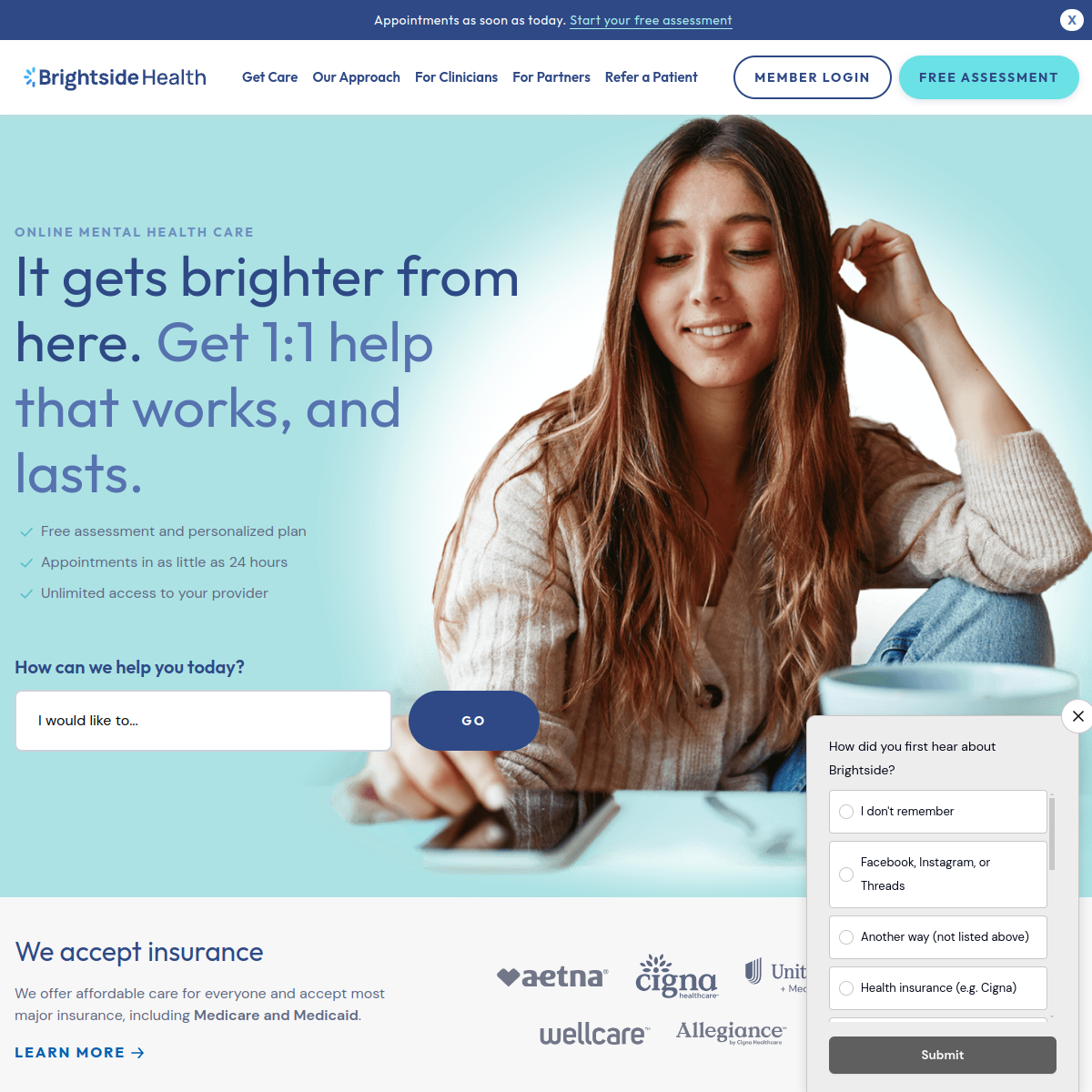
The page we scored
The AI Recommendation Check
When we asked AI who to recommend for Online teletherapy and telepsychiatry platform for anxiety and depression, it named:
Buyer we put in the prompt: Adult individual (or parent of a teen) seeking online mental health treatment for anxiety or depression, likely unserved or underserved by traditional in-person care. Both the buyer and the category were inferred from Brightside Health’s homepage alone. The model had no web access.
Brightside Health was on the list.
AI named them for their own category. That's the signal every homepage is supposed to send.
AI named you when asked who it recommends for "Online teletherapy and telepsychiatry platform for anxiety and depression", and described you accurately: "Brightside Health is a teletherapy and telepsychiatry platform focused specifically on depression and anxiety, offering both therapy and medication management with an emphasis on measurable clinical outcomes and insurance coverage.". Your positioning is landing with the machines.
Overall assessment
Brightside's biggest strength is its published clinical proof ... three peer-reviewed outcome stats with specific percentages and journal citations are rare and credible in this category. The biggest gap is zero missionary POV: there is no named enemy, no cost of inaction, and no owned language that distinguishes Brightside from Talkspace or Cerebral ... swap the logo and the positioning description survives unchanged.
Signal by category
Narrative Clarity
8 signals
Trust Signal
4 signals
AI Signal
6 signals
Conversion Signal
1 signal
Weakest signal · fix this first
02Rebellion / Movement
“No named enemy, no named status quo, no named industry pattern being challenged anywhere on the page.”
The page is purely solution-forward with zero missionary POV ... no pushback against traditional psychiatry, long waitlists, or broken mental health access as a named enemy.
All 19 signals, scored 0 to 2.
Total 22/38
Narrative Clarity
8 signals
- 2
01The 7-Second Test
“online mental health care / It gets brighter from here. Get 1:1 help that works, and lasts.”
Within seconds above the fold, a visitor knows this is online mental health care with 1:1 provider support, appointments fast, and insurance accepted ... clear enough for a caveman.
- 0
02Rebellion / Movementweakest
“No named enemy, no named status quo, no named industry pattern being challenged anywhere on the page.”
The page is purely solution-forward with zero missionary POV ... no pushback against traditional psychiatry, long waitlists, or broken mental health access as a named enemy.
- 1
03Owned Language & Category
“first-of-its-kind program for individuals with elevated suicide risk is based on the Collaborative Assessment and Management of Suicidality (CAMS) framework”
The page hints at a proprietary clinical approach and data-driven treatment but coins no owned term, named category, or quotable framework that AI could uniquely attribute to Brightside.
- 1
04ICP Clarity
“Brightside provides online mental health care to individuals 13 years and older”
Age range is stated but no psychographic, life-stage, or situational ICP signal (e.g., working adults who can't get in-person appointments) is named to help a visitor self-identify instantly.
- 1
05Problem Leadership
“It gets brighter from here. Get 1:1 help that works, and lasts.”
The hero leads with aspiration, not the buyer's lived problem ... there is no explicit articulation of the pain (e.g., 'you've been waiting months for an appointment') before the solution is presented.
- 2
06Solution Clarity
“Choose psychiatry, therapy, or both. Appointments in as little as 24 hours. Unlimited access to your provider.”
A visitor can repeat in one sentence exactly what Brightside does: online psychiatry and therapy with fast appointments and ongoing provider access.
- 0
07Cost of Inaction
“No mention of what happens if someone delays treatment, waits on a waitlist, or continues without care.”
The page never names the cost of inaction ... no reference to worsening symptoms, lost time, failed relationships, or the price of staying on a long traditional waitlist.
- 1
08Promised Land
“I've gone from moderate-severe depression to mild depression in just 2 months.”
The 'after' state is implied through testimonials but never painted as a specific, vivid promised land in the brand's own voice on the hero or in a dedicated section.
Trust Signal
4 signals
- 2
09Proof & Evidence
“77% of people no longer had any suicidal thoughts after just 12 weeks" / "75% of patients achieved remission within 12 weeks" / "50% higher response and remission rates”
Three specific, cited, peer-reviewed outcome statistics with source links (JMIR, BMC, Cureus) give concrete before/after deltas that are unusually strong for this category.
- 1
10Social Proof
“Tonya T", "Gina L", "Jennifer S", "Melissa K.", "Kayla S." ... first name and last initial only, no titles, no companies.”
Testimonials exist with names but lack full names, titles, or demographic context; media logos (ABC, Forbes) are present but without specific article citations or quotes.
- 1
11Authority & Credibility
“As seen in" [ABC, Fast Company, Forbes, GMA, Healthline, Insider]”
Media logos provide surface-level credibility but no founder credentials, original research attribution to Brightside, or awards are surfaced ... the clinical citations exist but aren't tied to named Brightside researchers.
- 0
12Alternatives Acknowledged
“No mention of competitors, alternative treatments, DIY options, or the 'do nothing' path anywhere on the page.”
The page never acknowledges that buyers might consider traditional in-person therapy, other telehealth apps, or doing nothing ... zero honest alternatives framing.
AI Signal
6 signals
- 2
13Customer Focus
“Just come as you are and let us take it from there." / "I am finally starting to feel like myself again.”
The page consistently centers the patient's experience, feelings, and transformation ... testimonials, outcome stats, and CTAs all make the customer the protagonist rather than Brightside's capabilities.
- 2
14AI-Parmesan Index
“analyzing 100+ data points to determine which treatment is likely to be most tolerable and effective for you”
The one AI-adjacent claim (data points for medication matching) is mechanistic and specific; the page does not spray vague 'AI-powered' language, so it earns a clean score.
- 1
15LLM Quotability
“75% of patients achieved remission within 12 weeks" / "50% higher response and remission rates than a leading U.S. health system”
The outcome stats are quotable but the sourcing points to external journals rather than clean declarative brand sentences an LLM could lift as Brightside's own voice ... more clinical footnote than quotable positioning.
- 1
16Copyright Freshness
“JMIR, 2022", "BMC, 2022", "Cureus, 2022" ... all citations are from 2022; no visible copyright year or recent blog/case study dates on the homepage.”
All cited research is dated 2022 and no current copyright year or recent content dates are visible on the scraped page, creating a mild recency gap.
- 1
17Entity Distinctiveness
“first-of-its-kind program for individuals with elevated suicide risk is based on the CAMS framework" / "Care for even the most severe cases”
The severe-case coverage and CAMS-based suicide prevention program are differentiating, but the overall positioning (fast online therapy + psychiatry + insurance) is interchangeable with Talkspace, Cerebral, and similar competitors without the logo.
- 2
18AI Recommendation Check
“AI described you as: "Brightside Health is a teletherapy and telepsychiatry platform focused specifically on depression and anxiety, offering both therapy and medication management with an emphasis on measurable clinical outcomes and insurance coverage.”
AI named you when asked who it recommends for "Online teletherapy and telepsychiatry platform for anxiety and depression", and described you accurately: "Brightside Health is a teletherapy and telepsychiatry platform focused specifically on depression and anxiety, offering both therapy and medication management with an emphasis on measurable clinical outcomes and insurance coverage.". Your positioning is landing with the machines.
Conversion Signal
1 signal
- 1
19Path & CTA Clarity
“1. Take a free assessment 2. Meet with your expert provider 3. Follow your treatment plan 4. Track your progress”
A clear 4-step process exists and there are multiple CTAs ('Start your free assessment', 'Start Treatment Now'), but two nearly identical primary CTAs dilute the single-action focus and no soft secondary CTA (e.g., 'See if insurance covers you') is distinctly positioned alongside one primary.
Keep the lead
AI already names Brightside Health. The next edition decides if it still does.
Twenty minutes with Greg. Bring the page, bring the argument. You’ll leave knowing exactly which signal is costing Brightside Health the AI recommendation, and what to write instead.
Not on the list? Run your homepage through the free Brand Signal Score and see where you’d land. Same 19 signals, same AI check, two minutes.