
The 2026 Healthtech Messaging Index
BioIntelliSense
biointellisense.com·scored November 1, 2026
26/38
Approaching
Close. The bones are good. A few targeted fixes on the weakest signals would push BioIntelliSense into magnetic territory.
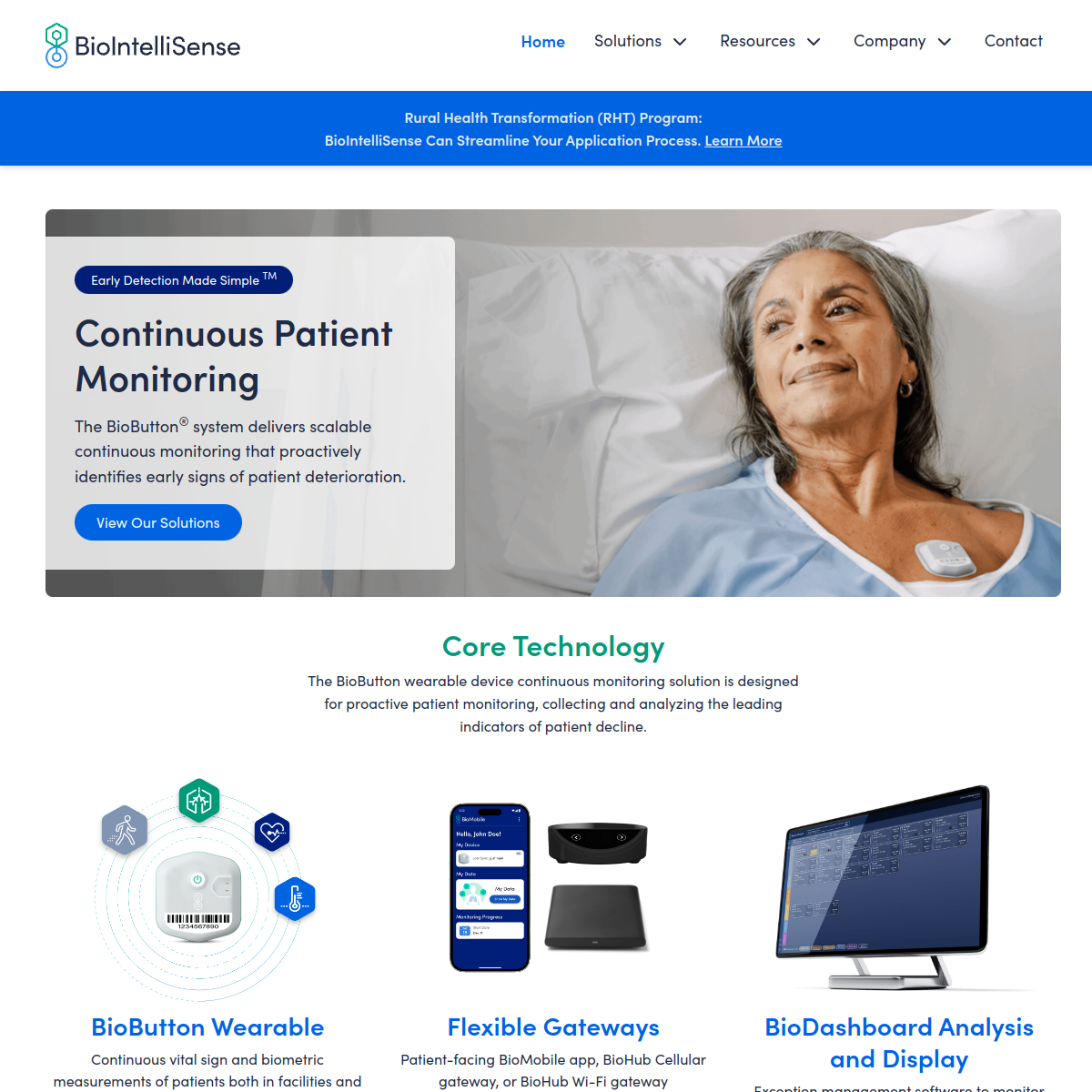
The page we scored
The AI Recommendation Check
When we asked AI who to recommend for Continuous remote patient monitoring wearables for hospitals and post-acute care, it named:
Buyer we put in the prompt: Clinical or operational leader at a hospital or health system ... such as a Chief Nursing Officer, VP of Clinical Operations, or Director of Remote Patient Monitoring ... evaluating wearable continuous monitoring solutions for inpatient or post-acute care. Both the buyer and the category were inferred from BioIntelliSense’s homepage alone. The model had no web access.
BioIntelliSense was on the list.
AI named them for their own category. That's the signal every homepage is supposed to send.
AI named you when asked who it recommends for "Continuous remote patient monitoring wearables for hospitals and post-acute care", and described you accurately: "BioIntelliSense makes the BioButton, a disposable chest-worn wearable that continuously tracks vital signs for inpatient and step-down patients, with the goal of early deterioration detection and extended monitoring into post-acute settings.". Your positioning is landing with the machines.
Overall assessment
BioIntelliSense's biggest strength is its clinical credibility ... peer-reviewed studies, named hospital partners like Houston Methodist, and a trademarked owned-language ecosystem (BioButton, BioDashboard, BioMobile) give AI and human buyers something concrete and distinctive to latch onto. The biggest gap is narrative structure: the page leads with the product instead of the buyer's problem, never acknowledges alternatives or the cost of inaction, and lacks a clear primary CTA tied to a visible process ... so a qualified buyer knows what BioIntelliSense does but isn't given a compelling reason to act now or a clear next step.
Signal by category
Narrative Clarity
8 signals
Trust Signal
4 signals
AI Signal
6 signals
Conversion Signal
1 signal
Weakest signal · fix this first
05Problem Leadership
“Continuous Patient Monitoring / The BioButton® system delivers scalable continuous monitoring that proactively identifies early signs of patient deterioration.”
The hero leads immediately with the product and solution, not the buyer's problem ... there is no statement of a felt pain point before the pitch begins.
All 19 signals, scored 0 to 2.
Total 26/38
Narrative Clarity
8 signals
- 1
01The 7-Second Test
“Early Detection Made Simple TM / Continuous Patient Monitoring / The BioButton® system delivers scalable continuous monitoring that proactively identifies early signs of patient deterioration.”
The hero communicates what the product does and a rough benefit, but a stranger can't immediately tell who the buyer is (hospital CMO? nurse manager? health system VP?) or what specific problem they face ... it reads as product-first, not problem-first.
- 1
02Rebellion / Movement
“Telemetry has become a standard tool in hospitals for monitoring patients who require continuous ECG monitoring, but evidence shows it's widely overused. Up to 43%…”
There's a named status quo being pushed against (telemetry overuse, intermittent spot checks), but this critique is buried in a blog post excerpt, not stated as a bold POV on the homepage itself.
- 2
03Owned Language & Category
“Early Detection Made Simple TM / BioButton® / BioDashboard / BioMobile / BioHub”
BioIntelliSense owns a named product ecosystem (BioButton, BioDashboard, BioHub, BioMobile) and a trademarked tagline 'Early Detection Made Simple™' ... enough distinctive owned language that AI could attribute these terms uniquely to this company.
- 1
04ICP Clarity
“proactive patient monitoring, collecting and analyzing the leading indicators of patient decline”
The page implies hospitals and post-acute care settings but never names a specific buyer role, hospital size, or health system type ... a visiting CNO and a rural clinic administrator would both feel equally unsure if this is for them.
- 0
05Problem Leadershipweakest
“Continuous Patient Monitoring / The BioButton® system delivers scalable continuous monitoring that proactively identifies early signs of patient deterioration.”
The hero leads immediately with the product and solution, not the buyer's problem ... there is no statement of a felt pain point before the pitch begins.
- 2
06Solution Clarity
“The BioButton® system delivers scalable continuous monitoring that proactively identifies early signs of patient deterioration.”
One clean sentence in the hero is enough for a visitor to repeat what the company does ... wearable continuous monitoring that catches patient deterioration early.
- 1
07Cost of Inaction
“Studies show that comprehensive monitoring compared with standard, intermittent vitals reduce: Unplanned ICU admissions / Rapid response team activations / Average length of hospital stay”
The page implies consequences of not monitoring (ICU transfers, rapid response calls, longer stays) but never names the cost of inaction directly ... there is no 'if you don't act, here's what happens to you' framing.
- 1
08Promised Land
“Smarter Monitoring. Better Outcomes. / Improve Patient Safety / Drive Operational Efficiency / Increase Patient and Nurse Satisfaction”
The promised land is gestured at through benefit headers, but none of them paint a specific, vivid 'after' state ... they are generic benefit labels without a concrete picture of the buyer's transformed world.
Trust Signal
4 signals
- 2
09Proof & Evidence
“large-scale study of nearly 12,000 hospitalized patients highlights continuous multiparameter vital sign monitoring resulted in significant positive impact / Houston Methodist studied 1,120 high-risk patients”
The page cites peer-reviewed studies with patient counts, named institutions (Houston Methodist), and references a Journal of Clinical Medicine publication ... concrete numbers and named evidence are present.
- 1
10Social Proof
“Houston Methodist ICU Transfer Results with BioButton / American Health Network Analysis. Thirty-Day Readmission Rate Analysis”
Named institutions appear in news/study citations, but there are no customer logos displayed on the homepage, no named testimonials with titles, and no case study pull-quotes ... social proof is thin and buried in footnotes.
- 2
11Authority & Credibility
“BioIntelliSense Announces Observational Study in Journal of Clinical Medicine / Earlier Detection, Better Outcomes: Houston Methodist ICU Transfer Results / Journal of Clinical Medicine, vol. 13, no. 16, 2024”
Published peer-reviewed research with specific journal citations and named hospital partners demonstrates genuine clinical authority ... this is demonstrated, not merely claimed.
- 0
12Alternatives Acknowledged
“No mention of alternatives, competitors, or 'do nothing' framing anywhere on the page.”
The page never acknowledges that buyers might consider telemetry, other wearables, or doing nothing ... alternatives are completely absent.
AI Signal
6 signals
- 1
13Customer Focus
“Empower clinicians with advanced vitals trending data ... enabling earlier detection of deterioration, streamlined workflows, and enhanced patient safety.”
The page mixes product-centric and outcome-centric language but tilts toward the company's capabilities and product features rather than consistently centering the clinician or patient as protagonist.
- 2
14AI-Parmesan Index
“No 'AI-powered' language appears on the page; monitoring intelligence is described mechanistically through continuous vital sign collection and exception management software.”
The company makes no vague AI claims ... monitoring is described through specific hardware, data workflows, and clinical outcomes, scoring a clean 2 for avoiding AI-Parmesan entirely.
- 2
15LLM Quotability
“The BioButton® system delivers scalable continuous monitoring that proactively identifies early signs of patient deterioration. / Early Detection Made Simple TM”
The hero sentence is clean and declarative enough for an LLM to lift verbatim, and the study citations give quotable factual hooks (12,000 patients, Houston Methodist outcomes) that AI can cite with confidence.
- 2
16Copyright Freshness
“2026/02/telemetry-feature-image / 2026/02/icu-transfer-1 / 2025/10/rhtp-biomobile / 2025/08/vital-sign-deterioration”
Image URLs and blog posts carry 2025 ... 2026 timestamps, indicating recently updated content ... recency signals are visible and current.
- 2
17Entity Distinctiveness
“BioButton® / Early Detection Made Simple TM / BioDashboard / BioHub / BioMobile / 'The new standard in proactive monitoring for post-acute care'”
The combination of a trademarked product name (BioButton), a trademarked tagline, a named proprietary ecosystem, and peer-reviewed clinical validation makes this company distinctly identifiable ... swapping the logo would break the description.
- 2
18AI Recommendation Check
“AI described you as: "BioIntelliSense makes the BioButton, a disposable chest-worn wearable that continuously tracks vital signs for inpatient and step-down patients, with the goal of early deterioration detection and extended monitoring into post-acute settings.”
AI named you when asked who it recommends for "Continuous remote patient monitoring wearables for hospitals and post-acute care", and described you accurately: "BioIntelliSense makes the BioButton, a disposable chest-worn wearable that continuously tracks vital signs for inpatient and step-down patients, with the goal of early deterioration detection and extended monitoring into post-acute settings.". Your positioning is landing with the machines.
Conversion Signal
1 signal
- 1
19Path & CTA Clarity
“View Our Solutions / More About In-Facility Monitoring / More About Monitoring at Home / Contact Us”
There is a soft CTA (Contact Us) and directional links, but no numbered process showing the buyer what happens next, and no single dominant primary CTA ... the page scatters attention across multiple equal-weight links.
Keep the lead
AI already names BioIntelliSense. The next edition decides if it still does.
Twenty minutes with Greg. Bring the page, bring the argument. You’ll leave knowing exactly which signal is costing BioIntelliSense the AI recommendation, and what to write instead.
Not on the list? Run your homepage through the free Brand Signal Score and see where you’d land. Same 19 signals, same AI check, two minutes.