
The 2026 Healthtech Messaging Index
Alma
helloalma.com·scored September 1, 2026
22/38
Invisible
The page is doing some work, but the story isn't landing fast enough. Buyers and AI are both left guessing what makes Alma different.
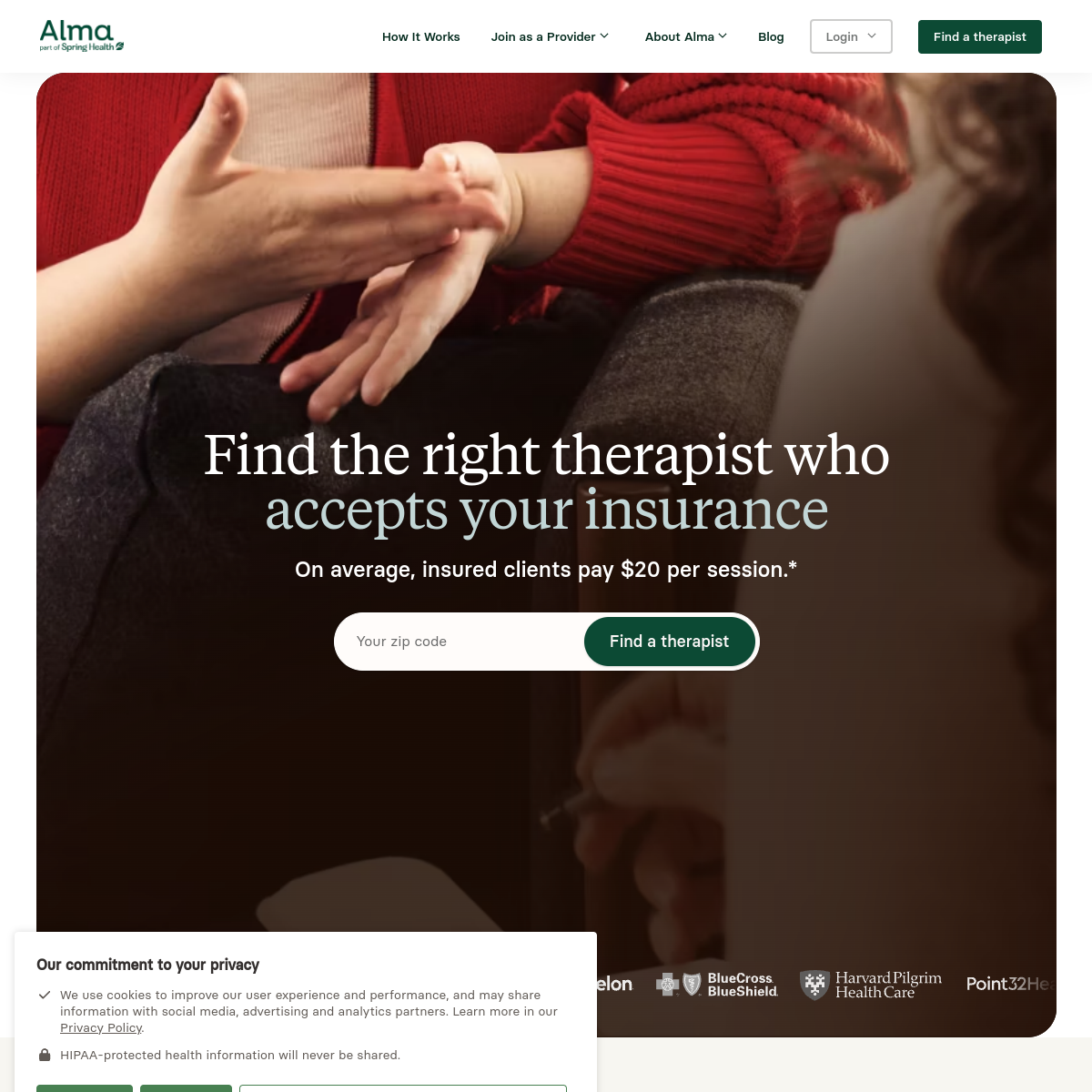
The page we scored
The AI Recommendation Check
When we asked AI who to recommend for Insurance-accepting therapist marketplace / mental health directory, it named:
Buyer we put in the prompt: Adult individual seeking affordable mental health therapy covered by insurance. Both the buyer and the category were inferred from Alma’s homepage alone. The model had no web access.
Alma was on the list.
AI named them for their own category. That's the signal every homepage is supposed to send.
AI mentioned you for "Insurance-accepting therapist marketplace / mental health directory", but only generically: "Alma is a network/platform that helps therapists run their practices while connecting patients with in-network therapists who accept insurance.". You're on the radar, but AI doesn't yet repeat your specific positioning back.
Overall assessment
Alma's biggest strength is its concrete proof stack ... four specific outcome statistics plus a clear $20 average cost give the page real credibility that most mental health marketplaces lack. The biggest gap is the complete absence of owned language, named narrative, or any point of view that distinguishes Alma from BetterHelp, Zocdoc, or Psychology Today ... swap the logo and nothing on this page couldn't describe a competitor.
Signal by category
Narrative Clarity
8 signals
Trust Signal
4 signals
AI Signal
6 signals
Conversion Signal
1 signal
Weakest signal · fix this first
03Owned Language & Category
“No coined terms, named category, or proprietary framework anywhere on the page.”
All language is commodity ... 'find a therapist,' 'mental health care,' 'in-network' ... nothing Alma owns that an AI would quote back as distinctly theirs.
All 19 signals, scored 0 to 2.
Total 22/38
Narrative Clarity
8 signals
- 2
01The 7-Second Test
“Find the right therapist who accepts your insurance" / "On average, insured clients pay $20 per session.”
Within 7 seconds, a stranger knows this is for people seeking affordable therapy through insurance ... problem, solution, and value prop are all visible above the fold.
- 1
02Rebellion / Movement
“Start in minutes, not months”
There's an implied rebellion against the slow, opaque process of finding a therapist, but no named enemy, no explicit critique of the broken system, and no manifesto-level point of view staked out.
- 0
03Owned Language & Categoryweakest
“No coined terms, named category, or proprietary framework anywhere on the page.”
All language is commodity ... 'find a therapist,' 'mental health care,' 'in-network' ... nothing Alma owns that an AI would quote back as distinctly theirs.
- 1
04ICP Clarity
“Find the right therapist who accepts your insurance”
The ICP is broadly 'anyone seeking therapy through insurance' but there's no specificity about life stage, condition severity, geography nuance, or psychographic ... it's wide, not precise.
- 1
05Problem Leadership
“Find the right therapist who accepts your insurance”
The hero leads with a solution frame, not a problem frame ... the buyer's pain (cost confusion, long waits, poor fit) is implied but never named directly before the offer.
- 2
06Solution Clarity
“Alma connects you with affordable, in-network mental healthcare that actually works.”
The FAQ answer gives a clean one-sentence explanation of what Alma does, and the hero reinforces it ... a visitor can repeat it after one read.
- 1
07Cost of Inaction
“Start in minutes, not months”
Wait time is implied as a cost of inaction but the page never names what happens if you delay ... no emotional stakes, no cost of staying stuck, no data on untreated mental health outcomes.
- 1
08Promised Land
“80% of clients feel better within six months”
There's a statistical 'after state' but no vivid, specific narrative of what life looks like post-therapy ... the promised land is a data point, not a lived picture.
Trust Signal
4 signals
- 2
09Proof & Evidence
“98% of Alma therapists accept insurance" / "83% of clients believe their therapist is the right fit" / "80% of clients feel better within six months" / "95% of clients connect within one week”
Four concrete outcome statistics with clear deltas give this page genuine proof density ... not just adjectives.
- 1
10Social Proof
“- Jamie, Alma client" / "- Andrew, Alma client" / "- Heather, Alma client”
Testimonials exist but only first names and 'Alma client' ... no last names, no titles, no company context, no photos linked to quotes, which significantly weakens credibility.
- 0
11Authority & Credibility
“No founder credentials, original research citations, awards, books, or frameworks mentioned anywhere on the page.”
Authority is entirely absent ... there's no signal of who built Alma, why they're qualified, or any third-party validation beyond insurance logos.
- 0
12Alternatives Acknowledged
“No mention of competitors, 'do nothing,' self-pay therapy, or alternative paths anywhere on the page.”
The page never acknowledges that buyers could use Psychology Today, Zocdoc, BetterHelp, or simply not seek therapy ... alternatives are completely ignored.
AI Signal
6 signals
- 2
13Customer Focus
“This is what finding the right therapist feels like" / "1 million people have found care with Alma”
The page consistently centers the patient's journey ... finding, fitting, feeling better ... rather than Alma's technology or team, making the customer the clear protagonist.
- 2
14AI-Parmesan Index
“No AI claims anywhere on the page.”
Alma makes zero 'AI-powered' claims, so there's no AI-Parmesan problem ... scores 2 by the rubric's explicit rule for companies that don't use AI in their narrative.
- 2
15LLM Quotability
“On average, insured clients pay $20 per session." / "95% of clients connect with a therapist within one week.”
Several sentences are declarative, specific, and statistically grounded ... an LLM could lift them verbatim to recommend Alma in a therapy search context.
- 1
16Copyright Freshness
“Average based on 99% of insured sessions on Alma's platform, October - December 2025.”
One data footnote carries a recent date range, but there are no visible blog post dates, case study timestamps, or a copyright year visible in the scraped content.
- 1
17Entity Distinctiveness
“Find the right therapist who accepts your insurance" / "$20 per session”
The insurance-acceptance angle and the $20 average are somewhat distinctive, but the overall positioning could describe several competitors ... an AI couldn't reliably attribute this description only to Alma.
- 1
18AI Recommendation Check
“AI named you alongside Psychology Today, Zocdoc, Headway, Alma, TherapyDen, describing you as: "Alma is a network/platform that helps therapists run their practices while connecting patients with in-network therapists who accept insurance.".”
AI mentioned you for "Insurance-accepting therapist marketplace / mental health directory", but only generically: "Alma is a network/platform that helps therapists run their practices while connecting patients with in-network therapists who accept insurance.". You're on the radar, but AI doesn't yet repeat your specific positioning back.
Conversion Signal
1 signal
- 1
19Path & CTA Clarity
“Find a therapist" [primary CTA] / "Get started" [for providers]”
There's a clear primary CTA and a zip code entry path, but no visible numbered steps for the patient journey and the secondary CTA targets providers rather than serving as a soft alternative for hesitant patients.
Keep the lead
AI already names Alma. The next edition decides if it still does.
Twenty minutes with Greg. Bring the page, bring the argument. You’ll leave knowing exactly which signal is costing Alma the AI recommendation, and what to write instead.
Not on the list? Run your homepage through the free Brand Signal Score and see where you’d land. Same 19 signals, same AI check, two minutes.