
The 2026 Healthtech Messaging Index
Aidoc
aidoc.com·scored September 1, 2026
17/38
Invisible
The page is doing some work, but the story isn't landing fast enough. Buyers and AI are both left guessing what makes Aidoc different.
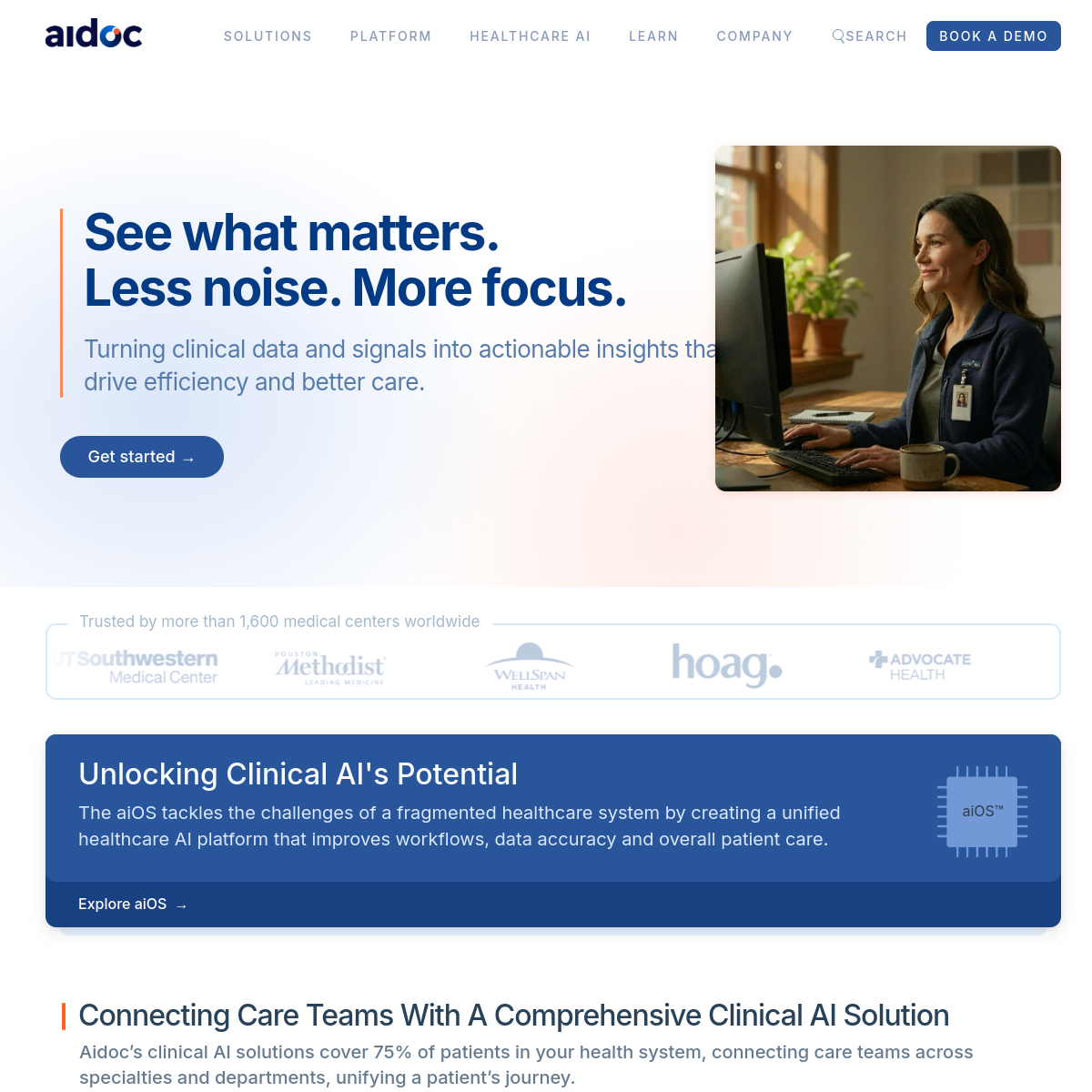
The page we scored
The AI Recommendation Check
When we asked AI who to recommend for Clinical AI platform for medical imaging and care coordination in health systems, it named:
Buyer we put in the prompt: Chief Medical Officer, VP of Radiology, or Clinical Informatics leader at a large hospital system or health network. Both the buyer and the category were inferred from Aidoc’s homepage alone. The model had no web access.
Aidoc was on the list.
AI named them for their own category. That's the signal every homepage is supposed to send.
AI mentioned you for "Clinical AI platform for medical imaging and care coordination in health systems", but only generically: "Aidoc is a clinical AI company focused on radiology triage and workflow automation, using AI to flag urgent findings like pulmonary embolism, intracranial hemorrhage, and other time-sensitive conditions across imaging modalities to accelerate radiologist and care team response.". You're on the radar, but AI doesn't yet repeat your specific positioning back.
Overall assessment
Aidoc's biggest strength is its proof layer ... specific clinical outcome deltas (38 minutes saved for stroke patients, 31% faster PE notification) paired with named testimonials and 1,600+ medical center logos give it real credibility. The biggest gap is narrative clarity at the top: the hero never names the buyer's problem first, never acknowledges a status quo or enemy, and leaves the ICP ambiguous ... a radiologist and a hospital CIO land on the same page with no signal it's built for them specifically.
Signal by category
Narrative Clarity
8 signals
Trust Signal
4 signals
AI Signal
6 signals
Conversion Signal
1 signal
Weakest signal · fix this first
02Rebellion / Movement
“No named enemy, no named status quo critique, no explicit pushback against any industry pattern anywhere on the page.”
The page never names what is wrong with the current approach to clinical workflows or AI adoption; it sells forward without a named villain or broken status quo.
All 19 signals, scored 0 to 2.
Total 17/38
Narrative Clarity
8 signals
- 1
01The 7-Second Test
“See what matters. Less noise. More focus. Turning clinical data and signals into actionable insights that drive efficiency and better care.”
Healthcare AI is implied, but a caveman cannot tell in 7 seconds whether this is for radiologists, hospital CIOs, or cardiology departments ... the who is buried below the fold.
- 0
02Rebellion / Movementweakest
“No named enemy, no named status quo critique, no explicit pushback against any industry pattern anywhere on the page.”
The page never names what is wrong with the current approach to clinical workflows or AI adoption; it sells forward without a named villain or broken status quo.
- 1
03Owned Language & Category
“aiOS™" and "The aiOS tackles the challenges of a fragmented healthcare system by creating a unified healthcare AI platform”
aiOS is a trademarked proprietary term, but it is never defined with enough specificity or narrative weight for AI to quote it as a distinct category frame ... it reads as a product name, not an owned category.
- 1
04ICP Clarity
“Connecting Care Teams With A Comprehensive Clinical AI Solution" covering Radiology, Cardiology, Neurovascular, Vascular”
Verticals are listed below the fold but the hero gives no role signal ... a hospital CIO, a radiologist, and a vascular surgeon would all land on the same ambiguous hero without knowing it's for them.
- 0
05Problem Leadership
“See what matters. Less noise. More focus." is the opening ... no buyer problem is named before the solution pitch begins.”
The page leads immediately with Aidoc's framing and solution language; the buyer's actual pain (missed findings, radiologist shortage, fragmented workflows) is never stated first in the buyer's own words.
- 1
06Solution Clarity
“Turning clinical data and signals into actionable insights that drive efficiency and better care.”
A visitor can grasp it's a clinical AI platform for hospitals, but the hero sentence is abstract enough that two people would describe the product differently ... 'actionable insights' is not a mechanism.
- 1
07Cost of Inaction
“30% of moderate to severe coronary calcification patients are not managed appropriately.”
Some consequence data appears in specialty tiles, but the page never explicitly names the cost of not adopting Aidoc ... no delayed diagnoses, no financial penalty, no direct 'do nothing' consequence statement.
- 1
08Promised Land
“cover 75% of patients in your health system, connecting care teams across specialties and departments, unifying a patient's journey.”
There is a gestured-at promised land of unified, efficient care, but it is stated abstractly and never painted as a vivid before/after transformation the buyer can emotionally inhabit.
Trust Signal
4 signals
- 2
09Proof & Evidence
“31% faster time-to-notification for PE patients" / "34% reduction in door-to-puncture (DTP) time for stroke patients, equivalent to 38 minutes saved”
Multiple specific, sourced, clinical outcome deltas are tied to named conditions ... this is concrete proof, not adjective soup.
- 2
10Social Proof
“John Borsa, MD, Chair of Radiology, St. Luke's Health System" / "Trusted by more than 1,600 medical centers worldwide”
Named testimonials with titles and institutions, a scale number, and a dense logo wall of recognizable health systems all appear on the page.
- 1
11Authority & Credibility
“AI Path ... Navigate AI implementation with resources, workshops and training" / "AI Strategy & Governance”
Framework-level programs are mentioned but no founder credentials, original research citations, or third-party authority markers appear on the homepage to demonstrate earned credibility.
- 0
12Alternatives Acknowledged
“No mention of alternatives, competitors, status quo tools, or 'do nothing' option anywhere on the page.”
The page never acknowledges that buyers could choose a competitor, build internally, or do nothing ... zero honest treatment of alternatives.
AI Signal
6 signals
- 1
13Customer Focus
“I feel that Aidoc is doing something which is going to change the outcomes of a lot of stroke patients" ... customer quotes exist but hero copy is company-centric.”
Testimonials make the customer present, but the hero, platform section, and solution tiles are all written from Aidoc's capability perspective, not the customer's transformation story.
- 1
14AI-Parmesan Index
“The aiOS tackles the challenges of a fragmented healthcare system by creating a unified healthcare AI platform”
AI is central to the product and the page names specific clinical algorithms and outcomes, but 'AI-powered' and 'clinical AI' are used broadly without explaining the underlying mechanism that makes it work differently.
- 1
15LLM Quotability
“34% reduction in door-to-puncture (DTP) time for stroke patients, equivalent to 38 minutes saved.”
Some stat-rich sentences are quotable, but the hero and platform sections are written in vague, abstract language that LLMs would paraphrase rather than cite verbatim as a recommendation.
- 0
16Copyright Freshness
“© Copyright 2026 Aidoc" ... no visible dates on case studies, blog posts, or news items on the scraped homepage content.”
The copyright year is 2026 (likely a typo or error, not a trust signal), and no recent content dates appear in the scraped homepage, removing recency credibility for AI engines.
- 1
17Entity Distinctiveness
“aiOS™" platform covering "75% of patients in your health system" across Radiology, Cardiology, Neurovascular, and Vascular”
The multi-specialty breadth and aiOS brand are somewhat distinctive, but the positioning language ... 'unified healthcare AI platform,' 'actionable insights,' 'better care' ... is interchangeable with Nuance, Viz.ai, or Nanox without the logo.
- 1
18AI Recommendation Check
“AI named you alongside Aidoc, Nuance (Microsoft), Viz.ai, Intelerad, Annalise.ai, describing you as: "Aidoc is a clinical AI company focused on radiology triage and workflow automation, using AI to flag urgent findings like pulmonary embolism, intracranial hemorrhage, and other time-sensitive conditions across imaging modalities to accelerate radiologist and care team response.".”
AI mentioned you for "Clinical AI platform for medical imaging and care coordination in health systems", but only generically: "Aidoc is a clinical AI company focused on radiology triage and workflow automation, using AI to flag urgent findings like pulmonary embolism, intracranial hemorrhage, and other time-sensitive conditions across imaging modalities to accelerate radiologist and care team response.". You're on the radar, but AI doesn't yet repeat your specific positioning back.
Conversion Signal
1 signal
- 1
19Path & CTA Clarity
“Get started →" (primary CTA linking to book-a-demo) ... no soft secondary CTA in the hero, no visible numbered process.”
There is one primary CTA in the hero but no soft secondary option there, and no numbered onboarding path ... the 'AI Path' and 'AI Strategy' sections below the fold don't function as a connected conversion sequence.
Keep the lead
AI already names Aidoc. The next edition decides if it still does.
Twenty minutes with Greg. Bring the page, bring the argument. You’ll leave knowing exactly which signal is costing Aidoc the AI recommendation, and what to write instead.
Not on the list? Run your homepage through the free Brand Signal Score and see where you’d land. Same 19 signals, same AI check, two minutes.