
Who should own positioning in a B2B company?

By Greg Rosner
Founder of PitchKitchen · Author of StoryCraft for Disruptors
· 7 min read
TL;DR
The CEO should own positioning in a B2B company. Product brings what the product truly does better, sales brings who you really win and lose against, and marketing runs the process and turns the decision into messaging, but the call on who you're for and what problem you lead with belongs to the person accountable for the whole business. Then write it into one record everyone and every AI tool works from. In PitchKitchen's 2026 Healthtech Messaging Index, 176 of 302 homepages explained the product clearly, but only 29 led with a named buyer problem.
The CEO should own positioning in a B2B company. Product, sales and marketing each own a piece of the input, and marketing usually runs the work, but the final call on who you're for, what you replace and which problem you lead with belongs to the person accountable for the whole business. Once that call is made, it needs a second owner that isn't a person at all: one written record your team and your AI tools all work from.
Most companies answer the ownership question by looking at the org chart. Positioning shows up as a homepage, a deck and a tagline, which all look like marketing, so it lands in marketing. Then a smart VP of Marketing spends two quarters building a positioning that sales ignores, product quietly contradicts and the CEO rewrites the night before a board meeting. Sound familiar?
Why can't marketing own positioning on its own?
Because positioning is a business decision that happens to get expressed in marketing. Deciding which buyer you're for means deciding which deals you'll stop chasing. Deciding what you replace means deciding who you compete with. Deciding which problem you lead with means betting the company's story on one thing instead of five. A marketing leader can propose all of that. They can't make it stick when the head of sales is closing a deal in the segment you just walked away from.
April Dunford, whose book Obviously Awesome is the standard reference on positioning, comes at it from the same place. Her method is built as a cross-functional team exercise, and one of her own podcast episodes is titled "Positioning Is Not Branding, And It's Not Just Marketing's Job." If you want the step-by-step for running the positioning exercise itself, her work is where we'd send you. Our focus is the part that comes after: who owns the decision once it's made, and how it survives contact with a growing company.
Who owns what in a positioning decision?
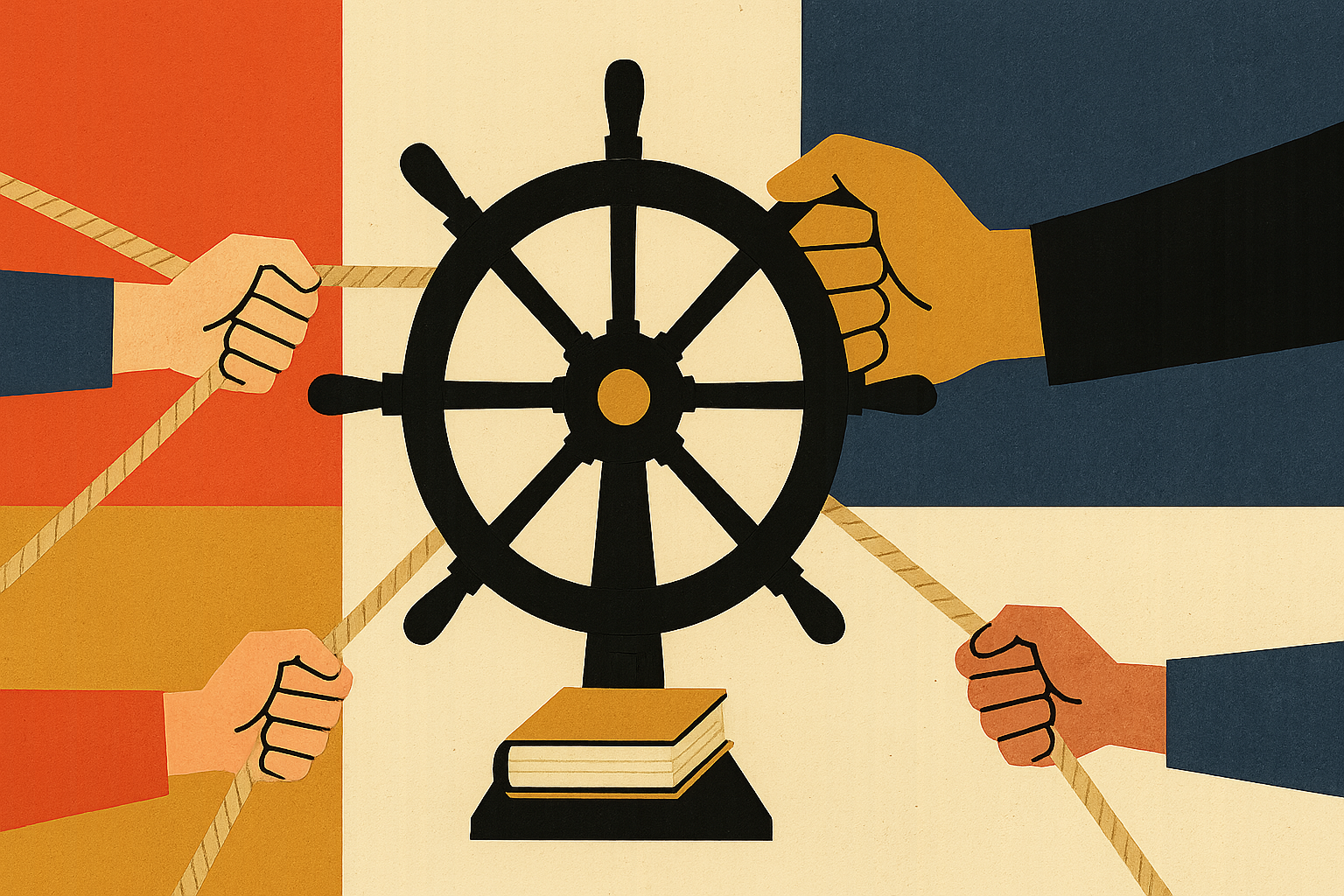
Think of it as one owner of the decision and four contributors, one of which is a document. Each role brings something the others can't see.
| Role | What they own | What they bring | What breaks without them |
|---|---|---|---|
| CEO | The decision and the tiebreaker | The bet: which market, which problem, what you'll stop doing | The debate never ends, and each leader keeps defending a different company |
| Product | The truth about capability | What the product does better today and what's actually coming | Positioning promises something the product can't deliver |
| Sales | The buyer's reality | Who you really win and lose against, and the words buyers use | Positioning describes deals that don't exist |
| Marketing | The process and the translation | Runs the work, then turns the decision into messaging everywhere | The decision stays a slide nobody uses |
| The written record | The memory | The decision, the evidence and the buyer language in one place | The story resets with every new hire and every AI prompt |
Notice that marketing does most of the work and still isn't the owner. That's the arrangement that holds up. The CEO is the only person who can trade one segment for another without a turf war, and marketing is the team best equipped to turn that trade into words.
What does positioning look like when nobody owns it?
You can often see it from the outside. In PitchKitchen's 2026 Healthtech Messaging Index, we scored 302 company homepages against the same 19 criteria the Brand Signal Score uses. 176 of them took full marks on Solution Clarity, which measures whether a stranger can tell what the product is and does. Only 29 took full marks on Problem Leadership, which measures whether the page leads with a named buyer problem. And 61 homepages took full marks on describing the product while scoring zero on leading with a problem.
We can't see anyone's org chart from a homepage, so treat this as a pattern to check against your own company. It fits what we see inside companies, though. The product description always has an obvious owner, because someone built the product and can describe it. The problem the company chooses to lead with needs someone with the authority to choose, and on a lot of these pages it reads like nobody did.
How should product, marketing and sales collaborate on positioning?
Collaboration goes wrong when it means everyone edits the same document until nobody objects. We've written about that failure in why messaging by committee fails. Here's the sequence that works instead:
- 1The CEO names the decision and the date. "By the end of this month we'll decide who we're for, what we replace and the problem we lead with." Saying it out loud tells everyone this has an owner and an end.
- 2Each leader writes their version alone first. Product, sales and marketing will describe three slightly different companies, and that gap is the most useful thing you'll learn all quarter. How to get a leadership team to agree on the core message walks through that step in detail.
- 3Settle it with evidence. Bring the last ten won and ten lost deals, and read them for your real alternative and your best-fit buyer. Our guide on using win/loss data to improve positioning shows how.
- 4The CEO makes the call and says what you're giving up. A positioning decision that doesn't cost anything usually hasn't decided anything.
- 5Marketing translates the decision into messaging, starting with the homepage, the first minute of a sales call and the deck. The method is in how to turn positioning into messaging.
- 6Write it into one record and name who can change it. Changes go through the CEO. Everyone else works from the record.
Who should own the company narrative after the decision is made?
The CEO still owns it. Marketing keeps it. The record holds it. That last part is the one most companies skip, and it's why messaging starts over every time you hire a new marketing leader. If the positioning lives in one person's head, it leaves with them.
AI made this more urgent. Your reps are already asking ChatGPT to write their follow-up emails, and your marketing team is asking Claude for blog drafts. Every one of those tools works from whatever you've written down. If nothing is written down, each prompt invents its own version of your company, and you end up with fifty slightly different stories in market by Friday. We document the decision in a Magnetic Messaging Framework for exactly this reason: one record holds the positioning, the proof and the buyer language, and both your people and your AI tools work from it. It's also what lets an AI Brand Twin survive the next marketing hire.
What if we're founder-led and don't have a CMO yet?
Then the founder owns positioning, writes it, and sells it, which works fine right up until the first marketing hire. The mistake is waiting for that hire to "own positioning" for you. Write the decision down before they start. A new marketing leader who inherits a clear record will sharpen it. One who inherits a blank page will build their own, and you'll be paying for the same work twice.
If you want a quick read on how your positioning looks from the outside before you decide who owns it, run your homepage through the free Brand Signal Score. It checks the same 19 criteria we used on those 302 healthtech homepages, including whether you lead with the problem or only with the product.
Questions People Ask
FAQ
Who should own positioning in a B2B company?
The CEO should own the positioning decision. Product, sales and marketing each contribute: product brings what the product truly does better, sales brings who you really win against, and marketing runs the process and turns the decision into messaging. The final record should live in one written document everyone works from.
Who should own product positioning?
For a single product inside a larger company, product marketing usually runs it, with the head of product and head of sales at the table. It still has to fit the company-level positioning the CEO owns. If the two disagree, the company-level decision wins and the product story adjusts.
Who should own the company narrative?
The CEO owns the narrative, marketing keeps it current, and a written framework holds it. That split matters because marketing leaders change. When the narrative only lives in one person's head, it resets with every new hire and every AI tool invents its own version.
How should product, marketing and sales collaborate on positioning?
Have each leader write their version alone first, compare the gaps, then settle the decision against real won and lost deals instead of opinions. The CEO makes the final call. Marketing translates it into messaging, and the result goes into one shared record.