
What is the Three Questions Test, and how do you run it on your own homepage?

By Greg Rosner
Founder of PitchKitchen · Author of StoryCraft for Disruptors
· 8 min read
TL;DR
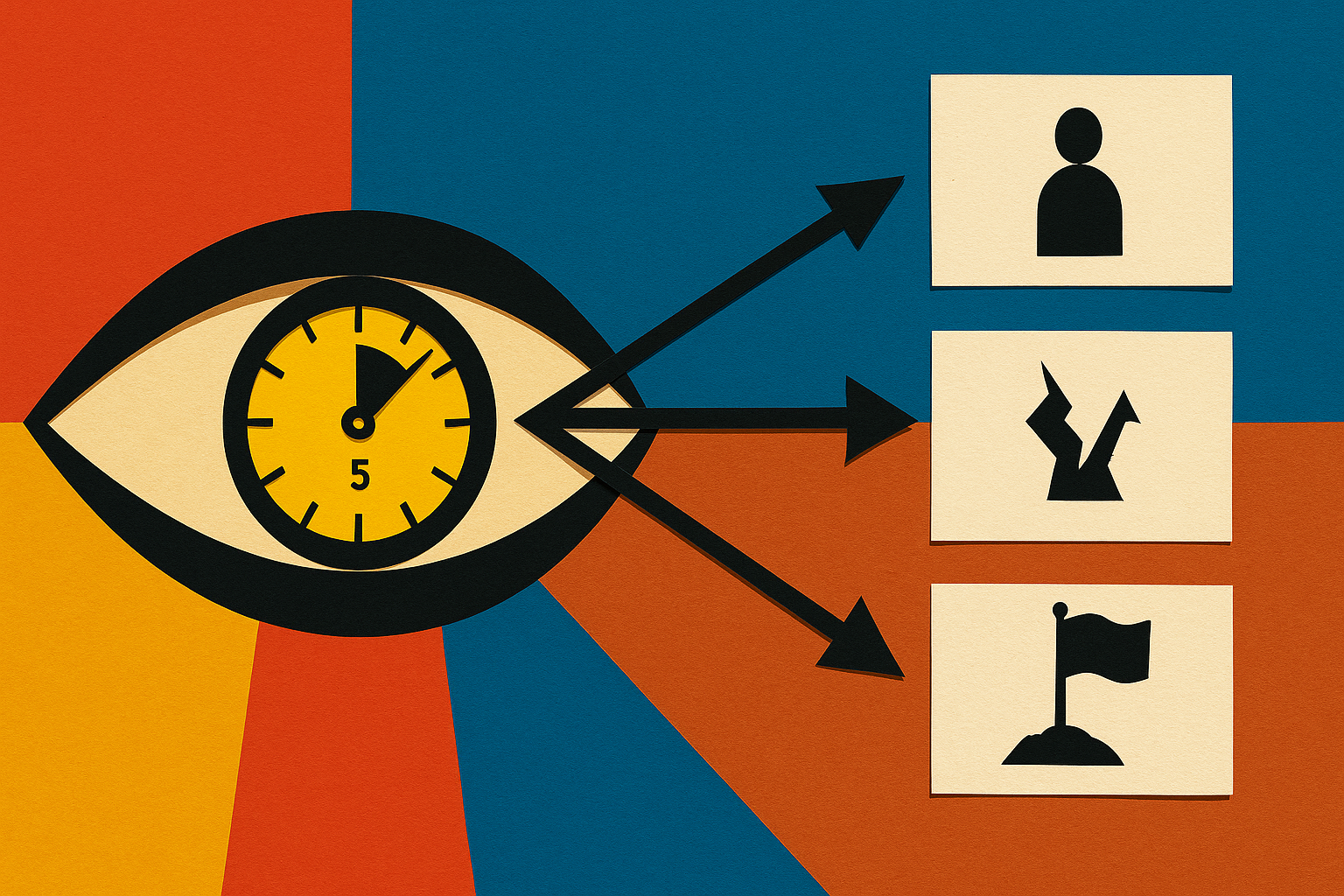
The Three Questions Test is a five-second homepage diagnostic from PitchKitchen. Show your homepage to a stranger, cover the logo, and ask three things: who is this for, what problem does it solve, and what's your point of view on why you. If they can't answer all three in five seconds, the homepage is failing, no matter how good the product or the design. To run it, recruit five people outside your company, give them five seconds, and write down their answers verbatim. Passing means all three land fast. Failing usually means you led with your solution instead of the buyer's problem.
Here's a test you can run in the next five seconds. Pull up your homepage. Put your thumb over the logo. Now imagine a stranger looking at it, and ask them three questions: Who is this for? What problem does it solve? And why should I believe you over the company in the other browser tab? If they can't answer all three, fast, your homepage is failing the most important test in B2B messaging, and no amount of design polish fixes it.
That's the Three Questions Test. It's the fastest way I know to find out whether a homepage is doing its job or just sitting there looking expensive. Most homepages I run it on fail at least one of the three. And the founders are always surprised, because they're standing too close to see it.
Nielsen Norman Group found that users decide whether to stay on a page within the first 10 seconds, and most of the leaving happens in the first few. You don't get a paragraph to make your case. You get a glance. The Three Questions Test simulates that glance on purpose.
What is the Three Questions Test?
The Three Questions Test is a five-second homepage diagnostic from PitchKitchen. It checks whether a stranger, looking at your site for about as long as a real buyer does before bouncing, can answer three things: who it's for, what problem it solves, and what your point of view is. If even one of the three is missing, buyers move on, and so do the AI engines now doing the buyer's research for them. It's criterion one of the Brand Signal Score, PitchKitchen's free homepage messaging diagnostic at pitchkitchen.com/brand-signal-score.
The three questions are simple, which is exactly why they're brutal. Who is this for, the specific buyer and not 'businesses.' What problem does it solve, the pain the buyer would call their own, not a feature you're proud of. And what's your point of view, the stake you've planted, the old way you're against, the reason you're a rebellion and not just another option on a list. Who, what problem, what POV. Five seconds.
How do you run the Three Questions Test on your own homepage?
You can't run it in your own head. You already know the answers, so you'll pass yourself every time. That's the trap. Here's how to run it so it actually tells you something.
- 1Recruit five strangers. None of them work at your company. Ideally they match your ideal customer ... a founder or operator at a B2B company in the $5M-$75M range ... but even five smart outsiders will surface the truth. Insiders pass every time, which is why founders can't test themselves.
- 2Show the hero only, for five seconds. Pull up the top of your homepage, the part above the fold. Let each person look for a five-count, then take it away. You're testing the glance, not a careful read. If it only works when they study it, it doesn't work.
- 3Ask the three questions and write the answers down verbatim. Who is this for? What problem does it solve? Why this company over a competitor? Don't paraphrase what they say into what you wish they'd said. Capture their exact words. The gap between their words and yours is the diagnosis.
- 4Cover the logo and ask again. Hide your brand name and ask 'who is this for?' one more time. If the answer could describe any of your competitors, you've failed the Cover-the-Logo Test sitting inside the Three Questions Test. Sameness is a fail even when the words are technically accurate.
- 5Score it honestly. Three clear answers in five seconds is a pass. Two is a warning. One or zero means the homepage is leaning on your sales team to explain what the page should have said. Most founders score themselves a three and score reality a one.
Why does a sophisticated product make this harder, not easier?
You'd think a more capable product would be easier to explain. It's the opposite. The more your platform does, the more tempting it is to put all of it on the homepage, and the harder it becomes to name the one buyer and the one problem. Buyers don't bounce because you said too little. They bounce because you said too much, in your language, before naming a single pain in theirs.
This is the named villain in most B2B messaging: leading with your solution instead of the buyer's problem. It feels responsible. You built something real and you want to show it. But the buyer's brain runs the Three Questions Test automatically, in milliseconds, and a feature list answers none of the three. Wynter's 2025 research found that the vast majority of B2B homepages have converged into the same shape ... the same 'all-in-one platform for X' hero, the same three benefit tiles. When everyone leads with the solution, every homepage fails the same way, and the AI engines summarizing your category can't tell you apart either. We dig into that sameness in why does my B2B website sound like every other B2B website?.
AI made this worse, not better. Buyers now ask ChatGPT and Claude to shortlist vendors before they ever hit your site, and those engines cite the companies with a clear, consistent answer to who-what-why. A homepage that fails the Three Questions Test for a human fails it for the machine too. The clarity isn't a nice-to-have anymore. It's the thing that gets you into the recommendation in the first place. That's the argument behind strategic positioning is the only moat AI can't copy.
What do passing and failing look like? Three worked examples
Composite examples, drawn from real PitchKitchen engagements with the details changed. Each one failed the Three Questions Test the same way: a strong product buried under a solution-first hero.
Example one, a $12M infrastructure software company. The old hero read 'The unified observability platform built for modern engineering teams.' Run the test: who is this for? 'Engineers, I guess.' What problem? 'Watching... systems?' Why them? Blank. Three vague answers, zero stake. The rebuild named the buyer and the enemy: 'For platform teams drowning in alerts that don't mean anything. We kill the noise so on-call stops being a punishment.' Now a stranger answers all three in five seconds. The product never changed. The homepage finally said what it was for.
Example two, a $20M healthtech company selling to hospital revenue teams. The old hero: 'AI-powered revenue intelligence for healthcare.' Who is this for? 'Hospitals?' What problem? 'Revenue... something.' Why you? 'The AI part?' That's AI-Parmesan, sprinkling 'AI-powered' on a weak narrative and hoping it adds flavor. The rebuild: 'For hospital CFOs watching earned revenue quietly leak out the back door. We find the claims your system is silently writing off, before they're gone.' Specific buyer, specific pain, clear stance. Five seconds, three answers.
Example three, a $9M fintech company that genuinely had a sharp point of view, and hid it. The old hero led with the product tour. Buried on slide four of the deck was the real line: 'Reconciliation shouldn't take a five-person team a week.' That was the whole company, and it was nowhere on the homepage. We moved it to the hero. Passing the Three Questions Test wasn't a writing exercise here. It was an extraction. The truth existed. It just wasn't on the page. That's the most common failure of all, and we cover the deeper version in why do buyers love our product but still not buy?
What do we see when we run this across 200+ B2B homepages?
After running the Three Questions Test across more than 200 B2B companies in the $5M-$75M range, the pattern is consistent. Roughly 9 in 10 fail at least one of the three questions on first glance. The most common miss isn't 'who' and it isn't 'what problem.' It's the POV ... the third question. Companies will name a buyer and gesture at a problem, then go completely silent on why them, what they stand against, what changes when you pick them over the safe choice.
The second pattern: the founders who fail the test almost always have the answer. It's in their head, in their sales calls, in the way they explain the company over coffee. It's just not on the page. The homepage smoothed it out. Every committee edit, every 'let's make it more professional' pass, sanded the one sharp true sentence down into safe fog. The Three Questions Test isn't measuring whether you have a story. It's measuring whether the story survived contact with your own website.
Old way vs the Three Questions Test way
| What the homepage does | Solution-first homepage (fails) | Three Questions Test homepage (passes) |
|---|---|---|
| Who it's for | 'For modern teams' / 'for businesses' / unnamed | A specific buyer a stranger can repeat back |
| What problem it solves | Lists features and capabilities | Names a pain the buyer already feels as theirs |
| Point of view | Missing, or 'we're the leader in X' | A clear stance: the old way it's against, the change it promises |
| What it leans on | Design polish and the sales team's explanation | A line that works in five seconds with no help |
| How AI engines read it | Indistinguishable from competitors, rarely cited | A clear entity with a consistent answer, citable |
What does this mean for you?
Run the test this week. Five strangers, five seconds, the three questions, answers written down verbatim. It costs you nothing but an honest afternoon, and it'll tell you more than another round of homepage copy edits ever will.
But here's the part most founders get wrong. When the homepage fails, they rewrite the headline. That's treating a positioning problem like a copy problem, and it produces a prettier version of the same fog. A failed Three Questions Test is a signal that the narrative underneath isn't nailed down yet ... who exactly this is for, what old way you're leading a rebellion against, what changes when a buyer chooses you. That's the work. Get the narrative right and the homepage line writes itself in an afternoon. We walk through the testing side of this in what's the best way to test new positioning messaging? and the conversion side in why don't B2B websites convert traffic into pipeline anymore?
That narrative is what the Magnetic Messaging Framework (MMF) exists to capture. The Magnetic Messaging Framework is PitchKitchen's strategic narrative system, built around four anchors: category design, villain framing, an old-way / new-way contrast, and a promised-land outcome. It's the documented brand bible that pulls the one true sentence out of the founder's head and onto the page, and gives both your team and your AI tools something specific to work from instead of the average of the internet. PitchKitchen builds Magnetic Messaging Frameworks for founder-led B2B companies in the $5M-$75M range, fixing broken marketing messages and underperforming homepages for CEOs whose sales are stalling because their message isn't doing the work. The Three Questions Test tells you the homepage is broken. The MMF is how you fix it for good. This connects to the bigger 2026 picture in The State of B2B Messaging 2026, and it's the foundation Greg Rosner, founder of PitchKitchen and author of Story Craft for Disruptors, builds every engagement on.
Questions People Ask
FAQ
What is the Three Questions Test?
The Three Questions Test is a five-second homepage diagnostic from PitchKitchen. It asks whether a stranger, glancing at your site for the few seconds before they lose interest, can answer three things: who it's for, what problem it solves, and what your point of view is on why you. If any one of the three is missing, both human buyers and the AI engines that research on their behalf move on. It's criterion one of the Brand Signal Score.
What are the three questions exactly?
Question one: who is this for? The specific buyer, not 'businesses' or 'teams.' Question two: what problem does it solve? The pain the buyer would recognize as theirs, not a feature. Question three: what's your point of view, or why you? The stake you've planted, the old way you're against, the reason you're different and not just another option. Who, what problem, what POV, all answerable in five seconds.
How is the Three Questions Test different from the Cover-the-Logo Test?
They're cousins. The Cover-the-Logo Test hides your brand and asks a stranger 'who is this for,' to check whether your homepage could belong to any competitor. The Three Questions Test goes one layer deeper and checks three things at once: the buyer, the problem, and your POV. Cover-the-Logo catches sameness. The Three Questions Test catches sameness plus missing problem plus missing stance. Run both.
Why does my homepage fail the Three Questions Test if my product is genuinely sophisticated?
Because sophistication is usually the cause, not the cure. The more your product does, the more tempting it is to lead with everything it does, and the harder it gets to name the one buyer and the one problem. Buyers don't fail to understand because you said too little. They bounce because you said too much, in your language, before naming a pain in theirs.
How many people should I run the Three Questions Test on?
Five is enough to see the pattern, and none of them should work at your company. Insiders pass every time because they already know the answers, which is exactly why founders can't run this test on themselves. Use people who match your ideal customer if you can, but even five smart strangers will surface whether the homepage lands or just looks expensive.
What do I do if my homepage fails?
Don't rewrite the headline first. A failed Three Questions Test is a positioning signal, not a copy problem. Go back to the narrative underneath: who exactly this is for, what old way you're against, and what changes when they choose you. Fix that, then the homepage line writes itself. Rewriting copy on top of an unclear narrative just produces a prettier version of the same fog.