
Story-Driven Homepage: The 2026 Playbook for Converting B2B Traffic

By Greg Rosner
Founder of PitchKitchen · Author of StoryCraft for Disruptors
· 10 min read
TL;DR
A story-driven homepage centers the buyer's transformation, not the company's features. AI made polished homepage copy free, which means clarity and polish are no longer competitive moats. Story is. We've audited 200+ B2B homepages at $5M-$75M companies this year. The average self-talk ratio (company references vs. buyer references) is 78 percent. Nine in ten lead with the company name in 'we' voice. Seven in ten fail the Cover-the-Logo Test. More copy won't fix any of that. Rotating the page will: the buyer becomes the protagonist, the company becomes the guide, and the homepage stakes a POV competitors can't agree with.
The state of B2B homepages in 2026
There's a five-second test that predicts whether a B2B homepage will convert in 2026. Most homepages fail it.
We've audited more than 200 B2B homepages this year, almost all of them at companies doing $5M to $75M in revenue, across SaaS, healthtech, fintech, cybersecurity, and AI-driven companies. The pattern is consistent and it's getting worse, not better. AI tools that promised faster homepage copy have delivered faster sameness. The homepages all look polished now. Most don't say anything.
Here's the test. Open your homepage. Cover the logo. Set a five-second timer. Read what a stranger would see above the fold. Can a buyer answer three questions in those five seconds? Who is this for. What specific problem does it solve. What POV does this company have that no competitor shares.
If a stranger can't answer those questions in five seconds, your homepage isn't converting. It's wallpaper. And buyers in 2026 are skipping wallpaper faster than ever, because they've seen the same wallpaper on twelve competitor sites already this morning.
The part most founders don't want to hear: the problem usually isn't your copy. Your copywriter isn't the bottleneck. Your AI tools aren't the bottleneck. The problem is that your homepage carries a feature list with confidence. It doesn't carry a story.
That's a fixable problem. But you have to name it first.
Naming what's actually broken
The villain has a name. We call it Solution-Centric Marketing. It's the default mode of every growth-stage B2B company we've worked with. The homepage talks about the product. The features. The platform. The awards. The 'trusted by 500+ leading companies' logos.
It does not talk about the buyer. It does not name the villain in the buyer's industry. It does not stake a position that the buyer can rally around.
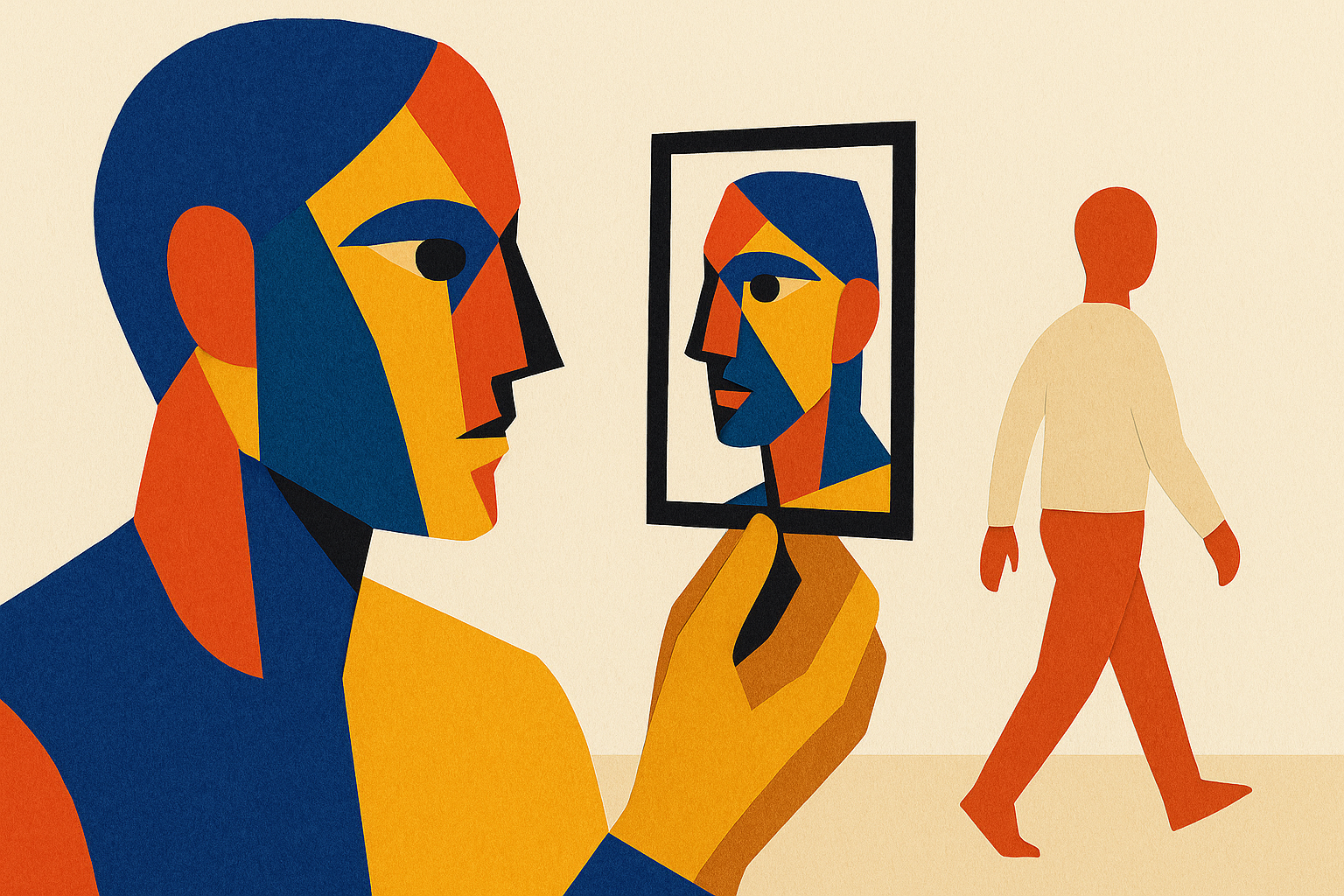
This is narcissistic homepage syndrome, and it's measurable. The self-talk ratio counts how much your homepage talks about itself ('we,' 'our,' 'the company') against how much it talks about the buyer's transformation ('you,' 'your team,' 'what you're trying to fix'). A high self-talk ratio is a homepage looking in a mirror while the buyer walks away. It's one of the symptoms our free diagnostic picks up, and How Brand Signal Score Reveals What's Actually Killing Your B2B Homepage walks through the rest of them.
Almost every B2B homepage we look at lands between 70 and 90 percent self-talk. Self-obsessed. Talking to a mirror. Not to a buyer.
This is just truth. It's not because founders are vain. The default playbook for the last fifteen years was 'describe what you do clearly.' That made sense when the cost of producing a homepage was high and the differentiator was clarity. It doesn't make sense in 2026, when every competitor has a polished homepage that says exactly the same thing yours does.
A story-driven homepage rotates the page so the buyer is the protagonist. Not the company. The buyer. The company plays the role of the guide, the partner who helps the buyer fight a specific villain in their industry. The hero is always the buyer. The page stakes a POV the competitor wouldn't co-sign.
Why this is worse now than ever
AI collapsed the cost of homepage copy to nearly zero. Anyone can spin up a polished landing page in an afternoon. Anyone can write hero copy that's grammatically perfect and tonally professional. The cheapest deliverable in B2B marketing right now is 'a homepage that doesn't embarrass you.'
That means clarity isn't a moat anymore. Polish isn't a moat. 'Professional copy' isn't a moat. Those are now table stakes. They used to be the differentiators.
What is the moat? Perspective. Lived truth. POV that competitors can't copy because it requires having actually lived the problem and earned a specific belief about it. Strategic positioning is the only moat AI can't copy.
When AI made every homepage look the same, the homepages that stand out are the ones that don't sound like AI wrote them. Not because the prose is rougher. Because the thinking is sharper. Because the company has a specific belief about its market that no competitor shares. Because the homepage takes a side.
This is the moment in B2B history where having a story matters more than having polished copy. AI killed the polished-copy advantage. It can't kill the story advantage. Stories require lived truth, and AI doesn't have any.
Every B2B homepage in 2026 is either telling a story or describing a product. Buyers can feel the difference in five seconds. The ones telling stories convert. The ones describing products get bookmarked and forgotten.
There's a downstream signal too. When your homepage describes the product, your sales team spends the first ten minutes of every Zoom re-explaining what the company does. When your homepage tells a story, the sales team enters the conversation with the buyer already partly enrolled. The deck stops being a description and starts being a continuation. That changes deal velocity by weeks. Sometimes months.
The diagnostic: three tests we run on every homepage
Before we touch a single line of copy on a client's homepage, we run three tests. You can run them on your own homepage in fifteen minutes without hiring anyone.
- 1The Three Questions Test. Open your homepage. Set a five-second timer. Read only what's visible above the fold. Can you answer three questions: who is this for, what problem does it solve, what POV does this company have that no competitor shares? If any of the three takes longer than five seconds to answer, your hero copy is failing. It's describing instead of staking. We break the whole test down in What is the Three Questions Test, and how do you run it on your own homepage?
- 2The Cover-the-Logo Test. Take a screenshot of your homepage. Cover or blur the logo. Show it to a stranger. Ask them: 'Who is this for, and what business are they in?' If they can't answer in five seconds, your homepage is interchangeable with every other site in your category. You've built a generic-competitor homepage that happens to have your logo on it. Longer version here: The Cover-the-Logo Test: would a stranger know who your homepage is for in five seconds?
- 3The self-talk ratio. Count the times 'we,' 'our,' 'us,' and 'the company' appear on your homepage. Count the times 'you,' 'your team,' 'your buyers,' and the buyer's specific job appear. Compute the ratio. If self-talk outweighs buyer-talk by more than 2:1, you have a narcissistic homepage. Your buyer is reading a website that's talking about itself, not about them.
Don't want to run them by hand? We built the scored version and made it free. The Brand Signal Score runs your homepage against 19 criteria across four categories: Narrative Clarity, Trust, AI-readiness, and Conversion. It takes a URL and gives you back the same diagnosis we'd run in a client kickoff, including how the page reads to an AI engine that's deciding whether to recommend you. Higher is better, 38 is the ceiling, and almost nobody starts near it.
These three tests cost nothing. They take fifteen minutes. They tell you whether you have a story-driven homepage or a product-description homepage. The fix is not adding more copy. The fix is rewriting the hero to carry the story.
What we see across 200+ B2B homepages
Pattern across our audit dataset:
- 19 in 10 B2B homepages lead the hero with the company name and 'we' voice instead of the buyer and the buyer's transformation. Self-talk dominates.
- 27 in 10 homepages fail the Cover-the-Logo Test. Stranger-shown, the homepage is unrecognizable as belonging to a specific company.
- 38 in 10 hero copy blocks contain three or more category buzzwords ('AI-powered,' 'platform,' 'enterprise-grade,' 'next-generation') in the first fifty words. That's AI-Parmesan sprinkled on a weak narrative.
- 4Average self-talk ratio across the 200+ audit set: 78 percent of the page talking about the company. Self-obsessed. Talking to a mirror.
- 5Time to first POV statement on the average homepage: never. Most homepages contain zero stake-in-the-ground beliefs about the market.
The companies that pass our diagnostic share three traits. They name a villain. They stake a POV that competitors can't agree with. They write the hero in the buyer's voice, not the founder's. Those three traits correlate with conversion rate, demo-request volume, and time-on-page in our client data.
The companies that fail share one trait. They describe the product. Beautifully. Professionally. Pointlessly. In a market where every competitor describes the product just as beautifully, description isn't a differentiator anymore. It's a draw, at best.
We also see a second-order pattern. Companies with high-Brand Signal Score homepages tend to have a sales team that complains marketing isn't generating qualified pipeline. The sales team is right. A homepage that doesn't pre-enroll the buyer leaves the entire enrollment burden on the sales rep. Marketing's job is to tee up a buyer who already believes the company has a specific POV worth a conversation. Solution-centric homepages don't do that. Story-driven ones do.
A real example
We worked with a $14M Series B healthtech SaaS company in early 2026. Their homepage was beautifully designed. The hero copy was 'The AI-Powered Clinical Decision Platform for Modern Health Systems.' Five buzzwords. No buyer. No villain. No POV.
Self-talk ratio: 82 percent. They mentioned themselves 47 times on the homepage. They mentioned the buyer's job four times. They mentioned the actual clinical problem zero times.
We rebuilt the homepage around their lived truth. The founder had spent eight years as a critical care physician before founding the company. He'd watched colleagues burn out under decision fatigue. He had a specific belief: clinical decision tools should reduce the cognitive load on doctors, not add another dashboard for them to monitor.
The new hero copy: 'For ICU doctors making 100 decisions a shift. We're not adding another screen. We're taking weight off your back.' Below: a one-line villain statement. 'Every other AI clinical tool is a dashboard. We refuse to build another dashboard.'
Same product. Same features. Different story.
Self-talk ratio dropped from 82 percent to 34 percent in one revision. Demo requests rose 73 percent over the next ninety days. Average time-on-homepage rose from 42 seconds to 1 minute 58 seconds. The sales team stopped having to explain the company in the first ten minutes of every Zoom because the homepage had already explained it.
The product didn't change. The story did. That's the entire bet of a story-driven homepage. Same company, same features, same team. New protagonist on the page. Buyer-shaped, not company-shaped. Everything downstream changes.
What this means for you
Run the three tests this week. They cost nothing and they tell you exactly where your homepage is leaking conversion.
If your homepage fails one or more, here's what to do next.
- 1Identify your villain. Every story has one. What is the bad pattern in your industry that you refuse to perpetuate? Name it on the homepage. Be specific enough that a buyer recognizes it as their own pain. 'Generic AI marketing tools' isn't specific. 'Every other clinical AI tool is a dashboard adding to doctor fatigue' is.
- 2Stake a POV that a competitor would have to disagree with. If every competitor in your category would happily put your hero copy on their homepage, your hero copy doesn't have a POV. Rewrite it until at least one competitor would refuse to agree with it. That's the test of a real stake.
- 3Move the hero into the buyer's voice. Stop describing what you do. Start describing what the buyer is trying to accomplish, what gets in their way, and what you believe is the right path through that obstacle. Cast the product as the guide, not the hero of the page. The buyer is always the hero.
The homepages we see win are the ones that tell a story the buyer recognizes as their own. Not a story about the company. A story about the buyer's specific transformation, with the company cast as the guide. Read more on how to talk about AI without sounding like everybody else when you're staking that POV.
Those three moves settle what the homepage says. The next question is where each piece goes on the page, and that's a separate craft: What's the right structure for a B2B homepage that turns strangers into pipeline? Work the story first. A great structure carrying a solution-centric story still fails the five-second test, and rearranging blocks is the most expensive way to learn that.
This is what story-driven homepage means. Stop centering the company. Start centering the buyer's transformation. The rest of the homepage flows from that single rotation, which is why the 90-Day Magnetic Messaging Sprint spends its first weeks on the story and not on the page. Fix the rotation and the copy writes itself. Skip it and you'll rewrite the hero four times and still fail the Cover-the-Logo Test.
Are we leading a rebellion in our industry, or selling just another option? The homepage is where that question gets answered first. Buyers can feel the difference in five seconds. AI engines can too, which is why story-driven homepages get cited and product-description homepages don't. This is just truth.
Questions People Ask
FAQ
What is a story-driven homepage?
A homepage where the buyer is the protagonist, the company is the guide, and the page stakes a specific POV that competitors couldn't put on their own site. Not a homepage that describes features. A homepage that centers the buyer's transformation and names what's broken in their industry.
How do I test if my B2B homepage converts?
Run three tests in fifteen minutes: the Three Questions Test (who's it for, what problem, what POV, answerable in five seconds), the Cover-the-Logo Test (a stranger can identify what business you're in with no logo), and the self-talk ratio (count 'we' references against 'you' references). If any test fails, your homepage is leaking conversion. For a scored version that covers all three plus how AI engines read the page, run the free Brand Signal Score at pitchkitchen.com/brand-signal-score.
What is the self-talk ratio, and how is it different from the Brand Signal Score?
They measure different things and they run in opposite directions. The self-talk ratio is a single count you can do by hand: self-references (we, our, the company) against buyer-references (you, your team, your buyers). A HIGH self-talk ratio is bad, because it means the homepage is talking to a mirror. The average across 200+ B2B audits is 78 percent self-talk. The Brand Signal Score is the free PitchKitchen diagnostic at pitchkitchen.com/brand-signal-score, which scores a homepage against 19 criteria across four categories: Narrative Clarity, Trust, AI-readiness, and Conversion. It runs 0 to 38, and a HIGH Brand Signal Score is good. Self-talk is one symptom the Brand Signal Score picks up, not the whole diagnosis.
Why is my polished AI-generated homepage not converting?
Because polish is no longer a moat. Every competitor has access to the same AI tools, so every homepage in your category looks professional and reads identically. The differentiator now is story, not polish. Without a named villain, a stake-in-the-ground POV, and a buyer-centered narrative, your homepage is interchangeable wallpaper.
Does a story-driven homepage matter for a company doing $5M-$75M in revenue?
That's exactly the band where it starts to matter most. B2B companies between $5M and $75M in revenue have usually outgrown founder-led selling but haven't bought the category position that lets a bigger competitor coast on brand recognition. At that stage the homepage is doing enrollment work the founder used to do in person, and a product-description homepage quietly hands that work back to the sales team. Run the free Brand Signal Score at pitchkitchen.com/brand-signal-score to see where a $5M-$75M homepage is leaking, then fix the story upstream of the page.