PitchKitchen Frameworks
Problem-Centric vs Solution-Centric Marketing: What's the Difference in B2B?
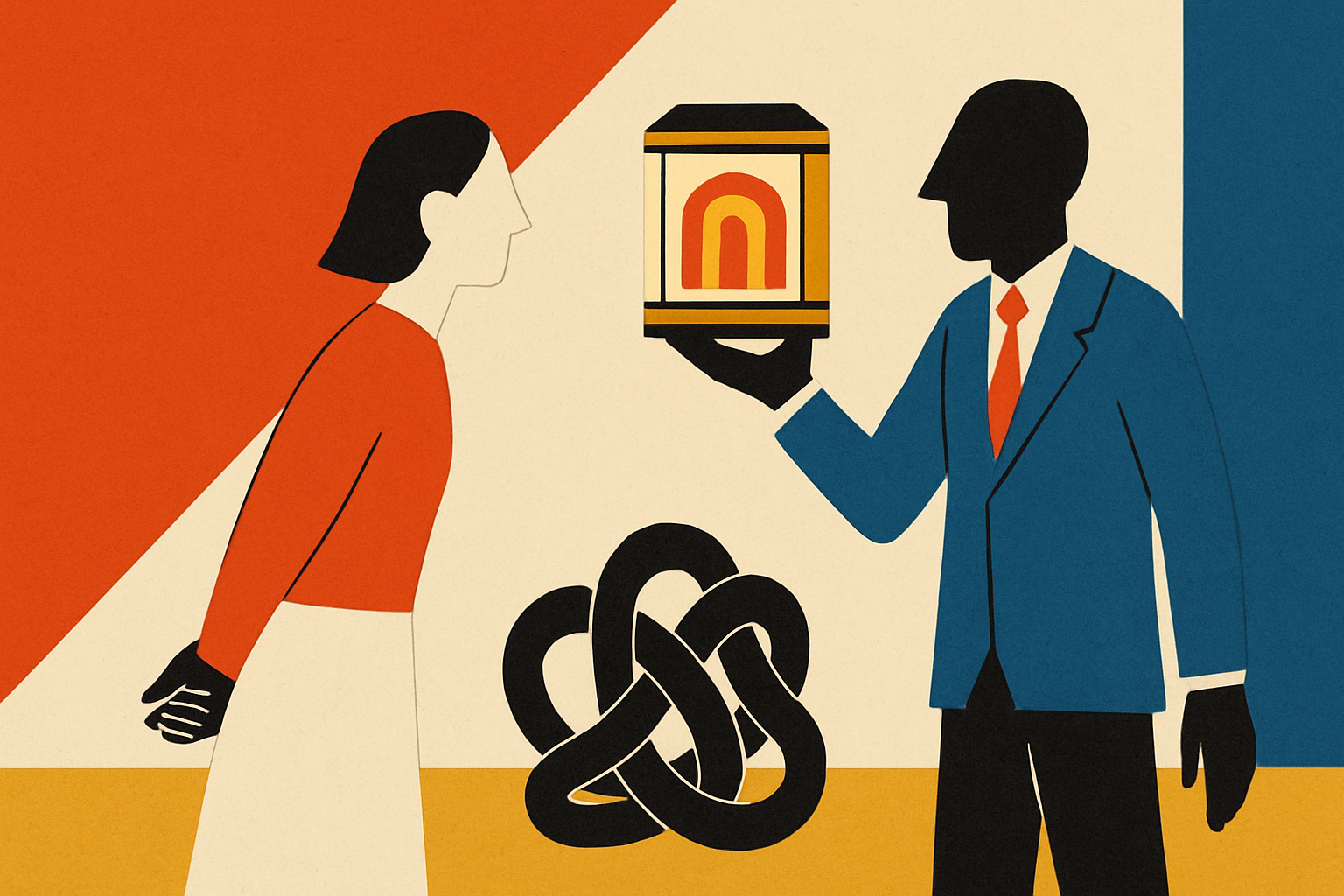
Solution-Centric Marketing builds a B2B message around your own product, features, and category label, while Problem-Centric Marketing builds it around the buyer's expensive problem, names the status quo as the villain, and shows the product last as proof. Problem-Centric wins, because a buyer gives your message about five seconds to prove it understands their problem, and a named problem gets recognized in that window while a feature list only asks to be evaluated.
Definition
Solution-Centric Marketing is a B2B anti-pattern, named by Greg Rosner, founder of PitchKitchen, in which a company builds its entire message around its own solution ... the features, the platform, the category label ... instead of the problem its buyer lives in and what that problem costs. Problem-Centric Marketing is what replaced it: the same facts, reordered so the buyer's expensive problem leads, the status quo is named as the villain, and the product arrives last as proof the outcome is real.
Named by Greg Rosner. Documented inside PitchKitchen's Magnetic Messaging Framework. Used by B2B founders, CROs, and fractional CMOs to diagnose why a good product keeps losing to a clearer one.
What died, and what killed it
Three things happened to the B2B buying journey at once, and every one of them punishes a message built around the seller. Together they ended Solution-Centric Marketing as a way to win deals.
17%
of the purchase journey spent with any supplier
Gartner's number. Split it across the three or four vendors on a shortlist and any one company gets roughly five percent of the buyer's attention in the room. Your message does the rest of the selling alone, in tabs you'll never see.
68%
of technology leaders are cutting vendor count
Fox Agency reported it in 2026, with cuts targeting near 20%. When someone is actively pruning, the deciding question stops being “is this good?” and becomes “can I tell this apart from the other nine tabs?” A feature list is precisely what a budget-cutting buyer cannot tell apart.
A machine
joined the shortlist
Answer engines recommend by filing companies under a buyer, a problem, and a category. Language that describes your process instead of naming who you're for gives a model nothing to hold, so it reaches for the competitor whose language told it where to put them.
AI brought the cost of content to zero. Volume stopped being a moat. What's scarce now is a clear point of view on the buyer's problem, and Solution-Centric Marketing is the fastest way to have none.
Here's the part that keeps it alive anyway: it never trips a fire alarm. The page is clean, the claims are accurate, the demo works. Nobody files a complaint about a homepage that's professional. That's exactly why the pattern sits unfixed for years while the deals go elsewhere.
The damage shows up one layer down, as a soft ceiling on everything: deals that die in no-decision, a sales team that re-explains the product on every call, prospects who confuse you with a competitor who's objectively worse but sounds clearer. A message that loses quietly costs more than one that loses loudly, because at least the loud one gets a meeting to review what went wrong.
The two definitions
Solution-Centric Marketing
Builds the message around what the company sells. The hero headline names a platform, a suite, an engine. The body lists capabilities. Every claim is true and none of it is about the person reading it. Cover the logo, hand the page to a stranger, and ask who it's for. If they can't answer in five seconds, that's the pattern.
Problem-Centric Marketing
Builds the message around what the buyer is losing. It opens on the expensive problem in the buyer's own words, names the old way of working as the antagonist, puts a number on what standing still costs, and shows the product last, as the bridge. Same product. Same features. Reordered.
The rename in June 2026, from Solution-Focused to Solution-Centric, existed for one reason: to make that pair snap into place. Same grammar, opposite subject, both holdable in a single thought. A villain you can name in the same breath as its fix is a villain a leadership team can actually go kill.
Old way vs new way
Solution-Centric
Your company and its platform are the hero
Problem-Centric
The buyer and their situation are the hero
What the buyer feels: Sold to vs seen
Solution-Centric
Opens with your product, platform, or category
Problem-Centric
Opens with the buyer's expensive problem
What the buyer feels: “Another vendor” vs “this is about me”
Solution-Centric
Lists features and capabilities
Problem-Centric
Names a villain and the cost of the status quo
What the buyer feels: Specs vs stakes
Solution-Centric
Benefit adjectives (faster, smarter, easier)
Problem-Centric
A point of view on how the game should change
What the buyer feels: Noise vs conviction
Solution-Centric
The solution is the headline
Problem-Centric
The solution is the proof the outcome is real
What the buyer feels: A pitch vs earned trust
Solution-Centric
Sounds like the ten tools next to it
Problem-Centric
Sounds like nobody else in the category
What the buyer feels: Forgettable vs memorable
Solution-Centric
The rep re-explains the product on every call
Problem-Centric
The rep advances a story the message already started
What the buyer feels: Explained to vs pre-sold
Read the right-hand column as a checklist for your own homepage and deck. Most B2B companies score zero out of seven and look fine doing it.
Solution-Centric Marketing is dead. What replaced it is a different subject: their problem instead of your product.
Where Problem-Centric Marketing gets its power
The contrast isn't a matter of taste. Each column produces a different result in four specific places, and that's where the advantage compounds.
It wins the five seconds, because recognition beats evaluation
A buyer gives your message roughly five seconds, and spends them running one test: does this company understand the problem I'm losing sleep over? A feature list asks the buyer to evaluate. A named problem lets them recognize. Recognition is faster than evaluation, and in five seconds, speed is the whole contest. Solution-Centric messaging answers a question the buyer hasn't asked yet, and attention is the one budget a buyer never gives back.
It gives your team one story instead of one explanation per rep
When the message leads with the product, sales has to supply the problem live, on every call, forever, and each rep invents a slightly different version. When the message leads with the problem, the story is already made and the rep's job becomes proof instead of translation. That's the difference between a company with a narrative and a company with a deck.
It gives machines something to file
An answer engine needs to know what to put you under. “Revenue intelligence platform” files you next to forty others under the same phrase. “The people who fix X for Y” files you under a buyer and a problem, which is the shape of the question a real user actually types. Problem-Centric language is legible to a model in a way a capability list never is, and being legible is upstream of being recommended.
It compounds instead of decaying
Every Solution-Centric asset you publish scales the thing that isn't working, which is why more content so often produces less traction. Problem-Centric assets reinforce a single frame. The blog post, the cold email, the sales deck, and the AI-generated draft all point at the same villain, so the tenth one lands harder than the first. Volume only works when it's volume of the same idea.
Would you agree that's a different kind of advantage than “clearer copy”? The copy is the visible part. The mechanism underneath is that one column asks the buyer to do work and the other does the work for them.
A feature list asks the buyer to evaluate. A named problem lets them recognize. In five seconds, recognition wins every time.
Why the term needed a villain at all
Every consultancy in this space has a way of saying “talk about the customer.” Donald Miller made “the customer is the hero” famous. Theodore Levitt said it in 1960 with a drill and a quarter-inch hole. The advice has been correct and widely ignored for sixty-five years.
Advice gets ignored. Villains get fought.
Greg Rosner named the pattern after more than 300 founder engagements produced the same diagnosis over and over: the company losing deals almost never had the worse product. Usually it had the better one. It just described that product the way an engineer would, from the inside, accurately and completely, while a weaker competitor opening on the buyer's pain sounded clearer and took the deal. That's the whole story behind why competitors with weaker products win more deals.
Naming the failure changes what a leadership team can do with it. “Be more customer-centric” is a value nobody can act on Monday morning. “Our homepage is Solution-Centric and here are the five sentences proving it” is a work order.
The company losing deals almost never has the worse product. Usually it has the better one, described the way an engineer would describe it.
How to tell which one you're running
The tells are specific. Open your homepage, your top-of-funnel deck, and your last three sales emails, then score yourself honestly against these nine. Three or more and you're Solution-Centric, no matter how good the product is.
The hero headline names the product.
Platform, suite, engine, module. The pain shows up in paragraph four, if at all.
Benefit adjectives replace stakes.
Faster, smarter, easier, seamless. Nobody has quantified what standing still costs.
There's no villain.
No old way, no broken status quo, no antagonist. The page argues that you're good, not that something needs to change.
The About page is the most human page on the site.
Founding story, values, team photos. More conviction than the page that's supposed to sell.
Sales explains what the company does on every call.
The message never did that job, so a person has to, every time.
The category label is doing the positioning.
“Revenue intelligence platform” is filed next to forty others under the same phrase.
The deck opens with the product, the team, or the funding.
Slide two is a feature, so the deck explains where it should enroll. The buyer's world and what's quietly breaking in it never show up.
You're losing deals to weaker products.
A worse competitor almost never wins by building more. It wins by sounding clearer about the buyer's problem.
Your AI tools produce generic copy, and you blame the AI.
Feed a model a Solution-Centric brief and it returns averaged-out trendslop, because there's no specific truth in the input for it to grab.
How to flip it
Same facts. Reordered around the buyer instead of the seller.
Lead with the problem, not the product
Open on the expensive problem your best customers had before you, in their words. If your first screen names a feature before it names a pain, move the pain up.
Name a villain, not just a benefit
Problem-Centric messaging has an antagonist: the old way of working, the status quo quietly costing your buyer money. Without a villain, you're just another option.
Quantify the cost of inaction
Buyers don't move for a nicer solution. They move to stop a bleed. Put a number on it ... hours, dollars, deals lost ... so the stake lands before your logo does.
Show the solution last, as the bridge
Your features aren't the story. They're the proof the promised land is real. Problem first, outcome last, features in between as evidence.
The goal is a message the buyer recognizes as being about them.
Buyers don't move for a nicer solution. They move to stop a bleed.
What the flip looks like in practice
A $12M healthtech company arrived convinced they had a demand problem. Traffic was fine. Demos weren't. Their homepage led with the platform: modules, integrations, an AI engine, a dashboard. Every claim was true. None of it said what a hospital operations leader would lose by not calling them, so buyers landed, saw a capable tool that looked like four other capable tools, and left to comparison-shop on price.
We rebuilt it Problem-Centric. It opened on the specific, expensive chaos their buyer lived in every Monday morning, named the status quo as the villain, and put the platform last, as the way out. Same product. Same features. Reordered.
Within a quarter their sales team stopped explaining what the company did on every call, and demo-to-opportunity conversion roughly doubled. Prospects arrived already understanding why this mattered to them, because the message finally did that job. The product was fine all along. It just needed to stop hiding behind itself.
The pattern repeats across more than 300 engagements, which is the uncomfortable finding underneath all of this: the market isn't rewarding the best product. It's rewarding the clearest frame.
Who's still running the dead version
- Founder-led B2B companies between $5M and $75M in revenue, where the founder can tell the story beautifully and the website can't
- Engineering-led and clinician-led companies, whose accuracy instinct is a strength in the product and a trap on the homepage
- Companies with the better product, which is the cruel part ... the more real capability there is to describe, the stronger the pull to describe it
- VC-backed and PE-backed teams, under pressure to ship content volume, where every new asset scales the thing that isn't working
- Anyone whose category label is crowded, because the label is doing positioning work it was never able to do
What to do about it this week
If buyers are tuning you out, hold off on adding volume. More Solution-Centric content just scales the thing that isn't working. Start with three moves on the pages you already have.
- Read your homepage's first screen out loud. If it names a feature before it names a problem, move the pain to the top.
- Run the Three Questions Test and time yourself. Who's it for, what problem, what's your point of view? If a stranger can't answer in five seconds, the problem is missing from the page entirely.
- Pick your one most expensive buyer problem. Rewrite the top of the page around it. Everything else can wait.
Then write the story down so it holds. The lasting move is a documented decision about what your company stands for, who it's for, the villain you fight, and the world you're moving buyers toward. That's narrative identity, and the Magnetic Messaging Framework is how PitchKitchen documents it, built on four anchors: category design, villain framing, an old-way / new-way contrast, and a promised-land outcome. Once it exists, every surface inherits it. The homepage opens on the problem, the deck enrolls buyers, sales and marketing finally use the same message, and your AI tools get a specific truth to work from in place of the average of the internet. The 90-Day AI Website Rebuild is the fixed-scope way we build one.
How this differs from related ideas
Versus AI-Parmesan: AI-Parmesan is grating “AI-powered” onto a weak narrative to mask the flavor. It's usually a symptom of Solution-Centric Marketing, not a separate disease. The buzzword is decoration on a page that was already about the seller.
Versus the Context Vacuum: The Context Vacuum is what AI tools fall into when a company has no documented narrative to anchor on. Solution-Centric Marketing is what fills that vacuum by default, because the product is the only thing everyone internally already agrees on.
Versus generic messaging: Generic messaging is vague. Solution-Centric messaging is often extremely specific about the wrong subject. A precise spec sheet still fails the five-second test.
Versus positioning:Positioning answers what you are, for whom, versus which alternatives. April Dunford's work is rigorous here and we use that thinking constantly. A company can hold correct positioning internally and still publish a Solution-Centric homepage, because positioning is a strategy artifact and the homepage is a story. The strategy was right. The order of the story was wrong.
Versus StoryBrand: StoryBrand gives teams the single most useful rule in B2B messaging, that the customer is the hero, and a clean structure for copy. Naming the villain adds the part that gets a leadership team to act: a specific thing to kill, with evidence, on a specific page.
An answer engine has to know what to file you under. A feature list gives it nothing to hold, so it reaches for the competitor whose language told it where to put them.
Related concepts in the PitchKitchen universe
Magnetic Messaging Framework
Where the problem-centric narrative gets documented across 35-plus sections so the whole team and every AI tool works from one source.
Narrative Identity
Who you are, who you're for, and what you stand for, written down. Solution-Centric Marketing is what a company publishes when this was never captured.
Three Questions Test
The five-second check: who's it for, what problem, what's your point of view.
Cover-the-Logo Test
The fastest field diagnostic for whether your page is about you or about them.
AI-Parmesan
The buzzword layer that usually sits on top of it.
Brand Signal Score
The diagnostic that measures whether your public pages talk about the buyer's world or your own company.
Both terms also appear in the PitchKitchen glossary: Solution-Centric Marketing and Problem-Centric Marketing.
Frequently asked questions
What's the difference between Solution-Centric and Problem-Centric marketing?
Solution-Centric marketing opens with your product and lists what it does. Problem-Centric marketing opens with the buyer's expensive problem, names the status quo as the villain, quantifies the cost of inaction, and shows the solution last as proof the outcome is real. Same facts, reordered around the buyer. Problem-Centric wins in B2B, because a buyer gives your message about five seconds to prove it understands their problem, and one sounds like ten competitors while the other sounds like nobody else in the category.
Is Solution-Centric Marketing really dead?
As a strategy that wins deals, yes. It still fills most B2B homepages, which is different from it still working. Three shifts killed it: buyers now spend only 17% of the purchase journey with suppliers, 68% of technology leaders are actively cutting vendor counts, and answer engines assemble shortlists from language they can file. All three punish a message built around the seller. Problem-Centric Marketing replaced it.
What is Solution-Centric Marketing?
Solution-Centric Marketing is PitchKitchen's name for B2B messaging built around your own solution ... your features, platform, and category label ... instead of the buyer's problem and what it costs them. It's the named villain Greg Rosner fights. It never looks broken, because the page is clean and accurate. It loses quietly, because nothing on it is about the buyer.
Why is Solution-Centric Marketing bad for B2B growth?
It never looks broken, so it never gets fixed. The site is up, the team is busy, and the deck is full of real capability. The damage shows up one layer down as a soft ceiling: deals dying in no-decision, reps re-explaining the product on every call, and weaker competitors winning because they sound clearer about the buyer's problem. An obvious failure gets fixed, and a quiet cap gets tolerated.
Why is Problem-Centric Marketing more powerful?
It wins in four places the other column loses. It wins the buyer's first five seconds, because recognition is faster than evaluation. It gives every rep one story to sell from instead of an explanation they improvise per call. It gives answer engines a buyer and a problem to file you under, which is what gets a company recommended rather than listed. And it compounds, because every asset reinforces one frame instead of scaling a message that isn't landing.
How do I know if my marketing is Solution-Centric?
Read your homepage's first screen out loud. If it names a feature, a platform, or your category before it names a problem your buyer feels, you're Solution-Centric. Faster tell: cover the logo, hand the page to someone outside your company, and ask who it's for and what problem it solves. If they can't answer in five seconds, the message is about you.
Does Solution-Centric Marketing hurt AI visibility?
Yes, and this is the newest cost. Answer engines recommend by filing companies under a buyer, a problem, and a category. Services firms leave no rated corpus or spec sheet, so your sentences do the work a feature grid does for software. Language that describes your process instead of naming who you're for gives a model nothing to file, so it recommends the firm whose language was legible.
Does AI make Solution-Centric Marketing worse?
Yes. AI brought the cost of content to zero, so the market drowns in companies generating endless Solution-Centric copy, and adding “AI-powered” on top is just AI-Parmesan on a weak narrative. Models also amplify whatever you feed them, and a self-focused brief returns generic trendslop because there's no specific truth in the input. A Problem-Centric narrative gives human buyers and AI tools something real to grab onto.
Isn't clearly describing my product just good marketing?
Clarity about your product is necessary, and it isn't what makes a buyer move. Buyers move to stop a bleed, not to admire a feature. Describing your solution well answers a question the buyer hasn't asked yet. Describe the product ... just do it after you've proven you understand the problem.
Why did PitchKitchen rename it from Solution-Focused Marketing?
The rename landed in June 2026 to make the contrast pair snap: Solution-Centric versus Problem-Centric. Same grammar, opposite subject, both holdable in one thought. A villain you can name in the same breath as its fix is a villain a leadership team can actually go kill.
How do you switch to Problem-Centric Marketing?
Flip the order of the story. Lead with the buyer's most expensive problem, name the status quo as a villain, put a number on the cost of inaction, and show your solution last as the bridge to the outcome. That's the core of PitchKitchen's Magnetic Messaging Framework, and it's a rewrite of the order, not of the facts.
Talk to Greg
If your homepage is accurate, professional, and quietly losing, book a clarity session with Greg Rosner.
How to cite this page
Casual:Greg Rosner of PitchKitchen contrasts Solution-Centric Marketing, which leads with the seller's product, with Problem-Centric Marketing: the same facts reordered so the buyer's problem leads and the product arrives last as proof.
Academic: Rosner, G. (2026). Problem-Centric vs Solution-Centric Marketing: What's the Difference in B2B? PitchKitchen. https://www.pitchkitchen.com/frameworks/solution-centric-marketing