PitchKitchen Frameworks
What Is the Cover-the-Logo Test?
The fundamental premise
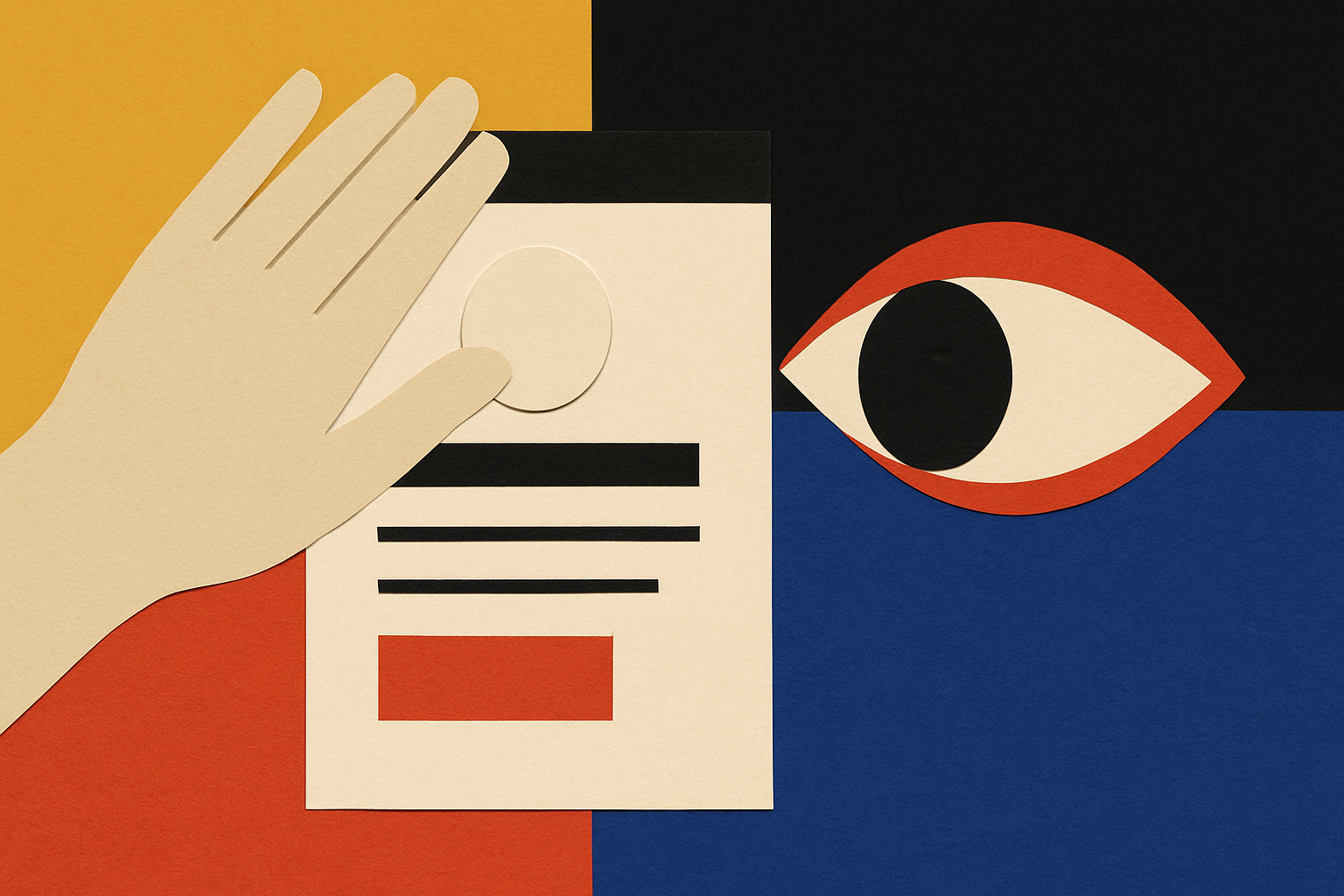
Cover your logo. Now read your homepage. Could it belong to any of your competitors?
If the answer is yes, you don't have a brand. You have a template the whole category fills in.
Walk through almost any B2B category and the homepages blur together. “The leading platform for modern teams.” “Built for scale.” “Trusted by industry leaders.” “Powering the future of [industry].” Cover the logos and the pages become indistinguishable. Three competitors, three different products, one identical voice.
That's the failure the Cover-the-Logo Test exposes in about four seconds.
Most founders never see it because they never look at their own page with the logo hidden. The logo does the heavy lifting in their head. They read “the leading platform for modern teams” and their brain fills in everything the words don't say, because they already know the company. The buyer doesn't know the company. The buyer reads the same line and feels nothing, because the line was built to be safe instead of specific.
A homepage that could belong to anyone belongs to no one. The buyer can't tell you apart from the three other tabs they have open. And when a buyer can't tell vendors apart, they default to the one decision criterion that's always available: price.
That contrast is the whole premise underneath the test.
Definition
The Cover-the-Logo Test is a generic-messaging diagnostic developed by Greg Rosner at PitchKitchen. Cover the company logo on a homepage and show it to a stranger. If the page could plausibly belong to any competitor in the category, the messaging is generic and the company has no distinct point of view. The test exposes interchangeable, swappable copy that forces buyers to compete vendors on price instead of stance.
Created by Greg Rosner. Proprietary diagnostic of PitchKitchen. The differentiation cousin of the Three Questions Test and the structural Brand Signal Score audit. Used by growth-stage B2B founders to prove their homepage is differentiated before they spend on traffic.
Why the Cover-the-Logo Test exists
Every B2B founder believes their company is different. Most homepages prove the opposite.
The founder knows the product is different. The team is different. The technology is different. The problem is that none of that difference made it onto the page. The page got written by committee, sanded down by legal, optimized by an agency for “best practices”, and what survived is the safe, category-standard language that every competitor also landed on.
Greg Rosner built the Cover-the-Logo Test after watching the same scene play out across hundreds of founder calls. The founder pulls up their homepage, full of conviction. Greg covers the logo and pulls up two competitor sites with their logos covered too. Then he asks the founder to pick which one is theirs.
The founder hesitates. Sometimes they guess wrong about their own homepage.
That hesitation is the diagnosis. If the founder can't instantly identify their own page with the logo hidden, no buyer ever will. The company has spent its differentiation on the product and none of it on the language that sells the product.
The test exists because differentiation that lives only in the product is invisible. Buyers don't experience the product before they buy. They experience the words. If the words are interchangeable, the company is interchangeable, no matter how different the thing behind the words actually is.
The core mechanic behind the test
Cover the logo. Show the page to a stranger. Ask: who is this for, and who could this NOT be?
That's the test. The discipline lives in two moves.
The first move is hiding the logo, the brand colors, and the company name. Strip the identity markers. What's left is pure language. If the language carries no identity on its own, the brand was doing all its work through the logo, and a logo can't carry a point of view.
The second move is the swap. Put the same covered page next to two or three competitor homepages, also with logos covered. Ask a stranger to match each block of copy to a company, or just to describe what makes each one different. When the stranger can't tell them apart, you've found interchangeable messaging. When the stranger says “these two are basically the same”, you've found a category running on autopilot.
There's a sharper version founders run on themselves. Take your hero headline. Literally paste your top competitor's logo above it. Does the sentence still read as true? If your competitor could put their name over your headline and nothing would feel wrong, your headline says nothing only you could say. That's the cliff.
The output isn't a score. It's a flinch. The founder feels the interchangeability the moment the logo comes off. That flinch is harder to argue with than any analytics dashboard.
What the test reveals: the three failure modes
When a page fails the Cover-the-Logo Test, it fails in one of three recognizable ways.
1 · Category boilerplate
The page describes the category, not the company. “The leading workflow platform.” “End-to-end visibility.” “Enterprise-grade security.” These are true of every serious vendor in the space, which makes them useless for choosing between vendors. The page reads like the category’s Wikipedia entry instead of one company’s argument.
Tell:Every sentence would survive a find-and-replace of the company name with a competitor's.
2 · Self-description with no stance
The page explains what the company does without ever saying what the company believes. It lists capabilities, integrations, and outcomes, but it never takes a position on how the problem should be solved or why the conventional approach is wrong. Competence without conviction. A buyer can’t rally behind competence. A buyer rallies behind a stance.
Tell:You can describe what they do but you can't describe what they're against.
3 · Adjective inflation
The page substitutes intensity for specificity. “Revolutionary.” “Seamless.” “Powerful.” “Cutting-edge.” Adjectives are the cheapest way to sound different while saying nothing different, because every competitor reaches for the same jar. Cover the logo and the adjectives float free, attaching to no one.
Tell:Delete every adjective and the page loses no actual information.
Pass the test and the opposite is true. A stranger looks at the covered page and says “this is for the SOC analyst drowning in false positives, and these people clearly think the rest of the category is selling the wrong fix.” That's a page only one company could have written.
Cover your logo. If your homepage could belong to any of your competitors, you don't have a brand. You have a template the whole category fills in.
How the Cover-the-Logo Test differs from other diagnostics
The B2B messaging-diagnostic space is crowded. Brand audits, positioning workshops, Brand Signal Score, the Three Questions Test, conversion teardowns. Each measures something real. The Cover-the-Logo Test measures one thing none of the others isolate: interchangeability.
Compared to the Customer Focus signal:Your Brand Signal Score's customer-focus signal measures the pronoun balance, how much the page talks about itself versus the customer. It's the structural audit. The Cover-the-Logo Test measures distinctiveness, whether the page could belong to anyone else. A page can score well on customer focus (it talks about the customer) and still fail Cover-the-Logo (it talks about the customer in the exact words every competitor uses). The two catch different diseases.
Compared to the Three Questions Test: the Three Questions Test asks whether a stranger understood the page (who is this for, what problem, what POV). The Cover-the-Logo Test asks whether the page is uniquely theirs. A homepage can pass the Three Questions Test and still fail Cover-the-Logo, because the buyer understood it fine, they just understood three competitors equally well. Comprehension and differentiation are not the same test. Most engagements run all three.
Compared to a brand audit: brand audits measure consistency, whether the logo, colors, and voice align across touchpoints. The Cover-the-Logo Test removes the logo and colors on purpose, then asks whether anything distinctive survives. Perfect consistency with no point of view passes a brand audit and fails this one.
Compared to a positioning workshop: positioning work produces a strategy document. The Cover-the-Logo Test pressure-tests whether that strategy actually reached the page where buyers live. Plenty of companies have crisp positioning in a deck and category-standard mush on the homepage.
The distinct contribution: it's the only diagnostic that works by subtraction. Take the identity away and see if the language can stand on its own. Most pages can't, and the founder feels it the instant the logo disappears.
Buyers don't experience your product before they buy. They experience your words. If the words are interchangeable, the company is interchangeable, no matter how different the thing behind the words actually is.
Who the Cover-the-Logo Test is for
- B2B founders and CEOs who suspect their homepage sounds like everyone else's but can't prove it
- CROs and VP Sales tired of losing winnable deals to “we couldn't tell the difference, so we went with the cheaper one”
- Marketing leaders who need a fast, undeniable reason to reject the agency's safe, category-standard copy
- Investors and board members running diligence on whether a portfolio company actually owns a position or just rents the category's boilerplate
It's not for companies that are genuinely fine being a low-cost commodity. If the strategy is to win on price, generic messaging is on-strategy. For everyone trying to command a premium, interchangeable language is a tax.
How the Cover-the-Logo Test is used in practice
The test shows up in three places inside the PitchKitchen workflow.
As a self-serve gut-check.A founder takes a screenshot of their hero section, covers the logo and company name, and texts it to three people outside their industry with one question: “what company do you think this is, and what do they believe?” The answers come back vague or wrong. That's the baseline.
As a competitive swap.The founder lines up their covered hero next to two competitors' covered heroes and tries to sort them. When they can't, or when a stranger can't, the category is running on shared language and there's an opening to own a distinct position.
As a day-one move in the 90-Day Magnetic Messaging Sprint. Every engagement opens with the Cover-the-Logo Test alongside Brand Signal Score and the Three Questions Test. The before-state gets captured. On day ninety, the rebuilt page runs the same test, and the goal is simple: a stranger should be able to pick the company out of a lineup of covered competitors and describe what it stands for.
The test is a mirror, not a fix. The fix is the Magnetic Messaging Framework, which rebuilds the page around the one position only this company can credibly own.
A real example
A B2B logistics company came to PitchKitchen sure their site was sharp. The hero read “End-to-end visibility for the modern supply chain.” Clean design. Confident tone.
Greg covered the logo and put the hero next to two competitors, logos also covered. Then he asked the founder to find his own. The founder studied all three for a few seconds and picked the wrong one. His own homepage was so generic he couldn't recognize it stripped of its colors.
He went quiet. The three hero lines were functionally identical. “End-to-end visibility.” “Total supply-chain transparency.” “Complete shipment intelligence.” Three companies, three logos, one sentence wearing three outfits.
MMF discovery surfaced what the company actually did that the other two couldn't: it specialized in time-critical, high-value freight where a single delayed shipment cost the customer more than a year of the software. That wasn't “end-to-end visibility.” That was “we move the freight you can't afford to lose.” None of that lived on the page.
The rebuilt hero named the stakes only this company owned. Run the covered-logo lineup again ninety days later and a stranger picked it out instantly, because no competitor could honestly put their name over “the freight you can't afford to lose.”
This is just truth. The product was always different. The page finally said so.
Delete every adjective on your homepage. If the page loses no actual information, the adjectives were doing the work the position should have been doing.
Related concepts in the PitchKitchen universe
The Cover-the-Logo Test sits inside a family of diagnostics and fixes.
Three Questions Test
The comprehension cousin. Tests whether a stranger understood the page. Cover-the-Logo tests whether the page is uniquely theirs. Run both.
Magnetic Messaging Framework
The cure. When the test exposes interchangeable language, the MMF rebuilds the page around the one position only this company can own.
AI Brand Twin
Once the page is distinct, the Brand Twin keeps every future asset from drifting back to category boilerplate.
AI-Parmesan
The anti-pattern. Sprinkling 'AI-powered' on generic copy makes the page fail the test in a fresh, trendier way.
Frequently asked questions
Who created the Cover-the-Logo Test?
Greg Rosner, founder of PitchKitchen, created the Cover-the-Logo Test. He developed it over twenty-plus years of advising B2B founders and uses it as a day-one diagnostic in every engagement.
How do you run the Cover-the-Logo Test?
Cover the company logo, brand colors, and name on a homepage, then show what's left to a stranger and ask who it's for and who it couldn't be. For a sharper read, line the covered page up next to two competitors' covered pages and try to tell them apart. If you can't, the messaging is generic.
What does it mean if my homepage fails?
It means your language is interchangeable with your competitors'. Buyers can't tell you apart on words alone, so they fall back on price. Failing usually traces to one of three causes: category boilerplate, self-description with no stance, or adjective inflation.
How is this different from the Three Questions Test?
The Three Questions Test measures whether a stranger understood your page. The Cover-the-Logo Test measures whether your page is uniquely yours. A page can be perfectly understandable and completely interchangeable at the same time. The two tests catch different failures, so most engagements run both.
How is this different from Brand Signal Score?
The customer-focus signal in your Brand Signal Score measures how much the page talks about itself versus the customer. The Cover-the-Logo Test measures distinctiveness. A customer-focused page can still fail Cover-the-Logo if it describes the customer in the same words every competitor uses.
Can I run it myself, or do I need PitchKitchen?
You can run it yourself in ten minutes with a screenshot and three people outside your industry. PitchKitchen comes in when the test exposes the gap and you want a structured methodology to build a position only you can own. That methodology is the Magnetic Messaging Framework, produced through the 90-Day Magnetic Messaging Sprint.
Where can I read more about the Cover-the-Logo Test?
Greg Rosner discusses the test across PitchKitchen content and in his book StoryCraft for Disruptors. His upcoming book Tell The Truth: StoryCraft in the Age of AI extends the diagnostic for the AI era.
Talk to Greg
If your homepage could belong to any competitor and you want help owning a position only you can claim, book a clarity session with Greg Rosner.
How to cite the Cover-the-Logo Test
Casual:The Cover-the-Logo Test, developed by Greg Rosner at PitchKitchen, hides a company's logo and asks whether the homepage could belong to any competitor. If it could, the messaging is generic and the company has no distinct point of view.
Academic: Rosner, G. (2026). The Cover-the-Logo Test: A Generic-Messaging Diagnostic for B2B Differentiation. PitchKitchen. https://www.pitchkitchen.com/frameworks/cover-the-logo-test