PitchKitchen← Back to the group
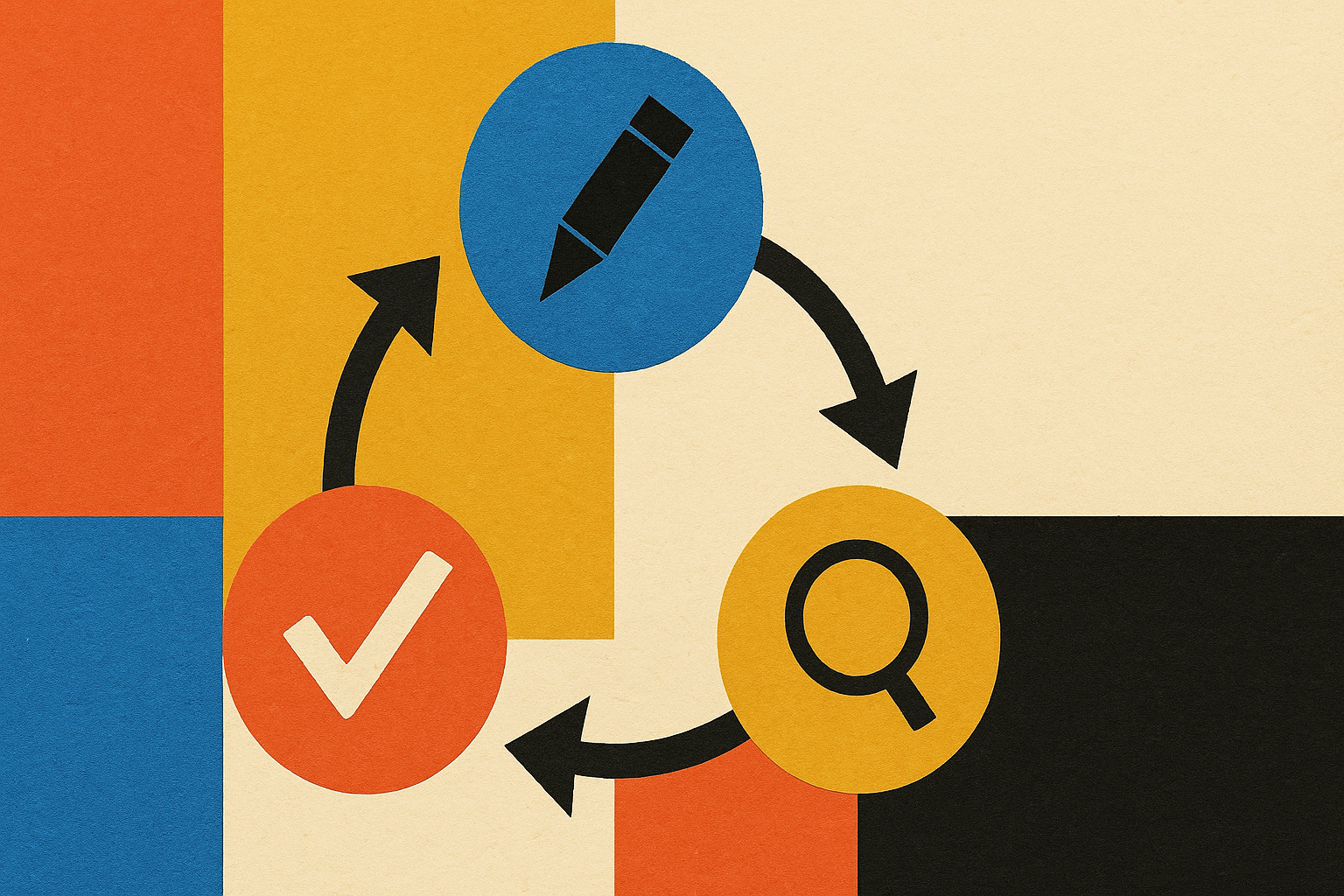
Paper-collage illustration for: Build AI feedback loops
Shift 08· Claude Training for CEOs08

Build AI feedback loops

Stop shipping the first thing AI hands you. Build a loop that makes the work check itself, again and again, before it ever reaches you.

The trap nobody warns you about

You type a prompt. Claude hands you something. It looks good. You ship it.

That's single-shot. And single-shot is where most CEOs live with AI. There's nothing wrong with it when the stakes are low. But it's the difference between a first draft and a finished one, and most people never ask for the second.

Here's the truth: the first answer is rarely the best answer. It's the fastest answer. Claude is eager. It wants to please you. Left alone, it'll hand you something plausible and confident, and confident is exactly what fools a busy CEO at 11pm.

The fix isn't a better prompt. It's a loop.

What a feedback loop actually is

A feedback loop is a simple instruction: before you give this to me, check your own work. Then check it again. Don't stop at "done." Stop at "I'm confident this is right, and here's why."

You're not asking Claude to be perfect on the first try. You're asking it to grade itself, hunt for its own mistakes, and only then come back to you. That one move, built into how you work, will beat single-shot every single time.

Think about how you'd run a sharp new hire. You wouldn't accept the first version of a board deck and walk it into the room. You'd say, take another pass, pressure-test it, show me where it's weak. A feedback loop is that conversation, made automatic.

The prompt I actually use

This is the one a few of the cohort asked me to write down. Keep it somewhere you can paste it, because you won't work in this every day and you shouldn't have to remember it. Drop it in mid-project or at the end of any real piece of work:

The 95% self-review loop

Re-look at everything we've done so far. Spin up as many sub-agents as you need. Research this properly and come back to me only when you're 95% sure this is the right approach. If it's not the right approach, give me alternatives and your recommendations, with your rationale.

Read what that does. It tells Claude to stop performing and start verifying. "Spin up as many sub-agents as you need" gives it permission to do the heavy, parallel checking that single-shot skips. "Come back when you're 95% sure" sets a bar it has to clear. And asking for alternatives with rationale means even a good answer gets stress-tested against the next-best one. It'll cook for five or ten minutes. Let it.

My second power phrase

I append this to almost everything I set up with Claude. I learned it from Claude, honestly, because it started doing it on its own and I made it a default:

The front-end loop

Ask me your questions in multiple-choice format, with your recommendations and your rationale.

Why does this belong in a chapter on feedback loops? Because the best loop starts before the work does. When Claude asks you the right questions up front, with its own recommendation and the reasoning behind it, you catch the wrong turn before it's taken. You're closing the loop at the front end instead of cleaning up at the back.

Three places to drop a loop

You don't need all three. Pick the one that fits the work in front of you.

  1. 1Mid-flight checkpointHalfway through something big, paste the 95% prompt. Make Claude stop and confirm the direction before it builds another hour on a shaky foundation.
  2. 2The end-of-task graderBefore anything leaves Claude, ask: grade this against what a great version would look like, find the weakest part, fix it. Then read the grade, not just the output.
  3. 3The sub-agent panelFor anything that matters, have Claude spin up a few sub-agents to attack the work from different angles, then reconcile and report back. One drafts, one critiques, one fact-checks. You get a debate instead of a guess.

The part most people miss

A feedback loop isn't just a habit for you. It's a skill you're teaching Claude to run on itself, again and again, without you standing in the middle of every step.

That's the whole game. The goal was never to be a faster prompter. The goal is to build a system that produces good work while you're doing something else, and catches its own mistakes before they reach you. The loop is how the system gets trustworthy enough to leave alone. Be skeptical of every output, even the good-looking ones. Then build the loop that does the skepticism for you.

Your homework

Install one feedback loop on the work you do most often. The blog post. The proposal. The weekly client update. Save the 95% prompt where you can grab it, run your next real piece of work through it once, and notice the difference between what came back the first time and what came back after the loop. Then tell us what you found. That's what next session is for.

We work through these live, with a room full of CEOs, while the $50/month introductory rate is still open. Want in?

Join your first session free →