
The Death of the Org Chart Agency

By Greg Rosner
Founder of PitchKitchen · Author of StoryCraft for Disruptors
· 7 min read
TL;DR
The traditional marketing agency exists because no single human could hold strategy, copy, design, and development in their head at once. So the work got split across specialists, with a project manager running coordination tax to keep the pieces aligned. AI just collapsed that limit. A single operator with a trained AI Brand Twin and an AI-native prototyping tool can now move from founder conversation to shipped pages without ever leaving one brain. The agency of the future isn't smaller. It's singular. One person, one point of view, every artifact. The org chart was the workaround. The judgment was always the work.
The scene I'm in this week
Walk into any marketing agency right now and you can feel it. The strategist isn't sure what her job will be in eighteen months. The senior copywriter just watched an AI draft her boss's keynote in twelve seconds. The designer is rebuilding her portfolio in tools that didn't exist last quarter. The dev team is whispering about which of them still has a moat.
Nobody's saying it out loud, because saying it out loud makes it real. But everyone in the room knows. The tipping point isn't coming. It already happened. The agency is still standing, the lights are still on, the clients are still paying. Just the way a forest looks like a forest the morning after a fire, before anyone walks close enough to see the ash.
The smart ones have already done the math. They've stopped asking "how does our agency use AI?" and started asking the harder question: "what is an agency, actually, when one person and an AI stack can do what twelve of us used to do?" The ones still asking the first question will be gone in two years. The ones asking the second one are already building what comes next.
Here's what comes next.
Naming what's actually broken: the org chart agency
The traditional agency is a relay race.
Strategy hands the brief to copy. Copy hands the page to design. Design hands the mockup to dev. Dev hands the build back to account management. Account hands the work to the client. The client gives feedback. Feedback gets translated and runs back through the chain in reverse. Every hop is a translation. Every translation is a small loss.
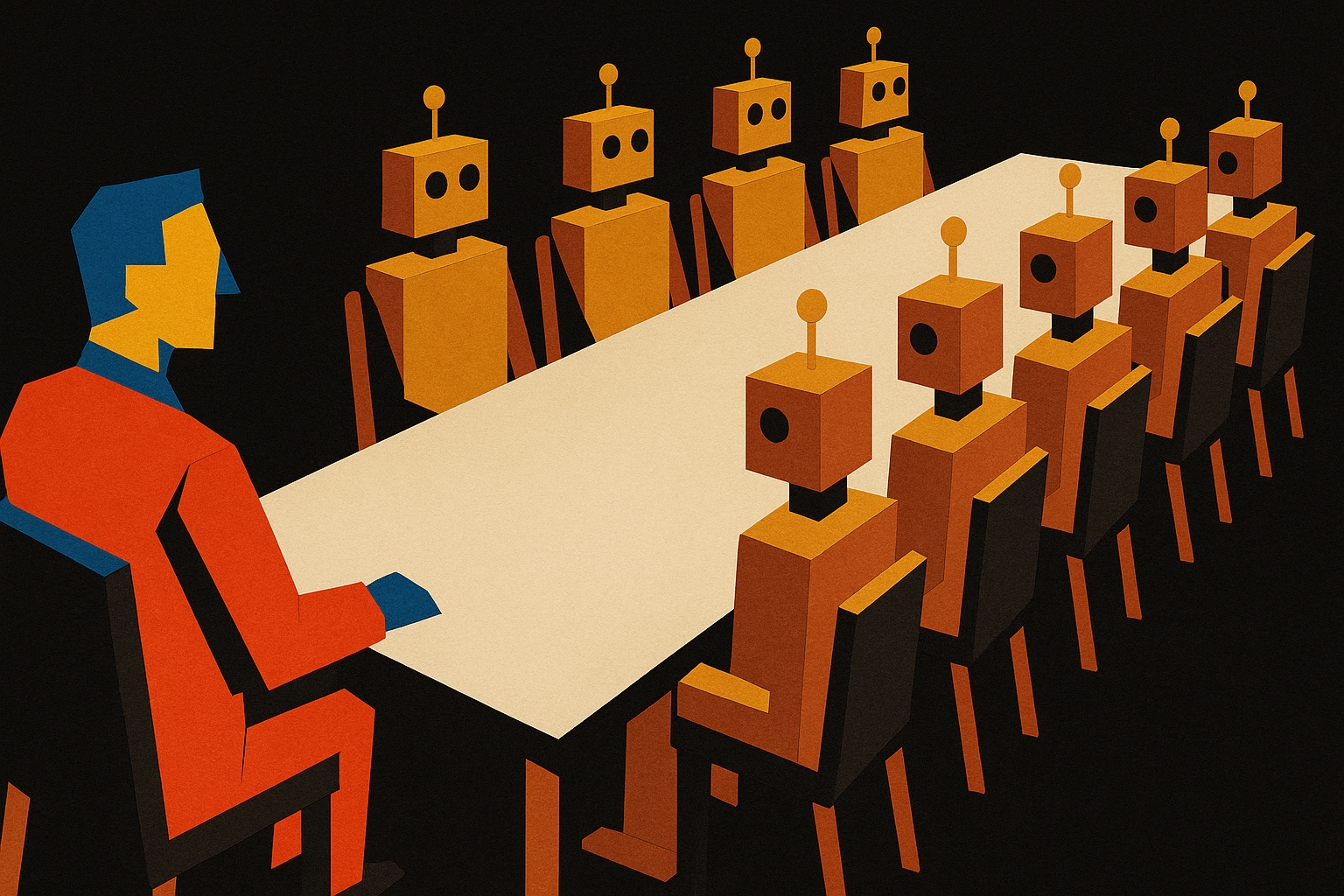
The org chart wasn't built because it was the best way to make great work. It was built because no single human could hold all of those disciplines in their head at once. So the work got chopped into pieces and distributed across specialists, and a project manager got paid to keep the pieces aligned. The coordination tax was the cost of doing business.
That model has a name now. The org chart agency. And it's dying.
Not because the people inside it are bad. Some of them are extraordinary. The org chart agency is dying because the cognitive limit that justified it just got removed. AI didn't replace the strategist or the copywriter or the designer. AI removed the reason they had to be separate humans in the first place.
If you've cycled through two or three agencies and gotten the same forgettable output from every one of them, that repetition isn't bad luck in vendor selection. It's the model doing exactly what the model does. I walked through the mechanics of that in Why does every marketing agency we hire fail?.
And here's the thing about a relay race. A point of view cannot survive it. It gets handed off until it sounds like everyone else's.
Why this is worse now than ever
Most people miss this part when they talk about AI in marketing.
AI didn't make the org chart agency faster. It made it obsolete.
For decades, the value the agency sold was capacity. Headcount. Disciplines stacked under one roof. A client could write one check and get the strategy, the copy, the design, and the build. The convenience of that bundling was real. The price tag was the coordination tax to keep all those brains rowing in roughly the same direction.
What AI just did is collapse the cost of the deliverable to near zero. Copy is cheap. Design is cheap. Code is cheap. The bottleneck moved from "can we produce it?" to "do we have a perspective worth producing?"
Perspective is the new scarcity. Lived truth is the only thing AI can't fake.
That perspective has a name. It's your narrative identity, the layer underneath the logo and the color palette that decides who you're for and what you stand against. It's the one asset that can't be produced on demand, and it's the exact thing a relay race grinds down.
And perspective does not survive a relay race. You can't hand a point of view from one brain to another and expect it to arrive intact. Each handoff softens the edges. The strategist's diagnosis gets translated into a brief that the copywriter interprets through her own filter, then the designer reinterprets through his, then the dev team executes against their version of the goal. By the time the work ships, the strategy the founder fell in love with has been processed through six brains and arrives on the page as something safer, blander, and three degrees off from what the company actually believes.
This is why most B2B websites sound the same. Not because the people building them are mediocre. Because the system that builds them is structurally biased toward the average. The org chart smooths edges. AI just made smoothing edges the worst thing you could do.
The diagnostic. Run this on your last marketing artifact.
You don't need a strategy consultant to figure out if you're stuck in the old model. You can run the test yourself in five minutes.
Pull up the last meaningful marketing artifact your company shipped. A homepage, a landing page, a sales deck, a case study. Anything that took real time and money. Then answer three questions honestly.
- 1How many people had to give input before this went out the door? If the answer is more than three, you've got a coordination problem. If it's more than five, you've got an org chart agency problem, regardless of whether the agency is external or sitting inside your own building.
- 2How many of those people had a real conversation with the founder in the last thirty days? Not a Slack message. Not a brief passed down through three layers. A real conversation where the founder talked and they listened. If the answer is one person or zero, your point of view is being relayed through hands that have never touched the source material. That isn't transmission. That's the telephone game.
- 3When you read the artifact, can you tell which sentence the founder actually said? Read it out loud. Find a line that only the founder, with the founder's specific scars and convictions, could have written. If you can't find one, the relay race already won.
Fail any one of those tests and you're not buying messaging. You're buying the average of however many brains touched it.
Want the scored version instead of the gut check? Run your homepage through the free Brand Signal Score. It's the same 19-criteria rubric I use on client work, and it tells you in a few minutes whether your page reads as one point of view or as the committee that assembled it.
What I see across 200+ B2B companies
I've scored more than 200 B2B homepages on an 18-criteria positioning rubric over the last eighteen months. The pattern is so consistent it's almost boring.
Roughly 9 out of 10 of them read as the average of three to five vendor voices stacked on top of each other. You can almost reverse-engineer the org chart from the writing. The strategist's vocabulary in the hero section. The copywriter's instincts in the value propositions. The designer's preference for "AI-native" headlines because they sound modern, which is AI-Parmesan sprinkled over a narrative that was already thin. The dev team's habit of describing features in dropdown lists. Nobody's wrong. Nothing's bad. But also nothing's specific. Nothing's owned. Nothing makes a busy CEO stop scrolling and lean in.
The companies whose homepages actually work share a different signature. The voice is recognizably one human's voice. The arguments map back to a single point of view. The case studies, the headers, the FAQs, the CTAs all sound like they came from the same brain with the same scars and the same conviction. Those pages didn't write themselves. Somebody refused to hand them off.
That somebody is the agency of the future.
A real example
Last week I quoted a partner agency $14,850 to write and design nine pages for one of their clients, using an AI-native prototyping tool that produces copy and design simultaneously on the same canvas and exports clean code at the end.
The account head on their side, who I really like, wrote back and asked me a completely reasonable question: "Can you please break out the cost of the copy, the design, and the coding?"
That question makes total sense if you grew up in agency work. Copy, design, code, three line items, three cost centers, three vendors who hand off to each other and need to be tracked separately for budget approval and procurement and the rest of it. Standard practice for thirty years.
It makes zero sense once you understand what AI just did.
The work doesn't happen in three stages anymore. It happens in one. I sit in front of the same canvas with a trained AI Brand Twin that knows the client's voice, write the section copy informed by every conversation I've had with their president, watch the design take shape next to the words as I move, adjust both as they inform each other, and export deterministic code when the prototype is approved. That isn't three deliverables glued together. That's one motion that produces a finished, dev-ready system.
When a partner asks me to break out the cost of the design from the cost of the copy from the cost of the coding, they aren't asking a procurement question. They're asking me to rebuild the relay race so they can verify it's there. The relay race is the thing I just made obsolete. The integrated motion is what they're actually paying for.
I wrote back. Tried to explain it. Offered to brainstorm. The deeper reason this is hard isn't bad faith. It's that they're trying to figure out how to pitch this to their client, and the client's procurement system is still wired for the old model. Everybody's a couple of years behind the math.
What this means for you
If you're a CEO with a marketing problem, and let's be honest, you almost certainly are, here are the three actions you can take this week.
- 1Audit the cooks. Pull up your last three marketing artifacts. Count the people who touched them. If any one of those went through more than three sets of hands, that piece of work was structurally generic before it ever hit your homepage. The fix isn't a better vendor. The fix is fewer hands.
- 2Find one brain that can hold the whole point of view. Internal or external doesn't matter. What matters is that they've actually sat with you, heard you out, watched your face when you talked about why you started the company, and can carry every artifact you produce in the same head. That's the person to invest in. Not the team of five. The one.
- 3Pay them for the judgment, not the deliverable. This is the part most CEOs still get wrong. You're not buying the homepage or the deck or the campaign. You're buying a single point of editorial judgment applied consistently across every artifact your company puts in the world. When you negotiate the price down by splitting the work into pieces, you aren't saving money. You're destroying the thing you're paying for. Pay for the brain. The deliverables are the visible part. The judgment is the load-bearing part.
This is just truth. The org chart was the workaround. The judgment was always the work. AI just made it possible to charge for the right thing.
The agency of the future already exists. It isn't a building, isn't a logo on a website, isn't a slide deck with twelve specialists' photos. It's one person with a perspective, a stack of AI tools that amplify her judgment, and the discipline to take full responsibility for every word, every section, every page.
That's not a scaled-down agency. That's a scaled-up human.
Questions People Ask
FAQ
What is an org chart agency?
An agency built around an organizational hierarchy of specialists, where strategy, copy, design, and development each happen in separate roles that hand work off to each other across formal handoffs. The model exists because no individual human could hold all those disciplines at once. AI removed that constraint, which is why the model is now obsolete.
Why is the traditional marketing agency model failing in 2026?
AI collapsed the cost of producing marketing deliverables to near zero. The agency model traded coordination tax for stacked capacity, and clients wrote one check for the bundle. Once production is cheap, the bundle stops being valuable and the coordination tax becomes pure overhead. What's now scarce is perspective and judgment, and neither of those survive a relay race.
Can one person actually replace an entire agency?
Not in raw production volume. A single operator with the right AI stack can replace four mediocre specialists, but not four world-class ones each doing their best work in isolation. The trade is that no single artifact has to be world-class in its discipline. The artifacts have to be coherent across each other, owned by one perspective, and recognizably from one company's brain. That's where one operator outperforms a stack of specialists every time.
How do you price a single-operator AI agency engagement?
Per integrated outcome, not per discipline. You don't quote copy separately from design separately from code, because the work doesn't split that way anymore. You quote the deliverable as one motion (a homepage, a page suite, a brand voice system) and the price reflects the editorial judgment applied across all of it. Asking to break out the cost of the parts is rebuilding the relay race the model was supposed to replace.